
Case Background
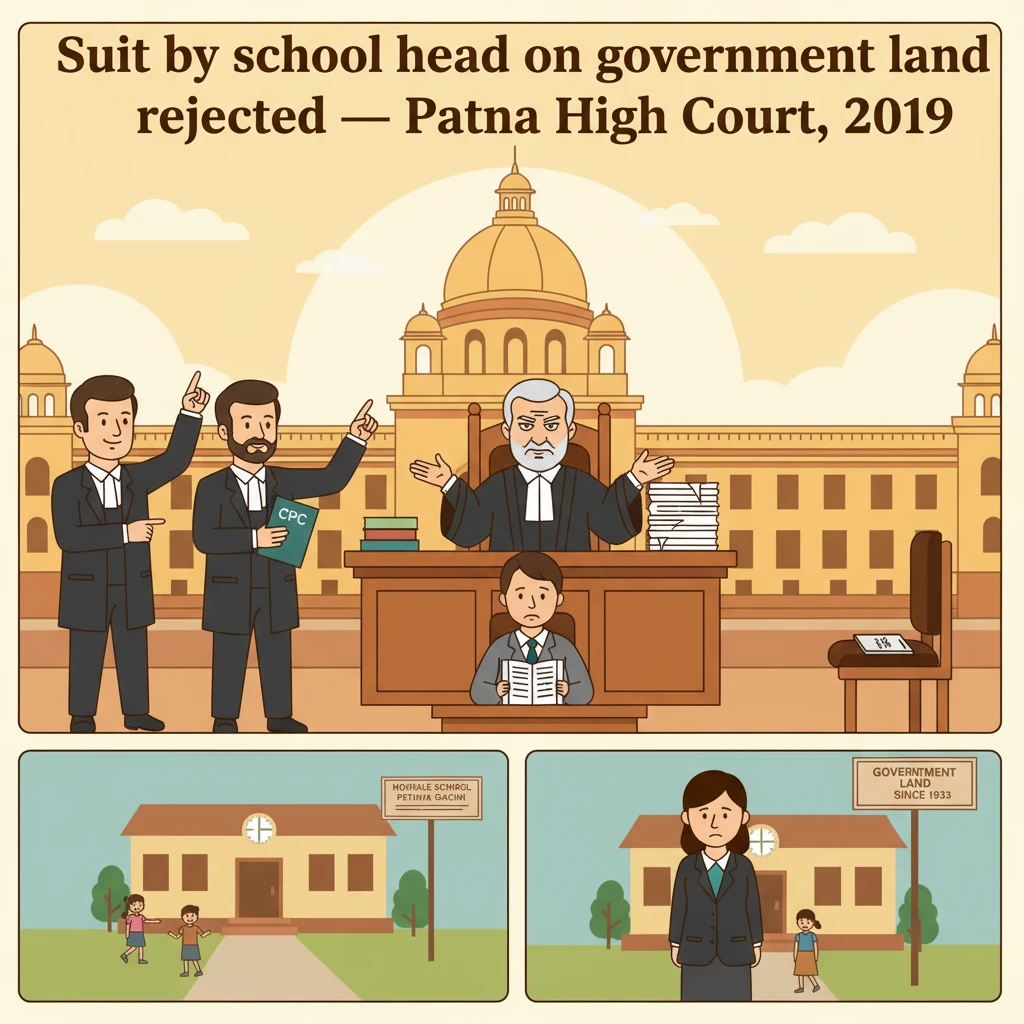
The dispute centres on a piece of land in Samastipur over which a government middle school has been running since 1933. The school, described in the judgment as Middle School, Pethiya Gachhi, claimed that it had become the lawful owner of this land.
Through its Head Mistress, Smt. Suchitra Kumari, the school filed Title Suit No. 210 of 2010 before the civil court. In that suit, the school sought a declaration that it was the bona fide title holder of the suit land. The basis of this claim was that the school had been running on the public land since 1933 and, by long and continuous possession, it had perfected its right, title and interest in law by adverse possession.
The defendant in that suit, who later became the petitioner in the High Court, challenged the maintainability of the case. He argued that since the school itself was a government school and the land in question was public land, only the State of Bihar could bring such a suit, not the Head Mistress in her own name or on her own authority.
To press this point, the defendant filed an application before the trial court under Order VII Rule 11 of the Code of Civil Procedure, 1908 (CPC). He prayed that the plaint be rejected at the threshold on the ground that it disclosed no cause of action in favour of the plaintiff as described in the plaint.
By order dated 30.09.2015, the trial court rejected this application under Order VII Rule 11 CPC and decided to proceed with the suit. Feeling aggrieved, the defendant approached the Patna High Court in Civil Revision No. 21 of 2016.
What the Court Examined and Decided
The civil revision came up before Hon’ble Mr. Justice Birendra Kumar of the Patna High Court. The judgment is an oral one, delivered on 22.02.2019.
Although the State of Bihar was not a party to the civil revision, the Court requested assistance from the State. Mr. Ram Vinay Prasad Singh, appearing for the State, assisted the Court. On the other side, learned senior counsel Mr. J.S. Arora and Mr. Ravi Bhatia appeared for the petitioner. No one appeared on behalf of the opposite party despite a Vakalatnama having been filed.
The first question before the High Court was narrow but important: whether the plaint in Title Suit No. 210 of 2010 disclosed a valid cause of action in favour of the plaintiff as described, namely the Middle School through its Head Mistress, so as to justify the continuation of the suit.
The High Court noted that, according to the plaint itself, the school was a government school running over public land. The relief sought was a declaration that the school had perfected title over this public land by adverse possession.
The petitioner’s argument was that, where the property is claimed to be public land and the school is a government school, any suit in relation to such property must be brought by the State, not by an individual officer of the school unless such officer is specifically authorised by the State.
To support the opposite side, learned counsel for the State produced certain letters issued by the head of the Education Department of the Government of Bihar. The Court carefully examined these letters. However, none of these documents showed that the Head Mistress had been authorised by the State Government to institute a title suit on behalf of the State of Bihar with respect to the land in question.
On these facts, the Court concluded that prima facie the Head Mistress, Suchitra Kumari, had no cause of action to bring the suit. In legal terms, it is not enough that some cause of action is stated in the plaint; it must be a cause of action that arises in favour of the plaintiff who has filed the suit.
To explain the legal framework, the Court reproduced Order VII Rule 11 CPC. This provision mandates rejection of a plaint in certain situations. Clause (a) states that the plaint shall be rejected where it does not disclose a cause of action. Other clauses (b) to (f) deal with under-valuation, insufficient stamping, bar by law, non-filing in duplicate, and failure to comply with Rule 9.
The petitioner’s senior counsel specifically relied on Clause (a) of Order VII Rule 11. He argued that in this case, even if the plaint narrated some facts, the cause of action did not belong to the named plaintiff, as the property was claimed to be State property and the relief was effectively being sought on behalf of the State.
The High Court accepted this line of reasoning. It held that for a suit to proceed, the cause of action must arise in favour of the plaintiff so that the Court can grant relief to that plaintiff. If the plaintiff has no legal standing or authority regarding the subject matter, the suit cannot proceed.
To further support its conclusion, the Court referred to Section 79 CPC, which deals with suits by or against the Government. Section 79 states that in a suit by or against the Central Government, the Union of India shall be named, and in a suit by or against a State Government, the State shall be named as party.
The Court also cited Order XXVII Rule 1 CPC, which governs filing of pleadings by or against the Government. This rule requires that in any suit by or against the Government, the plaint or written statement must be signed by a person whom the Government has appointed by general or special order, and verified by a person so appointed who is acquainted with the facts of the case.
Applying these legal provisions, the Court found it “evident” that the Head Mistress of the school was not an authorised person of the State Government for the purpose of instituting the suit. The plaint itself revealed that the suit property was claimed as property of the State and the relief prayed was on behalf of the State.
In this situation, the Court held that the present plaintiff, Smt. Suchitra Kumari, had no cause of action to bring the suit. Since the cause of action, if any, lay only with the State of Bihar, the plaint ought to have been rejected under Order VII Rule 11 CPC.
The Court found that the trial court, by its order dated 30.09.2015, had acted with material irregularity and illegality in rejecting the defendant’s application under Order VII Rule 11 CPC. It therefore set aside that impugned order.
Consequently, the High Court allowed the civil revision. The effect of this is that the plaint in Title Suit No. 210 of 2010 stands rejected for want of cause of action in favour of the named plaintiff.
At the same time, the Court was careful to protect the interests of the State. It clarified that the State of Bihar would be at liberty to bring a fresh suit through its authorised representative, according to law, if it so wishes.
The Court also addressed the issue of limitation. It directed that if the State chooses to file such a suit, the cause of action shall be deemed to arise from the date of the High Court’s order (22.02.2019) for the purpose of computing limitation, if any. This direction ensures that the State is not prejudiced by the time spent in the present proceedings where the suit had been instituted by an unauthorised person.
With these directions, the Patna High Court allowed Civil Revision No. 21 of 2016.
Why This Judgment Matters
This judgment is important for government schools, colleges, and other public institutions that function on government land. It clarifies that individual officers or heads of such institutions cannot, on their own, file suits claiming title over public land in the name of the institution unless they are specifically authorised by the State.
For ordinary citizens, it sends a clear message about who can speak for the Government in court. Only the Government itself, named as the State or the Union of India, and represented through duly authorised officers, can sue or be sued regarding government property.
The decision also protects the State from losing its rights over land because of unauthorised or poorly conceived litigation started by individuals without proper authority. At the same time, by allowing the State to file a fresh suit and treating the cause of action as starting from the date of this order, the Patna High Court has ensured that the State’s legal rights are not harmed by procedural mistakes.
For litigants facing suits over public land, this judgment offers a clear defence: if the suit is filed in the name of an individual government employee or an institution without State authorisation, they can ask the court to reject the plaint under Order VII Rule 11 CPC.
Legal Issues and Answers
- Issue: Whether a suit seeking declaration of title over public land used by a government school can be maintained when filed by the school through its Head Mistress, without proof of authorisation from the State Government.
Answer: No. The Patna High Court held that only the State, properly named and represented under Section 79 and Order XXVII CPC, could file such a suit. As the Head Mistress was not an authorised representative, she had no cause of action and the plaint was liable to be rejected under Order VII Rule 11(a) CPC. - Issue: Whether the trial court was right in rejecting the defendant’s application under Order VII Rule 11 CPC and allowing the suit to proceed.
Answer: No. The High Court found that the trial court had acted with material irregularity and illegality. It set aside the trial court’s order dated 30.09.2015 and allowed the application for rejection of plaint. - Issue: What is the position of the State’s rights after rejection of the plaint filed by an unauthorised person.
Answer: The Court granted liberty to the State of Bihar to file a fresh suit through an authorised representative, and directed that for limitation purposes, the cause of action would be deemed to arise from the date of the High Court’s order.
Cases Cited by the Court
- The judgment does not record any cited or relied upon case law. The Court relied directly on statutory provisions of the Code of Civil Procedure.
Case Details
Case Number: Civil Revision No. 21 of 2016
Case Title: Ganesh Choudhary v. The Middle School, Pethiya Gachhi, through Head Master Smt. Suchitra Kumari
Citation: 2019 (3) PLJR 544
Court: High Court of Judicature at Patna
Coram: Hon’ble Mr. Justice Birendra Kumar
Date of Judgment: 22.02.2019
Advocates for Petitioner: Mr. J.S. Arora, Senior Advocate; Mr. Ravi Bhatia, Advocate
Advocates for Respondent: Mr. Ram Vinay Prasad Singh, AC to GA-XII (appearing on behalf of the State to assist the Court)
Appearance for Opposite Party: None (though Vakalatnama filed)
Nature of Case: Civil revision challenging an order of the trial court refusing to reject the plaint under Order VII Rule 11 of the Code of Civil Procedure in a title suit for declaration of ownership over public land.
Link to Judgment: https://patnahighcourt.gov.in/viewjudgment/OCMyMSMyMDE2IzEjTg==-9I1gO9qV5og=
If you found this explanation helpful and wish to stay informed about
how legal developments may affect your rights in Bihar,
you may consider following Samvida Law Associates for more updates.







