
Case Background
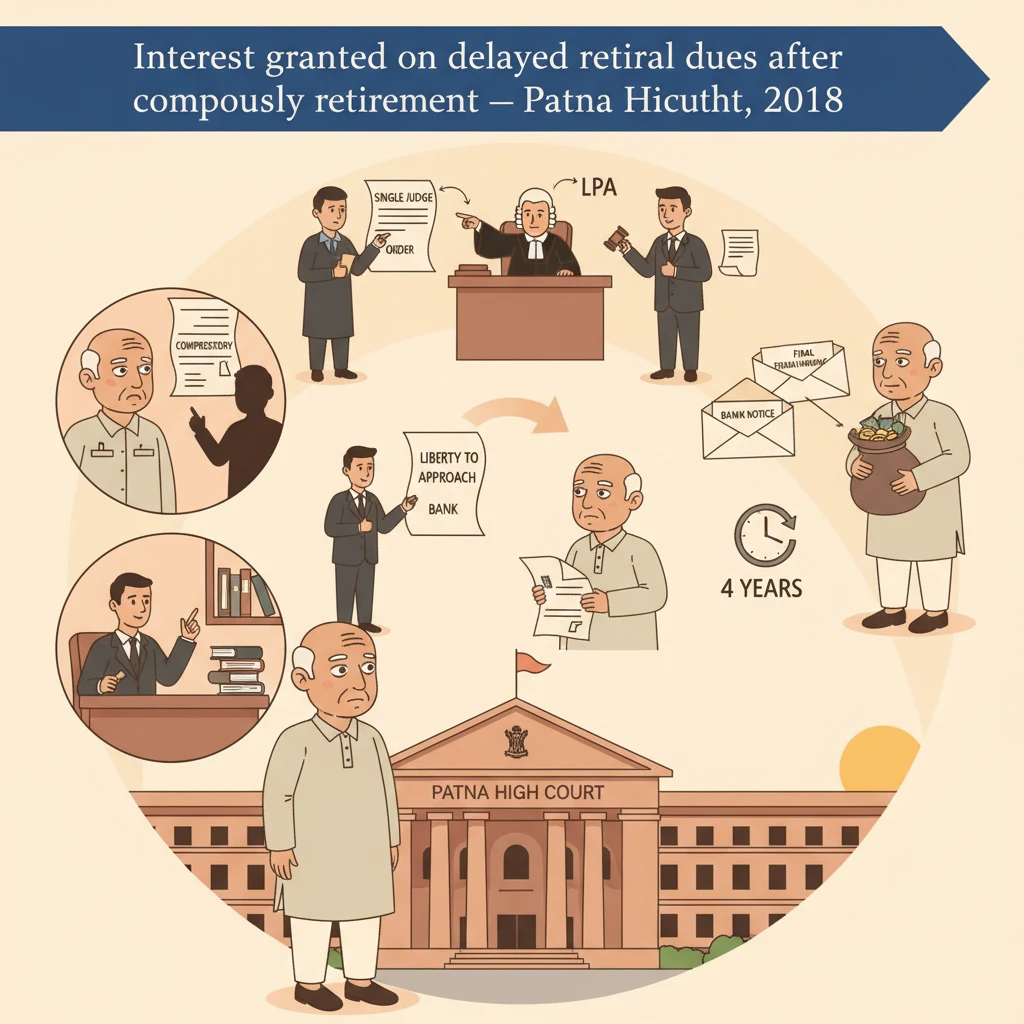
The petitioner was working as a Branch Manager in the State Bank of India. Disciplinary proceedings were initiated against him on various charges. As a result, on 27.12.2005, he was punished with compulsory retirement.
After this punishment order, the petitioner challenged the compulsory retirement before the authorities and then before the Patna High Court. He first filed C.W.J.C. No. 5070 of 2007. On 23.06.2009, a learned Single Judge disposed of that writ petition and directed the Disciplinary Authority to reconsider the quantum of punishment and pass a fresh order in accordance with law.
The Bank challenged that order in L.P.A. No. 976 of 2009. On 02.12.2010, a Division Bench allowed the appeal and set aside the order dated 23.06.2009. During that appeal, the petitioner’s counsel also raised a grievance that even the amounts admissible to him after compulsory retirement had not been paid.
The Division Bench noted that this aspect had not been raised or decided before the learned Single Judge. Therefore, it did not issue any direct order for payment. Instead, in paragraph 16 of its judgment, it granted liberty to the petitioner to approach the competent authority of the Bank. The Bench recorded that, on such approach, the Bank would be under an obligation to look into the matter and make payment of the admissible amount within three months from the date of receipt or production of a copy of that order.
Despite this liberty, the petitioner did not immediately approach the Bank for settlement of his retiral dues. The Patna High Court, in the present case, has recorded that he did not do so for almost four years after the Division Bench judgment.
In the meantime, the Bank itself took the initiative. On 09.03.2011, the Bank wrote to the petitioner, referring to the High Court’s order, and requested him to immediately submit the proposal for payment of terminal dues. When there was no response, the Bank again wrote to him on 17.11.2014, advising him to submit an application in the prescribed format at the earliest so that his dues could be settled without delay. This letter also cautioned him that failure to submit the applications within a week might result in delayed payment and, in that event, the Bank would not be liable to pay interest for the delay.
Further reminder letters dated 08.12.2014 and 12.12.2014 were sent by the Bank, again asking the petitioner to submit the necessary applications for settlement of his terminal benefits. Only after these communications did the petitioner finally complete the formalities and submit the required applications.
Once the applications were submitted, the Bank processed them and made payment of all admitted dues between February 2015 and August 2015. According to the Bank, the retiral benefits payable to the petitioner on the date of compulsory retirement (27.12.2005) were Rs. 14,41,592/-, covering Provident Fund, Gratuity and Leave Encashment. At the same time, the outstanding in the petitioner’s loan accounts with the Bank — housing loan, car loan and overdraft — totalled Rs. 6,89,636.07.
In the present writ petition, the petitioner does not dispute that his retiral dues were eventually paid. His grievance is about the delay in payment and his claim is for payment of interest on Provident Fund, Gratuity, Leave Encashment and arrears of pension from the date of superannuation/compulsory retirement till the date of actual payment.
What the Court Examined and Decided
The core question before the Patna High Court in C.W.J.C. No. 15361 of 2016 was whether the petitioner was entitled to interest on delayed payment of retiral benefits and, if yes, to what extent, and on what basis.
The petitioner argued that once the Bank passed an order of compulsory retirement on 27.12.2005, it was duty-bound to release all his terminal dues without undue delay. According to him, he could not be penalised for the Bank’s inaction. He relied on the Bank’s “Codified Circular Instructions on Settlement of Terminal Benefits”. Under those instructions, in the case of a punished employee who has not submitted an application for settlement of terminal benefits, the competent authority is required to send a registered letter to the employee at his last known address. This requirement is said to arise under Corporate Centre Circular No. CDO/ADM/SPL/1275 dated 2 June 1999 and CDO/PM/14/SPL/4975 dated 21 November 1997.
The petitioner’s stand was that the Bank had not followed these circulars when he was compulsorily retired. Therefore, he claimed that any delay was entirely attributable to the Bank and that he must be paid interest on the delayed amounts of Provident Fund, Gratuity, Leave Encashment and arrears of pension.
On the other hand, the Bank opposed the claim for interest. It submitted that the petitioner was mainly focused on challenging his compulsory retirement and not on settlement of his dues. He had actively pursued litigation against the retirement order, but he did not ask for settlement of his retiral dues by following the necessary procedures.
The Bank pointed out that even after the Division Bench order dated 02.12.2010 gave him liberty to approach the competent authority, the petitioner did not take steps. Instead, it was the Bank which, on 09.03.2011, first wrote to the petitioner asking him to submit his proposal for payment of terminal dues, and then again wrote on 17.11.2014, followed by reminder letters dated 08.12.2014 and 12.12.2014.
The Bank also submitted that its circulars were internal instructions to ensure prompt processing of dues, but they did not create a legal right in favour of employees to claim interest on delayed payments. The Bank emphasised that once the petitioner submitted his applications, payment was made within a few months — between February 2015 and August 2015.
To support its stand, the Bank relied on an earlier order dated 25.02.2016 passed by the Patna High Court in C.W.J.C. No. 13885 of 2012, Badri Prasad Singh vs. The State of Bihar & Ors. In that case, on the point of charging interest on a loan account after an employee’s superannuation, the Court had held that, until the loan account is finally settled, and unless the employee clearly expresses and communicates his desire that the loan be adjusted from his retiral benefits, the authorities cannot be blamed for not doing so at the initial stage. If, at the final stage, the authorities adjust the outstanding loan from retiral dues, such adjustment is not arbitrary and is within the Bank’s right to recover its dues.
After hearing both sides, the Court closely examined the conduct of the parties and the earlier orders in the petitioner’s litigation history.
First, the Court noted that there were “contributory laches” — that is, fault or delay — on both sides. The petitioner, being a Branch Manager, could not claim ignorance of the requirement to complete certain formalities and submit applications for payment of retiral dues. He had been active in challenging his compulsory retirement before the authorities and the High Court, yet he did not pursue the matter of his terminal benefits with similar seriousness.
The Court looked at paragraph 16 of the Division Bench judgment in L.P.A. No. 976 of 2009. There, the Bench had clearly stated that the petitioner could approach the competent authority of the Bank, and that on such approach, the Bank would be obliged to make payment of admissible dues within three months. Thus, the liberty to start the process lay with the petitioner.
The Court observed that the petitioner did not avail this liberty for almost four years. Instead, it was the Bank which repeatedly requested him to file the necessary applications. Once he did so, the admitted dues were paid within a few months. The Court therefore concluded that, as far as the Division Bench’s directions were concerned, the Bank appeared to have respected them and made payment accordingly.
Second, the Court addressed the role of the Bank and its responsibility under its own guidelines. It accepted that, as per the internal instructions and circulars, Bank authorities were expected to be vigilant and sensitive in dealing with employees who had been compulsorily retired, so that such employees could at least receive their terminal benefits within a reasonable time.
The Court found that there was indeed some delay on the part of the Bank in not taking timely steps to write to the petitioner and initiate the process immediately after his compulsory retirement. The first letter from the Bank, calling upon him to complete the formalities, was only in 2011, about five to six years after the retirement order.
In the Court’s view, this justified some relief to the petitioner. However, it made it absolutely clear that this relief should not be treated as recognition of a legal right to interest under the Bank’s circulars. Nor should it be understood as holding that the Bank was contractually or statutorily obliged to pay interest on delayed retiral dues. Instead, the Court characterised the relief as an “indulgence” to serve the cause of justice and to balance the equities between the parties.
Coming to quantification, the Court divided the timeline into three phases: first, December 2005, when the order of compulsory retirement was passed; second, December 2010, when the Division Bench delivered its order in L.P.A. No. 976 of 2009; and third, the year 2015, when the Bank actually made payment of retiral dues.
There was roughly a five-year gap between each of these milestones. Taking a cue from this timeline and keeping in mind its earlier discussion on contributory delay, the Court decided to grant simple interest at the rate of 6% per annum for a period of five years on the amount of Rs. 14,41,592/-, which was the quantified retiral benefit payable to the petitioner on 27.12.2005.
The Court directed that this interest amount be paid within two months from the date of production of a copy of its order before respondent no. 2 (the Chief General Manager, State Bank of India, Local Head Office, Western Gandhi Maidan, Patna-800001).
With these directions, the writ petition was disposed of.
Why This Judgment Matters
This judgment is important for retired employees, especially those facing compulsory retirement, and for banks and large organisations handling retiral dues.
First, it shows that the Patna High Court can grant interest on delayed payment of retirement benefits even where there is fault on both sides. The Court looked at the overall fairness of the situation, not just technical rules.
Second, it reminds employees that they must complete necessary formalities and submit proper applications, even when they are contesting a punishment like compulsory retirement. Waiting only for the result of litigation may hurt their claim for full relief later.
Third, it signals to banks and employers that they should be proactive and sensitive towards retired employees and follow their own internal guidelines regarding settlement of terminal benefits. Delay can still lead to a direction to pay interest by the Court, even if not as a strict legal right.
Fourth, the judgment carefully limits its own reach. The Court expressly says that interest is granted here as a special indulgence to do justice and balance equities, and not because the Bank’s circulars themselves create a legally enforceable right to interest. This point is crucial for similar future disputes.
Legal Issues and Answers
- Issue: Is a compulsorily retired bank employee entitled to interest on delayed payment of retiral benefits such as Provident Fund, Gratuity, Leave Encashment and pension when there is delay on the part of both the employee and the Bank?
Answer: The Court held that there were contributory laches by both sides, and that the Bank’s circulars did not by themselves give a legal right to interest. However, in the interest of justice and to balance equities, the Court granted simple interest at 6% per annum for five years on the quantified retiral amount, treating this as an indulgence rather than a matter of right. - Issue: Did the Bank comply with the directions of the Division Bench in L.P.A. No. 976 of 2009 regarding payment of admissible dues?
Answer: Yes. The Court found that once the petitioner finally submitted the required applications, the Bank made payment of his dues within a few months, thereby respecting the Division Bench’s order to make payment of admissible amounts. - Issue: Can adjustment of outstanding loan dues from retiral benefits be considered arbitrary?
Answer: Referring to the earlier decision in Badri Prasad Singh vs. The State of Bihar & Ors., the Court accepted that the Bank is justified in recovering its outstanding loan amounts by adjusting them against retiral dues at the final stage, and such action cannot be termed arbitrary in the circumstances stated.
Cases Cited by the Court
- C.W.J.C. No. 13885 of 2012, Badri Prasad Singh vs. The State of Bihar & Ors., order dated 25.02.2016 (Patna High Court).
- The Division Bench judgment in L.P.A. No. 976 of 2009 (related to the petitioner’s earlier challenge to compulsory retirement) is referred to and relied upon for the liberty and obligation regarding payment of admissible amounts.
Case Details
Case Number: Civil Writ Jurisdiction Case No. 15361 of 2016
Case Title: Jagannath Prasad vs. The State Bank of India & Ors.
Citation: 2019(3) PLJR 442
Court: High Court of Judicature at Patna
Coram: Hon’ble Mr. Justice Ahsanuddin Amanullah
Date of Judgment: 25.08.2018
Advocates:
- For the petitioner: Mr. Md. Nadim Seraj, Advocate
- For the State Bank of India: Mr. S. D. Sanjay, Senior Advocate, assisted by Mr. Anjani Kumar Mishra, Advocate
Nature of the Case: Writ petition seeking mandamus and certiorari regarding interest on delayed payment of retiral dues (Provident Fund, Gratuity, Leave Encashment and arrears of pension) following compulsory retirement.
Link to Judgment: Patna High Court Judgment in CWJC No. 15361 of 2016
If you found this explanation helpful and wish to stay informed about how legal developments may affect your rights in Bihar, you may consider following Samvida Law Associates for more updates.







