
Case Background
The dispute arose from a recruitment process for constables under Advertisement No. 1 of 2004 issued by the Bihar Police authorities. The petitioner submitted his application and was selected for appointment as a constable.
After he applied, but before all formalities were completed, an FIR was registered against him as Bihta P.S. Case No. 301 of 2005. The FIR cited several sections of the Indian Penal Code, and after investigation, a chargesheet was submitted, with cognizance ultimately taken under Section 307 IPC and other provisions.
Despite this development, the petitioner continued in the selection process. After his selection, he was required to fill up a character verification form. This form was meant to capture details of his past conduct, including any criminal case.
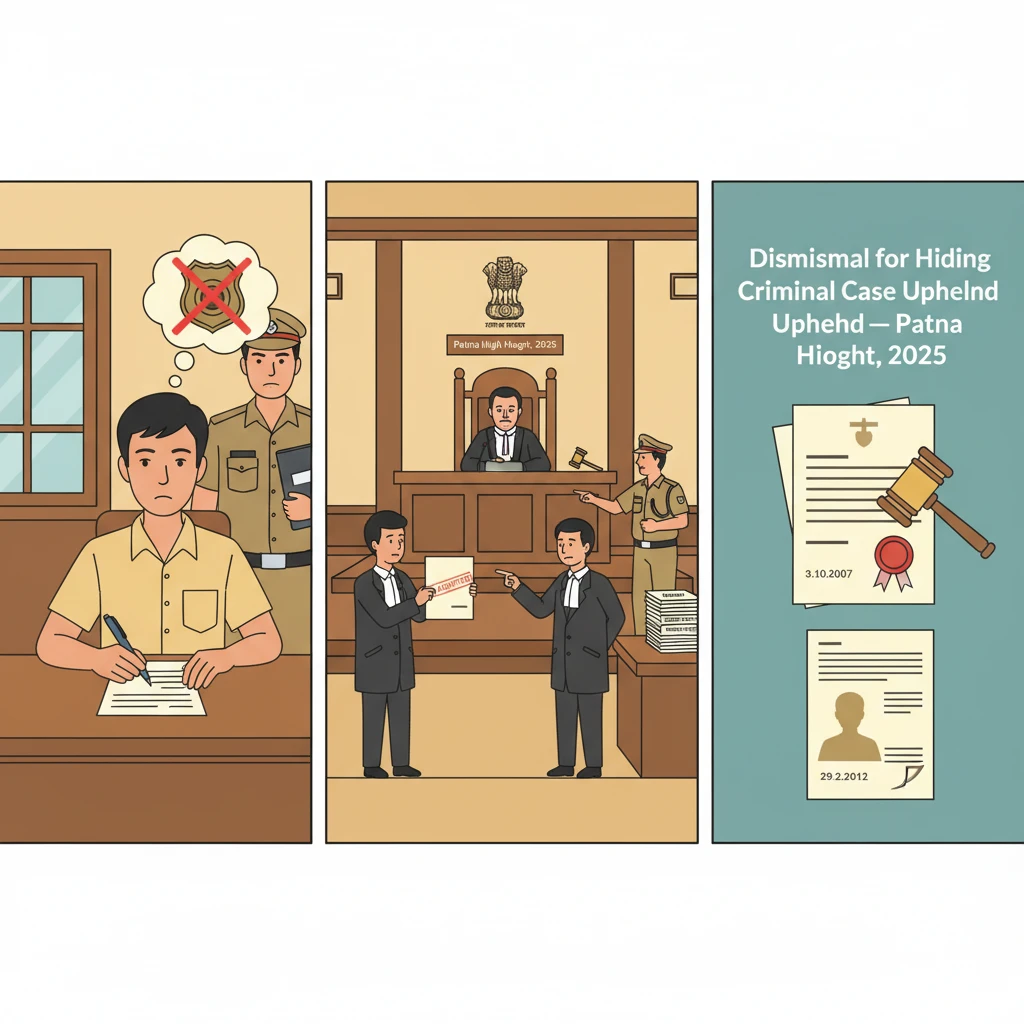
The petitioner did not disclose the criminal case in that form. Later, during police verification, the authorities independently discovered the pending case. Treating this as a false statement and suppression of material information, the Commandant, B.M.P.-14, Patna, dismissed the petitioner from service by order dated 3.10.2007 (Annexure-3/Annexure-10).
The petitioner filed an appeal before the D.I.G. of Police, B.M.P. Central Zone, Patna, which was rejected by order dated 25.8.2011 (Annexure-11). He then submitted a memorial to the Director General of Police, Bihar, which was also rejected on 29.2.2012. After losing at every departmental level, he approached the Patna High Court by way of this civil writ petition in 2013 challenging all three orders.
In the meantime, the criminal case itself proceeded to trial as Sessions Trial No. 1040 of 2008. By judgment dated 29.5.2009, the trial court acquitted the petitioner and others of the charges, including Section 307 IPC.
What the Court Examined and Decided
Justice Partha Sarthy of the Patna High Court heard the writ petition. The core question was whether the dismissal for suppressing the pending criminal case in the character verification form was legal and justified.
The petitioner’s counsel accepted that, in 2007, when the character verification form was filled, the petitioner knew about the pending Bihta P.S. Case No. 301 of 2005. However, it was argued that he believed, perhaps mistakenly, that he only had to disclose cases that existed when he first applied in 2004. Since the FIR was registered later, he thought disclosure was not required.
The petitioner sought support from three Supreme Court judgments: Commissioner of Police and Others v. Sandeep Kumar, (2011) 4 SCC 644; Ram Kumar v. State of Uttar Pradesh and Others, (2011) 14 SCC 709; and Pramod Singh Kirar v. State of Madhya Pradesh & Ors., 2023 (1) PLJR 26 (SC). Based on these cases, counsel argued that:
First, the underlying criminal case arose from a trivial dispute, and the petitioner had ultimately been acquitted. Second, the non-disclosure was out of fear or misunderstanding and did not involve any grave moral turpitude. Third, in such situations, a more lenient approach should be adopted, and a young recruit should not be removed from service for life.
On the other hand, the State’s counsel opposed the petition. He pointed out that certain facts were beyond dispute: the petitioner knew about the criminal case in 2007 when he filled the verification form; he did not disclose it; and the pendency of the case surfaced only during official verification. On this basis, the department treated the statement as false.
The State argued that once falsehood in the verification roll was discovered, the department was bound by the Bihar Police Manual to act. The counsel submitted that there was no illegality either in the dismissal order of the Commandant, the appellate order of the D.I.G., or the order of the Director General of Police rejecting the memorial.
To counter the petitioner’s reliance on earlier Supreme Court cases, the State cited three more recent judgments: Avtar Singh v. Union of India & Ors., (2016) 8 SCC 471; Rajasthan Rajya Vidyut Prasaran Nigam Limited v. Anil Kanwariya, (2021) 10 SCC 136; and Union of India & Ors. v. Dillip Kumar Mallick, (2023) 12 SCC 331. These authorities emphasise the importance of truthfulness in disclosure and uphold the employer’s right to terminate services when a candidate suppresses material facts about criminal cases.
After hearing both sides and reviewing the record, the Patna High Court reconstructed the chronology. Advertisement No. 1 of 2004 led to the petitioner’s selection as a constable. Only after his application, in 2005, was he named as an accused in Bihta P.S. Case No. 301 of 2005, which, after investigation, resulted in a chargesheet under Section 307 IPC among other sections. Allegations included that he abused and assaulted the informant with the butt of a pistol, causing head injuries.
The Court noted that though the petitioner was later acquitted by judgment dated 29.5.2009 in Sessions Trial No. 1040 of 2008, this acquittal came after the departmental action. The crucial stage was the filling of the character verification form. At that time, he was under a clear duty to faithfully disclose the pending case.
The Court then examined the petitioner’s reliance on Supreme Court precedents. In Sandeep Kumar, the Supreme Court observed that an applicant’s non-disclosure of involvement in a case under Section 325/34 IPC might have been due to fear of automatic disqualification and that the offence was not as serious as murder or dacoity, warranting a lenient view.
In Ram Kumar, the Supreme Court found that the Senior Superintendent of Police had not considered whether the candidate was actually suitable for appointment as a constable. Instead, the authority simply treated the application as illegal and irregular because the candidate had not mentioned the criminal case in the verification roll. The Supreme Court interfered and directed his reinstatement.
In Pramod Singh Kirar, the Supreme Court dealt with an incident under Section 498A IPC from 2001 in which the appellant had been acquitted in 2006. Significantly, the employment application came much later, in 2013/2014. Given the time gap and acquittal, the Supreme Court ordered that he be appointed to the post of constable as he was otherwise meritorious.
Against this backdrop, the Patna High Court turned to the relevant service rule. Rule 673(c) of the Bihar Police Manual governs “enlistment orders”. The Court quoted the rule in full. Under this rule, after a recruit is enlisted, the verification roll is sent to the Superintendent of the district of the recruit’s home. On return of the verification roll with a report that the person bears good character and has made a truthful statement as to his antecedents, the Superintendent initials the entry and orders the verification roll to be filed.
However, the rule contains a crucial safeguard: if the person’s character is reported to be bad or his statement false, he “shall be removed from the force”. The language is mandatory and leaves little discretion once falsehood is established.
Applying Rule 673(c), the Court found that when the petitioner’s character verification was carried out, the authorities discovered that he had concealed the pending criminal case. This made his earlier statement in the verification roll false. Under the explicit terms of Rule 673(c), such a recruit must be removed from service.
The Court held that the respondents had done exactly what the rule required. They entered the enlistment orders, sent the verification roll, received the report revealing suppression of information, and then removed the petitioner from the force. In these circumstances, there was no illegality in the dismissal order or in the appellate and revisional orders.
The Court also noted that, given these statutory provisions and facts, the Supreme Court judgments cited by the petitioner did not assist him. Those cases dealt with different factual backgrounds, including trivial offences, different timings, and instances where the authority had not undertaken a proper suitability assessment. Here, by contrast, there was a specific statutory rule mandating removal for making a false statement in the verification roll, and the petitioner had admittedly suppressed the pendency of Bihta P.S. Case No. 301 of 2005.
On this reasoning, the Patna High Court concluded that the petitioner had failed to make out any ground for interference under writ jurisdiction. The writ application lacked merit and was accordingly dismissed. As a result, the orders of dismissal dated 3.10.2007, the appellate rejection dated 25.8.2011, and the rejection of the memorial dated 29.2.2012 all remain in force.
Why This Judgment Matters
This judgment is important for anyone seeking government or police jobs in Bihar. It shows that even if a criminal case arises after applying, candidates must disclose it honestly when asked during character verification.
The Patna High Court has made it clear that under Rule 673(c) of the Bihar Police Manual, hiding a pending criminal case and giving a false statement is enough to justify removal from service, even if the person is later acquitted.
For recruits and serving personnel, the ruling underlines that honesty in all forms and declarations is non-negotiable. For the police department, it confirms that they can rely on Rule 673(c) to act against those who suppress material facts about their antecedents.
Legal Issues and Answers
-
Issue: Whether dismissal of a police constable for suppressing a pending criminal case in the character verification form was legal under the Bihar Police Manual.
Answer: Yes. The Court held that, once the false statement was discovered during verification, Rule 673(c) mandated his removal from the force, and the dismissal orders were lawful. -
Issue: Whether later acquittal in the criminal case or Supreme Court decisions favouring leniency could save the petitioner’s job.
Answer: No. The Court found the cited decisions distinguishable on facts and held that acquittal did not cure the earlier suppression; therefore no interference was warranted.
Cases Cited by the Court
- Commissioner of Police and Others v. Sandeep Kumar, (2011) 4 SCC 644
- Ram Kumar v. State of Uttar Pradesh and Others, (2011) 14 SCC 709
- Pramod Singh Kirar v. State of Madhya Pradesh & Ors., 2023 (1) PLJR 26 (SC)
- Avtar Singh v. Union of India & Ors., (2016) 8 SCC 471
- Rajasthan Rajya Vidyut Prasaran Nigam Limited v. Anil Kanwariya, (2021) 10 SCC 136
- Union of India & Ors. v. Dillip Kumar Mallick, (2023) 12 SCC 331
Case Details
Case Number: Civil Writ Jurisdiction Case No. 20946 of 2013
Case Title: Utpal Kant Prasad Verma v. The State of Bihar & Ors.
Coram: Hon’ble Mr. Justice Partha Sarthy
Citation: 2026(1) PLJR 324
Advocates: Mr. Parashuram Singh, Advocate for the petitioner; Mr. Sushil Kumar Singh, AC to AAG-10 for the respondents
Nature of the Case: Writ petition under civil writ jurisdiction challenging dismissal from service and rejection of departmental appeal and memorial
Date of Judgment: 21.11.2025
Link to Judgment: View full judgment on Patna High Court website
If you found this explanation helpful and wish to stay informed about
how legal developments may affect your rights in Bihar,
you may consider following Samvida Law Associates for more updates.







