
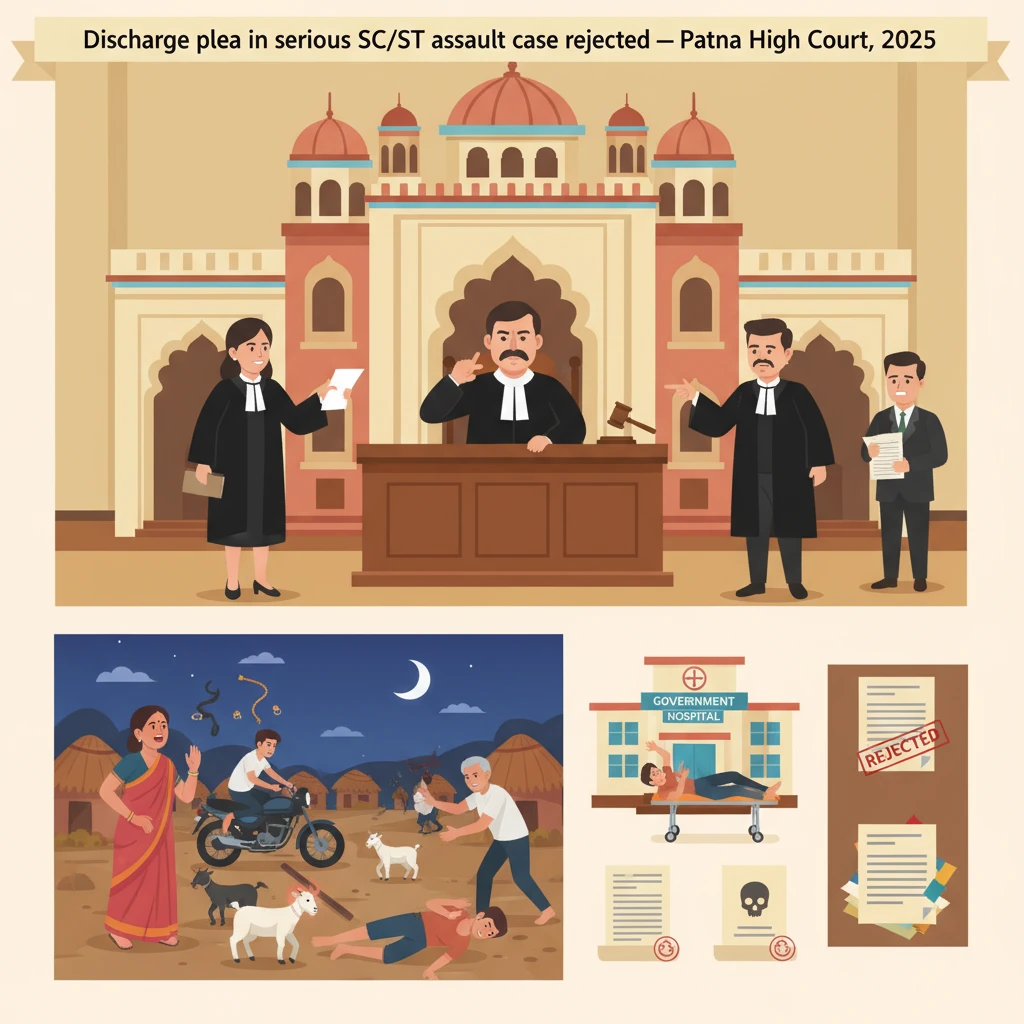
Case Background
This case arises out of Kalyanpur P.S. Case No. 68 of 2023 from East Champaran district. The informant, who is respondent no. 2 in the appeal, submitted a written application before the Station House Officer of Kalyanpur Police Station.
According to the written report, on 27.02.2023 at about 8:00 PM, the present appellants along with others allegedly ran over two she-goats with an Apache motorcycle. When the informant protested, she was allegedly abused by the accused persons.
The informant claimed that when she tried to stop the abuses and attempted to take the key of the motorcycle, the accused persons caught hold of her hair and thrashed her on the ground. It was further alleged that they used her caste name while abusing her, snatched her Mangalsutra and earrings, and tore her clothes.
When the informant’s son, Ankit Kumar, protested against this behaviour, it was alleged that appellant no. 1 assaulted him on the head with an iron rod, causing a head injury and making him fall to the ground. Thereafter, he was allegedly assaulted indiscriminately with an iron rod and a danda on other parts of his body. The informant’s husband was also said to have been badly assaulted.
The injured son was first taken to Kalyanpur Government Hospital, from where he was referred to Sadar Hospital for better treatment. On the basis of the informant’s application, Kalyanpur P.S. Case No. 68 of 2023 was registered under Sections 279, 341, 342, 323, 324, 307, 354(B), 504, 506, 34 of the Indian Penal Code and Section 3(i)(r)(s) of the Scheduled Castes and Scheduled Tribes (Prevention of Atrocities) Act.
During investigation, the Investigating Officer recorded statements of witnesses under Section 161 of the Cr.P.C., prepared the inquest report of Ankit Kumar (noted in paragraph 67 of the case diary), and collected the post-mortem report. The post-mortem report indicated the cause of death as head injury. After investigation, the officer submitted a charge sheet against the accused persons under Sections 147, 148, 149, 341, 342, 323, 324, 307, 354(B), 504, 506, 302, 34 of the IPC and Sections 3(i)(r)(s), 3(2)(va) of the SC/ST (POA) Act. Cognizance was taken by the Special Judge under these sections.
Before the Special Judge, SC/ST Act, East Champaran, Motihari in SC/ST Trial No. 107 of 2024 (CIS No. 80 of 2024), the present appellants filed an application under Section 227 of the Cr.P.C. seeking discharge from the case. By order dated 26.05.2025, the Special Judge rejected the discharge petition. Aggrieved by this order, the appellants filed Criminal Appeal (SJ) No. 3204 of 2025 before the Patna High Court.
What the Court Examined and Decided
The appeal came before Hon’ble Mr. Justice Alok Kumar Pandey of the Patna High Court. The Court heard the learned counsel for the appellants and the learned Special Public Prosecutor for the State.
On behalf of the appellants, several grounds were urged for setting aside the order rejecting discharge. First, it was argued that there was a delay of about two days in lodging the FIR. The alleged occurrence took place on 27.02.2023, whereas the FIR was lodged on 01.03.2023. According to the appellants, no plausible explanation had been given for this delay, and therefore the authenticity of the prosecution case was doubtful.
Second, counsel submitted that there was a case and counter case between the parties regarding the same date of occurrence. On this basis, it was argued that there had been free fighting between both sides and that this aspect had not been properly appreciated by the trial court while considering discharge.
Third, the appellants contended that the occurrence, as alleged in the FIR, did not take place in public view. On this ground, they claimed that no offence under the SC/ST (POA) Act was made out. They argued that the trial court had failed to consider this and other material on record, and that the discharge petition was dismissed mechanically without proper reasoning.
It was further urged that since two cases were lodged regarding the same date of occurrence, the trial court ought to have considered the other version also before rejecting discharge. According to the appellants, ignoring the counter case had led the court to a wrong conclusion.
The State, represented by the learned Special Public Prosecutor, opposed the appeal. Referring to the FIR itself, he pointed out that there were clear allegations that the appellants and others had abused the informant by taking her caste name and had thrashed her on the ground. He emphasized the specific allegations that Mangalsutra and earrings were snatched from the informant and that her clothes were torn, which pointed towards both physical assault and humiliation.
The Special Public Prosecutor stressed the allegation that appellant no. 1 had assaulted the informant’s son, Ankit Kumar, on the head with an iron rod, resulting in serious head injury. Thereafter, the son was allegedly beaten indiscriminately with an iron rod and danda, and the informant’s husband was also badly assaulted.
He submitted that after a full investigation, the Investigating Officer had found sufficient material to file charge sheet under serious sections, including Section 302 of the IPC and Sections 3(i)(r)(s) and 3(2)(va) of the SC/ST (POA) Act. Cognizance had been taken accordingly. The statements of witnesses recorded under Section 161 Cr.P.C. appeared to support the prosecution version and indicated the involvement of the appellants.
The Court was informed that paragraph 67 of the case diary contained the inquest report of deceased Ankit Kumar and that the post-mortem report concluded that death was due to head injury. The State argued that the trial court had discussed the evidence in paragraphs 7 and 8 of the impugned order while dismissing the discharge petition, and that there was no reason for the High Court to interfere at this stage.
After hearing both sides and examining the materials, the Patna High Court noted that there were specific allegations against appellant no. 1 of assaulting the informant’s son on the head with an iron rod, resulting in head injury. There were also allegations that the appellants, along with others, had abused the informant by taking her caste name, thrashed her on the ground, snatched her Mangalsutra and earrings, and tore her clothes.
The Court observed that from a plain reading of the FIR, it was evident that the appellants and others were present at the place of occurrence. In these circumstances, the Court held that it could not be said that the alleged incident did not take place in public view. This finding was significant for considering the applicability of the SC/ST (POA) Act provisions.
The High Court further recorded that the Investigating Officer had completed investigation on all aspects and submitted a charge sheet under Sections 147, 148, 149, 341, 342, 323, 324, 307, 354(B), 504, 506, 302, 34 of the IPC and Sections 3(i)(r)(s), 3(2)(va) of the SC/ST (POA) Act, and that cognizance had been taken under these sections. This indicated that the trial court had already accepted that there was sufficient material to proceed against the accused.
Crucially, the High Court reminded that at the stage of considering charge or discharge, the court is not required to weigh the evidence as if it were conducting a full trial. The question at this stage is only whether there is sufficient ground to proceed against the accused, not whether the material is enough to secure conviction.
The judgment states that the court, at the stage of framing charge, is not expected to go deep into the probative value of the material on record. The concerned Special Judge had already discussed the material in paragraph 7 of the impugned order dated 26.05.2025. In the light of the evidence and allegations summarized above, the contention of the Special Public Prosecutor was found to be tenable and sustainable.
In conclusion, the Patna High Court found no reason to differ from the findings of the Special Judge, SC/ST Act. The order rejecting the discharge petition was upheld. Consequently, the criminal appeal was dismissed at the admission stage itself.
However, the Court clarified that the appellants would be at liberty to raise all the points they had argued before the High Court at the appropriate stage in the trial court. This means that their legal and factual defences can still be argued during the trial, including at the stage of evidence and arguments on conclusion of trial.
Why This Judgment Matters
This judgment is significant for accused persons and complainants in serious assault and SC/ST cases in Bihar and especially in East Champaran. It shows that the Patna High Court will not lightly interfere with a trial court’s refusal to discharge accused when the case diary and FIR contain specific allegations supported by witness statements.
The Court emphasised that delay of a couple of days in lodging the FIR, existence of a counter case, or arguments about free fighting are matters that can be tested during trial. These grounds alone may not be enough to secure discharge when there are detailed allegations of assault, caste-based abuses, and serious injury or death.
For members of Scheduled Castes and Scheduled Tribes, the judgment underlines that if the FIR clearly states that caste abuses were made, ornaments were snatched, clothes were torn, and assaults were committed, the case is likely to go to full trial under the SC/ST (POA) Act. The question whether the incident occurred in public view will be judged from the contents of the FIR and surrounding facts, not merely on technical arguments.
For accused persons, the ruling clarifies that discharge under Section 227 Cr.P.C. is limited. At that stage, courts look only for a prima facie case. They do not conduct a mini-trial or closely examine the reliability of statements. Serious allegations backed by investigation will normally lead to trial.
Legal Issues and Answers
-
Issue: Whether the appellants were entitled to discharge under Section 227 Cr.P.C. in view of alleged delay in FIR, existence of counter case, and challenge to the applicability of SC/ST (POA) Act.
Answer: No. The Patna High Court held that there were specific allegations and supporting material indicating the appellants’ involvement, and that at the stage of charge the court only has to see if there is sufficient ground to proceed, not to evaluate the probative value of evidence. -
Issue: Whether, on the face of the FIR, it could be said that the alleged incident did not occur in public view so as to exclude offences under the SC/ST (POA) Act.
Answer: No. The Court held that the FIR showed the appellants and others were present at the place of occurrence and the incident could not be said to have not taken place in public view, so the SC/ST charges could proceed.
Cases Cited by the Court
- The judgment does not mention or rely upon any specific earlier case law by name or citation.
Case Details
Case Number: Criminal Appeal (SJ) No. 3204 of 2025; arising out of Kalyanpur P.S. Case No. 68 of 2023; SC/ST Trial No. 107 of 2024 (CIS No. 80 of 2024).
Case Title: Sanjeet Singh @ Sanjeet Kumar Singh and another v. The State of Bihar and another.
Coram: Hon’ble Mr. Justice Alok Kumar Pandey.
Date of Judgment: 10.11.2025.
Citation: 2026(1) PLJR 285.
Advocates: Mr. Praveen Prabhakar, Advocate for the appellants; Mr. Binay Krishna, Special Public Prosecutor for the State. Name of counsel for respondent no. 2 is not mentioned.
Nature of the Case: Criminal appeal (single judge) challenging rejection of discharge application under Section 227 Cr.P.C. in a case under IPC and SC/ST (POA) Act.
Link to Judgment: Click here to read the full Patna High Court judgment
If you found this explanation helpful and wish to stay informed about how legal developments may affect your rights in Bihar, you may consider following Samvida Law Associates for more updates.







