
Case Background
The case arises out of a disciplinary proceeding against a Chief Medical Officer (Non-Functional Selection Grade) serving under the Central Government Health Scheme (CGHS) at Patna. She joined Central Government Health Services in 1997 and took charge as Medical Officer on 24.06.1998. She was promoted to Senior Medical Officer in 2001, Chief Medical Officer in 2009, and Chief Medical Officer (NFSG) in 2013.
According to her version recorded in the judgment, she had rendered about 24 years of unblemished service. She stated that she was due for promotion to the Senior Administrative Grade in 2016, but this was denied. She further claimed that she was subjected to harassment, first by a transfer from Patna to Prayagraj, and then by a motivated departmental proceeding.
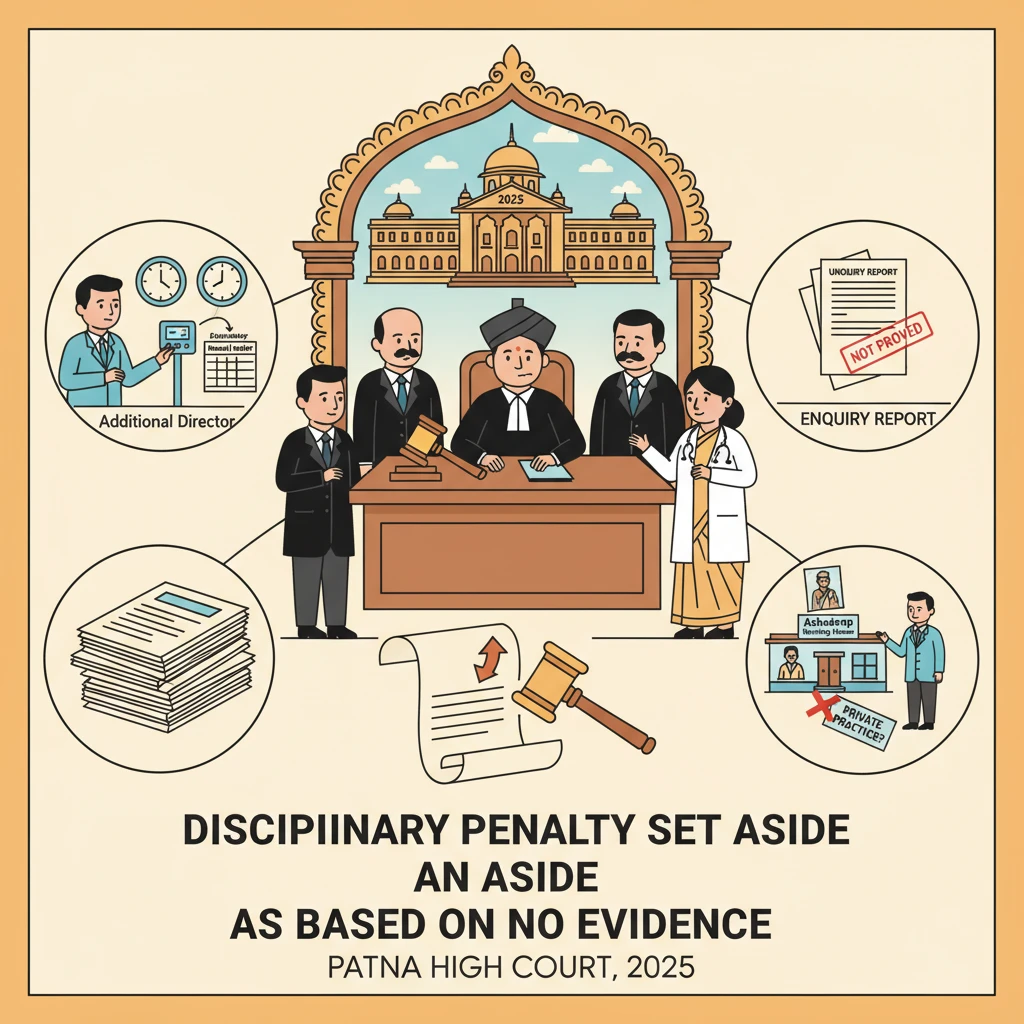
The departmental proceeding was initiated under Rule 14 of the Central Civil Services (Classification, Control and Appeal) Rules, 1965, by a memorandum of charge dated 17.05.2021. Two articles of charge were framed against her. First, that she was a habitual late comer and left the Wellness Centre early while posted as CMO (NFSG) at the office of the Additional Director, CGHS, Patna. Second, that she was involved in private practice at Ashadeep Nursing Home, Bhikhna Pahari, Patna, during the same posting period.
She filed her written statement of defence on 29.05.2021, refuting both charges. A regular departmental enquiry was then conducted, in which she participated. The Enquiry Officer submitted his report on 28.12.2021, holding that both charges were “not proved” on the basis of the evidence before him.
Despite this, the disciplinary authority disagreed with the Enquiry Officer’s findings. A disagreement note, together with the enquiry report, was served on the officer through a memorandum dated 25.02.2022. She submitted a detailed representation against the disagreement on 15.03.2022.
The matter was then referred to the Union Public Service Commission (UPSC) for advice. UPSC, by advice dated 13.04.2023 (forwarded by memorandum dated 14.06.2023), held Article I “not proved” but Article II “proved on preponderance of probability”. Relying on this, it advised a penalty of reduction by one stage in the time scale of pay for two years, with denial of increments during that period but without postponement of future increments after the penalty period.
The officer again submitted a representation on 11.07.2023, assailing the UPSC advice. She argued that the advice had relied on an earlier fact-finding report dated 23.06.2017 rather than the evidence recorded in the regular enquiry and the findings of the Enquiry Officer. She also contended that proving a charge at the stage of “advice upon punishment” on mere “preponderance of probability” was not proper in the face of a clear “not proved” finding by the Enquiry Officer.
Despite this, the disciplinary authority imposed the punishment suggested by UPSC by order dated 14.08.2023, communicated through office order dated 23.08.2023. Aggrieved, the officer approached the Central Administrative Tribunal, Patna Bench, by Original Application No. OA/050/00758/2023.
The Tribunal, by order dated 30.05.2025, allowed the Original Application. It quashed the punishment order dated 14.08.2023 and directed the authorities to grant all consequential benefits within three months. It held that there was no conclusive proof, not even a preponderance of probability, to sustain the allegation of private practice, and that the case was one of “no evidence”.
The Union of India (through the Ministry of Health and Family Welfare and CGHS authorities) then filed Civil Writ Jurisdiction Case No. 17666 of 2025 before the Patna High Court to challenge the Tribunal’s order.
What the Court Examined and Decided
The Patna High Court, speaking through Hon’ble Mr. Justice Mohit Kumar Shah (for the Division Bench also comprising Hon’ble Justice Smt. Soni Shrivastava), closely examined the disciplinary record as summarised by the Tribunal.
The Court first noted the critical findings of the Enquiry Officer dated 28.12.2021. Regarding the allegation of late coming, the Enquiry Officer found that no proper attendance records of doctors were maintained by the Additional Director, CGHS, Patna. Biometric attendance was available from 01.05.2017 but was not working properly. The manual attendance register was kept by the Additional Director, who simply marked all doctors as present and did not enforce proper attendance rules.
The fact-finding committee had tried to rely on computer log-in times to show late coming. However, during cross-examination, both committee members admitted that computer log-in and log-off times could not accurately show arrival and departure, and that log-off time could not even be ascertained. Another committee that visited the Wellness Centre on 13.09.2019 found her attendance satisfactory. On this basis, the Enquiry Officer concluded that Article I (habitual late coming and leaving early) was not proved.
On the allegation of private practice at Ashadeep Nursing Home, the Enquiry Officer considered both documentary and oral evidence. A fact-finding committee of two doctors, including Dr. Naresh Panchal and Dr. Sanjay Kumar-II, had earlier found no evidence of her private practice there, except that the nursing home was being run by her husband from their residence.
A later two-member committee comprising Shri S. Sridhar and Shri Pawan Patel visited the nursing home on 13.09.2019. They relied mainly on one pamphlet bearing the officer’s name and the hearsay statement of a patient’s attendant. The committee did not find her name on the website, on any name plate, visiting card, letter head or prescription. She was not found present at the nursing home during their visit. The authenticity of the single pamphlet could not be established. The Enquiry Officer, therefore, held that even basic facts necessary to weigh probabilities were not proved, and concluded that Article II (private practice) was also not proved.
Despite these detailed findings, the disciplinary authority issued a disagreement note but, as the High Court highlighted, failed to clearly state which evidence had been ignored by the Enquiry Officer and how that evidence established guilt. This omission, according to the Court, caused grave prejudice to the officer.
UPSC’s advice, as noticed by the Court, accepted that Article I was not proved but considered Article II proved on “preponderance of probability”. The UPSC referred to a visit by its team to Ashadeep Nursing Home around 10.30 a.m. on 13.09.2019. The hospital’s safai karmachari said no doctor was then present and that doctors would come in the evening. She handed over a pamphlet carrying the name of the nursing home, the officer, and her husband. One attendant claimed that the officer was treating her patient, which the safai karmachari denied, stating that another doctor, Dr. Asha Sinha, was the doctor there. The safai karmachari also said the pamphlet was more than nine years old. On this slender material, UPSC inferred preponderance of probability that the officer engaged in private practice.
The Tribunal, and later the High Court, focused on the weakness of this reasoning. The Tribunal had held that the nursing home was apparently named after “Dr. Asha Sinha”, not the officer, and even prosecution witnesses had conceded in cross-examination that the charges were not proved. Merely relying on a nine-year-old pamphlet, with no verification of its printing or use, could not reasonably establish ongoing private practice. The Tribunal also noted that the officer’s husband, who ran the nursing home, had died and the nursing home itself was no longer functioning, making continuing blame against her unjustified.
Before the High Court, the learned Additional Solicitor General (ASG) argued that in departmental enquiries, strict rules of evidence do not apply and that guilt can be established on preponderance of probability rather than proof beyond reasonable doubt. He also submitted that the Tribunal should not have re-appreciated the evidence.
However, the ASG did not deny that this was effectively a case of “no evidence”. He also, in view of the factual findings that the husband had died and the nursing home had closed, did not seriously press for interference with the Tribunal’s order.
The High Court reaffirmed that in writ jurisdiction under Articles 226 and 227 of the Constitution, courts do not act as appellate authorities in disciplinary matters. They cannot re-assess evidence but can check whether:
- The enquiry was held by a competent authority and followed prescribed procedure.
- There was any violation of natural justice.
- The authorities considered extraneous or irrelevant matters.
- The conclusions were so arbitrary and capricious that no reasonable person could reach them.
- The findings were based on no evidence.
For this, the Court relied on the Supreme Court judgment in Union of India v. P. Gunasekaran, (2015) 2 SCC 610. It also cited Nirmala J. Jhala v. State of Gujarat, (2013) 4 SCC 301, which stresses that judicial review is confined to checking whether conclusions are supported by some legal evidence and not to assessing sufficiency or reliability like an appellate court.
The Bench further referred to R.R. Parekh v. High Court of Gujarat, (2016) 14 SCC 1, and later decisions including Roop Singh Negi v. Punjab National Bank, (2009) 2 SCC 570; Kuldeep Singh v. Commissioner of Police, (1999) 2 SCC 10; and State of U.P. v. Saroj Kumar Sinha, (2010) 2 SCC 772. These authorities emphasise that suspicion, however strong, cannot substitute for legal proof even in departmental proceedings, and that a finding based on no evidence is perverse and liable to be set aside.
Applying these principles, the Court held that, so far as Charge I (late coming) was concerned, it had already been concluded as “not proved” and was not in issue. On Charge II (private practice), the material on record, read together with the Enquiry Officer’s report and the Tribunal’s analysis, showed “absolutely no evidence” to establish guilt. The conclusion drawn by the disciplinary authority, relying heavily on the UPSC’s presumption and a single, old pamphlet, was “wholly arbitrary and capricious”, such that no reasonable person could have reached it.
The presumption by UPSC that since the officer joined CGHS service in 1998 she “might be” doing private practice nine years earlier while in service, was termed by the Court as perverse and incongruous. In the absence of any inquiry into when and by whom the pamphlet was printed, and given that the nursing home had shut down after the husband’s death, this presumption could not stand.
The High Court concluded that the case was one of “no evidence” and that the punishment order dated 14.08.2023 was unsustainable. Since the Tribunal had correctly applied the law and there was no legal infirmity in its order dated 30.05.2025 in OA/050/00758/2023, the writ petition filed by the Union of India had no merit.
Accordingly, by judgment dated 25.11.2025, the Division Bench dismissed Civil Writ Jurisdiction Case No. 17666 of 2025, thereby affirming the Tribunal’s order quashing the punishment and directing grant of consequential benefits to the officer.
Why This Judgment Matters
This judgment is important for government employees, especially doctors and other professionals working under central schemes like CGHS. It shows that disciplinary action cannot rest on guesswork, old documents of doubtful value, or unverified complaints.
The Patna High Court makes it clear that even though departmental enquiries use a lower standard of proof than criminal trials, there must still be some real, reliable evidence. A single pamphlet, without proof of who issued it or when, and conflicting statements from witnesses, is not enough to damage a person’s career.
The judgment also protects employees from misuse of the idea of “preponderance of probability”. Authorities cannot simply say that something is “probable” without demonstrating the base facts. If the Enquiry Officer, after a full enquiry, finds charges “not proved”, higher authorities must identify specific, overlooked evidence before disagreeing and imposing punishment.
For many employees facing departmental proceedings, this decision reinforces that courts and tribunals can step in where findings are based on no evidence or are plainly unreasonable. It reassures them that long years of service cannot be brushed aside on the strength of suspicions alone.
Legal Issues and Answers
- Issue: Whether the punishment imposed on the government doctor for alleged private practice and late coming could stand when the Enquiry Officer had found both charges not proved and there was virtually no supporting evidence.
Answer: No. The Patna High Court held that the case was one of “no evidence”, that the disciplinary authority’s conclusion was arbitrary and capricious, and that the Central Administrative Tribunal rightly set aside the punishment and directed consequential benefits. - Issue: What is the scope of the High Court’s power in judicial review of disciplinary proceedings under Articles 226 and 227 of the Constitution of India?
Answer: The High Court reiterated that it cannot re-appreciate evidence like an appellate court, but can interfere where findings are based on no evidence, where conclusions are wholly arbitrary, or where procedure and principles of natural justice are violated. On this limited scrutiny, the Court found the punishment to be unsustainable.
Cases Cited by the Court
- Union of India v. P. Gunasekaran, (2015) 2 SCC 610
- Nirmala J. Jhala v. State of Gujarat, (2013) 4 SCC 301
- R.R. Parekh v. High Court of Gujarat, (2016) 14 SCC 1
- Roop Singh Negi v. Punjab National Bank & Others, (2009) 2 SCC 570
- Kuldeep Singh v. Commissioner of Police & Others, (1999) 2 SCC 10
- State of Uttar Pradesh & Others v. Saroj Kumar Sinha, (2010) 2 SCC 772
Case Details
Case Number: Civil Writ Jurisdiction Case No. 17666 of 2025
Case Title: The Union of India & Ors. v. Dr. Vibha Sinha
Coram: Hon’ble Mr. Justice Mohit Kumar Shah and Hon’ble Justice Smt. Soni Shrivastava
Date of Judgment: 25.11.2025
Citation: 2026 (1) PLJR 242
Advocates:
- For the Petitioners/Respondents (Union of India and CGHS authorities): Dr. K.N. Singh, Senior Advocate, Additional Solicitor General of India; Mr. Rabindra Kumar Priyadarshi, Senior Panel Advocate
- For the Respondent/Applicant (Doctor): Not specified in the judgment
Nature of the Case: Writ petition by Union of India challenging an order of the Central Administrative Tribunal allowing an Original Application and quashing a disciplinary penalty.
Impugned Tribunal Order: Order dated 30.05.2025 in OA/050/00758/2023, Central Administrative Tribunal, Patna Bench
Impugned Departmental Order: Order of punishment dated 14.08.2023, communicated by office order dated 23.08.2023
Link to Judgment: Patna High Court Judgment
If you found this explanation helpful and wish to stay informed about
how legal developments may affect your rights in Bihar,
you may consider following Samvida Law Associates for more updates.







