
Case Background
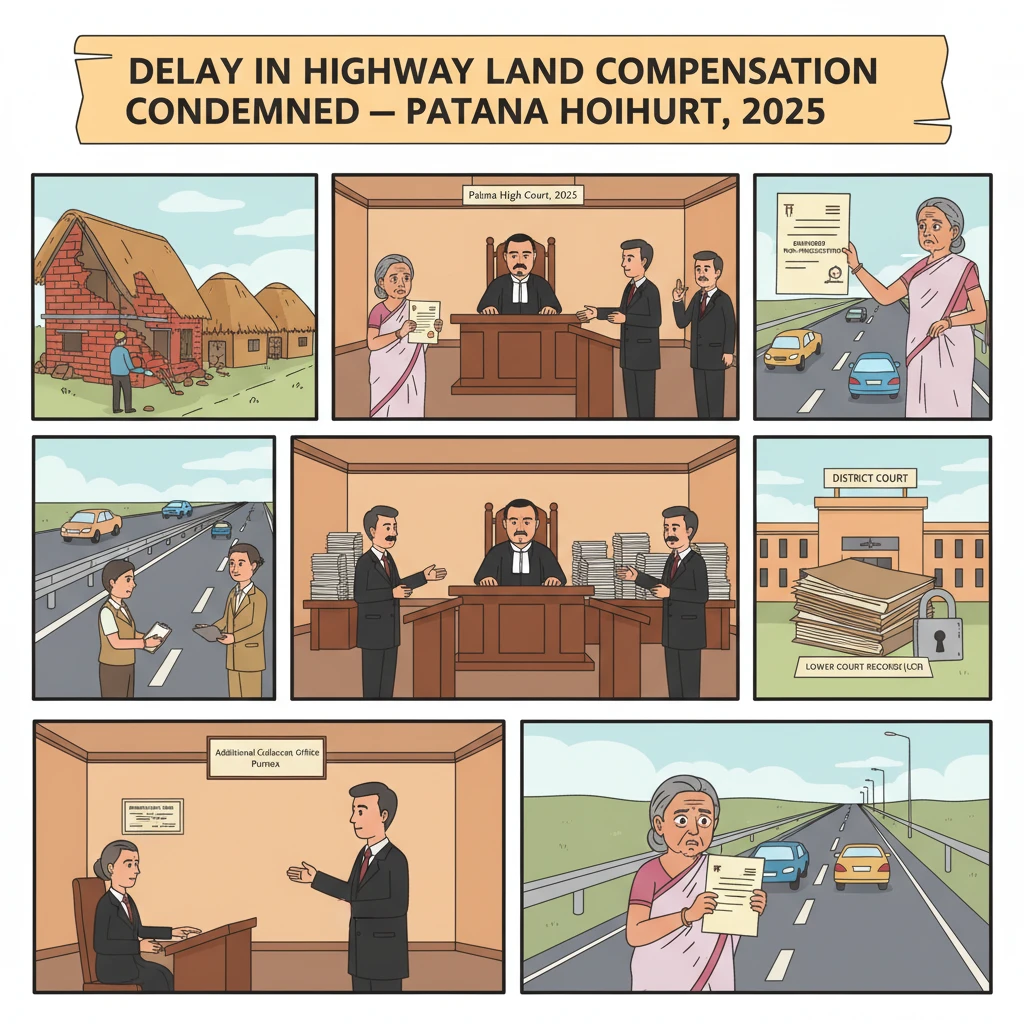
The case arose from the widening of National Highway No. 57 in Araria district, Bihar. For this project, part of the petitioner’s pucca building and three thatched houses were acquired for the National Highways Authority of India (NHAI) by the Central Government.
The acquisition and the resulting damage led to a dispute over the amount of compensation payable to the petitioner. The matter went before an arbitrator as Arbitration Case No. 16 of 2010 (Bibi Ishrat Jahan vs. Land Acquisition Officer, Araria & Ors.).
On 18.10.2012, the Additional Collector-cum-Arbitrator, Purnea, delivered an award. The arbitrator held that demolition of part of the petitioner’s building for the widening of NH-57 had caused damage to the entire building. On this basis, he directed payment of compensation of Rs. 16,38,650/- to the petitioner.
NHAI challenged this arbitral award by filing Misc. Case No. 04 of 2013 before a competent court. However, that case was dismissed for non-prosecution because NHAI did not pursue it. After this dismissal, NHAI filed Misc. Case No. 18 of 2019 as a restoration petition, seeking to revive the earlier challenge.
By the time the writ petition reached the Patna High Court, the restoration case was still pending and had not been restored, allegedly for want of the lower court records (LCR). Meanwhile, the petitioner had not received the compensation awarded in 2012, even though the highway had long been in use.
Faced with this prolonged delay, the petitioner approached the Patna High Court in Civil Writ Jurisdiction Case No. 17049 of 2017. She sought a writ directing the respondents to pay the entire compensation awarded by the arbitrator along with penal interest for acquisition of her land, pucca building and three thatched houses for widening NH-57.
What the Court Examined and Decided
The Patna High Court, through Hon’ble Mr. Justice Rajiv Roy, heard the matter on 18.11.2025. The Court heard arguments from counsel for the petitioner, counsel for NHAI and the State’s counsel.
The Court first recounted the key facts. Part of the petitioner’s house had been demolished for widening NH-57. The arbitrator, after assessing the situation, concluded that this partial demolition had effectively damaged the entire building. As a result, he fixed compensation of Rs. 16,38,650/- in favour of the petitioner.
The Court noted that NHAI had initially filed Misc. Case No. 04 of 2013 to challenge this arbitral award. However, NHAI did not seriously pursue that challenge, leading to dismissal of the case for non-prosecution. Only later did NHAI move for restoration through Misc. Case No. 18 of 2019, which at the time of the High Court’s judgment remained pending, not yet restored.
The Court described NHAI’s conduct as routine and aimed merely at avoiding payment. It observed that NHAI had “slept over the matter” after filing the initial case, allowing it to be dismissed for want of prosecution.
Recognising the ongoing hardship to the petitioner, the Court had earlier, on 09.09.2025, directed NHAI to file an affidavit. It wanted clarity on whether any steps were being taken in the matter, and specifically whether NHAI intended to make payment in absence of any stay order on the arbitral award.
On the date of final hearing, there was still no written reply from NHAI. However, its counsel orally confirmed that the restoration petition in Misc. Case No. 18 of 2019 remained pending because the lower court records had not been received.
The Court contrasted this slow official response with the petitioner’s suffering. While vehicles had been running on NH-57 “since long”, the petitioner had been waiting more than a decade for compensation that should have been paid soon after the 2012 award. The Court noted that the arbitrator had reached a definite conclusion, on conclusive evidence, that the building was damaged and that the petitioner was entitled to compensation.
At this stage, counsel for the petitioner relied on section 36(2) of the Arbitration and Conciliation Act, 1996. This provision deals with enforcement of arbitral awards when a challenge under section 34 is pending.
The Court reproduced section 36 in detail. The key part for this case is section 36(2), which states that filing an application to set aside an arbitral award does not by itself render the award unenforceable. The award becomes unenforceable only if the court hearing the section 34 challenge grants an order of stay of the award’s operation on a separate stay application under section 36(3).
Section 36(1) further clarifies that once the time limit for filing a setting-aside application under section 34 expires, the arbitral award can be enforced like a civil court decree, subject to section 36(2).
Applying these provisions, the Patna High Court focused on a crucial fact: there was no order of stay on the arbitral award in favour of the petitioner. Although NHAI had filed proceedings to challenge the award and then filed a restoration case, these steps alone did not make the award unenforceable.
The Court emphasised that in the absence of a specific stay order, the law requires that the arbitral award be treated like a decree and enforced. The pending restoration petition could not be used as a shield to indefinitely postpone payment.
The Court strongly criticised NHAI’s conduct. It recorded that NHAI had deliberately allowed the earlier case to be dismissed, and had then allowed the restoration petition to remain pending without bringing it to a logical conclusion. This behaviour was seen as a tactic that caused unnecessary suffering to a private citizen whose property had been taken for a public project.
On the basis of the factual record and section 36(2) of the Arbitration and Conciliation Act, the Court held that the petitioner was entitled to receive the arbitral award amount of Rs. 16,38,650/-. The Court directed that this amount “has to be cleared” to the petitioner by 31st December, 2025.
The Court then addressed what would happen if NHAI still failed to pay by the given deadline. It ruled that if payment was not made by 31.12.2025, the petitioner would be entitled to interest at the rate of 9% per annum with effect from 01.01.2026 until actual payment.
To ensure accountability of the officials involved, the Court also fixed a further outer limit. It ordered that if payment was still not cleared by 31st March, 2025, the petitioner would be entitled to an additional sum of Rs. 25,000/-. Importantly, this additional amount was directed to be paid from the personal pocket of the concerned NHAI official who had failed to look into the matter.
Finally, on the strength of these findings and directions, the Court allowed the writ petition.
Why This Judgment Matters
This judgment is significant for landowners whose land or houses are taken for road or highway projects. It explains that if an arbitral award grants compensation and there is no court order staying that award, the award must be enforced like a court decree.
The Patna High Court’s insistence on enforcing the award despite pending restoration proceedings sends a message that authorities cannot delay payment simply by filing cases and then not pursuing them. Government bodies and agencies like NHAI must act responsibly once people’s properties are acquired.
The decision also shows that courts are willing to impose interest and even personal cost on officials if they ignore lawful awards for long periods. This can act as a deterrent against bureaucratic delay and indifference, particularly where ordinary citizens are waiting for compensation for public projects.
For people affected by similar acquisitions, this case provides reassurance that the law offers protection against endless delay. It shows that approaching the High Court can result in clear timelines and financial consequences for non-compliance.
Legal Issues and Answers
- Issue: Can NHAI withhold payment of an arbitral compensation award for land and building acquisition merely because it has filed a challenge and a restoration case, when no stay order has been granted on the award?
Answer: No. The Patna High Court held that under section 36(2) of the Arbitration and Conciliation Act, 1996, filing such cases does not by itself make the award unenforceable. In the absence of a specific stay order, the award must be enforced like a court decree and the compensation must be paid. - Issue: What consequence follows when authorities delay compliance with a lawful arbitral award for years after acquisition of property for a public highway project?
Answer: The Court directed immediate payment of the award amount, imposed 9% interest from a fixed future date in case of non-payment by the deadline, and ordered an additional Rs. 25,000/- to be recovered personally from the responsible NHAI official if payment was not made by the extended cut-off date.
Cases Cited by the Court
- The judgment does not mention or rely upon any other judicial precedents. No external cases are cited.
Case Details
Case Number: Civil Writ Jurisdiction Case No. 17049 of 2017
Case Title: Bibi Ishrat Jahan v. The Union of India & Ors.
Coram: Hon’ble Mr. Justice Rajiv Roy
Citation: 2026 (1) PLJR 271
Date of Judgment: 18.11.2025
Advocates:
- For the petitioner: Mr. Uday Bhanu Roy, Advocate; Mr. Baleshwar Kamat, Advocate
- For the respondents/State: Mr. Jitendra Kumar, AAG-11
- For NHAI: Mr. Kumar Goutam, Advocate; Ms. Priyanshu Kumari, Advocate
Nature of the Case: Writ petition seeking enforcement of arbitral compensation award relating to land and building acquisition for National Highway widening.
Link to Judgment: Click here to access the official Patna High Court judgment
If you found this explanation helpful and wish to stay informed about
how legal developments may affect your rights in Bihar,
you may consider following Samvida Law Associates for more updates.







