
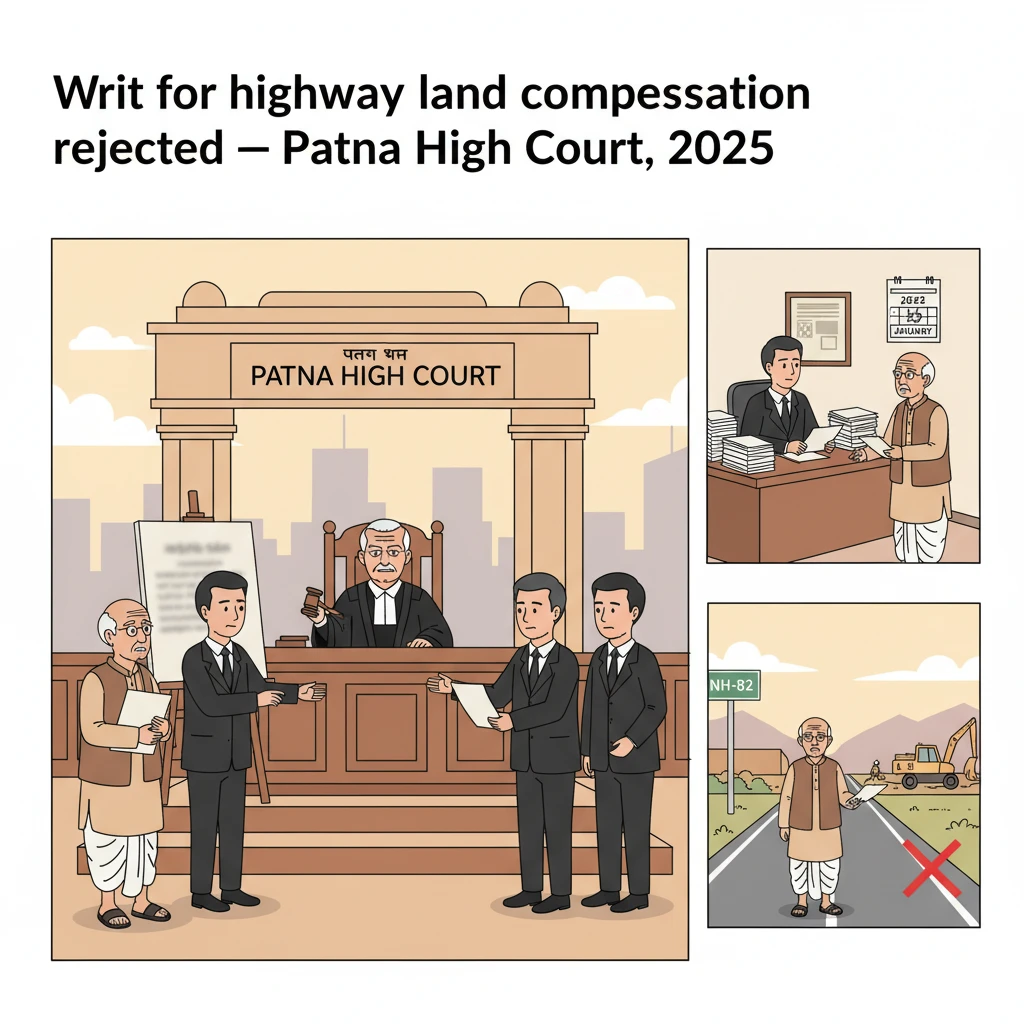
Case Background
The dispute arises from land situated in Village Salempur, Police Station Mufassil, District Gaya. The land falls under Khata No. 73, Plot No. 102. It lies on the route of National Highway No. 82 (Gaya–Hisua–Rajgir–Bihar Sharif Section).
The petitioner claimed that his grandfather, Late Banwari Mahto @ Banwari Yadav, got title over this land through a settlement from the then ex-landlord, Govind Lal Nakfofa, in respect of Khata No. 73, Plot No. 102, having an area of 3.44 acres. In a compensation proceeding, Compensation Case No. 105/2016, 53–54, the petitioner’s grandfather was allegedly shown as a settled raiyat.
Earlier, in 1981, some portion of Plot No. 102 had been acquired for construction of an over-bridge over River Falgu. For that earlier acquisition, the petitioner’s uncle, Muni Yadav, received compensation vide Land Acquisition Case No. 5 filed by the State Government on 22.08.1996.
In the government records, the land of Plot No. 102 under Khata No. 73 was at one stage recorded in the name of the petitioner’s grandfather. However, on 14.05.2020, the Circle Officer, Manpur, Gaya, cancelled the mutation. Before that, when the mutation was earlier disturbed, the petitioner’s aunt, Late Puniya Devi, had filed Mutation Appeal No. 30 of 2011–12/51 of 2010–11 before the Deputy Collector, Land Reforms, Gaya (DCLR, Gaya).
By order dated 15.06.2011, the DCLR, Gaya allowed the appeal and directed that the demand for land of Khata No. 73, Plot No. 102, area 3.72 acres, would continue in the name of the petitioner’s aunt. The son of the ex-landlord then preferred Revision Case No. 210 of 2011–12 before the Additional Collector, Gaya, challenging the DCLR’s order.
The Additional Collector dismissed the revision on 24.07.2014. This order became important later because the State argued that both sides then colluded to sell the land.
For highway construction, the Government of Bihar first published a notification in the newspaper on 10.06.2018. In that notification, according to the petitioner, his land appeared at Serial No. 10 and was described as private land to be acquired. The petitioner annexed this as Annexure-1 in the writ petition.
Subsequently, on 31.01.2019, a Central Government notification was issued by the Ministry of Road Transport and Highways and was published in the Hindi daily “Hindustan” on 26.04.2019. It stated that on publication, the listed land would vest in the Central Government. In this notification, the land at Serial No. 103, corresponding to the petitioner’s land in Village Salempur, area 0.5348 hectare, Plot No. 102, was shown as gairmajarua (government land).
The petitioner claimed he was unaware that his land had been described as government land. He was waiting for notice from the competent authority of NH-82 for compensation. He allegedly came to know of the change only when officials of NH-82 came to measure the land.
What the Court Examined and Decided
The petitioner filed a writ petition under Article 226 of the Constitution seeking four main reliefs. First, quashing of the Gazette of India notification dated 31.01.2019 to the extent it showed his land as gairmajarua. Second, a direction to correct the notification and award compensation for acquisition of his land. Third, a direction to measure land for NH-82 strictly according to the sanctioned map without harming other residents. Fourth, any other appropriate relief.
Through senior counsel, the petitioner argued that there was a clear inconsistency between the Bihar Government’s earlier notification dated 10.06.2018, which treated his land as private, and the later Central Government notification dated 31.01.2019, which treated the same land as gairmajarua. He asserted that his family’s long-standing title, settlement from the ex-landlord, earlier acquisition and compensation, and mutation orders in favour of his aunt all showed the land to be private, not government land.
He also stated that he had sold portions of Plot No. 102 to different purchasers who obtained mutation in their names. According to him, the sanctioned map had exempted the purchasers’ land, yet in February 2021 their land was also measured for acquisition.
After the writ petition was filed, the petitioner learned from Annexure-B to the State’s counter-affidavit that a committee made up of the Land Acquisition Officer, Gaya, Circle Officer, Manpur, DCLR, Sadar Gaya, and Deputy Collector, Gaya, had recommended cancellation of the jamabandi of the petitioner’s land. He alleged that the report dated 26.08.2021 was biased, prepared after the writ petition to frustrate his claim, and made without giving him an opportunity of hearing. Through I.A. No. 01/2022, he sought setting aside of this committee report as well.
The State, through learned Standing Counsel-25, relied heavily on the order dated 24.07.2014 of the Additional Collector in Revision Case No. 210/11–12. It argued that the petitioner’s grandfather’s claim was based on a settlement said to have been made in 1938. In contrast, the descendants of the ex-landlord claimed that the land had been acquired by the ex-landlord through an unregistered sale deed of 1945. If the ex-landlord purchased the land in 1945, there could not have been a settlement in favour of the petitioner’s grandfather in 1938. This contradiction, according to the State, showed that the petitioner’s story was doubtful.
The State alleged that, after the 24.07.2014 revision order, the descendants of the ex-landlord and the descendants of Banwari Mahto @ Banwari Yadav colluded. They allegedly “illegally and jointly” sold Plot No. 102 to one Mukesh Kumar by a registered sale deed, which is subject matter of CWJC No. 12610/2021. The recital of that sale deed, filed as Annexure-A, allegedly showed contradictory claims by the vendors, further muddying the title.
The State also relied on the joint enquiry report dated 26.08.2021 (Annexure-B) prepared by ADM, Gaya; DLAO, Gaya; DCLR, Sadar, Gaya; and Anchal Adhikari, Manpur. According to this committee, at the time the acquisition notification was issued, the recorded raiyat of Plot No. 102 was one Chaman Lal Khatik. Yet, there was no evidence showing how his name came in the khatiyan.
On checking old records, particularly Compensation Case No. 105/16, 53–54, the committee found that Plot No. 102 under Khata No. 73 was recorded as gairmajarua malik. On that basis, it held that the jamabandi and rent receipts in favour of private persons were suspicious and recommended steps to cancel the jamabandi.
Respondent No. 6, Bihar State Road Development Corporation (BSRDC), argued that the Central Government notification only reflected the land status as shown in land revenue records on the date of notification. In those records, Khata No. 73, Plot No. 102, Mauza Salempur, Circle Manpur, was described as common land (gairmajarua parti kadeem). On that basis, a notification under Section 3A of the National Highways Act, 1956 was issued in the Official Gazette on 11.04.2018. Therefore, there was no reason to quash the notification.
The Court looked closely at the scheme of Sections 3A and 3C of the National Highways Act, 1956. Under Section 3A, the Central Government declares its intention to acquire land by notification in the Official Gazette, giving a brief description of the land. The Court accepted the submission of Respondent No. 6 that the description used in the Section 3A notification was drawn from the revenue records as they stood on the date of publication.
Crucially, the Court recorded that the petitioner did not deny that, on the date of notification, the revenue record showed the land as gairmajarua. Since the notification under Section 3A was based on existing records, the Court held that there was no illegality in the publication of the Gazette notification dated 31.01.2019.
The Court then noted that, after publication of the notification, the law under Section 3C of the National Highways Act allows “any person interested” to file objections within a prescribed time. The petitioner did not file any objection under Section 3C within the limitation period. This failure, the Court held, went against him and weakened his challenge.
On the question of compensation, the Court emphasised an important principle: before claiming compensation for acquired land, a person must show that his right and title to the land are completely undisputed. In this case, because of the enquiry report, the conflicting stories of settlement and sale, the presence of the name of Chaman Lal Khatik in the khatiyan without supporting documents, and the classification of the land in old records as gairmajarua malik, the Court found that serious disputes of title existed.
The Court acknowledged that the enquiry committee had not given an opportunity of hearing to the petitioner. This, it said, “was not proper.” The petitioner also alleged mala fides in constituting the committee after the writ was filed. Even so, the Court pointed out that the petitioner had a specific, effective remedy under the Bihar Mutation Act, 2011 to challenge the recommendation or any subsequent order based on it. Hence, the writ court need not interfere at this stage.
According to the Court, the key feature of this case was that it involved “disputed questions of title which require evidence.” Such questions, it held, cannot be appropriately decided in writ jurisdiction under Article 226. The proper remedy for the petitioner is to approach the civil court, seek a declaration of title over the land in question, and, only after such declaration, claim compensation for acquired land.
Regarding the specific prayer for setting aside the report dated 26.08.2021 of the four-member committee, the Court termed it premature. The petitioner had not shown that any actual cancellation of mutation had yet taken place on the basis of that report. Even if cancellation occurs, the Court observed, the Bihar Mutation Act, 2011 provides an alternative remedy by way of appeal and further revision. For that reason also, the Court declined to exercise writ jurisdiction.
In the final paragraph, the Court concluded that there was “no merit in this writ petition.” Accordingly, it dismissed the writ petition and disposed of all pending interlocutory applications.
Why This Judgment Matters
This judgment is important for landowners whose land is marked as government land during highway or other public projects. It shows that revenue records on the date of notification are crucial. If those records show land as gairmajarua, the acquiring authority may treat it as government land, and the High Court will be slow to interfere in writ jurisdiction.
The decision also highlights that if a landowner disagrees with the description of land in a National Highways Act notification, they must promptly use Section 3C and file objections within the time limit. Waiting silently and later filing a writ makes the case weaker.
The Court further clarified that when there is serious doubt or conflict over land title, the High Court will not examine evidence under Article 226. Instead, parties must go to civil court, get a clear declaration of title, and use statutory remedies under the Bihar Mutation Act, 2011 for mutation-related disputes.
For people in Bihar facing similar issues during road projects, this case underlines the need to keep their land records clean, respond to notifications on time, and use the right forum—mutation authorities for record corrections and civil courts for title disputes.
Legal Issues and Answers
-
Issue: Can the Patna High Court, in writ jurisdiction, quash a National Highways Act notification describing land as gairmajarua and direct compensation when the petitioner’s title is disputed and revenue records show it as government land?
Answer: No. The Court held that the notification was based on existing revenue records, the petitioner had not objected under Section 3C within time, and serious disputes about title required evidence and must be decided by the civil court and mutation authorities, not in writ proceedings. -
Issue: Should the High Court set aside the enquiry committee report dated 26.08.2021 recommending cancellation of jamabandi, when the petitioner was not heard by the committee?
Answer: Not at this stage. Though the lack of hearing was “not proper”, the Court held that the petitioner has an efficacious alternative remedy under the Bihar Mutation Act, 2011 to challenge the recommendation or any consequent orders, so writ interference was declined.
Cases Cited by the Court
- The judgment does not mention or rely on any reported case law by name or citation.
Case Details
Case Number: Civil Writ Jurisdiction Case No. 9564 of 2021
Case Title: Chando Yadav v. The State of Bihar & Others
Coram: Hon’ble Mr. Justice Shailendra Singh
Citation: 2026(1) PLJR 195
Date of Judgment: 27-11-2025
Advocates:
- For the Petitioner: Mrs. Nivedita Nirvikar, Senior Advocate; Mrs. Shashi Priya, Advocate; Mr. Shashank Shekhar, Advocate
- For the State (Respondent Nos. 1–4): Mr. Sajid Salim Khan, SC-25
- For Respondent No. 6 (Bihar State Road Development Corporation): Mr. P.K. Shahi, Senior Advocate; Mr. Manish Dhari Singh, Advocate
Nature of the Case: Writ petition under Article 226 of the Constitution challenging land acquisition notification and seeking compensation and related directions.
Link to Judgment: Patna High Court Judgment in CWJC No. 9564 of 2021
If you found this explanation helpful and wish to stay informed about
how legal developments may affect your rights in Bihar,
you may consider following Samvida Law Associates for more updates.







