
Case Background
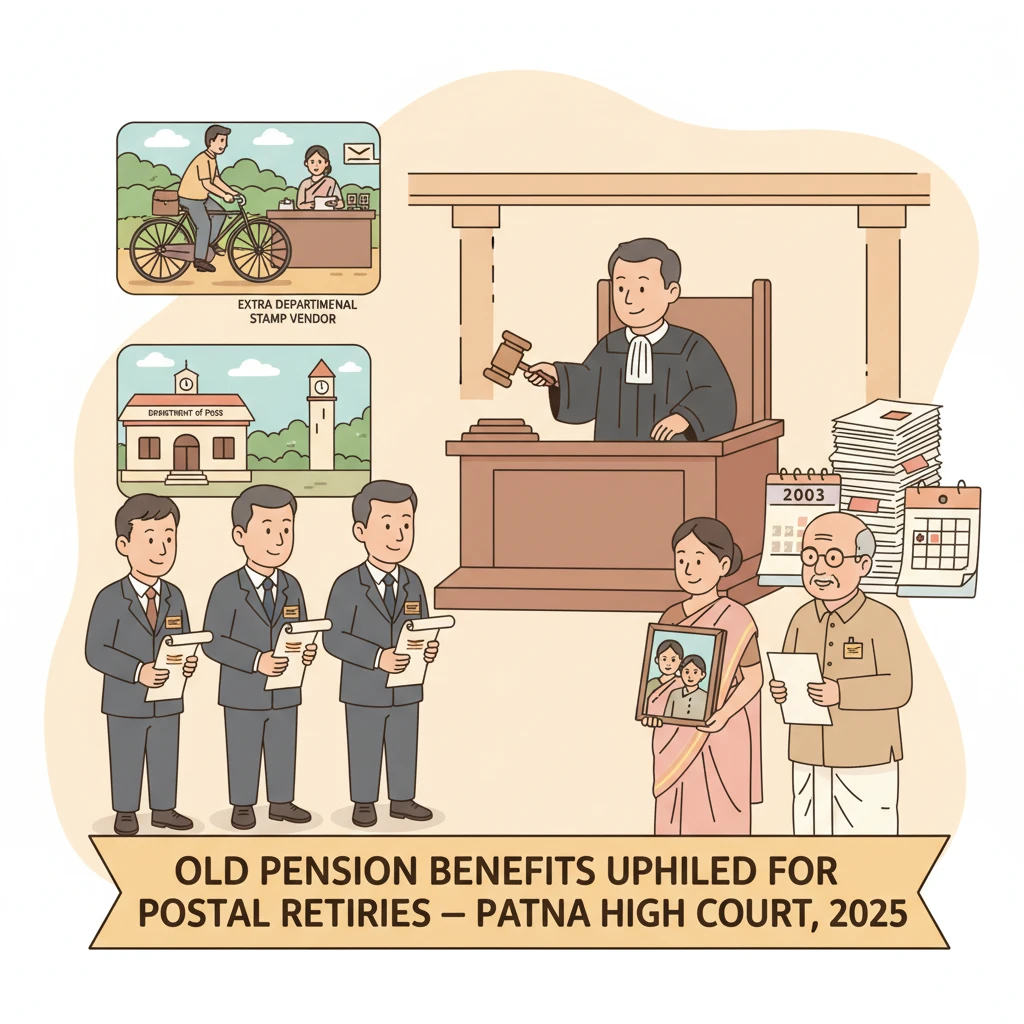
The dispute arose from the service conditions of two postal employees from Bhagalpur Postal Division. Both had started their careers decades ago as Gramin Dak Sevak (GDS) or Extra Departmental Stamp Vendor between 1974 and 1976.
Later, the postal department began the process of filling Group-D vacancies for the years 2000–2003 from among Extra Departmental employees, on the basis of seniority. A Departmental Promotion Committee (DPC) meeting was scheduled for November 2003, but it was not held on time.
Because of this delay, the promotions were effected only on 26.04.2005. Both employees were then promoted to the Group-D cadre against the 2003 vacancy year and subsequently placed in the Multi Tasking Staff (MTS) cadre.
The husband of the original applicant in the first case superannuated on 31.01.2016 and later passed away on 09.08.2021. The original applicant in the second case retired from service on 31.12.2018. Their grievance was that, despite long service and promotion against pre-2004 vacancies, they were not being granted benefits under the old pension scheme.
Feeling aggrieved, the two employees approached the Central Administrative Tribunal, Patna Bench, by filing O.A. No. 050/00947/2022 and O.A. No. 050/00948/2022. They asked that their service be counted appropriately so they could receive pension and other pensionary benefits under the old pension scheme, treating 2003 as the relevant year.
On 14.01.2025, the Tribunal allowed both applications. It directed the authorities to include them in the old pension scheme and to fix their pension and pensionary benefits accordingly. The Union of India and other postal authorities, dissatisfied with this outcome, filed two writ petitions before the Patna High Court: CWJC No. 14291 of 2025 and CWJC No. 14268 of 2025.
Since both writ petitions challenged the same Tribunal order and involved identical issues, the High Court heard them together and decided them by a common judgment dated 25.11.2025.
What the Court Examined and Decided
The Division Bench of the Patna High Court, comprising Hon’ble Mr. Justice Mohit Kumar Shah and Hon’ble Justice Smt. Soni Shrivastava, examined the narrow but important question: should these employees fall under the old pension scheme or the new pension scheme, which came into effect from 01.01.2004?
The petitioners (Union of India and postal authorities) argued that the employees could not be covered by the old pension scheme. Their core point was that the employees had joined the regular Group-D/MTS cadre only in 2005. According to them, because the employees became regular staff after 01.01.2004, they had to be governed by the new pension scheme, which replaced the old one from 31.12.2003.
On the other hand, the original applicants had earlier argued before the Tribunal that they were promoted in 2005 against vacancies of the year 2003. The delay in holding the DPC was entirely due to lapses on the part of the authorities. There was no fault on the part of the employees. Therefore, they said they should not be made to suffer loss of pension benefits because of administrative delay beyond their control.
They also relied on legal precedents. One was the judgment of the Supreme Court in P. N. Premachandran vs. State of Kerala, reported in (2004) 1 SCC 245. Another was a Division Bench judgment of the Patna High Court dated 28.08.2020 in CWJC No. 17285 of 2018, The Union of India & Others vs. Uma Kant Jha. These decisions supported the principle that employees should not be deprived of benefits due to delays or lapses attributable to the administration.
The Central Administrative Tribunal carefully considered these submissions and precedents. It ultimately directed that the applicants be granted the benefit of the old pension scheme.
Before the High Court, the Bench turned to the same precedents, particularly the judgment in Uma Kant Jha. In that case, the respondent was an Extra Departmental Branch Postmaster appointed on 26.10.1976, later promoted to MTS on 26.04.2005, and retired on 30.11.2016. His pension had been fixed under the new pension scheme.
In Uma Kant Jha, it was argued that promotion in 2005 was against a 2003 vacancy, and therefore service should be counted from 2003, making him eligible for the old pension scheme. The Tribunal and later the High Court accepted that dispute and held that such an employee was entitled to benefits under the old scheme.
The Patna High Court in Uma Kant Jha explained why. It noted that Extra Departmental employees form a separate cadre, with separate rules, and are not regular employees. However, they serve the postal department and can be promoted into the regular MTS cadre, with 25% of MTS vacancies reserved for them through a DPC. To be promoted, they must complete a specified period of service as Extra Departmental employees.
The judgment further clarified that the new pension scheme, effective from 01.01.2004, applies to central government employees who entered service after that date. In that case, the employee had entered postal service as an Extra Departmental employee in 1976, and then promoted to regular MTS on 26.04.2005 against 2003 vacancies. Therefore, his entry into central government service could not be said to be after 01.01.2004, even though he became regular later.
At the same time, the Court recognised that qualifying service for pension would be only the service rendered as regular MTS, because service as Extra Departmental employee is not pensionable. Even so, the key point was that he was already a government servant before the cut-off date of 01.01.2004.
The Division Bench in Uma Kant Jha also referred to its earlier decision in CWJC No. 17204 of 2015, The Union of India & Ors. vs. Mukti Prasad Yadav, reported in PLJR 2016(2) 480. In that case, employees with temporary status in the Department of Posts prior to 01.01.2004, but regularized later, were held to be governed by the old pension scheme. The Court said that the new pension scheme is meant for persons entering government service after 01.01.2004. Those already serving in some recognised capacity before that date, even if only temporarily, would not be pushed into the new scheme simply because formal regularisation happened later.
Using this reasoning, the Patna High Court in the present case put a direct query to the petitioners’ counsel. The Court asked whether the facts of the respondents’ case were different from those in Uma Kant Jha in any meaningful way.
The answer, recorded in the judgment, was that there was no difference. The petitioners’ counsel admitted that the present cases were fully covered by the earlier judgment in Uma Kant Jha.
Once this was clear, the Bench noted that the pension scheme from 01.01.2004 applies only to those who entered central government service after that date. In the present case, both employees had entered postal service as Gramin Dak Sevak/Extra Departmental employees during 1974–76. They were later promoted on 26.04.2005, after the DPC recommended their names against vacancies of the year 2003.
Therefore, their entry into central government service could not be said to be after 01.01.2004. On this basis, the Court held that they were entitled to be included in the old pension scheme, and their pension and pensionary benefits had to be fixed accordingly.
The Court found that the situation was squarely covered by its earlier judgment in Uma Kant Jha and that the facts and circumstances were “more or less identical.”
Taking into account the submissions of the petitioners, the Supreme Court judgment in P. N. Premachandran, and the binding Division Bench decision in Uma Kant Jha, the Court concluded that the Tribunal’s order did not suffer from any error.
Consequently, the Patna High Court dismissed both writ petitions (CWJC No. 14291 of 2025 and CWJC No. 14268 of 2025) as being without merit. The Tribunal’s direction to grant the old pension scheme benefits to the two employees thus stands confirmed.
Why This Judgment Matters
This judgment is significant for many postal employees who started as Gramin Dak Sevaks or other Extra Departmental staff before 01.01.2004 but were promoted into regular cadres after that date.
The Patna High Court has clearly reinforced that the cut-off date for deciding between the old and new pension schemes is the date of initial entry into government service, not the date of later promotion or regularisation, provided the person was already serving the department in a recognised capacity.
For employees similarly placed in Bihar, especially in the postal department, this decision offers a clear path: if they entered service before the start of the new pension scheme and were later promoted against pre-2004 vacancies, they may have a strong claim to old pension benefits.
The judgment also sends a message that employees should not lose pension rights because the administration delayed holding promotion meetings or filling vacancies on time. Where the delay is entirely on the employer’s side, the employee should not be penalised.
Legal Issues and Answers
- Issue: Whether postal employees who entered service as Gramin Dak Sevak/Extra Departmental employees in 1974–76 but were promoted to Group-D/MTS on 26.04.2005 against 2003 vacancies are to be governed by the old pension scheme or the new pension scheme effective from 01.01.2004.
Answer: The Patna High Court held that such employees are covered by the old pension scheme because their entry into central government service occurred long before 01.01.2004, and promotion in 2005 against 2003 vacancies does not shift them into the new scheme. - Issue: Whether the Central Administrative Tribunal, Patna Bench, erred in directing that the applicants be granted benefits under the old pension scheme.
Answer: The Court held that the Tribunal’s order was correct and fully supported by earlier binding judgments, and therefore refused to interfere, dismissing both writ petitions.
Cases Cited by the Court
- P. N. Premachandran vs. State of Kerala, (2004) 1 SCC 245.
- The Union of India & Others vs. Uma Kant Jha, CWJC No. 17285 of 2018, judgment dated 28.08.2020 (Patna High Court).
- The Union of India & Ors. vs. Mukti Prasad Yadav, CWJC No. 17204 of 2015, reported in PLJR 2016(2) 480 (Patna High Court) — discussed in the extracted passage from Uma Kant Jha.
Case Details
Case Numbers: Civil Writ Jurisdiction Case No. 14291 of 2025; Civil Writ Jurisdiction Case No. 14268 of 2025.
Case Title: The Union of India & Ors. vs. Nawal Kishor Thakur; The Union of India & Ors. vs. Panchanand Singh.
Citation: 2026 (1) PLJR 41.
Coram: Hon’ble Mr. Justice Mohit Kumar Shah; Hon’ble Justice Smt. Soni Shrivastava.
Advocates: For the petitioners (Union of India and postal authorities): Mr. Radhika Raman, Sr. CGC; Mr. Ram Tujabh Singh, CGC. Names of counsel for the respondents are not mentioned in the judgment.
Nature of the Case: Writ petitions under civil writ jurisdiction challenging a common order dated 14.01.2025 passed by the Central Administrative Tribunal, Patna Bench, Patna in O.A. No. 050/00947/2022 and O.A. No. 050/00948/2022 concerning applicability of old pension scheme versus new pension scheme for postal employees promoted from Extra Departmental cadre.
Link to Judgment: Official Patna High Court judgment
If you found this explanation helpful and wish to stay informed about how legal developments may affect your rights in Bihar, you may consider following Samvida Law Associates for more updates.







