
Case Background
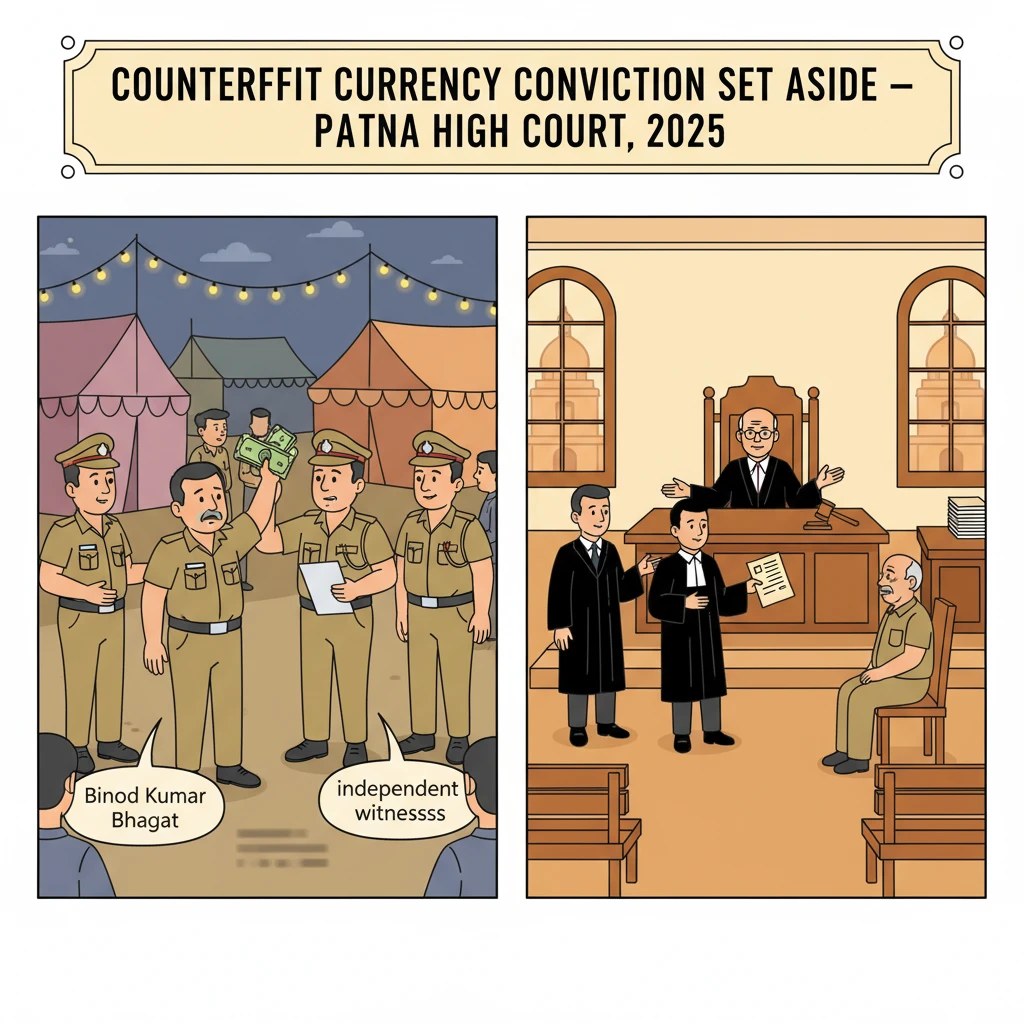
The case started with a written report lodged by the then Officer-in-Charge of Goraul Police Station in District Vaishali. According to the report, on 13.10.2000 at about 8:00 P.M., while on duty, he received secret information that some people were dealing in counterfeit currency notes at a local Mela.
Acting on this information, the officer, along with other police officials, went to the Mela. They caught hold of one suspicious man roaming in the Mela area. On inquiry, he disclosed his name as Binod Kumar Bhagat, the appellant in this case.
The informant alleged that, on search, 23 currency notes of Rs.100/- each were recovered from the appellant and that these notes were fake and forged. A seizure list was said to have been prepared in presence of two independent witnesses. The appellant allegedly stated that one Ramesh Paswan had given him the fake notes to use in the Malang Asthan Mela.
On the basis of this written report, Goraul P.S. Case No.134 of 2000 was registered under Sections 419, 420, 489(A)/34 of the Indian Penal Code. After investigation, the police submitted charge-sheet under Sections 489(A), 489(C), 420/34 IPC. Cognizance was taken, and the case was committed to the Court of Session, becoming Sessions Trial No.392 of 2001.
The trial court framed charges, which the appellant denied. The prosecution examined thirteen witnesses and produced several documents, including the FIR, the seizure list, 23 notes of Rs.100/-, an RBI report, and the appellant’s statement before the police. After recording the appellant’s statement under Section 313 of the Code of Criminal Procedure, the trial court convicted him under Section 489(C) IPC and sentenced him to seven years’ rigorous imprisonment and a fine of Rs.5,000/-, with further six months’ rigorous imprisonment in default.
Aggrieved by the judgment of conviction dated 05.10.2004 and sentence dated 06.10.2004 passed by the learned 6th Additional Sessions Judge, Vaishali at Hajipur, the appellant filed Criminal Appeal (SJ) No.727 of 2004 before the Patna High Court under Section 374(2) of the Cr.P.C. The appellant was granted bail by a coordinate Bench of the High Court on 03.01.2005.
During the hearing of the appeal, Mr. Abhishek Kumar, earlier appointed as amicus curiae, did not appear. On 29.11.2025, the Court appointed Mr. Raju Patel as amicus curiae to assist in deciding the appeal. Mrs. Anita Kumari Singh appeared as Additional Public Prosecutor for the State.
What the Court Examined and Decided
The Patna High Court, presided over by Hon’ble Mr. Justice Chandra Shekhar Jha, closely examined both the oral and documentary evidence led during the trial, as well as the rival arguments advanced before it.
At the outset, the Court reproduced Section 489(C) of the Indian Penal Code, which punishes possession of forged or counterfeit currency or bank notes where the person has knowledge or reason to believe the notes are forged and intends to use them as genuine. The focus of the Court, therefore, was on whether the prosecution had proved, beyond reasonable doubt, that counterfeit currency was recovered from the appellant’s possession and that he had the necessary knowledge and intention.
The amicus curiae attacked the conviction on several fronts:
First, he pointed out serious contradictions in the prosecution evidence regarding who actually conducted the search of the appellant. PW-1 deposed that one “Mahesh Babu,” a constable present at the spot, had searched the appellant. However, the informant, PW-8, claimed in his evidence that he himself had conducted the search.
The Court took note that this contradiction was not a minor one. The person who conducted the search is central to proving recovery of incriminating articles. Further, Mahesh Babu was not examined at all in the trial. This absence left a gap in the recovery story which the prosecution did not fill.
Second, the amicus curiae highlighted that the Investigating Officer, S.K. Jha, was also not examined. This meant that key aspects of investigation, such as how the seizure was conducted, how the case property was handled, and how the statements were recorded, could not be tested in cross-examination.
Third, the FIR (fard-e-beyan) was not proved through the informant himself. Instead, the prosecution got it exhibited through PW-7, Subodh Kumar, who was a formal witness and an advocate’s clerk. The Court observed that PW-7 had no occasion to know either the contents of the FIR or the signature of the Investigating Officer on it. Given that the informant (PW-8) was available and deposed, this mode of proving the FIR was found wanting, and the Court held that the FIR did not appear to have been duly proved.
Fourth, the seizure witnesses, PW-5 (Lalu Rai) and PW-6 (Raja Sah), turned hostile. They stated in court that no counterfeit notes were recovered in their presence. They only identified their signatures on the seizure list. As a result, the independent support for the alleged recovery collapsed. The Court held that, in light of their hostile stance, the very recovery of counterfeit notes from the appellant became doubtful.
The amicus curiae also submitted that the appellant’s supposed confessional statement, proved through PW-13, was made before the police and hence had no evidentiary value in law. The Court accepted the legal position that such a confessional statement before the police cannot be the basis of conviction.
The State, through the learned A.P.P., argued that minor contradictions should not discredit the prosecution case and that the counterfeit nature of the notes had been scientifically established. PW-11, Suman Rai, had conducted scientific tests and found the notes to be fake, with his report exhibited as Exhibit-5. PW-12, Krishna Kant Sharma, a retired Treasurer of the RBI, identified the seized notes and stated that they were counterfeit. The A.P.P. also contended that non-examination of the Investigating Officer is not always fatal to the prosecution.
The Court balanced these arguments by distinguishing between proving that notes are counterfeit and proving that such notes were recovered from a particular person with necessary knowledge and intention.
The Court then referred to two Supreme Court decisions relied upon by the amicus curiae. In Rajesh Patel v. State of Jharkhand, reported in (2013) 3 SCC 791, the Supreme Court emphasised how non-examination of important witnesses like the doctor and the Investigating Officer can prejudice the accused. The Patna High Court reproduced paragraph 18 of that judgment, where the Supreme Court held that reasoning which overlooks such non-examination can be erroneous.
The Court also relied on Umashankar v. State of Chhattisgarh, reported in (2001) 9 SCC 642, and specifically reproduced paragraph 8 of that judgment. The Supreme Court there made it clear that offences under Sections 489-B and 489-C IPC require mens rea—knowing or having reason to believe that the currency notes are forged or counterfeit. Mere possession or use, without proof of this knowledge or intention, is not enough to convict.
In Umashankar, the Supreme Court had also disapproved of courts “presuming” mens rea without material on record and stressed that such presumption is not warranted under Section 4 of the Evidence Act in the absence of evidence and proper questioning under Section 313 Cr.P.C.
Applying these principles to the present case, the Patna High Court found that:
Most of the independent witnesses (PW-2, PW-3, PW-4, PW-5, and PW-6) either turned hostile or provided no support to the prosecution case. Their testimonies could not be used to corroborate the prosecution version.
The key foundational facts—who searched the appellant and whether any counterfeit notes were actually recovered in the presence of witnesses—remained doubtful due to contradictions and hostile witnesses.
The FIR itself was not appropriately proved, as it was exhibited through an advocate’s clerk rather than the informant or the Investigating Officer.
The non-examination of the Investigating Officer, in these circumstances, was not a mere technical lapse but a serious defect that prejudiced the defence, as per the reasoning in Rajesh Patel.
Although the expert evidence (PW-11 and PW-12) established that the notes produced were counterfeit, this could not, by itself, connect the counterfeit notes to the appellant beyond reasonable doubt. The Court clearly stated that their testimonies were not sufficient to conclude, without any doubt, that the seized counterfeit currency was recovered from the appellant’s possession.
There was also no clear material showing that the appellant had the knowledge or reason to believe that the notes were counterfeit and intended to use them as genuine, as required by Section 489(C) IPC and clarified in Umashankar.
In light of these shortcomings, the Court held that the prosecution had failed to prove its case beyond reasonable doubt. The conviction under Section 489(C) IPC, based on such shaky evidence, could not be sustained.
Consequently, the Court set aside the judgment of conviction dated 05.10.2004 and the order of sentence dated 06.10.2004 in Sessions Trial No.392/2001. The criminal appeal was allowed.
Since the appellant was already on bail, the Court ordered that he be discharged from his bail bonds and that his sureties stand discharged. Any fine paid was directed to be returned to the appellant. The Court also directed that the Lower Court Records be sent back to the concerned court and a copy of the judgment be forwarded to the trial court.
Finally, the Court directed the Patna High Court Legal Services Committee to pay Rs.5,000/- as consolidated fee to Mr. Raju Patel, the amicus curiae, for his assistance in disposing of the appeal.
Why This Judgment Matters
This judgment is important for people who may face allegations of possessing fake currency, especially in routine checks or at crowded events like Melas. The Patna High Court has shown that a conviction cannot rest only on the police version without proper and reliable support.
The case makes it clear that when independent seizure witnesses deny recovery, when there are contradictions about who searched the accused, and when crucial officers like the Investigating Officer are not examined, the benefit of doubt must go to the accused.
The judgment also underlines that simply proving that notes are fake is not enough. The prosecution must also show that the accused knew or had reason to believe the notes were counterfeit and intended to use them as genuine.
For ordinary citizens, this decision shows that courts carefully test the quality of evidence and do not automatically uphold convictions based on suspicion or weak proof.
Legal Issues and Answers
- Issue: Whether the prosecution proved beyond reasonable doubt that counterfeit currency was recovered from the appellant’s possession in a lawful and reliable manner.
Answer: No. Due to contradictions about the search, hostile seizure witnesses, doubtful proof of the FIR, and non-examination of the Investigating Officer, the alleged recovery itself became doubtful. - Issue: Whether the essential ingredients of Section 489(C) IPC, including knowledge and intention to use counterfeit notes as genuine, were established against the appellant.
Answer: No. Relying on Umashankar v. State of Chhattisgarh, the Court held that there was no material to prove the necessary mens rea, so the conviction under Section 489(C) could not stand. - Issue: Whether expert evidence alone, proving that seized notes are counterfeit, is sufficient to sustain a conviction when basic facts of seizure and investigation are shaky.
Answer: No. The Court held that even though experts confirmed the notes were counterfeit, their evidence alone could not connect the notes to the appellant beyond reasonable doubt.
Cases Cited by the Court
- Rajesh Patel v. State of Jharkhand, (2013) 3 SCC 791
- Umashankar v. State of Chhattisgarh, (2001) 9 SCC 642
Case Details
Case Number: Criminal Appeal (SJ) No.727 of 2004
Case Title: Binod Kumar Bhagat v. State of Bihar
Citation: 2026 (1) PLJR 68
Court: High Court of Judicature at Patna
Bench/Coram: Hon’ble Mr. Justice Chandra Shekhar Jha
Date of High Court Judgment: 29.11.2025
Trial Court Details: Judgment of conviction dated 05.10.2004 and order of sentence dated 06.10.2004 in Sessions Trial No.392/2001 arising out of Goraul P.S. Case No.134 of 2000, by the learned 6th Additional Sessions Judge, Vaishali at Hajipur
Offences Alleged: Sections 419, 420, 489(A)/34 IPC (FIR); charges under Sections 489(A), 489(C), 420/34 IPC; conviction under Section 489(C) IPC
Nature of Case: Criminal appeal under Section 374(2) of the Code of Criminal Procedure against conviction and sentence
Advocates:
- For the Appellant: Mr. Raju Patel, Amicus Curiae (appointed by the High Court)
- For the Respondent/State: Mrs. Anita Kumari Singh, Additional Public Prosecutor
Final Outcome: Appeal allowed; conviction and sentence set aside; appellant discharged from bail bonds; fine, if paid, to be returned.
Link to judgement ; file:///C:/Users/Adity/OneDrive/Documents/Vaktrita%20Final/case%201287.pdf
If you found this explanation helpful and wish to stay informed about
how legal developments may affect your rights in Bihar,
you may consider following Samvida Law Associates for more updates.







