
Case Background
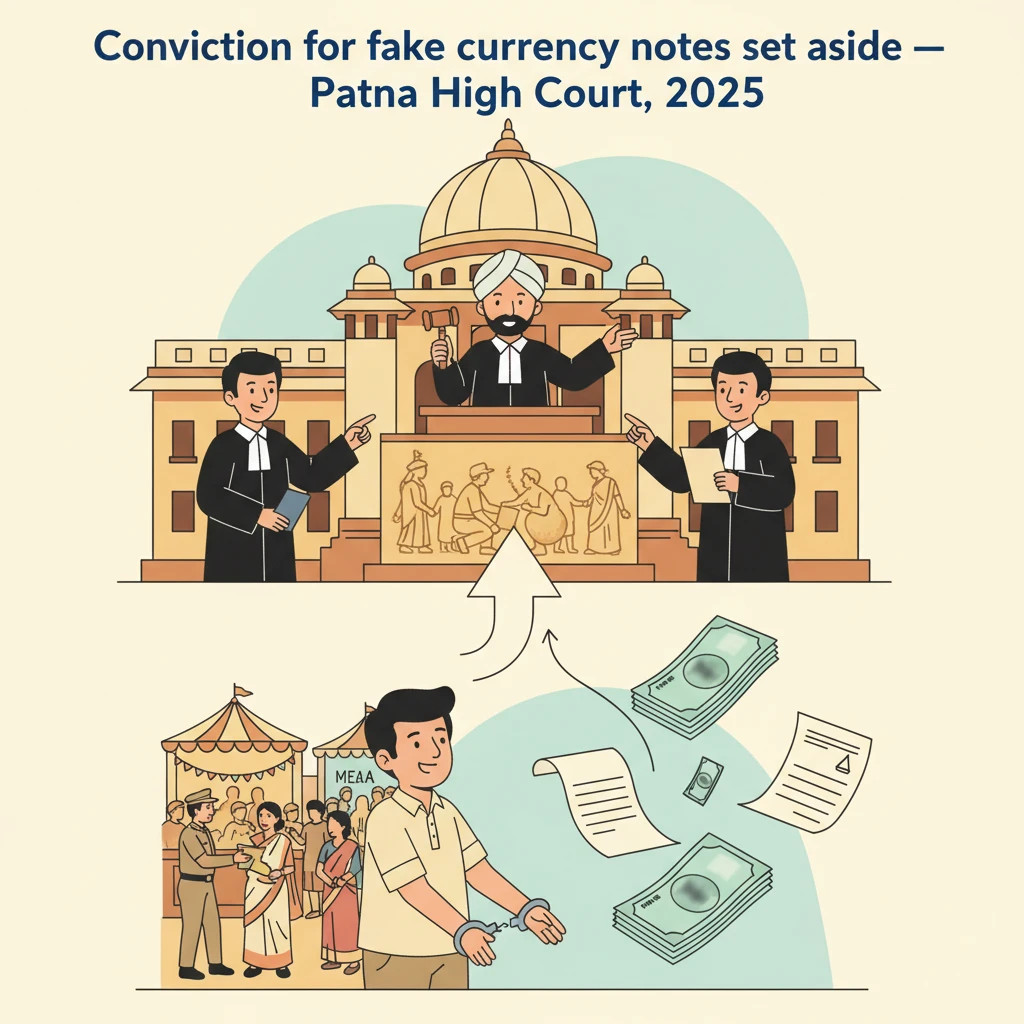
The case began with a police raid at a fair (Mela) in the jurisdiction of Goraul Police Station, District Vaishali, on 13.10.2000 at about 8:00 PM.
The informant, then Officer‑in‑Charge of Goraul P.S., claimed that he received secret information that some persons were dealing in counterfeit currency notes in the Mela.
He went to the Mela with other police officials and allegedly caught hold of a suspicious man roaming there. On inquiry, the person disclosed his name as Binod Kumar Bhagat, the later appellant before the Patna High Court.
According to the written report, the police searched him and allegedly recovered 23 currency notes of Rs. 100/‑, which were said to be fake and forged. A seizure list was prepared in presence of two independent witnesses. On being questioned, the man allegedly stated that one Ramesh Paswan had given him the fake notes for use in the Malang Asthan Mela.
On this basis, Goraul P.S. Case No. 134 of 2000 was registered under Sections 419, 420, 489A/34 of the Indian Penal Code. After investigation, the police submitted charge‑sheet under Sections 489A, 489C, 420/34 IPC.
The Magistrate took cognizance and committed the case to the Court of Session, where it was registered as Sessions Trial No. 392/2001 before the 6th Additional Sessions Judge, Vaishali at Hajipur.
The trial court framed charges and explained them to the accused, who pleaded not guilty and claimed to be tried.
The prosecution examined thirteen witnesses and produced several documents, including the FIR and fard‑e‑beyan, envelopes, the 23 currency notes of Rs. 100/‑ as material exhibits, the Reserve Bank of India report, the statement of the accused and the seizure lists.
After the prosecution evidence closed, the statement of the accused was recorded under Section 313 Cr.P.C. He denied the allegations completely and claimed innocence and false implication.
Despite his defence, by judgment dated 05.10.2004 and order of sentence dated 06.10.2004, the trial court convicted him under Section 489C IPC and sentenced him to seven years’ rigorous imprisonment and a fine of Rs. 5,000/‑, with six months’ further rigorous imprisonment in default.
Aggrieved, he filed Criminal Appeal (SJ) No. 727 of 2004 in the Patna High Court under Section 374(2) of the Code of Criminal Procedure. He was granted bail by a coordinate Bench on 03.01.2005.
During the hearing of the appeal, Mr. Abhishek Kumar, previously appointed as amicus curiae, could not appear. On 29.11.2025, the Court appointed Mr. Raju Patel as amicus curiae to assist in the appeal. Mrs. Anita Kumari Singh, APP, appeared for the State.
What the Court Examined and Decided
The Patna High Court, per Hon’ble Mr. Justice Chandra Shekhar Jha, examined the entire trial court record, the evidence of all witnesses and the rival submissions.
The Court first reproduced Section 489C IPC, which punishes a person who has in his possession any forged or counterfeit currency note or bank note, knowing or having reason to believe it is forged or counterfeit and intending to use it as genuine or that it may be used as genuine.
This made it clear that for a conviction, the prosecution had to prove not only possession but also knowledge or reason to believe that the notes were fake and an intention to use them as genuine.
On the factual side, the Court noted that key prosecution witnesses turned hostile. Ganesh Mahto (PW‑2), Binod Kumar Kushwaha (PW‑3) and Ram Ekbal Sah (PW‑4) did not support the prosecution case. Nothing emerged from their testimony which could be used either to support or contradict those witnesses who had supported the case. Their evidence was therefore treated as not relevant.
More importantly, the seizure list witnesses, Lalu Rai (PW‑5) and Raja Sah (PW‑6), who were supposed to have witnessed the recovery of the alleged fake notes, also turned hostile. They clearly stated that no counterfeit notes were recovered before them. They only identified their signatures on the seizure list.
Because of this, the Court found that the prosecution story regarding the actual recovery of counterfeit currency from the accused became doubtful. The independent witnesses, who should have confirmed the seizure, did not do so.
The Court next looked at how the FIR had been proved. The informant, Madan Prasad Singh (PW‑8), did depose before the trial court. However, despite his availability, the FIR was formally exhibited through PW‑7, Subodh Kumar, an advocate’s clerk and only a formal witness.
The Court observed that as an advocate’s clerk, PW‑7 had no occasion to know the contents of the FIR or the signature of the Investigating Officer on it. Therefore, exhibiting the FIR through such a witness meant that the FIR itself did not appear to have been duly proved in accordance with law.
The Court then considered contradictions concerning who actually searched the accused. PW‑1 categorically said that the search was conducted on the accused by one Mahesh Babu, a constable present at the spot. But the informant, PW‑8, deposed that he himself carried out the search.
This was not a small discrepancy. Read along with the evidence of PW‑5 and PW‑6 that no recovery was made in their presence, it created serious doubt about whether the alleged seizure of 23 fake Rs. 100/‑ notes really occurred in the manner described by the police.
The Court also noted other deficiencies in the prosecution case raised by the amicus curiae. The Investigating Officer, S.K. Jha, was not examined at the trial. The amicus relied on the Supreme Court decision in Rajesh Patel v. State of Jharkhand, (2013) 3 SCC 791, to argue that non‑examination of important witnesses can prejudice the accused.
The Patna High Court reproduced paragraph 18 of Rajesh Patel, where the Supreme Court held that non‑examination of crucial witnesses such as the doctor and Investigating Officer in that case prejudiced the accused, and criticised the reasoning of the High Court there as erroneous.
In the present case, the absence of the Investigating Officer meant that the defence could not properly test the investigation, the alleged seizure, or the manner in which the fake currency was dealt with and sent for examination. This added to the doubts already arising from hostile witnesses and contradictions.
The amicus curiae further pointed out that the alleged confessional statement of the accused, proved through PW‑13, was made before the police and therefore had no evidentiary value in law. The High Court accepted that such a statement, made to police, cannot by itself form the basis of conviction and is not relevant to prove that no one else but the appellant committed the offence.
The State, through the APP, argued that minor contradictions should not shake an otherwise sound conviction. She pointed out that the seized counterfeit currency notes were duly exhibited through PW‑12, Krishna Kant Sharma, a retired Treasurer of the Reserve Bank of India, who identified them. PW‑11, Suman Rai, had conducted a scientific test and found all the seized currency to be fake, and this was exhibited as Exhibit‑5.
The High Court acknowledged this evidence. It accepted that PW‑11 and PW‑12 showed that the currency notes examined by them were counterfeit. However, the crucial question was whether it was proved beyond reasonable doubt that these particular fake notes had been recovered from the possession of the accused in the manner alleged.
On this point, the Court held that the testimony of PW‑11 and PW‑12 was “not so relevant” to the extent that, on their evidence alone, one could safely conclude that the counterfeit currency had been seized from the accused without doubt.
The Court then turned to the requirement of mens rea (guilty mind) under Sections 489B and 489C IPC. Relying on Umashankar v. State of Chhattisgarh, (2001) 9 SCC 642, the Court reproduced paragraph 8 of that judgment.
In Umashankar, the Supreme Court held that, for offences under Sections 489B and 489C, the prosecution must prove that the accused knew or had reason to believe the notes were counterfeit and intended to use them as genuine. Mere possession or use of such notes without proof of this mental element is not enough for conviction.
The Supreme Court in that case had found that the prosecution brought no material to prove mens rea and that the trial court had wrongly “presumed” it. On those facts, it set aside the conviction and acquitted the accused.
Applying this reasoning, the Patna High Court considered whether the prosecution in the present case had proved the necessary mens rea of the accused. The judgment records no material showing that the appellant knew or had reason to believe that the notes were fake, beyond the disputed seizure and a confessional statement to police which had no evidentiary value.
With the seizure itself in serious doubt, large parts of the prosecution evidence collapsing due to hostile witnesses, contradictions on who conducted the search, non‑examination of the Investigating Officer, and an improperly proved FIR, the Court held that the conviction could not stand.
The Court concluded that it was not safe to uphold the trial court’s finding that the seized counterfeit currency was recovered from the possession of the appellant and that he had the required guilty knowledge and intention. The benefit of doubt had to go to the accused.
Consequently, the Patna High Court set aside the judgment of conviction dated 05.10.2004 and the order of sentence dated 06.10.2004 passed in Sessions Trial No. 392/2001 arising out of Goraul P.S. Case No. 134 of 2000 by the 6th Additional Sessions Judge, Vaishali at Hajipur.
The criminal appeal was allowed. Since the appellant was already on bail, the Court discharged him from the liabilities of his bail bonds, discharged the sureties and directed that any fine paid be returned to him. The office was directed to send back the lower court records and a copy of the judgment to the trial court. The Court also directed the Patna High Court Legal Services Committee to pay Rs. 5,000/‑ as consolidated fee to the amicus curiae.
Why This Judgment Matters
This judgment of the Patna High Court is important for anyone accused in cases involving fake or counterfeit currency, and also for police officers and trial courts handling such cases.
First, the Court emphasised that mere production of fake notes and expert reports is not enough. The prosecution must clearly prove that the notes were actually recovered from the accused in a lawful and reliable manner.
If seizure witnesses turn hostile, if there are contradictions on who conducted the search, or if the FIR and investigation are not properly proved, the benefit of doubt will go to the accused.
Second, the Court reinforced that a conviction under Section 489C IPC requires proof of the accused’s mental state — knowledge or reason to believe that the notes were counterfeit and intention to use them as genuine. This flows directly from the Supreme Court’s decision in Umashankar.
Third, the judgment highlights the importance of examining the Investigating Officer and other key witnesses. Non‑examination, as underlined by the Supreme Court in Rajesh Patel, can seriously prejudice the accused and weaken the prosecution case.
For ordinary people, this decision shows that courts do not accept police versions blindly. Evidence must be reliable, properly proved and free from major contradictions. Where doubts remain, higher courts are willing to overturn convictions and protect the liberty of individuals.
Legal Issues and Answers
- Issue: Whether the prosecution proved beyond reasonable doubt that the appellant was in possession of counterfeit currency notes, as required under Section 489C IPC.
Answer: No. Due to hostile seizure witnesses, contradictions on who conducted the search and non‑examination of the Investigating Officer, the alleged seizure from the appellant was held doubtful. - Issue: Whether the necessary mens rea (knowledge or reason to believe that the notes were counterfeit and intention to use them as genuine) was established against the appellant.
Answer: No. Relying on Umashankar v. State of Chhattisgarh, the Court found no material proving such mens rea and held that conviction under Section 489C IPC could not be sustained. - Issue: Whether the conviction could stand on the basis of expert evidence from RBI officials and the alleged confessional statement to police.
Answer: No. While expert evidence proved that the notes examined were counterfeit, it did not conclusively link them to the appellant. The confessional statement to police had no evidentiary value, and overall evidence was insufficient for conviction.
Cases Cited by the Court
- Rajesh Patel v. State of Jharkhand, (2013) 3 SCC 791.
- Umashankar v. State of Chhattisgarh, (2001) 9 SCC 642.
- M. Mammutti v. State of Karnataka, (1979) 4 SCC 723 : 1980 SCC (Cri) 170 : AIR 1979 SC 1705 (referred to within Umashankar).
Case Details
Case Number: Criminal Appeal (SJ) No. 727 of 2004
Case Title: Binod Kumar Bhagat v. State of Bihar
Citation: 2026 (1) PLJR 68
Court: High Court of Judicature at Patna
Bench / Coram: Hon’ble Mr. Justice Chandra Shekhar Jha
Date of Judgment: 29.11.2025
Appellant: Binod Kumar Bhagat
Respondent: State of Bihar
Advocates:
- Mr. Raju Patel, Amicus Curiae for the appellant.
- Mrs. Anita Kumari Singh, APP for the State.
Originating Case: Sessions Trial No. 392/2001 arising out of Goraul P.S. Case No. 134 of 2000.
Offence Involved: Alleged possession of counterfeit currency notes; conviction under Section 489C IPC set aside.
Nature of the Case: Criminal appeal under Section 374(2) Cr.P.C. against conviction and sentence by the Sessions Court.
Link to Full Judgment: Patna High Court judgment in Cr. App (SJ) No. 727 of 2004
If you found this explanation helpful and wish to stay informed about how legal developments may affect your rights in Bihar, you may consider following Samvida Law Associates for more updates.







