
Case Background
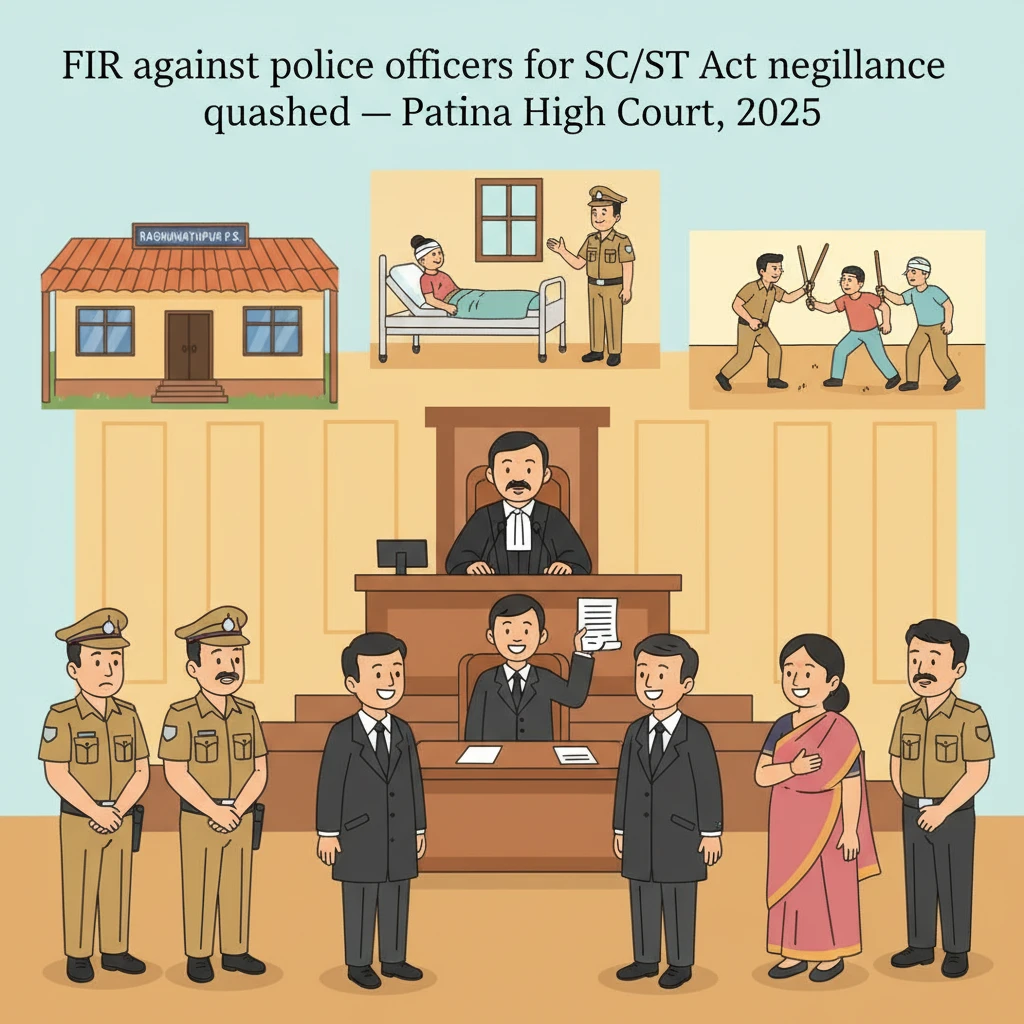
The judgment arises from two connected criminal writ petitions before the Patna High Court. Both petitions challenged the same FIR, Raghunathpur P.S. Case No.156 of 2024, registered in District Siwan.
This FIR was lodged by the then Station House Officer (S.H.O.) of Raghunathpur Police Station, based on a memo received from the Superintendent of Police, Siwan. The memo enclosed a file from the National Commission for Scheduled Tribes, which had conducted an enquiry into an earlier case, Raghunathpur P.S. Case No.271 of 2022.
In that earlier case, an informant belonging to a Scheduled Tribe, namely respondent no.6 in one of the writ petitions, had given her fardbeyan (initial statement) in the emergency ward of Sadar Hospital, Siwan, on 21.11.2022. This statement related to a land dispute incident in which several persons were allegedly injured.
The present petitioners are police officers. One was the then S.H.O. of Raghunathpur Police Station. The other was the Investigating Officer (I.O.) of Raghunathpur P.S. Case No.271 of 2022. The 2024 FIR accused them of neglecting their duties under section 4 of the Scheduled Castes and Scheduled Tribes (Prevention of Atrocities) Act, 1989.
According to the impugned FIR, the Commission’s enquiry found three main lapses in handling Case No.271 of 2022: delay of five days in registering the FIR, failure to add section 307 of the Indian Penal Code despite alleged head injuries to five persons, and failure by the I.O. to properly investigate by not obtaining the injury report and not recording the statement of one injured person and witnesses from the informant’s side.
On these allegations, Criminal Writ Jurisdiction Case No.1421 of 2024 and Criminal Writ Jurisdiction Case No.1720 of 2024 were filed before the Patna High Court to quash Raghunathpur P.S. Case No.156 of 2024.
What the Court Examined and Decided
The Court, presided over by Hon’ble Mr. Justice Sandeep Kumar, heard both matters together because they challenged the same FIR and arose from the same factual background.
In the first petition, the then S.H.O. argued that there was no negligence in registration of Raghunathpur P.S. Case No.271 of 2022. He explained that the fardbeyan was recorded by the P.S.I. of Siwan Town Police Station at Sadar Hospital, Siwan, which is outside the territorial jurisdiction of Raghunathpur Police Station.
The fardbeyan was forwarded to Raghunathpur Police Station on the same day, but the original copy did not reach the station. The S.H.O. came to know of the statement through Siwan Town Police Station, sent a Chaukidar to bring the original, and received it only on 26.11.2022. On that very day, he registered Raghunathpur P.S. Case No.271 of 2022. On this basis, he said any alleged delay was not due to him, and he could not be blamed for negligence before getting the original document.
He further submitted that he had not recorded the fardbeyan himself, and that recording took place outside his police station limits. Once the original was received, he promptly registered the case, so section 4 of the SC/ST Act could not apply to him.
The S.H.O. also pointed to the nature of the incident. According to him, it was a free fight between the informant side and another person, over land. Both sides sustained injuries. From the other side, an FIR, Raghunathpur P.S. Case No.266 of 2022, had been lodged on 21.11.2022, with seven injured persons.
He highlighted that although the informant party in Case No.271 of 2022 claimed that five persons suffered head injuries, they did not go to the nearer Primary Health Centre, located about 5 to 10 kilometres away. Instead, they travelled more than 40 kilometres to Sadar Hospital, Siwan, and their treatment started after more than two hours. The petitioner argued that this conduct created doubt about the prosecution version.
The S.H.O. also relied on medical findings and subsequent supervision. At Sadar Hospital, the doctor examined all injured persons and found their injuries to be simple in nature. The case was later supervised by the S.D.P.O., Siwan Sadar, and also examined by the Superintendent of Police. Neither of these senior officers found that an offence under section 307 IPC (attempt to murder) was made out. Finally, in the S.P.’s final report dated 31.03.2023, the case was found true only under sections 448, 341, 323, 354, 504, 506/34 IPC and sections 3(1)(r), 3(1)(s)/3(2)(va) of the SC/ST Act.
On this basis, the S.H.O. submitted that he could not be penalised for not including section 307 IPC in the FIR, particularly when higher officers, after scrutiny, came to the same conclusion. He stressed that section 4 of the SC/ST Act punishes only negligence in duty that is wilful, and that there was no such wilful neglect on his part. He also informed the Court that he was already facing a departmental proceeding for the same incident.
The second petition was filed by the Investigating Officer of Case No.271 of 2022. He broadly supported the S.H.O.’s version and gave additional details of his investigation. He said that after being assigned the investigation, he went to the place of occurrence and attempted to record the statement of the informant and her family members. However, they were not found at their house.
According to him, local inquiry revealed that the informant and her family had left the house fearing arrest. On perusal of the injury reports and medical documents, he found the injuries to be simple in nature and therefore submitted the memo of charge without including section 307 IPC. He maintained that he acted strictly on the basis of medical evidence, as reflected in the case diary, and had not been negligent or biased.
On the other hand, the State, through its counter affidavits, opposed the quashing of the FIR. It argued that the FIR in Case No.156 of 2024 should be allowed to proceed, as the matter was still under inquiry, and therefore the writ petitions were premature. The State specifically pointed out that the 2024 FIR arose from the handling of Raghunathpur P.S. Case No.271 of 2022, an SC/ST (Prevention of Atrocities) case, and not from the cross-case, Raghunathpur P.S. Case No.266 of 2022.
The State emphasised that the 2024 FIR had been registered pursuant to findings and recommendations of the National Commission for Scheduled Castes (the judgment refers to this as National Commission for Scheduled Castes, after earlier mentioning National Commission for Scheduled Tribes) in its review dated 11.06.2024. The Commission had made adverse observations about the petitioners, alleging serious lapses and dereliction of duty during the investigation of Case No.271 of 2022.
The State also submitted that the written explanation of the I.O. before the Superintendent of Police, Siwan, could not by itself clear him of the procedural lapses noted by the Commission. It maintained that both officers were negligent and biased and had failed to discharge their legal duties properly.
After hearing both sides, the Court turned to the legal framework. Section 4 of the SC/ST Act prescribes punishment for a public servant, who is not a member of a Scheduled Caste or Scheduled Tribe, if he or she wilfully neglects duties required under the Act and rules. The Court reproduced section 4, including sub-section (2), which lists duties like registering FIRs under appropriate sections, recording victim and witness statements, and filing charge sheets within 60 days. The proviso requires that charges against a public servant be booked on the recommendation of an administrative enquiry. Sub-section (3) allows the Special Court or Exclusive Special Court to take cognizance and direct penal proceedings.
The Court relied extensively on the Supreme Court decision in State of GNCT of Delhi and Others v. Praveen Kumar @ Prashanth, (2024) SCC OnLine SC 1591. That judgment clarified that an administrative enquiry and its recommendation are a pre-condition for penal proceedings under section 4(2). It described the proviso as an inbuilt safeguard for public servants, so that every dissatisfied complainant cannot trigger criminal prosecution. The test in such an enquiry is whether the public servant wilfully neglected the duties required by the Act of 1989.
The Patna High Court also cited State of Orissa v. Mohd. Illiyas, (2006) 1 SCC 275, which explained the meaning of “wilful.” An act is wilful if it is intentional, conscious, and deliberate, not casual, accidental, or due to genuine inability. It must be done with bad purpose or evil motive, with full knowledge of its consequences. The Court noted that this meaning has been reiterated by the Supreme Court in U.N. Bora v. Assam Roller Flour Mills Assn., (2022) 1 SCC 101, and Balwantbhai Somabhai Bhandari v. Hiralal Somabhai Contractor, (2023) 17 SCC 545.
From these rulings and section 4 itself, the High Court distilled a key principle: to attract section 4 of the SC/ST Act, negligence in performance of duty must be deliberate and wilful. Therefore, any authority invoking section 4 must first come to a clear conclusion that the public servant acted with wilful negligence—meaning, with intention and knowledge, and not merely through error or misunderstanding.
Applying this to the facts, the Court examined the three main allegations against the officers.
First, on delay in lodging the FIR for Case No.271 of 2022, the Court accepted that the fardbeyan was recorded at Sadar Hospital, Siwan, which is outside the jurisdiction of Raghunathpur Police Station. The station did not receive the original copy immediately. Once the original was made available, the S.H.O. promptly registered the case on 26.11.2022. On these facts, the Court found no deliberate or wilful negligence in delay.
Second, regarding non-addition of section 307 IPC, the Court noted that the medical reports showed simple injuries. Both the S.D.P.O., Siwan Sadar, and the Superintendent of Police, Siwan, had supervised the case and also did not find section 307 IPC to be attracted. Ultimately, the SP’s final report dated 31.03.2023 did not include section 307 IPC but only the lesser IPC offences and relevant SC/ST Act sections. Therefore, the omission of section 307 by the S.H.O. and I.O. could not be treated as intentional wrongdoing, when senior officers, after full scrutiny, had taken the same view.
Third, on failure to record certain statements, the Court took note of the I.O.’s explanation that when he went to the informant’s house to record her statement, she and her family were not present. Neighbours informed him that they had left fearing arrest. In such a situation, the Court held, the failure to record the informant’s statement could not automatically be considered wilful neglect.
On an overall assessment, the Court concluded that the conduct of the petitioners did not show any deliberate or wilful neglect of duty. It further noted that criminal proceedings against police officers under section 4 of the SC/ST Act cannot be initiated by ignoring the mandatory requirements built into that provision.
Continuing the criminal proceeding, in the Court’s view, would amount to an abuse of the process of the court. Accordingly, it allowed both writ petitions and quashed Raghunathpur P.S. Case No.156 of 2024 and all consequential proceedings, insofar as they related to the petitioners.
Why This Judgment Matters
This decision is important for both police officers and members of Scheduled Castes and Scheduled Tribes.
For police officials, the Patna High Court has underlined that they can be prosecuted under section 4 of the SC/ST Act only when there is clear material showing wilful neglect of duty. Mere delay caused by procedural issues, reliance on medical evidence, or following the view of senior officers is not enough by itself to start criminal proceedings.
For SC/ST complainants, the judgment explains that while the Act gives them strong protection, criminal action against public servants requires an administrative enquiry that specifically finds wilful negligence. This ensures that the law is used to punish real misconduct, not every difference of opinion about how an investigation should be conducted.
Practically, the ruling signals that courts will examine the factual steps taken by police—such as when documents were received, what medical reports showed, and whether witnesses were available—before allowing a prosecution for neglect of duty to go forward.
Legal Issues and Answers
-
Issue: Can police officers be prosecuted under section 4 of the SC/ST (Prevention of Atrocities) Act, 1989, for delay in registration of an FIR, non-addition of section 307 IPC, and alleged lapses in investigation of an SC/ST case?
Answer: No, not on the facts of this case. The Court held that the officers’ conduct, viewed with the medical evidence and jurisdictional facts, did not show deliberate or wilful neglect of duty, so section 4 was not attracted. -
Issue: When does negligence by a public servant under the SC/ST Act become a criminal offence under section 4?
Answer: Only when the negligence is wilful—that is, intentional, conscious, and deliberate—and when an administrative enquiry recommends action, as clarified by the Supreme Court and reflected in section 4. -
Issue: Should the FIR in Raghunathpur P.S. Case No.156 of 2024 be allowed to continue against the petitioners?
Answer: No. The Court held that continuation of the criminal proceedings would be an abuse of process and therefore quashed the FIR and all consequential proceedings as against the petitioners.
Cases Cited by the Court
- State of GNCT of Delhi and Others v. Praveen Kumar @ Prashanth, (2024) SCC OnLine SC 1591.
- State of Orissa v. Mohd. Illiyas, (2006) 1 SCC 275.
- U.N. Bora v. Assam Roller Flour Mills Assn., (2022) 1 SCC 101.
- Balwantbhai Somabhai Bhandari v. Hiralal Somabhai Contractor, (2023) 17 SCC 545.
- Other older English decisions referred to within Mohd. Illiyas, as quoted by the Court (for explanation of “wilful”).
Case Details
Case Number: Criminal Writ Jurisdiction Case No.1421 of 2024 with Criminal Writ Jurisdiction Case No.1720 of 2024; arising out of Raghunathpur P.S. Case No.156 of 2024, District Siwan.
Case Title: Md. Tanweer Alam v. The State of Bihar & Ors; Sanjay Kumar Singh v. The State of Bihar & Ors.
Coram: Hon’ble Mr. Justice Sandeep Kumar.
Citation: 2026(1) PLJR 119.
Advocates:
In Criminal Writ Jurisdiction Case No.1421 of 2024:
- For the petitioner: Mr. Ansul, Senior Advocate; Mr. Nafisu Zzoha, Advocate.
- For the respondents: Mr. Kameshwar Kumar, G.P.-17.
In Criminal Writ Jurisdiction Case No.1720 of 2024:
- For the petitioner: Mr. Rajesh Kumar Chaudhary, Advocate.
- For the respondent-State: Mr. Prashant Pratap, G.P.-2; Mr. Asit Kumar Jha, A.C. to G.P.-2.
Nature of the Case: Criminal writ petitions seeking quashing of FIR (Raghunathpur P.S. Case No.156 of 2024) under section 4 of the Scheduled Castes and Scheduled Tribes (Prevention of Atrocities) Act, 1989.
Date of Judgment: 20.11.2025.
CAV Date: 02.09.2025.
Link to the Judgment: Click here to view the full judgment of the Patna High Court.
If you found this explanation helpful and wish to stay informed about how legal developments may affect your rights in Bihar, you may consider following Samvida Law Associates for more updates.







