
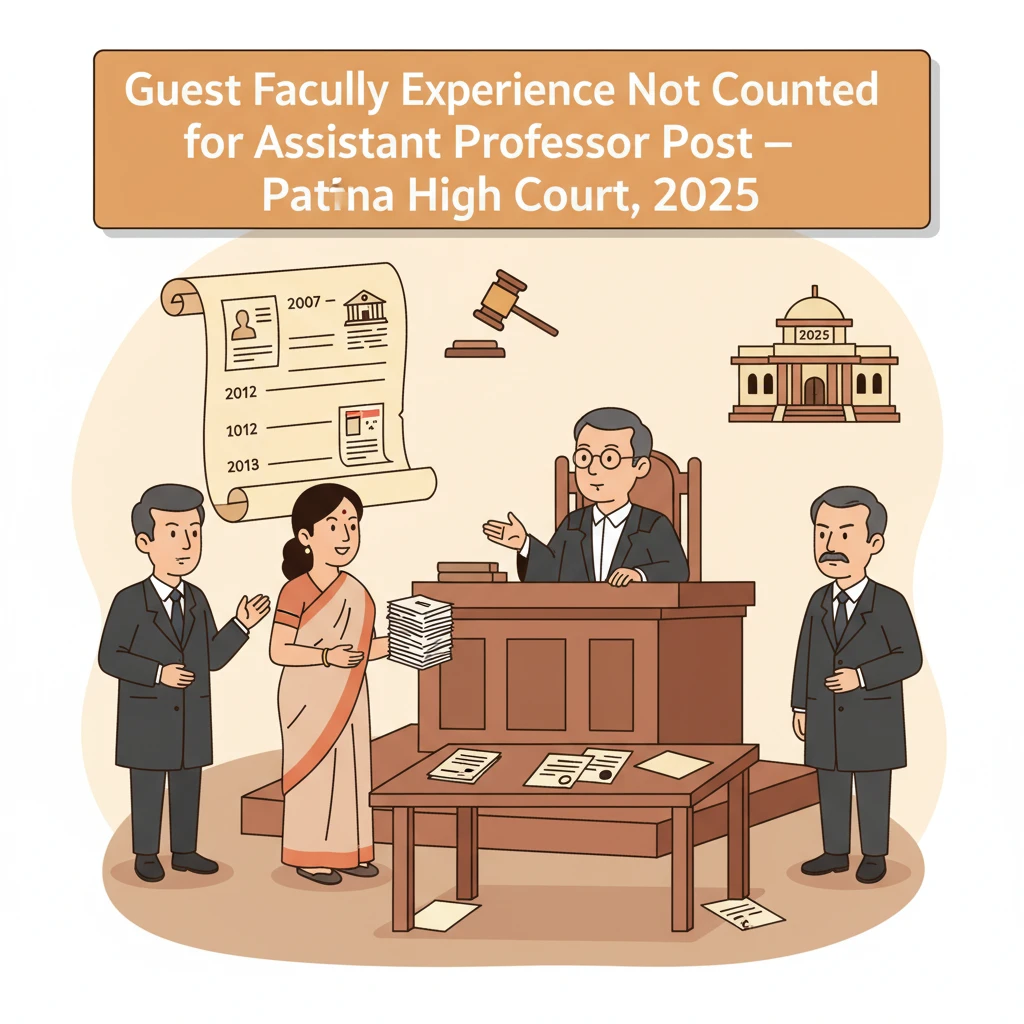
Case Background
The case arose from recruitment to the post of Assistant Professor (Management) in L.N. Mishra Institute of Economic Development and Social Change, Patna (the Institute). The Bihar State University Service Commission (BSUSC) issued Advertisement No. BSUSC/LNMI-01/2024 inviting applications for Professor/Assistant Professor (Management/Computer).
The petitioner, Dr. Mamta Kumari, had been associated with the Institute for a long period. She was first appointed on 08.02.2008 as a Faculty Member in Marketing Management on a contractual basis, following a 2007 advertisement for Senior Guest Faculty/Guest Faculty. The appointment was initially for six months but could be extended in special circumstances.
Her services were extended from time to time. Office Order No. 1031/10 dated 09.10.2010 extended her appointment until regular appointment of faculty members and also increased her remuneration. On 01.09.2011, the Institute issued a new advertisement for contractual appointments. The petitioner applied and was called for interview.
However, before the result of that selection process was declared, the Institute terminated the services of the petitioner and five other adjunct faculty members by Memo No. 540/12 dated 03.10.2012.
The petitioner challenged her termination by filing C.W.J.C. No. 2872 of 2013 before the Patna High Court. She later withdrew that case and filed a more comprehensive writ petition, C.W.J.C. No. 23378 of 2018. A Bench of the High Court noticed that the petitioner had been allowed to continue as an Adjunct Faculty Member. The Court disposed of that writ with an observation that she should not be replaced by any other ad-hoc engagement unless there was a plausible reason to do so.
While she continued to discharge duties at the Institute, BSUSC published the 2024 advertisement for regular faculty recruitment. The petitioner, claiming eligibility, applied for the post of Assistant Professor (Management).
Under clause 3(C)(iii) of the advertisement, candidates with at least five years’ teaching experience after obtaining a Master’s degree, on regular or contractual basis as Assistant Professor, were to receive preference. Additional benefit was promised to candidates already working as Assistant Professor on contract basis in the Institute, as per AICTE Regulation 2019, Rules 7.4 and 7.5.
The petitioner sought a work experience certificate from the Director of the Institute, as it was a mandatory document for the recruitment process. She participated in the interview, but when the merit list dated 14.05.2025 was published, her name did not appear.
Through an application under the Right to Information Act, she came to know that she had been held ineligible on the ground that she did not possess the requisite experience under clause 3(C)(iii). This led to the present writ petition, C.W.J.C. No. 14317 of 2025.
What the Court Examined and Decided
The petitioner asked the Patna High Court to quash the merit list dated 14.05.2025 for Assistant Professor (Management) under Notification No. BSUSC/LNMI-01/2024. She also sought a direction that she be treated as an “incumbent faculty member” and given the benefit of AICTE Rules 7.4 and 7.5 and clause 5.2(B)(iii) of the advertisement, which granted up to 25 marks (5 marks per year) for contractual Assistant Professors with satisfactory service.
Her senior counsel submitted that she had put in about 16 years of teaching service with a good attendance record. It was argued that, as an Adjunct/contractual faculty member, she was entitled to experience marks under clause 5.2(B)(iii). If those marks were properly added, her total score would have exceeded the cut-off.
Counsel stressed that the advertisement itself promised the benefit of AICTE Rules 7.4 and 7.5 to candidates working as Assistant Professor on contract basis in the Institute. It was argued that denying her the benefit, despite her long and continuous service, was arbitrary, discriminatory and violative of Articles 14 and 16 of the Constitution of India, and also malafide.
Reference was made to the petitioner’s appointment letter and to the earlier High Court order in C.W.J.C. No. 23378 of 2018, to say that the Institute had acknowledged her as an Adjunct Faculty Member on contractual basis. Therefore, she should be treated as a contractual Assistant Professor and her experience should be counted at least for five years for preference marks.
The petitioner also faced the stand of the respondents that she had only worked as Guest Faculty and therefore was not entitled to experience weightage. Her counsel countered that even guest teachers and contract teachers perform similar duties of teaching students, and relying on earlier decisions, stated that denial of marks for such experience violated Article 14 of the Constitution.
A certificate issued by the Registrar of the Institute dated 28.12.2024 was placed on record through a supplementary affidavit. It recorded that she had been engaged as Guest Faculty on a per-class basis from 2012 to 2024.
To support these arguments, the petitioner relied on three decisions: the Supreme Court decision in Asim Kumar Bose v. Union of India & Ors., AIR 1989 SC 509, and two Patna High Court decisions, Krishna Mohan Singh & Ors. v. State of Bihar & Ors., 2022 (3) PLJR 87, and Sandeep Kumar Jha & Ors. v. State of Bihar & Ors., 2024 (3) PLJR 5.
On behalf of BSUSC, it was submitted that 24 posts of Assistant Professor (Management) had been advertised and 79 candidates appeared in the interview. After the full process, a select list by category was prepared and sent for appointments.
The Commission pointed out that the petitioner enclosed two experience certificates. The first showed she worked as Guest Faculty from 01.11.2006 to 07.02.2008 (1 year 3 months 7 days) in the Department of Advertisement, Sales Promotion and Sales Management. This did not satisfy clause 3(C)(iii) of the advertisement.
The second certificate showed that she worked as Assistant Professor (Management) as Guest Faculty and Adjunct Faculty from 08.02.2008 to 10.11.2012 (4 years 9 months 2 days). This was less than five years and still did not meet clause 3(C)(iii), which demanded minimum five years teaching experience after Master’s degree as Assistant Professor. Moreover, the Institute’s own certificate described her as Guest Faculty. Therefore, according to BSUSC, she did not meet the minimum conditions for experience and was correctly held ineligible.
Counsel for the Institute emphasised that Advertisement No. 1/2024 was framed in line with AICTE Regulations, 2019. Clause 2.25 of the 2019 Regulations, which deals with counting past service for direct recruitment, states clearly that previous appointment can be counted only if it was not as Guest Faculty for any duration and if several other conditions are fulfilled, including appointment on recommendation of a duly constituted selection committee and drawing at least the salary of a regular Assistant Professor.
Since the petitioner had been working as Guest Faculty, the Institute argued that an experience certificate for counting past service could not be issued under Regulation 2019. It was also pointed out that a similar demand by other Guest Faculty members of the Institute in C.W.J.C. No. 19391 of 2024 had been rejected by the High Court, which held that no weightage was to be given to Guest Faculty.
The counsel for AICTE supported the arguments of BSUSC and the Institute.
Justice Harish Kumar examined the relevant provisions in detail. First, the Court reproduced clause 3(C)(iii) of the advertisement, which required a minimum of five years teaching experience after the Master’s degree as Assistant Professor on regular or contractual basis, and gave the benefit of AICTE Regulation 2019, Rules 7.4 and 7.5 to candidates working as Assistant Professor on contract basis in the Institute.
The Court also took note of the Institute’s governing framework: the Lalit Narayan Mishra Institute of Economic Development and Social Change Institute Rules, 2017, framed under the Bihar Private Educational Institution (Taking Over) Act, 1987 and later amended in 2024. Rule 10(1) mandated that teaching posts must follow AICTE/UGC standards as directed by the State Government.
The key provision was Regulation 2.25(f) of the AICTE Regulations, 2019. It provides that previous appointment would not be counted for direct recruitment if it was as Guest Faculty for any duration. It allows counting of ad-hoc or temporary service of more than one year only if several strict conditions are met together, including:
- service of more than one year;
- appointment on recommendation of a duly constituted selection committee;
- selection to a permanent post in continuation of that ad-hoc or temporary service;
- drawing gross emoluments not less than the initial pay of a regular Assistant Professor/Associate Professor/Professor; and
- clear negotiated terms mentioning nature and period of experience.
The Court held that all these conditions must be read together. If they are not satisfied, past ad-hoc or temporary service cannot be counted. Guest Faculty service is expressly excluded.
The Court further noted that clauses 7.4 and 7.5 of AICTE Regulations, 2019, relied upon by the petitioner, deal with nomenclature of degree and incumbent faculty members with previous qualifications, and do not materially affect the present issue of counting guest faculty experience as past service for direct recruitment.
Turning to the precedents cited by the petitioner, the Court carefully distinguished each one. In Asim Kumar Bose, the Supreme Court was concerned with whether teaching experience as a Specialist in a teaching hospital with an ex officio designation could count as experience for Assistant Professor. There, the recruitment rules did not exclude such experience or require that it be gained only on regular appointment. That was found to be different from the present case where AICTE Regulation 2019 clearly excludes guest faculty experience.
In Krishna Mohan Singh, the dispute related to a later clarification about which authority could issue valid teaching experience certificates. The Court there accepted the clarification and did not rule on any right of Guest Faculty to have their experience counted. In fact, the discussion about Guest Faculty related to a draft UGC Regulation, 2018 that had not yet come into force, and the Court declined to grant relief on that basis.
In Sandeep Kumar Jha, the controversy concerned preference marks for teaching experience in school teacher recruitment under a Bihar Public Service Commission advertisement. The Court there observed that award of such “grace marks” was a policy matter; it did not order benefit for guest teachers but merely directed the State to take a policy decision regarding them in future, noting that guest and contract teachers perform similar duties.
Against this background, the Patna High Court returned to the petitioner’s own appointment. It found that the 2007 advertisement invited applications for Senior Guest Faculty/Guest Faculty. Although her appointment letter did not use the words “Guest Faculty” and spoke of contractual appointment, and later the term “Adjunct Faculty Member” was used, her engagement clearly flowed from the 2007 Guest Faculty advertisement.
Therefore, the Court held that she could not be treated as an Adjunct Faculty Member in the sense of a contractual Assistant Professor for counting past service. In the Court’s view, she never worked as a contractual employee on temporary or ad-hoc basis in a manner that satisfied AICTE Regulation 2.25(f).
The Court added that even if it accepted the argument that she served on an ad-hoc or temporary contractual basis for more than a year, she still did not meet the strict conditions under the proviso to Regulation 2.25(f). Hence, her past service could not be counted for direct recruitment. The earlier decisions relied upon by her did not help because they did not deal with the binding text of AICTE Regulation 2019, which clearly excludes guest faculty.
On this reasoning, the Court held that the decision of BSUSC and the Institute not to give her experience marks was correct. Consequently, the merit list dated 14.05.2025 could not be termed illegal or arbitrary.
Finding no merit in the writ petition, the Court dismissed it, leaving the selection process and the merit list undisturbed.
Why This Judgment Matters
This judgment is important for teachers working as Guest Faculty or Adjunct Faculty in Bihar and elsewhere. It shows that, where AICTE Regulations 2019 apply, guest faculty experience will not be counted as past service for regular recruitment to posts like Assistant Professor unless the regulations are amended.
For institutions like L.N. Mishra Institute and recruitment bodies like BSUSC, the decision confirms that they must strictly follow AICTE norms. They cannot extend experience benefits to categories of teachers whom the regulations expressly exclude.
For contract and guest teachers, the case highlights the need to clearly understand the terms of engagement. Even long years of service as Guest Faculty, without the status and pay of a regular or properly appointed contractual Assistant Professor, may not translate into experience weightage when regular posts are filled.
The judgment also clarifies that earlier case law cannot override clear regulatory provisions. Where a regulation like AICTE Regulation 2.25(f) explicitly rules out counting guest faculty experience, courts are likely to follow that text instead of more general equality arguments.
Legal Issues and Answers
-
Issue: Whether the petitioner’s long service as Guest/Adjunct Faculty at the Institute could be treated as qualifying teaching experience for preference marks and benefit under AICTE Regulations 2019 and the 2024 BSUSC advertisement.
Answer: No. The Court held that AICTE Regulation 2.25(f) expressly excludes guest faculty experience from being counted as past service for direct recruitment and the petitioner did not satisfy the strict conditions for counting ad-hoc or temporary service. -
Issue: Whether the merit list dated 14.05.2025 for Assistant Professor (Management) was illegal for not granting experience weightage to the petitioner.
Answer: No. Since the petitioner did not meet the prescribed experience conditions, the Commission rightly treated her as ineligible; the merit list was upheld and the writ petition dismissed.
Cases Cited by the Court
- Asim Kumar Bose v. Union of India & Ors., AIR 1989 SC 509 – distinguished; concerned counting teaching experience of a Specialist in a teaching hospital, where rules did not exclude such experience.
- Krishna Mohan Singh & Ors. v. State of Bihar & Ors., 2022 (3) PLJR 87 – distinguished; related to clarification on who could issue valid experience certificates and did not grant special benefit for guest faculty.
- Sandeep Kumar Jha & Ors. v. State of Bihar & Ors., 2024 (3) PLJR 5 – distinguished; dealt with school teacher recruitment and preference marks, and recognised that policy decisions on grace marks lie with the State.
- C.W.J.C. No. 19391 of 2024 (Patna High Court) – referred; in that case, the Court held that no weightage was to be given to Guest Faculty at the same Institute under AICTE Regulation 2019.
Case Details
Case Number: Civil Writ Jurisdiction Case No. 14317 of 2025
Case Title: Dr. Mamta Kumari v. Bihar State University Service Commission & Ors.
Court: High Court of Judicature at Patna
Coram: Hon’ble Mr. Justice Harish Kumar
Date of Judgment: 11-11-2025
Citation: 2026(1) PLJR 01
Advocates:
- For the petitioner: Ms. Nivedita Nirvikar, Senior Advocate; Mr. Arya Achint, Advocate; Mr. Amar Shakti, Advocate
- For BSUSC: Mr. Pawan Kumar, Advocate
- For L.N. Mishra Institute: Mr. Vipin Kumar, Advocate
- For AICTE: Mrs. Archana, Advocate
Nature of the Case: Writ petition under Article 226 of the Constitution challenging a recruitment merit list and seeking experience weightage for Assistant Professor (Management) post.
Link to Full Judgment: Patna High Court Judgment in CWJC No. 14317 of 2025
If you found this explanation helpful and wish to stay informed about
how legal developments may affect your rights in Bihar,
you may consider following Samvida Law Associates for more updates.







