
Case Background
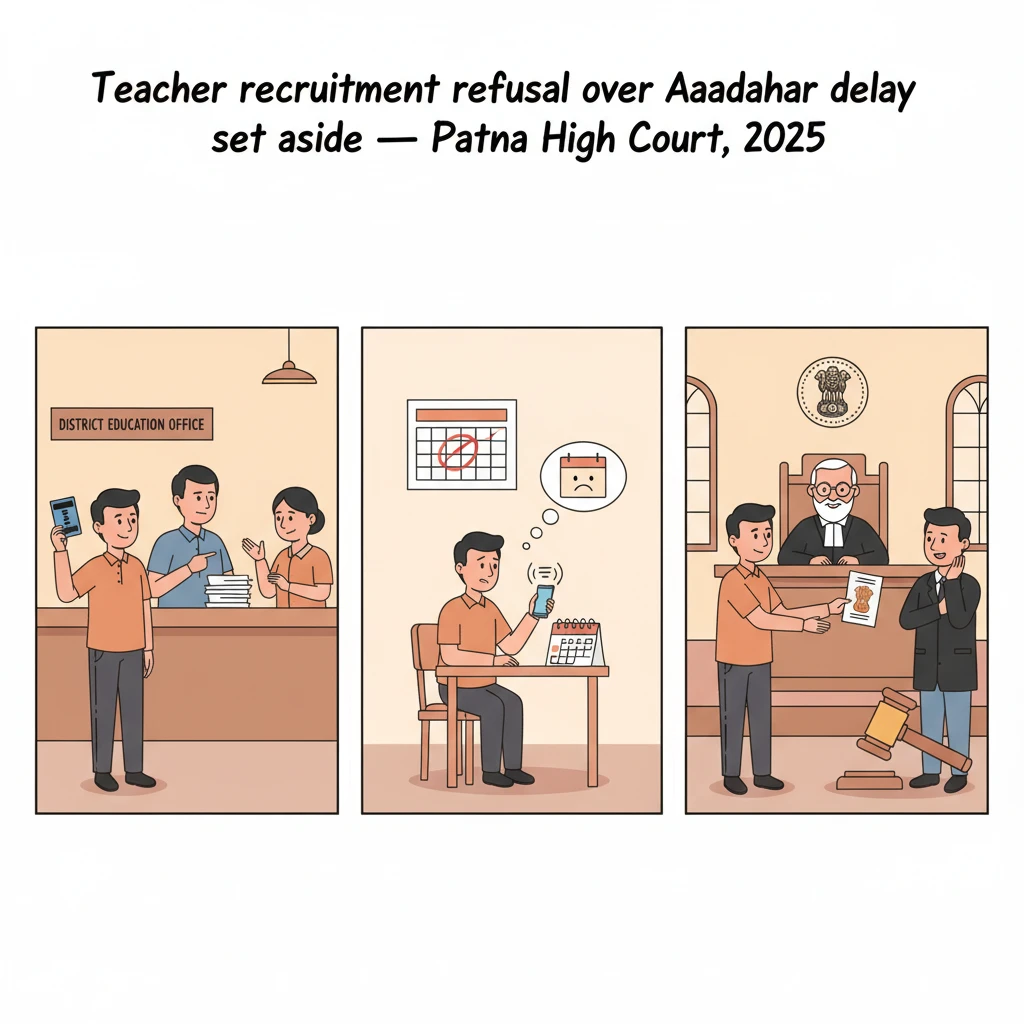
The petitioner is an aspirant for the post of Senior Secondary School Teacher in the subject of Music under the Teacher Recruitment Examination-2 (TRE-2) conducted by the Bihar Public Service Commission (BPSC).
He holds a B.A. (Prabhakar) in Vocal Music from Prayag Sangit Samiti, Allahabad and a postgraduate degree in Vocal Music from Pracheen Kala Kendra, Chandigarh.
On 04.11.2023, BPSC issued Advertisement No. 27 of 2023 for TRE-2, inviting applications for various teaching posts in government schools of Bihar. In Music, 582 posts of Senior Secondary Teachers were advertised, including 71 posts reserved for Backward Class category.
The petitioner, being qualified, applied for the post. Since he did not yet have an Aadhaar card, he mentioned his PAN card number in the identity document column and paid the additional biometric fee of Rs. 200/- as required for such candidates.
The Senior Secondary examination was held on 15.12.2023. The petitioner appeared after undergoing biometric verification and secured 83 marks. In the merit list, his name appeared at serial no. 303 under the unreserved category. On 25.12.2023, BPSC notified district allotments and he was allotted Madhubani district.
Counselling and document verification in Madhubani district began on 25.12.2023 and was to continue till all candidates were covered. The petitioner’s counselling date was 28.12.2023.
Before the advertisement was published, the petitioner had already applied on 30.10.2023 to UIDAI for issuance of Aadhaar. The acknowledgment stated that the Aadhaar number would be generated within 90 days. However, the Aadhaar was actually issued much later, on 03.05.2024.
On 28.12.2023, the petitioner appeared for counselling with his PAN card, but the authorities refused to verify his documents solely because he did not have an Aadhaar card. He again approached them on 01.01.2024 and 08.01.2024 but was repeatedly denied participation in document verification for the same reason.
He submitted representations, including to the District Education Officer, Madhubani, but there was no relief. Counselling continued in the district up to 31.03.2024. By that time, he still had not received his Aadhaar card and was never allowed to participate in counselling.
Disheartened, he filed this writ petition under Article 226 of the Constitution seeking a direction to conduct his counselling and document verification for appointment as Senior Secondary Music Teacher.
What the Court Examined and Decided
The Patna High Court first identified the core dispute: whether the petitioner could be refused counselling and document verification only because he did not possess an Aadhaar card on the counselling dates, even though he had otherwise qualified in the examination and complied with the advertisement.
The petitioner’s counsel emphasized that Aadhaar was not a mandatory eligibility condition in the advertisement. Clause 10, Note (1) of Advertisement No. 27 of 2023 stated that if a candidate did not provide Aadhaar number while filling the online form, they had to pay an extra Rs. 200/- as biometric fee. It further stated that at the time of verification, it was “expected” that the candidate would provide Aadhaar number and the mobile number linked with it. It also warned that if any difficulty arose in receiving OTP on the mobile during document verification, the candidate’s eligibility might be affected.
The argument was that the language of the clause showed Aadhaar was desirable for smooth biometric verification, not an absolute mandatory requirement whose absence would automatically cancel candidature. In line with this, the advertisement itself had created an alternative mechanism by permitting use of another ID and charging an extra Rs. 200/-.
The petitioner had, in fact, used this alternative. He filled in his PAN card details and paid Rs. 200/-. He then appeared in the examination, underwent biometric verification, and faced no objection to his identity or eligibility at that stage. He then cleared the exam and got a district allotment.
His counsel further pointed out that the petitioner had applied for Aadhaar on 30.10.2023, before the 04.11.2023 advertisement, and that UIDAI’s acknowledgment promised generation of Aadhaar number within 90 days. Yet, UIDAI issued his Aadhaar only on 03.05.2024, well after the last counselling date. Thus, the delay was entirely beyond the petitioner’s control. For this, he should not be made to suffer, especially when he was otherwise meritorious.
To support the plea that a candidate cannot be punished for procedural lapses not attributable to them, the petitioner relied on three Supreme Court decisions: Narender Singh v. State of Haryana, (2022) 3 SCC 286; Civil Appeal No. 9040 of 2022 (Kumari Laxmi Saroj & Ors. v. State of U.P. & Ors.); and SLP (Civil) No. 27139 of 2024 (Shreya Kumari Tirkey v. State of Jharkhand & Ors.).
The State, on the other hand, argued that counselling and document verification ran from 25.12.2023 until all candidates were covered. The petitioner participated but did not have an Aadhaar card, so biometric verification could not be done. He was given opportunities but never produced Aadhaar before the last counselling date. The State stressed that Aadhaar details were needed to conduct biometric verification properly and that the recruitment process for TRE-2 had since been completed, with TRE-3 also over. Therefore, no relief should be granted at this late stage.
BPSC’s counsel pointed out that its role was limited to conducting examination, declaring results and allotting districts. There was no allegation of irregularity against BPSC itself.
The Court then examined the law on adherence to recruitment instructions. It acknowledged that courts, in writ jurisdiction, cannot generally alter or relax conditions in an advertisement, relying on State of T.N. v. G. Hemalathaa, (2020) 19 SCC 430. However, it stressed that the present case turned on how Clause 10, Note (1) should be understood and whether the petitioner could be faulted for something beyond his control.
Looking closely at Clause 10, Note (1), the Court held that giving Aadhaar number was not mandatory. Candidates without Aadhaar could instead pay Rs. 200/- for biometric verification using another identity document. The clause merely “expected” candidates to provide Aadhaar and linked mobile number for convenience in verification and warned that problems with OTP might affect eligibility. This, the Court noted, was about smooth functioning, not a hard condition of eligibility.
On facts, the Court found that the petitioner had:
- Applied for Aadhaar before the advertisement was issued.
- Relied on UIDAI’s assurance of a 90-day generation period, which should have ended around 30.01.2024.
- Mentioned his PAN as ID and paid Rs. 200/- biometric fee, as the advertisement allowed.
- Appeared in the exam, cleared biometric verification, scored 83 marks and secured a high merit position (serial no. 303 in unreserved category).
- Been allotted a district and timely reported for counselling but was turned away solely for lack of Aadhaar.
The Court concluded that the petitioner was not at fault. He had done everything required and had even tried to secure Aadhaar in advance. The delay in Aadhaar generation was attributable to the issuing authority, not to him.
The Court then examined the Supreme Court precedents relied upon by the petitioner. In Narender Singh, the candidate was denied appointment because he could not produce a No Objection Certificate (NOC) in time, though the delay was due to his employer. The Supreme Court held that a candidate cannot be punished for no fault of his and directed his appointment as he was more meritorious than the last selected candidate.
Similarly, in Kumari Laxmi Saroj & Ors., candidates for Health Worker posts could not produce registration from the Uttar Pradesh Nurses and Midwife Council despite having applied in time. The Supreme Court held that, since the delay was not their fault, they should not suffer, and it applied Narender Singh.
In Shreya Kumari Tirkey, a successful candidate in the Jharkhand Combined Civil Services Examination missed her scheduled medical examination due to confusion about dates. The Supreme Court observed that medical examination tests physical fitness, not merit, and that procedural hurdles should not be used to deny opportunities to meritorious candidates, particularly those from marginalized communities.
Relying on these judgments, the Patna High Court held that recruitment processes must aim to select meritorious candidates while giving equal opportunity, in line with Articles 14 and 16 of the Constitution. Purely procedural lapses or administrative delays that are not the candidate’s fault should not defeat a meritorious claim.
The Court also recorded that the petitioner belongs to the Backward Class category, had secured 83 marks, cleared the unreserved cut-off for Music and stood at serial no. 303 in the unreserved list. He had applied for Aadhaar in time but did not receive it within the promised period. Therefore, he could not be made to suffer for no fault.
Balancing these considerations, the Court allowed the writ petition. It directed the Director, Secondary Education (respondent no. 2) and the District Education Officer, Madhubani (respondent no. 4) to complete the petitioner’s document verification within eight weeks from receipt or production of the judgment and then to freshly allot him a school against any vacant post of Senior Secondary Music Teacher.
If the post had already been sent for fresh recruitment or included in a subsequent advertisement, his appointment would still be made against the existing vacant post. For seniority and other service benefits, he would be treated at par with the last candidate appointed as Senior Secondary Music Teacher under the unreserved category, except that he would not receive monetary benefits for the earlier period.
Why This Judgment Matters
This decision is important for candidates in Bihar and elsewhere who face rejection due to procedural or technical issues beyond their control, especially in large-scale recruitments like TRE.
The Patna High Court has clearly held that where an advertisement itself creates an alternative to Aadhaar-based verification and does not make Aadhaar mandatory, authorities cannot insist on Aadhaar at counselling and deny participation to otherwise eligible and meritorious candidates.
The judgment reinforces that recruitment agencies and district authorities must read instructions fairly and give real effect to alternative procedures that have been provided to avoid hardship.
It also brings the law in Bihar in line with recent Supreme Court rulings that candidates should not lose job opportunities because of delays by other authorities, such as UIDAI or councils issuing registrations or NOCs.
For teacher aspirants and other job-seekers, the message is that if you have complied with the advertisement, applied in time for necessary documents, and the delay is not your fault, courts can step in to protect your right to fair consideration.
Legal Issues and Answers
- Issue: Can an otherwise qualified candidate in TRE-2 be denied counselling and appointment solely for not producing an Aadhaar card when the advertisement only “expects” Aadhaar and provides an alternative biometric process?
Answer: No. The Court held that Aadhaar was not a mandatory condition, an alternative mechanism existed, and the petitioner could not be penalised for delay in Aadhaar issuance beyond his control. His counselling and appointment must proceed. - Issue: Should courts interfere in recruitment processes where denial of appointment arises from procedural lapses not attributable to the candidate?
Answer: Yes, where the candidate has complied with the advertisement, is more meritorious than others, and the defect stems from actions or delays of other authorities, courts can grant relief, following Supreme Court precedents such as Narender Singh and Kumari Laxmi Saroj.
Cases Cited by the Court
- State of T.N. v. G. Hemalathaa, (2020) 19 SCC 430
- Narender Singh v. State of Haryana and Ors., (2022) 3 SCC 286
- Civil Appeal No. 9040 of 2022, Kumari Laxmi Saroj & Ors. v. State of U.P. & Ors.
- SLP (Civil) No. 27139 of 2024, Shreya Kumari Tirkey v. State of Jharkhand & Ors.
- Union of India v. Mahendra Singh, 2022 SCC OnLine SC 909
- Cherukuri Mani v. Chief Secretary, Government of Andhra Pradesh (referred in Mahendra Singh)
Case Details
Case Number: Civil Writ Jurisdiction Case No. 16208 of 2024
Case Title: Deo Narayan Yadav v. The State of Bihar & Ors.
Court: High Court of Judicature at Patna
Coram: Hon’ble Mr. Justice Harish Kumar
Date of Judgment: 25-11-2025
Citation: 2026 (1) PLJR 60
Advocates:
- For the petitioner: Mr. Shashank Chandra, Advocate
- For the State respondents: Mr. Standing Counsel (4); Mr. AC to SC-4
- For BPSC: Mr. Sanjay Pandey, Advocate; Mr. Nishant Kumar Jha, Advocate
Nature of the Case: Writ petition under Article 226 of the Constitution challenging denial of counselling/document verification and seeking direction for appointment as Senior Secondary Music Teacher under TRE-2.
Link to Judgment: Click here to read the full judgment of the Patna High Court
If you found this explanation helpful and wish to stay informed about
how legal developments may affect your rights in Bihar,
you may consider following Samvida Law Associates for more updates.







