
Case Background
The petitioners in this case are a mother and her son. The mother is the widow of a deceased employee of the Department of Posts, and the son is the dependent for whom a job was sought.
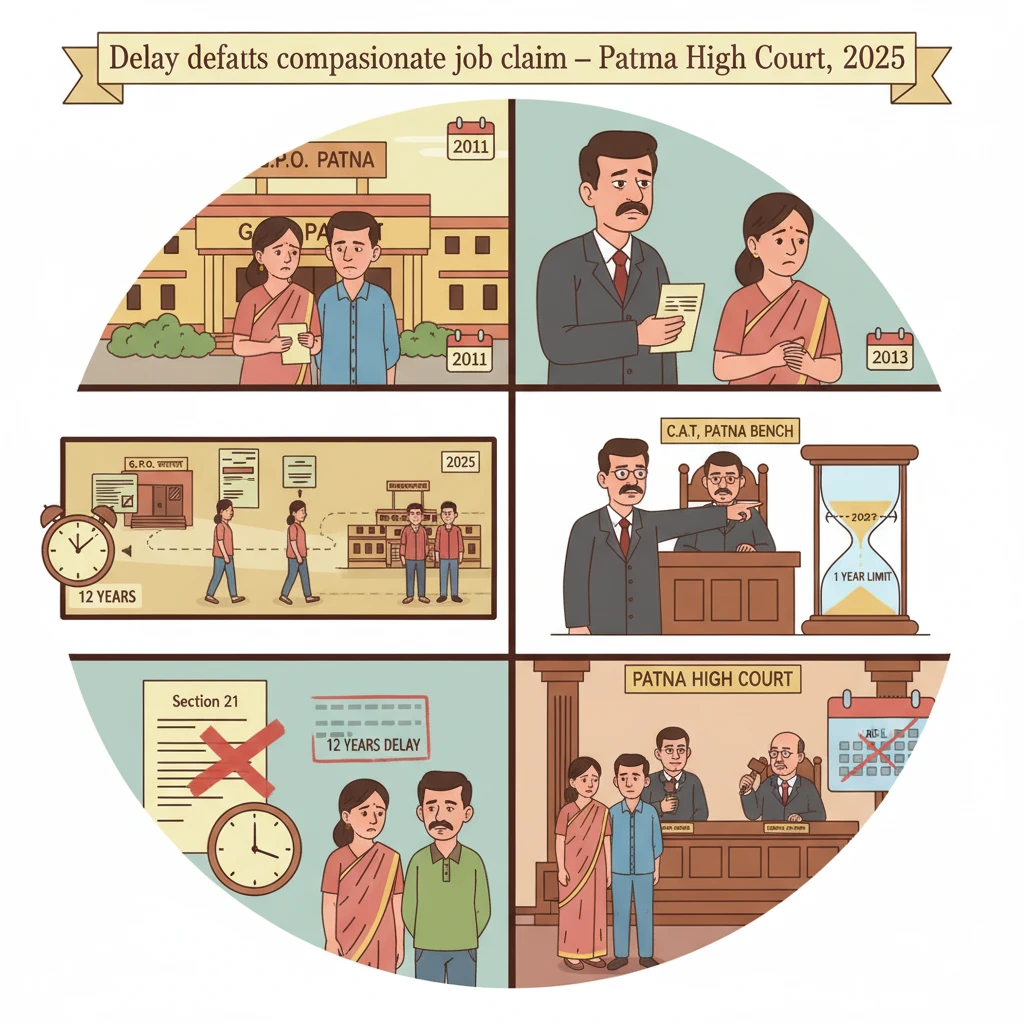
The deceased employee, late Kameshwar Prasad, was working as a Grade-IV employee in the Department of Posts. He was deputed at the General Post Office (G.P.O.), Patna. He died in harness on 22.04.2011, meaning he passed away while still in service.
After his death, the widow (petitioner no. 1) submitted an application on 27.10.2011 to the Chief Post Master General, G.P.O., Patna. In that application, she requested a compassionate appointment for her son (petitioner no. 2) in the Postal Department.
The Department considered the request and, by letter dated 27.04.2013, rejected the case of petitioner no. 2 for compassionate appointment. The petitioners say that this rejection letter did not give any reasons. They claim they kept trying to get relief from the authorities “from pillar to post” after 27.04.2013, but did not get any favourable response.
Finally, in 2025, around 12 years after the rejection order and 14 years after the employee’s death, they approached the Central Administrative Tribunal, Patna Bench, by filing Original Application No. 050/00511/2025. On 21.07.2025, the Tribunal (referred to as the Ld. C.A.T. in the judgment) dismissed their original application.
Unhappy with the Tribunal’s decision, the petitioners filed the present Civil Writ Jurisdiction Case No. 15391 of 2025 before the Patna High Court. They challenged the Tribunal’s order dated 21.07.2025.
What the Court Examined and Decided
The Division Bench of the Patna High Court, comprising Hon’ble Mr. Justice Mohit Kumar Shah and Hon’ble Justice Smt. Soni Shrivastava, heard the matter. The oral judgment was delivered by Hon’ble Mr. Justice Mohit Kumar Shah on 25.11.2025.
The main attack by the petitioners was on the Department’s rejection letter dated 27.04.2013 and, indirectly, on the Tribunal’s order upholding it. The petitioners’ side was led by learned counsel who argued that the rejection of the son’s claim for compassionate appointment was illegal.
According to the petitioners, the rejection letter dated 27.04.2013 did not mention any reasons at all for turning down the request for compassionate employment. Their argument was simple: if no reason is stated, the rejection is arbitrary and unlawful, and therefore petitioner no. 2 should be granted a compassionate appointment.
On the other hand, learned counsel for the Union of India and the Postal authorities raised a preliminary objection. He pointed out that the original application before the Tribunal itself was time-barred under Section 21 of the Administrative Tribunals Act, 1985.
Section 21 of the Administrative Tribunals Act, 1985 clearly provides that a Tribunal cannot admit an application which is not filed within one year from the date when the final order has been passed by the authority. Here, the final order (rejection of compassionate appointment) was passed on 27.04.2013. Yet the original application was filed only in 2025. The respondents highlighted that this meant a delay of about 12 years.
The Patna High Court carefully considered the rival submissions and examined the Tribunal’s order. The Court noted the key dates: the employee’s death on 22.04.2011, the application for compassionate appointment on 27.10.2011, the rejection of the claim on 27.04.2013, and the filing of the original application before the Tribunal only in 2025.
The Bench emphasized that the law on delay and laches is well settled. When a person whose rights are allegedly violated approaches a Constitutional Court under writ jurisdiction after a long, unexplained delay, without adequate reasons, such a person cannot expect indulgence from the Court.
The Court mentioned that writ jurisdiction is extraordinary and equitable. While it is meant to protect citizens’ rights, the Court must also be alive to the principle that indolent or negligent litigants who wake up after many years should not be rewarded. On the sole ground of delay and laches, a writ petition can be thrown out at the very threshold.
In support of this principle, the Patna High Court referred to several judgments of the Hon’ble Supreme Court:
- Chennai Metropolitan Water Supply & Sewerage Board & Others vs. T.T. Murali Babu, (2014) 4 SCC 108.
- State of Uttaranchal & Anr. vs. Shiv Charan Singh Bhandari & Ors., 2013 AIR SCW 6627.
- C. Jacob vs. Director of Geology & Mining and Anr., AIR 2009 SC 264.
- State of Jammu & Kashmir vs. R.K. Zalpuri & Others, AIR 2016 SC 3006.
- State of Tamil Nadu vs. Seshachalam, (2007) 10 SCC 137.
By citing these decisions, the Court reinforced that high delay, without proper explanation, is enough reason to dismiss a case, even without going into the full merits.
After dealing with the issue of delay, the Court also considered the case on merits, especially because it related to compassionate appointment. The Bench observed another well-settled principle: a claim for compassionate employment must be considered only to help a family in immediate financial distress following the death of the breadwinner.
The Court explained that if compassionate appointments are entertained after a long lapse of time, many similar cases would arise where old claims come up, even though the immediate crisis has long passed. The key is the time when the relief is needed to rescue a family in distress, not the idea of holding a job in reserve forever for a dependent.
For this proposition, the Court referred to the landmark Supreme Court judgment in Umesh Kumar Nagpal vs. The State of Haryana and others, (1994) 4 SCC 138. The Patna High Court specifically quoted paragraph 6 of that judgment.
In that paragraph, the Supreme Court held that compassionate employment cannot be granted after the lapse of a reasonable period, and such period should be specified in the rules. Compassionate appointment is not a vested right that can be exercised at any time. Its sole object is to enable the family to get over the financial crisis at the time of the death of the sole breadwinner. Therefore, a claim cannot be made and granted after the crisis is over and after a long gap.
Applying this principle, the Patna High Court concluded that even on merits, the petitioners were not entitled to relief. In this case, about 14 years had passed from the date of death of the employee (22.04.2011) to the date of the High Court’s decision. The Court held that compassionate appointment cannot be granted after such a long lapse of time.
The Court further added that compassionate employment cannot be claimed as a matter of right after many years. The very purpose of this scheme is immediate relief. Once that immediate phase is over, the legal foundation for compassionate appointment disappears.
In addition to this, the Court reiterated that the original application before the Tribunal was itself barred by limitation as per Section 21 of the Administrative Tribunals Act, 1985. The delay of about 12 years from the final order to approaching the Tribunal was fatal to the petitioners’ case.
Considering both these aspects—delay and laches, and the nature and purpose of compassionate appointment—the Bench held that there was no illegality in the Tribunal’s order dated 21.07.2025.
Ultimately, the Patna High Court dismissed the writ petition as being without merit. The petitioners were denied any relief, and the Tribunal’s rejection of their claim stood confirmed.
Why This Judgment Matters
This judgment is important for families of deceased government employees, especially those in Bihar dealing with the Department of Posts and other government departments.
First, it makes clear that waiting too long to challenge a rejection of compassionate appointment can completely close the doors to relief. Courts will not come to the aid of those who remain silent for years and then suddenly file cases.
Second, it reinforces that compassionate appointment is meant for immediate financial crisis after the death of a breadwinner. It is not a long-term guarantee that one post will be kept reserved for a dependent, to be claimed at any time in future.
Third, for persons thinking of approaching the Central Administrative Tribunal, it underlines the strict one-year limitation under Section 21 of the Administrative Tribunals Act, 1985. Delayed applications can be rejected without examining the full merits.
In simple terms, the judgment tells affected families: if you wish to challenge a decision about compassionate appointment, you must act quickly, within the legal time limits, and not wait for many years.
Legal Issues and Answers
- Issue: Whether a claim for compassionate appointment and the challenge to its rejection can be entertained after about 12 years, when the original application before the Central Administrative Tribunal was filed far beyond the limitation period in Section 21 of the Administrative Tribunals Act, 1985.
Answer: No. The Patna High Court held that the original application was clearly barred by limitation, and delay and laches alone were sufficient grounds to reject the claim. - Issue: Whether the petitioners were entitled to compassionate appointment on merits, nearly 14 years after the death of the employee.
Answer: No. The Court held that compassionate employment cannot be granted after such a long lapse of time, as it is only meant to meet the immediate financial crisis at the time of death, relying on the Supreme Court’s decision in Umesh Kumar Nagpal.
Cases Cited by the Court
- Chennai Metropolitan Water Supply & Sewerage Board & Others vs. T.T. Murali Babu, (2014) 4 SCC 108.
- State of Uttaranchal & Anr. vs. Shiv Charan Singh Bhandari & Ors., 2013 AIR SCW 6627.
- C. Jacob vs. Director of Geology & Mining and Anr., AIR 2009 SC 264.
- State of Jammu & Kashmir vs. R.K. Zalpuri & Others, AIR 2016 SC 3006.
- State of Tamil Nadu vs. Seshachalam, (2007) 10 SCC 137.
- Umesh Kumar Nagpal vs. The State of Haryana and others, (1994) 4 SCC 138.
Case Details
Case Number: Civil Writ Jurisdiction Case No. 15391 of 2025
Case Title: Radha Devi & Anr. vs. The Union of India & Ors.
Coram: Hon’ble Mr. Justice Mohit Kumar Shah and Hon’ble Justice Smt. Soni Shrivastava
Date of Judgment: 25.11.2025
Citation: 2026 (1) PLJR 10
Advocates:
- For the Petitioners: Mr. Raghvendra Kumar, Advocate; Mr. Rishabh Mishra, Advocate; Mr. Saurav Kumar, Advocate
- For the Respondents: Mr. Rajen Sahay, SCGS, Advocate
Nature of the Case: Writ petition (challenge to order of Central Administrative Tribunal dismissing original application concerning compassionate appointment)
Link to Judgment: Click here to view the full judgment of the Patna High Court
If you found this explanation helpful and wish to stay informed about
how legal developments may affect your rights in Bihar,
you may consider following Samvida Law Associates for more updates.







