
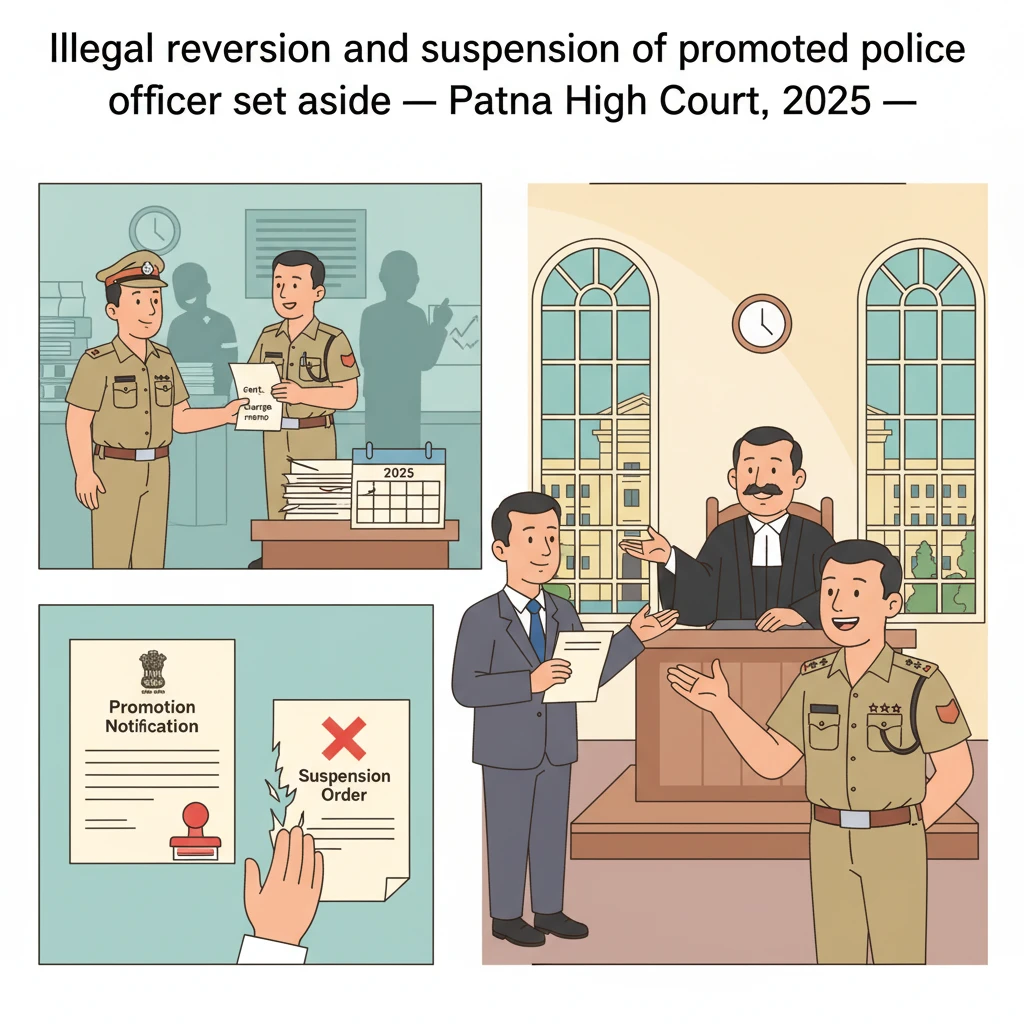
Case Background
The petitioner was serving in the Bihar Police as an Inspector. As per the gradation list of Inspectors, his turn for promotion to the rank of Deputy Superintendent of Police (DSP) had come.
A Zonal Board headed by the Zonal Inspector General of Police, Tirhut Zone, scrutinised the service records of all Inspectors within the zone of consideration, including the petitioner. A meeting of the Director General’s Board (DG Board) was convened on 27.06.2016 to recommend promotions from Inspector to DSP.
The petitioner was found fit for promotion. The Police Headquarters, Bihar, Patna, recommended his promotion to the Home (Police) Department through Letter No. 4841/XP dated 30.06.2016. A Departmental Promotion Committee (DPC) met on 17.11.2016 and decided to promote him.
Acting on this, the Government issued Notification under Memo No. 9399 dated 30.11.2016, promoting the petitioner to DSP. His services as DSP were later confirmed with effect from 30.11.2017.
Shortly after his promotion, on 04.05.2017, the Superintendent of Police concerned communicated and forwarded a charge memo to the Enquiry Officer for conducting a departmental proceeding. The Enquiry Officer served this charge memo on the petitioner on 11.05.2017. This departmental proceeding was numbered as Departmental Proceeding No. 33 of 2016.
The Enquiry Officer completed the enquiry and sent the file to the disciplinary authority on 12.07.2018. Since the petitioner was then serving as DSP, the file was sent to the Home Department. The Home Department sought clarification from the DGP, Bihar, on whether any departmental proceeding was pending at the time of recommendation and promotion.
By Letter No. 8688 dated 04.10.2018, the Joint Secretary, Home Department, noted that despite a pending Departmental Proceeding No. 33 of 2016, the DG Board had recommended and the DPC had decided to promote the petitioner. The DGP was requested to recommend reversion to the earlier post so that the matter could be placed again before the DPC.
The petitioner then submitted a representation to the Principal Secretary, Home Department, on 24.10.2018, but no relief followed. On 13.03.2019, a meeting of the DG Board was held. The Board decided to recall its earlier recommendation and revert the petitioner to Inspector.
Meanwhile, Departmental Proceeding No. 33 of 2016 culminated in his exoneration by order contained in Memo No. 1137 dated 22.05.2020, issued by the Inspector General of Police, Tirhut Range, Muzaffarpur. Relying on this exoneration, the petitioner approached the High Court seeking restoration of his promotion.
Despite his exoneration, the Home Department, through Resolution in Memo No. 7324 dated 21.07.2022, cancelled the petitioner’s promotion. On that basis, Memo No. 626 dated 14.10.2022 was issued by the Police Headquarters under the signature of the Inspector General of Police (Headquarter), placing him under suspension retrospectively with effect from 28.07.2022.
Three writ petitions were thus filed: one for restoration of promotion (CWJC No. 6524 of 2023), one to challenge the DG Board resolution dated 12.03.2019 (CWJC No. 17097 of 2019), and one to challenge the retrospective suspension (CWJC No. 7335 of 2023). All were heard together and disposed of by this common judgment.
What the Court Examined and Decided
The Patna High Court, through Hon’ble Mr. Justice Harish Kumar, closely examined the sequence of events around the petitioner’s promotion, the initiation of departmental proceedings, the later cancellation of promotion, and the suspension order.
On behalf of the petitioner, it was highlighted that the first step towards any departmental proceeding took place on 23.10.2016, when the Superintendent of Police, Vaishali, sent a draft charge memo to the DIG, Muzaffarpur, for approval. The DIG immediately returned it, directing that an explanation be sought before initiating departmental proceedings.
On 14.11.2016, the DIG, Tirhut Division, Muzaffarpur, again wrote to the Superintendent of Police, Vaishali, asking him to obtain an explanation from the petitioner within three days. In compliance, the Superintendent of Police issued Memo No. 10744 dated 16.11.2016 calling for the petitioner’s explanation within 24 hours against the proposed charges.
The petitioner submitted his explanation on 17.11.2016. The Superintendent of Police, Vaishali, then forwarded the explanation and his own recommendation for the minor punishment of “censure” to the DIG via Letter No. 10999 dated 20.11.2016.
The petitioner argued that, despite this clear sequence, the DIG, Muzaffarpur, signed the charge memo on 16.11.2016, before receiving the explanation, and that this was anti-dated. This charge memo, although signed as of 16.11.2016, was only issued to the petitioner via Order dated 18.11.2016.
The petitioner contended that on two crucial dates—27.06.2016 (when DG Board met to consider promotions) and 17.11.2016 (when DPC met and granted promotion)—no valid departmental proceeding was pending because no approved charge memo had been issued. Therefore, later decisions to cancel promotion and revert him were arbitrary and mala fide.
He further pointed out that the Enquiry Officer in Departmental Proceeding No. 33 of 2016 did not find the charges proved and that the disciplinary authority (Inspector General of Police, Tirhut Range, Muzaffarpur) accepted these findings and exonerated him by Memo No. 1137 dated 22.05.2020. Once exonerated, there was no legal basis to cancel his promotion.
Another disputed step was the DGP’s order in Memo No. 112 dated 12.02.2024, passed during the pendency of the writ petitions. By exercising power under Rule 853 A of the Bihar Police Manual, the DGP reviewed the exoneration order in Departmental Proceeding No. 33 of 2016 and directed a fresh departmental proceeding, starting from framing of charge. The petitioner challenged this in an interlocutory application.
The petitioner argued that this suo motu review, done after about four years, acknowledged that the earlier charge memo and proceedings were themselves defective and not in line with the Bihar Government Servants (Classification, Control & Appeal) Rules, 2005. Later, acting on the opinion of the Advocate General and the judgment in Anjan Kumar Singh vs. State of Bihar & Ors., (2001) 3 BLJR 1903, the DGP cancelled Memo No. 112 dated 12.02.2024 by issuing Memo No. 443 dated 24.06.2025.
The State, in defence, submitted that Departmental Proceeding No. 33 of 2016 was pending when the DPC granted the petitioner promotion. As per the Resolution No. 7457 dated 11.09.2002 of the Department of Personnel and Administrative Reforms, no government servant should be promoted if any departmental proceeding is pending, or if any punishment is in force, or if a criminal case is pending. On this basis, the DG Board in its meeting on 12.03.2019 withdrew the recommendation for promotion and the Government cancelled the promotion by order dated 21.07.2022.
The Court then turned to the core question: was there actually a departmental proceeding pending on the relevant promotion dates?
From the record, the Court found that up to 20.11.2016, the charge memo had not been approved by the DIG, Tirhut Division, Muzaffarpur. Yet, the DIG purportedly approved the charge memo with an anti-dated signature of 16.11.2016 and sent it to the Superintendent of Police, Vaishali, through Memo No. 2153 dated 16.11.2016. The Superintendent then issued the charge memo through Vaishali District Order No. 1634/16 dated 18.11.2016.
The Court held that this act of the DIG was an iniquitous move, appeared actuated with malice, and seemed designed to deprive the petitioner of his promotion by putting an anti-dated approval just before the DPC meeting on 17.11.2016.
Relying on the Supreme Court’s decision in Union of India & Ors. vs. K.V. Jankiraman & Ors., (1991) 4 SCC 109, the Court reiterated that a departmental proceeding is considered initiated only when a charge memo in the disciplinary proceeding is issued to the employee. Merely sending drafts or considering charges does not amount to initiation.
The Court also referred to Coal India Ltd. & Ors. vs. Saroj Kumar Mishra, (2007) 9 SCC 625, Chairman-cum-Managing Director, Coal India Limited & Ors. vs. Ananta Saha & Ors., (2011) 5 SCC 142, and Union of India & Ors. vs. Anil Kumar Sarkar, (2013) 4 SCC 161, where it was consistently held that disciplinary proceedings commence only when a charge memo is issued.
Citing State of Punjab vs. Khemi Ram, (1969) 3 SCC 28, the Court noted that once an order is issued and sent out to the concerned government servant, it is considered communicated, whether or not he actually receives it. Therefore, what mattered was the date of issuance, not actual receipt.
Applying these principles, the Court held that on the dates when the DG Board and the DPC considered and granted promotion, no departmental proceeding was legally pending against the petitioner, because the charge memo was issued only on 18.11.2016. Hence, the later review and recall of promotion on the ground of “pending proceeding” had no lawful basis.
The Court further observed that even if one assumes that a charge memo existed at the time of promotion, the proper course under law would have been to keep the recommendation in a sealed cover and, upon exoneration, to grant promotion from the due date. Instead, the respondents cancelled the promotion even after exoneration, which the Court found to be mala fide and arbitrary.
Regarding the DGP’s review order contained in Memo No. 112 dated 12.02.2024, the Court noted that the DGP himself later cancelled it via Memo No. 443 dated 24.06.2025 after obtaining legal opinion from the Advocate General. As a result, there was no longer any live order reviewing the exoneration, and the exoneration order in Memo No. 1137 dated 22.05.2020 stood revived and in force.
The Court also critically examined the retrospective suspension order in Memo No. 626 dated 14.10.2022, which placed the petitioner under suspension with effect from 28.07.2022. The Court held that neither Rule 9 of the Rules, 2005, nor the Bihar Police Manual provides for retrospective suspension “in contemplation” of a departmental proceeding. It also noted that no charge-sheet was framed within three months from the suspension order, nor was the suspension renewed as required. Consequently, the suspension was held to be bad, illegal and mala fide.
Summarising its findings, the Court concluded that:
- There was no valid departmental proceeding pending when the petitioner was recommended and promoted as DSP.
- An anti-dated charge memo was used to create an artificial ground to deprive him of promotion.
- The cancellation of promotion after exoneration was arbitrary and tainted with mala fide.
- The attempt by the DGP to review the exoneration was legally flawed and itself withdrawn.
- The retrospective suspension order had no legal backing and was unjustified.
On these grounds, the Court set aside the reversion order and directed restoration of the petitioner’s promotion with all consequential benefits.
Why This Judgment Matters
This judgment is important for government employees, especially police personnel, who face departmental proceedings around the time of their promotion.
First, it clarifies that a departmental proceeding is treated as “pending” only from the date a formal charge memo is issued. Drafts and internal discussions do not count. Officers cannot be denied promotion based on back-dated or manipulated documents.
Second, even where a proceeding is genuinely pending, the correct legal practice is to keep the promotion decision in a sealed cover. If the officer is later exonerated, he or she must be granted promotion from the due date. Authorities cannot cancel promotion after exoneration on vague or arbitrary grounds.
Third, the Patna High Court has condemned the practice of issuing retrospective suspension orders without clear legal authority. Suspension must follow the rules strictly; it cannot be used as a tool of harassment.
Finally, the judgment sends a clear message that mala fide actions, colourable exercise of power, and anti-dated orders will not be tolerated. Senior authorities, including police officers, are expected to act fairly and within the limits of law.
Legal Issues and Answers
-
Issue: Was there a valid departmental proceeding pending against the petitioner at the time his promotion to DSP was recommended and granted, justifying later cancellation of promotion and reversion?
Answer: No. The Court held that the departmental proceeding commenced only when the charge memo was issued on 18.11.2016, after the DPC’s decision on 17.11.2016. Therefore, there was no pending proceeding at the relevant time, and the subsequent reversion was illegal and mala fide. -
Issue: Could the authorities validly suspend the petitioner retrospectively with effect from a past date in contemplation of departmental proceedings?
Answer: No. The Court found no provision under Rule 9 of the Rules, 2005, or the Bihar Police Manual permitting retrospective suspension. The suspension order was held to be bad, illegal, and mala fide, especially as no charge-sheet was framed within three months nor was the suspension renewed. -
Issue: What is the effect of the DGP’s attempted review of the exoneration order in Departmental Proceeding No. 33 of 2016?
Answer: Since the DGP’s review order (Memo No. 112 dated 12.02.2024) was later cancelled by Memo No. 443 dated 24.06.2025, the exoneration order in Memo No. 1137 dated 22.05.2020 stands revived. There is no departmental proceeding now pending against the petitioner.
Cases Cited by the Court
- Shrisht Dhawan (SMT) vs. M/s Shaw Brothers, (1992) 1 SCC 534
- Union of India & Ors. vs. K.V. Jankiraman & Ors., (1991) 4 SCC 109
- Coal India Ltd. & Ors. vs. Saroj Kumar Mishra, (2007) 9 SCC 625
- Chairman-cum-Managing Director, Coal India Limited & Ors. vs. Ananta Saha & Ors., (2011) 5 SCC 142
- Union of India & Ors. vs. Anil Kumar Sarkar, (2013) 4 SCC 161
- State of Punjab vs. Khemi Ram, (1969) 3 SCC 28
- Anjan Kumar Singh vs. State of Bihar & Ors., (2001) 3 BLJR 1903
Case Details
Case Numbers: Civil Writ Jurisdiction Case No. 6524 of 2023; Civil Writ Jurisdiction Case No. 17097 of 2019; Civil Writ Jurisdiction Case No. 7335 of 2023
Case Title: Shankar Kumar Jha @ Shankar Jha vs. The State of Bihar & Ors. (CWJC No. 6524 of 2023); Shankar Kumar Jha vs. The State of Bihar & Ors. (CWJC No. 17097 of 2019); Shankar Kumar Jha vs. The State of Bihar & Ors. (CWJC No. 7335 of 2023)
Coram: Hon’ble Mr. Justice Harish Kumar
Date of Judgment: 11.09.2025
Citation: 2025(4) PLJR 578
Advocates for Petitioner: Mr. Vinay Ranjan, Adv.; with Mr. Prashant Shekhar, Adv., and Mr. Raju Kumar, Adv. in CWJC No. 6524 of 2023; Mr. Vinay Ranjan, Adv. in CWJC No. 17097 of 2019; Mr. Vinay Ranjan, Adv. in CWJC No. 7335 of 2023
Advocates for Respondents: Mr. P.K. Verma, AAG-3; Ms. Divya Verma, AC to AAG-3; Mr. Mankeshwar Tiwari, AC to AAG-3 (in CWJC No. 6524 of 2023); Mr. Md. Nadim Seraj, GP-5; Ms. Shalini, AC to GP-5 (in CWJC No. 17097 of 2019); Mr. Sheo Shankar Prasad, SC-8; Mr. Sanjay Kumar, AC to SC-8 (in CWJC No. 7335 of 2023)
Nature of the Case: Writ petitions under Article 226 of the Constitution challenging cancellation of promotion, DG Board decision, and retrospective suspension; seeking restoration of promotion and consequential benefits in service.
Link to Judgment: Patna High Court official judgment link
If you found this explanation helpful and wish to stay informed about
how legal developments may affect your rights in Bihar,
you may consider following Samvida Law Associates for more updates.







