
Case Background
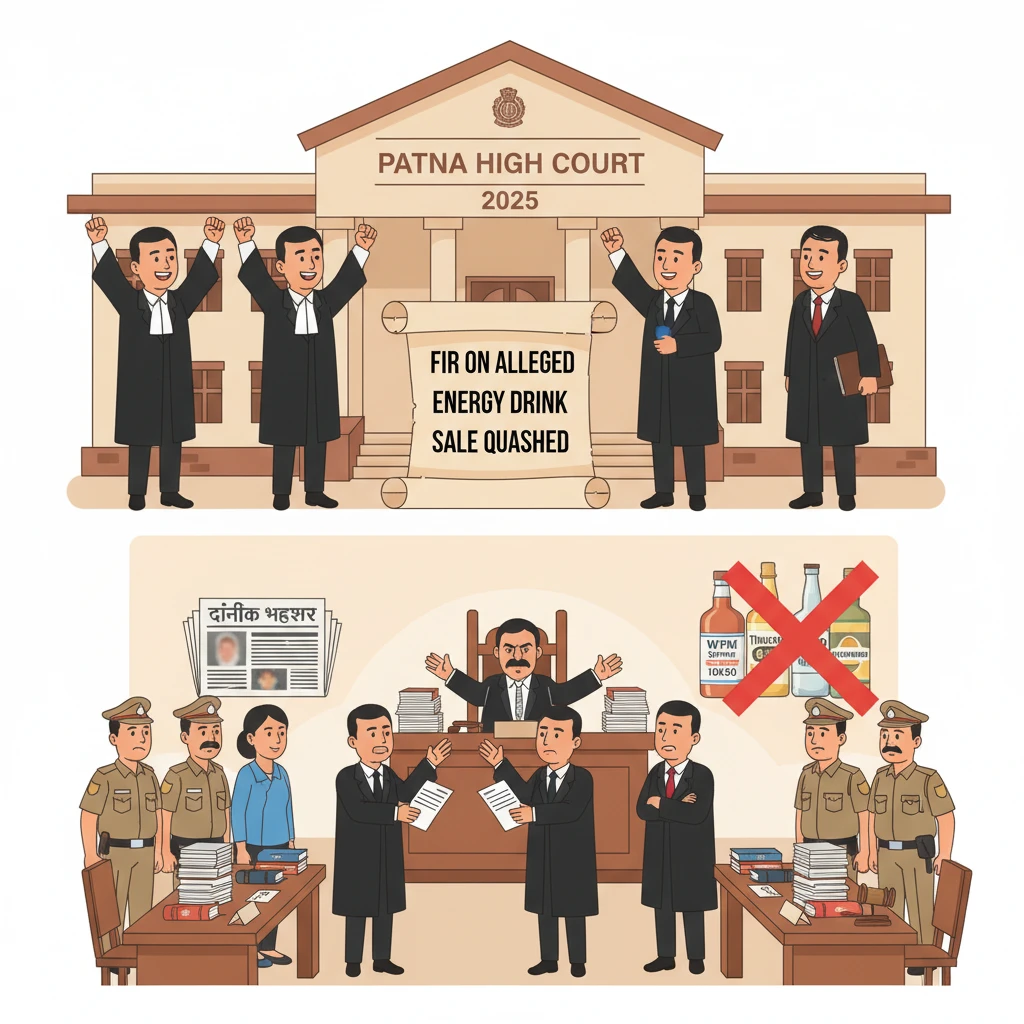
The case started with a news report in the Hindi daily “Dainik Bhaskar” dated 09.02.2017. The report claimed that, in the name of an energy drink, beer was being sold. It further stated that the name of the alleged energy drink was similar to “Thunder Bolt” and “Kingfisher”, and that testing had shown an alcohol content of 4% to 5%.
On the basis of this report, the Excise Superintendent, Madhubani, informed that an energy drink was being sold and distributed by M/s Siddhi Enterprises at Bigrahpur, Patna. Acting on this information, an Excise Inspector and two Sub-Inspectors conducted a raid at the premises linked with the petitioners.
During the raid, different beverages were found, namely WFM Super Strong 10000 and 100000, Thousand Bolt, Kalalon Golden, and Kingfermer. It was alleged that the Sales Manager, Ramesh Kumar, and the Accountant, Rajiv Ranjan, were apprehended on the spot.
The allegation was that beverages containing alcohol (beer) were being sold in the name of energy drinks, and that the owner and staff of the firm were misusing bottles whose shape and names resembled branded beer bottles. On this basis, Ramkrishna Nagar Police Station Case No. 34 of 2017 was registered for offences under Sections 419 and 420 of the Indian Penal Code and Sections 30(a), 35(c) and 32 of the Bihar Excise and Prohibition Act.
The petitioners approached the Patna High Court in a criminal writ petition seeking quashing of the FIR, unsealing of their premises, protection from coercive action under the Bihar Prohibition and Excise Act, 2016, and other appropriate reliefs. During the pendency of the writ, their premises were later de-sealed by order of the Collector, Patna, but the FIR and criminal proceedings remained, leading to the present judgment.
What the Court Examined and Decided
The petitioners limited their main grievance before the Patna High Court to the prayer for quashing of the FIR. They argued that the products they marketed were non-alcoholic energy drinks and not liquor, and therefore the Bihar Prohibition and Excise Act did not apply to them.
The petitioners relied heavily on an earlier decision of the Patna High Court in Criminal Writ Jurisdiction Case No. 627 of 2017, M/s Smart India Marketing Proprietorship and Another vs State of Bihar and Others, reported in 2018 (3) PLJR 165. That decision, concerning almost identical products and allegations, had been affirmed by the Supreme Court in SLP No. 600 of 2018 (State of Bihar and Others vs M/s Smart India Marketing Proprietorship and Another).
According to the petitioners, they were suppliers of energy drinks and the items WFM Super Strong 10000 and 100000, Thousand Bolt, Kalalon Golden, and Kingfermer had been seized by Excise officials across Bihar. These items were sent to the Excise Chemical Analyst, Bihar, Patna. The reports, annexed by the petitioners as Annexure-12, showed ethyl alcohol content between 0.2% v/v and a maximum of 0.4% v/v.
The petitioners also placed on record that petitioner no. 1’s firm had a valid license from the Deputy Director (F & VO), N.R., Ministry of Food Processing Industries, New Delhi, since 1998 (Annexure-2). They submitted that, even before launching the products, the beverages were tested and found non-alcoholic.
The Government itself had earlier tested the products. Samples sent by the Sub-Inspector, Excise, Sadar Western Circle to the laboratory were found to be non-alcoholic, and a report to this effect was issued on 06.09.2016 (Annexure-4). Later, WFM Food Products’ goods were marketed by Shrinaath Traders, which, by letter dated 18.12.2016 (Annexure-5), appointed M/s Siddhi Enterprises as marketer for the entire State of Bihar for the products WFM Super Strong 10000 and 100000, Thousand Volt, Kalalon Golden 500000, and Kingfermer.
M/s Siddhi Enterprises also held a license dated 31.01.2017 from the Department of Health and Family Welfare, Government of Bihar, under the State Food Safety Authority under the Food Safety and Standards Act, 2006. This license was valid from 31.01.2017 to 30.01.2020 (Annexure-7). The petitioners produced challans, bills, and receipts (Annexure-8 series) showing that products were supplied through Shrinaath Traders under proper documentation.
Feeling harassed by excise officials, petitioner no. 1 wrote on 18.01.2017 to the Excise Commissioner, Bihar, requesting that the products be examined at a government laboratory, asserting that the products were non-alcoholic. This letter was received on the same day (Annexure-9). Another letter dated 08.02.2017 was sent seeking sampling and government analysis (Annexure-10).
Samples were later collected by officers of the Food Safety Authority, Darbhanga, and were sent to Mitra S.K. Private Limited, Kolkata, a government authorised test centre, on 28.03.2017. As per report dated 16.02.2017 (Annexure-11), the products were found to have no alcoholic content. The report was sent to excise officials across districts, and in all such reports, ethyl alcohol content was found only between 0.2% v/v and 0.4% v/v (Annexure-12 series).
On this basis, the petitioners argued that, even taking the prosecution story at its best, the goods were non-alcoholic beverages and did not fall under the Bihar Excise and Prohibition Act. They stressed that the facts of the Smart India Marketing case were identical and, therefore, no offence was disclosed by the FIR.
The State took a different stand. It submitted that samples collected from different districts and tested by the Excise Chemist, Bihar, Patna had shown ethyl alcohol content between 0.2% and 0.4%, which matched Annexure-12. But they further asserted that samples seized from the Patna godown and tested by the Forensic Science Laboratory (FSL), Patna on 31.03.2017 showed ethyl alcohol content between 2.24% v/v and 2.58% v/v.
According to the State, this variation from 0.2% to 2.58% made the beverage intoxicating in nature (Annexure A of the counter affidavit). The State pointed to a “zero tolerance” prohibition policy and argued that allowing beverages with such alcohol content would defeat the policy and the constitutional goal under Article 47 of the Constitution of India. They claimed that the alcohol percentage found matched lager beer quality.
The State relied on Section 13 of the Bihar Prohibition and Excise Act read with definitions under Sections 2(3), 2(40) and 2(44), asserting that there was complete prohibition of all beverages containing alcohol, irrespective of strength. They also alleged that after full prohibition in Bihar, the petitioners started marketing beverages containing alcohol under the guise of fruit beer/energy drinks. The product names like “Kingfarmer”, “Kingfeemer” and “Thousand Volt” were said to be similar to well-known beer brands like Thunderbolt and Kingfisher, and that the petitioners were passing intoxicating beverages in similar bottles as energy drinks.
The Court then turned to the law. It reproduced the statutory definitions from the Bihar Prohibition and Excise Act. Section 2(3) defines “alcoholic” as “a solution or mixture containing alcohol and being of any strength and purity.” Section 2(4) defines “alcoholic beverage or portable liquor” as any beverage containing alcohol in conformity with BIS standards which may be intoxicating and is fit for human consumption. Section 2(6) defines “BIS standards” as standards prescribed by the Bureau of Indian Standards or other Central Government authority.
The Court emphasised that statutory provisions cannot be read in isolation. If the legislature had intended complete prohibition even on non-alcoholic beverages as per BIS standards, there would have been no need to define “alcoholic beverage or portable liquor” separately in Section 2(4); Section 2(3) alone would have sufficed.
On careful consideration, the Court held that the Act prohibits intoxicants or liquor containing alcohol of any strength and purity, as per Section 2(3). At the same time, it does not prohibit sale of non-alcoholic substances that conform to BIS standards, in view of the definitions in Sections 2(4) and 2(6).
The Court noted that, in the present case, as per Annexure-12 series, the ethyl alcohol content in the petitioners’ products was between 0.2% v/v and 0.4% v/v, i.e., not more than 0.4% v/v. It also considered the BIS specification for carbonated beverages—non-alcoholic beer—produced by the petitioners’ counsel and not disputed by the State. Under this standard, non-alcoholic beer is defined as a beverage containing less than 0.5% ethyl alcohol by volume.
Thus, the Court concluded that the petitioners were selling non-alcoholic substances in accordance with BIS standards. The penal provision in the Act has to be specific and clear. Since the Act itself requires that alcoholic beverages or portable liquors must conform to BIS standards, and the petitioners’ drinks had alcohol content below the threshold for “non-alcoholic beer” (less than 0.5%), no offence under the Act could be said to be made out.
The Court further observed that the law is settled: if an FIR does not disclose a cognizable offence, it is fit to be quashed because its continuance would be an abuse of the process of law and would cause failure of justice.
The Court also noted that the State did not dispute Annexure-12 series, which were reports of the Excise Chemical Analyst, Bihar, Patna. It took note of the petitioners’ argument that earlier tests found no alcoholic content and that the later higher readings (after about one month and fifteen days) could be due to fermentation over time, for which the petitioners could not be held liable. The petitioners had also questioned the fairness and identity of the samples in the later test, pointing out that it was not clear if the tested material actually came from their seized products.
Referring back to the earlier Smart India Marketing case on similar facts, the Court reiterated that an offence is to be judged as on the date of its commission. If on the date of seizure the energy drink did not contain alcoholic substance beyond BIS “non-alcoholic” standards, no offence under the Act was committed.
In light of these findings, the Court held that the FIR in Ramkrishna Nagar P.S. Case No. 34 of 2017 did not disclose any cognizable offence against the petitioners. Consequently, it quashed the FIR. The writ petition was allowed and all pending interlocutory applications were disposed of.
Why This Judgment Matters
This judgment is important for traders, distributors, and small businesses in Bihar who deal in beverages that may contain trace amounts of alcohol but are still classed as non-alcoholic under BIS standards.
The Patna High Court clarified that the Bihar Prohibition and Excise Act does not criminalise every drink containing any trace of alcohol. What is targeted is intoxicating liquor, not non-alcoholic beverages that comply with BIS norms.
For people who are raided, have their goods seized, or face FIRs on the allegation that they are selling beer in the garb of energy drinks, this judgment shows that lab reports and BIS standards can be crucial. If the alcohol content is below the BIS limit for non-alcoholic beverages, the case may not stand.
The decision also reinforces that the police and excise authorities cannot misuse prohibition laws to harass licensed businesses, especially when the products have already been tested by government-approved laboratories and found to be non-alcoholic.
Legal Issues and Answers
- Issue: Whether the beverages marketed by the petitioners, with ethyl alcohol content between 0.2% and 0.4% v/v, fall within the scope of “alcoholic beverage or portable liquor” prohibited under the Bihar Prohibition and Excise Act.
Answer: No. The Court held that these drinks are non-alcoholic as per BIS standards (less than 0.5% v/v) and therefore their sale is not prohibited by the Act. - Issue: Whether Ramkrishna Nagar P.S. Case No. 34 of 2017 disclosed any cognizable offence justifying continuation of criminal proceedings against the petitioners.
Answer: No. The Court found that the FIR did not disclose any offence under the Bihar Prohibition and Excise Act or otherwise on the facts tested in conformity with BIS standards, and hence the FIR was fit to be quashed. - Issue: Whether later test reports showing higher alcohol content due to possible fermentation could be used to fasten criminal liability on the petitioners for the alleged offence date.
Answer: No. The Court, following the earlier Smart India Marketing ruling, held that the offence must be judged on the date of seizure, and since the products were non-alcoholic on that date, no offence was committed.
Cases Cited by the Court
- M/s Smart India Marketing Proprietorship and Another vs State of Bihar and Others, Criminal Writ Jurisdiction Case No. 627 of 2017, reported in 2018 (3) PLJR 165.
- State of Bihar and Others vs M/s Smart India Marketing Proprietorship and Another, SLP No(s). 600 of 2018, affirming the Patna High Court judgment.
Case Details
Case Number: Criminal Writ Jurisdiction Case No. 1405 of 2017; arising out of P.S. Case No. 34 of 2017, Ramkrishnanagar Police Station, District Patna.
Case Title: Kumari Punam & Others vs The State of Bihar & Others.
Coram: Hon’ble Mr. Justice Alok Kumar Pandey.
Date of Judgment: 09.09.2025 (Uploading Date: 13.09.2025).
Citation: 2025 (4) PLJR 463.
Advocates:
For the Petitioners: Mr. Arvind Kumar Tewary, Advocate; Ms. Akanksha Verma, Advocate.
For the State: Mr. Nalin Vilochan Tiwary, Advocate.
Nature of the Case: Criminal writ petition seeking quashing of FIR and consequential reliefs.
Link to Full Judgment: Patna High Court Judgment – Cr. WJC No. 1405 of 2017
If you found this explanation helpful and wish to stay informed about
how legal developments may affect your rights in Bihar,
you may consider following Samvida Law Associates for more updates.







