
Case Background
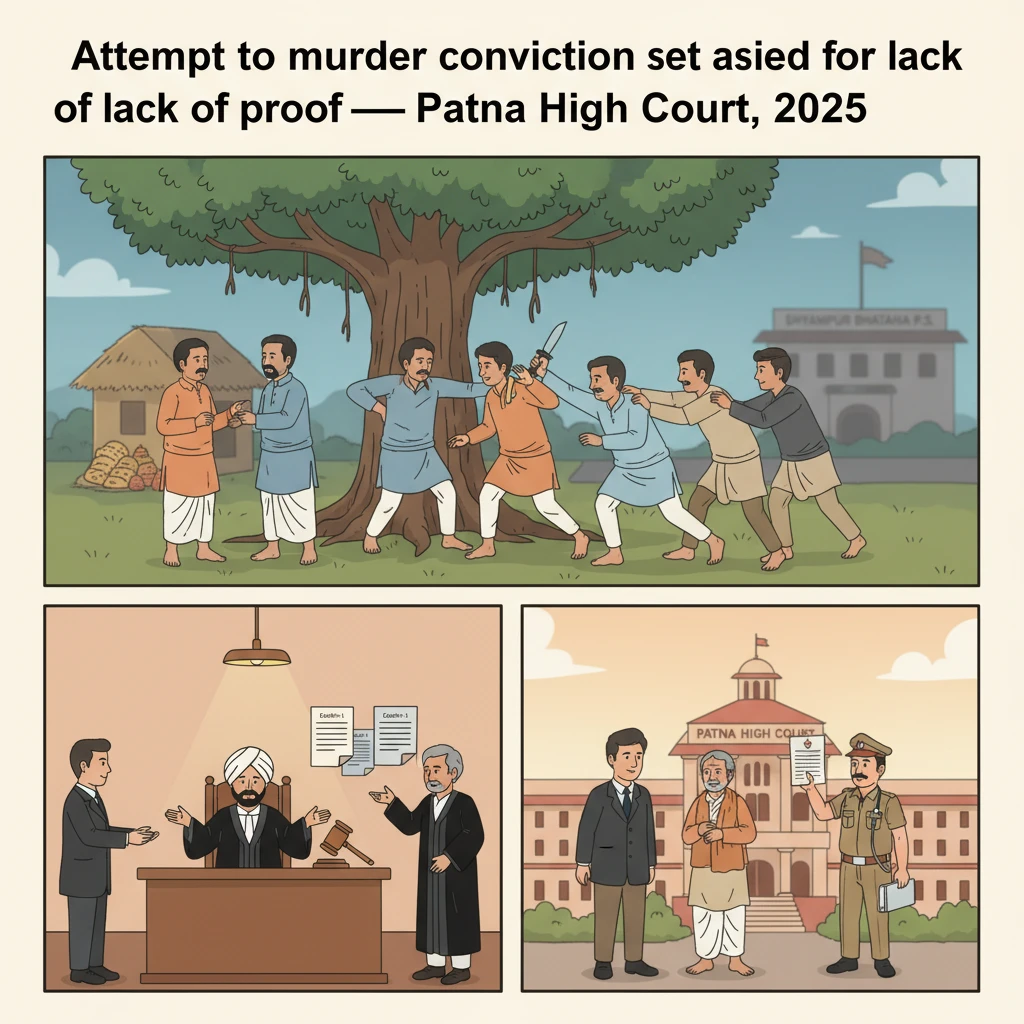
This criminal appeal arose from an incident said to have taken place on 01.03.2001 at about 9:55 p.m. in a village under Shyampur Bhataha Police Station, District Sheohar.
The written report was lodged by informant Bhagya Narain Singh (P.W.4). He stated that he was talking to his nephew Dinesh Singh (P.W.3) about attending a feast (“bhoj”) hosted by a co-villager. At that time, Pappu Singh allegedly arrived with a knife, accompanied by the present appellant Guddu Singh @ Ghutuk Singh @ Gutuk Singh and others.
According to the informant, they demanded money from Dinesh Singh and started abusing him. When Dinesh objected to the abuses and said they could demand dues lawfully but had no right to abuse, a quarrel started.
The informant alleged that Vijay Singh and Sanjay Singh, brothers of Pappu Singh, also came and abused Dinesh, saying he was making a false excuse and that he should be killed. On this, the present appellant was said to have thrown Dinesh Singh to the ground, and Pappu Singh allegedly assaulted Dinesh with a knife repeatedly, causing bleeding injuries and unconsciousness. The informant claimed that when he tried to intervene, he was pushed by Vijay and Sanjay Singh. Villagers gathered on his alarm. The motive was stated to be a dispute over dues.
On this written application of P.W.4, Shyampur Bhataha P.S. Case No. 08 of 2001 was registered for offences under Sections 307, 341, 324, 447 and 504/34 of the Indian Penal Code.
After investigation, the Magistrate took cognizance and committed the case to the Court of Sessions. The learned 1st Additional Sessions Judge, Sitamarhi conducted Sessions Trial No. 71 of 2002/14 of 2003, framed charges, and the accused pleaded not guilty.
The prosecution examined six witnesses: P.W.1 Umesh Singh, P.W.2 Raj Narain Singh, P.W.3 Dinesh Singh (injured), P.W.4 Bhagya Narain Singh (informant), P.W.5 Dr. Ramesh Chandra Singh, and P.W.6 Investigating Officer Dipankar Srigyan. One defence witness, D.W.1 Chandan Singh, was also examined. The prosecution exhibited the injury report of Dinesh Singh (Exhibit-1), the formal FIR (Exhibit-2) and blood-stained jacket and shirt (Exhibit-3).
On the basis of this material, the Trial Court convicted the appellant under Section 307/34 IPC, sentencing him to rigorous imprisonment for five years with a fine of Rs. 2,500/-, and in default, six months’ further rigorous imprisonment. Sentences were to run concurrently.
The appellant then filed the present Criminal Appeal (SJ) No. 779 of 2006 before the Patna High Court under Section 374(2) of the Code of Criminal Procedure, challenging both the judgment of conviction dated 31.05.2005 and the order of sentence dated 07.06.2005.
What the Court Examined and Decided
Before the Patna High Court, the main challenge was to the conviction under Section 307 read with Section 34 IPC. The appellant argued that he was not the main assailant and that the legal requirements for attempt to murder were not proved beyond reasonable doubt.
The defence pointed out that, as per the prosecution itself, Pappu Singh was the person who allegedly inflicted the knife blows. The appellant’s conviction was based on Section 34 IPC (common intention) as a co-accused allegedly holding the victim. Therefore, both the nature of injuries and the proof of “common intention” became crucial.
The defence highlighted that P.W.3 Dinesh Singh, the injured witness, stated that three knife blows were inflicted upon him while other co-accused caught hold of him. However, P.W.5, the doctor who examined him, deposed that all the injuries were simple in nature.
The injury report (Exhibit-1), as reproduced in the judgment, recorded:
(i) Sharp cut wound on right side of the back below scapula ½” x 2½” x 3½” deep in antero-inferior direction.
(ii) Two side by side sharp cut wounds on the top of the shoulder ½” x 1½” x skin deep.
(iii) Small sharp cut wound on the mid of the forehead.
All injuries were opined to be simple in nature and caused by a sharp-edged weapon.
The defence also stressed that the Investigating Officer (P.W.6), on inspecting the place of occurrence, did not find any blood stains, dragging marks, or footmarks. He also did not seize any blood-stained earth or verify the blood-stained clothes by forensic examination.
P.W.3 himself admitted in his testimony that his blood-stained shirt, jacket and vest were not collected by the police. The I.O. deposed that no such blood-stained clothes were produced before him. This created a direct conflict between the injured’s version and the I.O.’s testimony.
The I.O. further stated that when he prepared the requisition for the injury report of P.W.3, he did not mention the names of the culprits. During cross-examination, he also confirmed that key portions of the depositions of P.W.1 and P.W.2 were not stated before him at the time of investigation, including alleged orders to kill and the specific roles attributed to Vijay Singh, Sanjay Singh and the appellant.
The appellant’s counsel argued that these contradictions showed that the prosecution witnesses had made improvements for the first time in court, and that their testimony could not be treated as wholly reliable. The Court accepted that the manner of assault, as narrated by P.W.3 and P.W.4, appeared doubtful in light of the medical evidence and the I.O.’s deposition.
On the legal side, the defence submitted that for a conviction under Section 307 IPC, the core requirement is “intention to cause death”, which must be inferred from the totality of circumstances, including weapon used, manner of assault, seat of injuries, and conduct of the accused. They relied on the Supreme Court’s decisions in Jage Ram and Others v. State of Haryana, (2015) 11 SCC 366 and Nand Lal v. State of Chhattisgarh, (2023) 10 SCC 470. The Patna High Court reproduced and relied upon relevant passages from Jage Ram summarising how intention for Section 307 IPC is to be assessed.
Applying these principles, the High Court noted that here, though a knife was allegedly used and three sharp injuries were found, all injuries were simple. There was also inconsistency about the exact place of injuries: P.W.4 had spoken of blows on the “right lungs” and head, whereas the doctor’s report located injuries on the right side of the back below the scapula, top of the shoulder and mid-forehead. This mismatch, coupled with the lack of objective signs of blood or dragging at the spot, weakened the prosecution’s version of the manner and gravity of assault.
On Section 34 IPC, the appellant argued that at best it was a case of “similar intention” but not “common intention” in law. Relying on Abdul Sayeed v. State of Madhya Pradesh, (2010) 10 SCC 259, the Court reproduced paragraph 49 of that judgment, which clearly distinguishes “common intention” from “same” or “similar” intention and stresses that common intention implies a pre-arranged plan or a meeting of minds, which may be formed even at the spot but must still be proved.
In the present case, the Court, after reviewing the evidence, found no clear and reliable proof that the appellant shared a common intention with Pappu Singh to commit murder or attempt to murder. The I.O.’s testimony, showing that several crucial allegations about orders to kill and the appellant holding the victim were never stated during investigation, strongly suggested later improvements.
Another significant aspect considered by the High Court was the manner in which the statement of the appellant under Section 313 of the Code of Criminal Procedure had been recorded. It was argued that the questions were put in a cryptic and mechanical manner and that all incriminating circumstances were not properly brought to the attention of the accused.
The Court referred to the Supreme Court’s judgment in Sukhjit Singh v. State of Punjab, (2014) 10 SCC 270, and extracted paragraphs 10 to 13, which emphasise that Section 313 CrPC is not an empty formality; the accused must be specifically and fairly questioned about each material circumstance so that he can explain it. Failure to do so can prejudice the accused and affect the validity of the conviction.
Considering this law, the Patna High Court held that the recording of the appellant’s Section 313 statement in a very condensed and mechanical way, without putting all incriminating evidence to him, further undermined the fairness of the trial and the reliability of the conviction.
Summarising the overall evidence, the Court held that:
• The manner of assault as claimed by the prosecution witnesses was doubtful and not fully supported by medical evidence.
• The injuries were simple, and there was insufficient material to firmly infer an intention to cause death, as required under Section 307 IPC, in light of the principles laid down in Jage Ram.
• The alleged knife was never seized, and there was no forensic confirmation of blood on clothes.
• The I.O.’s evidence contradicted important parts of the testimonies of P.W.1, P.W.2, P.W.3, and P.W.4, indicating material improvements at the trial.
• The Section 313 CrPC examination was defective and did not properly confront the accused with all incriminating circumstances.
In these circumstances, the Court concluded that the prosecution had failed to establish its case beyond all reasonable doubt. The conviction under Section 307/34 IPC rested mainly on the uncorroborated and partly inconsistent testimony of the injured witness, which, in the Court’s view, could not sustain such a serious conviction.
The High Court therefore extended the benefit of doubt to the appellant, allowed the appeal, set aside the judgment of conviction dated 31.05.2005 and the order of sentence dated 07.06.2005, and acquitted the appellant of all charges.
Since the appellant was already on bail, he was discharged from his bail bond, his sureties were released, and any fine paid was ordered to be refunded. The Court also directed that the lower court records be sent back along with a copy of the judgment.
Why This Judgment Matters
This judgment is important for accused persons and complainants in attempt to murder cases in Bihar and beyond. The Patna High Court has sent a clear message that a serious conviction under Section 307 IPC cannot be upheld if the evidence is doubtful or incomplete.
For victims and witnesses, it highlights that courts will test their statements against medical reports and police investigation records. If there are major contradictions, or if important objects like the weapon or blood-stained clothes are not seized or examined, the prosecution case may fail.
For accused persons, the case shows that the Court will closely examine whether “intention to cause death” was really proved, especially when injuries are simple. The Court will also check whether the trial court properly followed Section 313 CrPC by fairly putting every important piece of evidence to the accused for explanation.
Practically, the ruling reinforces that benefit of doubt must go to the accused when the prosecution version is not fully reliable. It also reminds investigating officers and trial courts to conduct investigations and examinations carefully, as lapses can lead to acquittals even in serious cases.
Legal Issues and Answers
- Issue: Whether the evidence on record proved beyond reasonable doubt that the appellant had the intention to cause death so as to sustain conviction under Section 307/34 IPC.
Answer: No. The Patna High Court found that the injuries were simple, the manner of assault was doubtful, and the intention to cause death was not established in line with the principles laid down in Jage Ram and other Supreme Court decisions. - Issue: Whether the prosecution had proved that the appellant shared a “common intention” with the main assailant under Section 34 IPC.
Answer: No. Relying on the principles stated in Abdul Sayeed, the Court held that the evidence did not reliably show a pre-arranged plan or common intention; at best, there could be similar intention, which is not enough for Section 34 IPC. - Issue: Whether the defective and mechanical recording of the appellant’s statement under Section 313 CrPC affected the validity of the conviction.
Answer: Yes. Following Sukhjit Singh, the Court held that the Section 313 examination was inadequate, as all incriminating circumstances were not fairly put to the appellant, which contributed to setting aside the conviction.
Cases Cited by the Court
- Jage Ram and Others v. State of Haryana, (2015) 11 SCC 366 – on the ingredients of Section 307 IPC and assessment of intention.
- Nand Lal v. State of Chhattisgarh, (2023) 10 SCC 470 – cited regarding appreciation of evidence and reliability of witnesses.
- Abdul Sayeed v. State of Madhya Pradesh, (2010) 10 SCC 259 – on the concept of “common intention” under Section 34 IPC.
- Sukhjit Singh v. State of Punjab, (2014) 10 SCC 270 – on proper and fair recording of statements under Section 313 CrPC.
- Other Supreme Court decisions were quoted within these main citations (Tara Singh v. State, Hate Singh Bhagat Singh v. State of Madhya Bharat, Ajay Singh v. State of Maharashtra, State of M.P. v. Kashiram, State of Maharashtra v. Balram Bama Patil, Girija Shankar v. State of U.P., R. Prakash v. State of Karnataka, Sevaka Perumal v. State of T.N., State of M.P. v. Saleem, Mohan Singh v. State of Punjab) as part of the extracted passages.
Case Details
Case Number: Criminal Appeal (SJ) No. 779 of 2006
Case Title: Guddu Singh @ Ghutuk Singh @ Gutuk Singh v. State of Bihar
Citation: 2025 (4) PLJR 446
Court: High Court of Judicature at Patna
Bench/Coram: Hon’ble Mr. Justice Chandra Shekhar Jha
Date of High Court Judgment: 20.09.2025
Trial Court Case: Sessions Trial No. 71 of 2002/14 of 2003, arising out of Shyampur Bhataha P.S. Case No. 08 of 2001
Trial Court Judge: 1st Additional Sessions Judge, Sitamarhi
Offences Alleged: Sections 307, 341, 324, 447, 504/34 IPC (trial court conviction under Section 307/34 IPC)
Outcome in High Court: Appeal allowed; conviction and sentence set aside; appellant acquitted; bail bond and sureties discharged; fine, if paid, to be refunded.
Advocates:
For the Appellant: Mr. Shailendra Kumar Singh, Advocate; Mr. Karu Kumar, Advocate; Mr. Chhotelal Mishra, Advocate.
For the State (Respondent): Learned APP.
Nature of Case: Criminal appeal under Section 374(2) CrPC against conviction and sentence in a sessions trial for attempt to murder and allied offences.
Link to Full Judgment: Click here to read the full judgment of the Patna High Court
If you found this explanation helpful and wish to stay informed about
how legal developments may affect your rights in Bihar,
you may consider following Samvida Law Associates for more updates.







