
Case Background
The petitioner was working as Assistant Director, Mines and Geology, Nalanda. On 13.11.2009, he was also given additional charge of Assistant Director, Mines and Geology, Gaya.
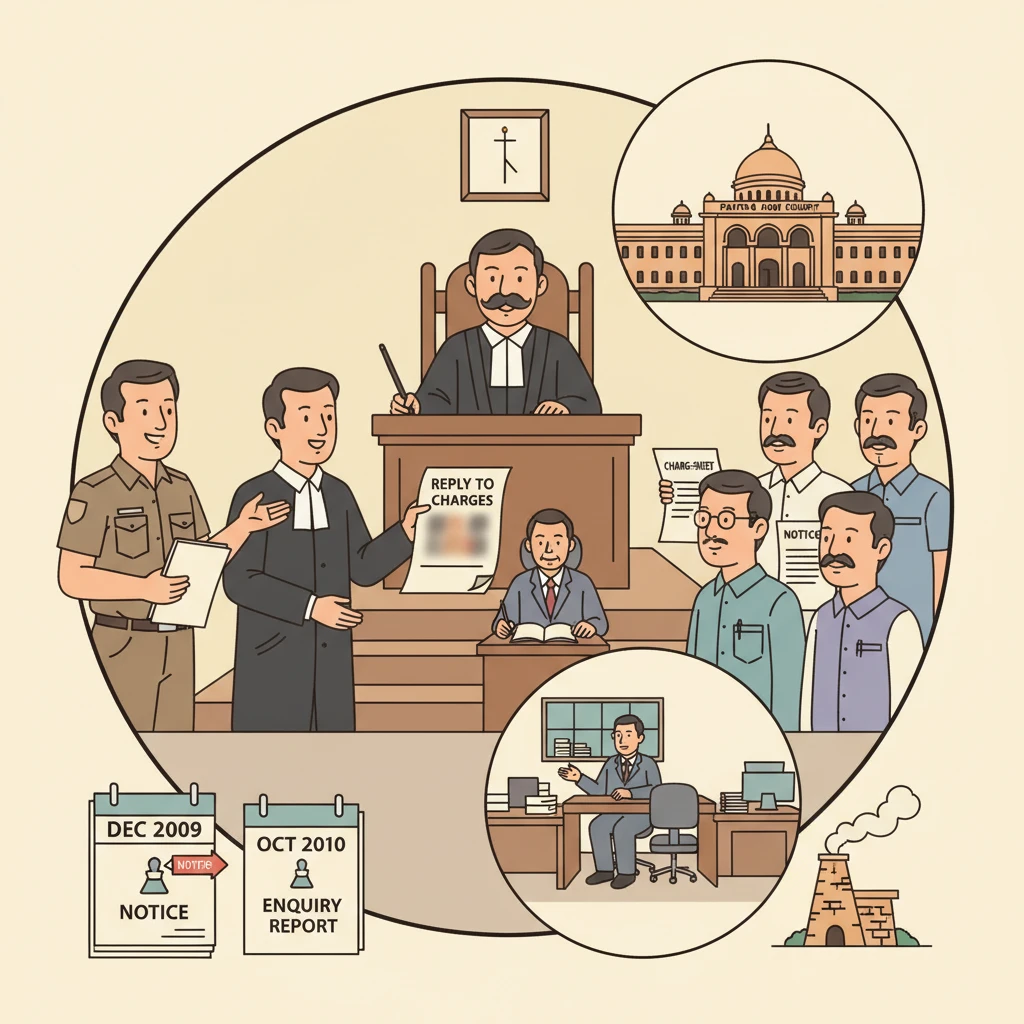
On 27.12.2009, during a period when the Chief Minister was to visit the area, the District Magistrate, Nalanda issued a notice to the petitioner. He was asked to explain within 24 hours why he was not at his headquarters at the time of the Chief Minister’s visit and why he had gone to Rajgir where he had been deputed for law and order duty.
A second show-cause notice followed on 28.12.2009 stating that no reply had yet been received. The petitioner submitted his reply on 28.12.2009 denying the allegations. He sent another reply on 2.1.2010 dealing specifically with allegations related to an illegally running brick kiln.
The District Magistrate, Nalanda then wrote to the Principal Secretary, Mines and Geology Department on 14.1.2010. In that letter, the District Magistrate stated that the petitioner’s reply was not satisfactory and that the petitioner had not made available the enquiry report regarding the brick kiln. The District Magistrate requested that appropriate departmental proceedings be initiated.
Based on this, a charge-sheet dated 30.7.2010 was issued to the petitioner. It contained four charges: first, that he was directed to coordinate with the Block Development Officer, Giriyak and the Officer In-charge, Giriyak and conduct an enquiry into the illegal brick kiln and submit a report; second, that he failed to submit that report; third, that despite directions that all officers must remain at their headquarters during the Chief Minister’s visit, he left his station; and fourth, that in his absence the enquiry into the illegal brick kiln had to be done by the Circle Officer, Police Inspector and Officer In-charge, Giriyak.
The petitioner filed a detailed, charge-wise reply before the Conducting Officer on 14.9.2010. The Conducting Officer submitted an enquiry report on 25.10.2010. He found that the charge of not following directions of the authority was partly proved. He observed that the petitioner should have taken prior permission before leaving headquarters and that such a lapse by an experienced officer could not be appreciated. On the fourth charge, he opined that there was a lack of alertness on the petitioner’s part.
The petitioner was placed under suspension on 23.12.2010. On 14.6.2011, he was supplied a copy of the enquiry report and asked to respond within a fortnight. He filed a detailed reply to the enquiry report on 11.8.2011.
Thereafter, by Memo No. 278 dated 30.1.2012 issued under the signature of the Deputy Secretary, Mines and Geology Department, Government of Bihar, three punishments were imposed: (i) censure to be entered in his confidential record for 2009-10; (ii) stoppage of three increments with cumulative effect; and (iii) denial of full salary and allowances for the suspension period from 23.12.2010 to 29.1.2012, allowing only subsistence allowance.
Aggrieved by this punishment order, the petitioner approached the Patna High Court in this writ petition.
What the Court Examined and Decided
Justice Partha Sarthy of the Patna High Court heard the matter. Both sides were represented: the petitioner by his counsel and the State and Mining Department by theirs.
On behalf of the petitioner, it was argued that the punishment order dated 30.1.2012 had already been approved by the Departmental Minister and the Chief Minister, as revealed through documents obtained under the Right to Information Act. Therefore, any departmental review or appeal before them would be meaningless.
The petitioner’s counsel stressed that he had submitted detailed replies to every charge, yet the authorities failed to appreciate the material he put forward. A central point raised was that it was the petitioner himself who had lodged the FIR regarding the illegal brick kiln.
Specifically, on 27.12.2009 at about 5 p.m., the petitioner lodged Giriyak P.S. Case No. 196 of 2009 concerning the illegal brick kiln. The FIR clearly recorded that the site had been inspected the same day from 12 p.m. to 4 p.m., and that the inspection was conducted along with the Block Development Officer, Police Inspector, Officer In-charge of Giriyak Police Station and others. This, according to the petitioner, showed that he had in fact complied with the instructions about the brick kiln.
The petitioner’s counsel contended that the enquiry report itself was defective because the documents relied upon by the department were never formally proved by examining witnesses. In support, he relied on the Supreme Court judgment in Roop Singh Negi vs. Punjab National Bank & Ors. (2009) 2 SCC 570, and two Patna High Court decisions: Ashwini Kumar vs. State of Bihar & Ors. 2017 (3) PLJR 500 and Obaidur Rahman vs. State of Bihar & Ors. 2009 (4) PLJR 451.
On the other hand, the State’s counsel argued that the disciplinary proceedings had followed due process. At every stage, show-cause notices were given and opportunities were provided. The petitioner was given the enquiry report and allowed to respond. Only after considering his reply, the punishment order was passed. The respondents also stated that a three-member report (Annexure-5) lacked the petitioner’s signature simply because he was not present during the inspection, and that the order of punishment suffered from no illegality.
The Court then carefully examined the facts and the record. It noted the petitioner’s version regarding each charge. For Charges 1 and 2, the petitioner’s stand was that he had immediately complied with the District Magistrate’s instructions on 27.12.2009 by coordinating with the local officers, participating in the inspection from 12 p.m. to 4 p.m., and then lodging the FIR the same evening. For Charge 3, he explained that, due to his additional charge of Gaya, he had to go there to ensure timely auction of sand ghats, which was in the larger interest of the State. For Charge 4, he submitted that non-appearance of his signature on the report dated 27.12.2009 should not be treated as disobedience since he was the informant in the FIR itself.
The Court noticed a serious inconsistency between the inspection report and the FIR. The report dated 27.12.2009, submitted by the Circle Officer, Giriyak, bore the signatures of the Officer In-charge, Giriyak Police Station, the Police Inspector, Giriyak Circle and the Circle Officer. That report wrongly stated that Giriyak P.S. Case No. 196 of 2009 had been registered by the District Mines Officer, Nalanda.
However, the FIR itself, produced as Annexure-4, clearly showed that the informant was the petitioner in his capacity as Assistant Director, Mines and Geology, Nalanda. This discrepancy undermined the version in the inspection report that tried to distance the petitioner from the FIR.
The Court then turned to the charge-sheet structure. Column 2 contained the four charges. Column 3, dealing with evidence, referred only to two documents: Letter No. 6671 dated 27.12.2009 from Nalanda Collectorate, Bihar Sharif and Letter No. 360 dated 14.1.2010 from the same office.
On perusal of the enquiry report, the Court found that no other evidence was produced by the Presenting Officer. Although the report vaguely mentioned some oral evidence, it did not say who was examined or what was said. There was no clear record of any witness having been examined to prove the charges or the documents.
The Court concluded that neither any witness had been examined to support the charges, nor were the two documents listed in the charge-sheet proved through evidence. Despite that, the enquiry report further referred to another document, Letter No. 12 dated 27.12.2009, which was not even listed as evidence in the charge-sheet. This further showed the loose manner in which the enquiry was conducted.
On these facts, the Court held that this was a case of “no evidence” against the petitioner. The disciplinary findings were not supported by legal proof.
The Court then cited the Supreme Court’s decision in Roop Singh Negi. There, the Supreme Court held that disciplinary proceedings are quasi-judicial in nature. The enquiry officer must base findings on materials legally brought on record. Documents collected during investigation cannot, by themselves, be treated as evidence unless proved by witnesses. An FIR is not evidence by itself in a departmental enquiry without proof of the facts stated in it.
The Court also referred to a Division Bench judgment of the Patna High Court in Devendra Prasad vs. The State of Bihar & Ors. (LPA No. 1302 of 2017, decided on 19.10.2023). Following Roop Singh Negi, that decision reiterated that documents in departmental enquiries must be proved by witnesses, even admissions or confessions to police are not enough without supporting evidence, and that suspicion, however strong, cannot substitute legal proof.
Applying these settled principles, the Court found that the enquiry against the petitioner was legally unsustainable. There was no acceptable evidence led to prove the charges, no witnesses examined, and documents were not proved. The enquiry report rested on conjectures rather than legal proof.
Therefore, in the facts and circumstances, the Court held that Memo No. 278 dated 30.1.2012, containing the order of punishment, could not stand in law. It set aside the punishment order.
The writ application was allowed with all consequential reliefs. This means that the petitioner is entitled to restoration of benefits that had been affected by the censures, stoppage of increments, and denial of salary during suspension, subject to the department implementing the Court’s order.
Why This Judgment Matters
This Patna High Court judgment is important for government employees and officers facing departmental inquiries. It makes clear that authorities cannot punish an employee based only on suspicion, assumptions, or unproved documents.
The Court has reinforced that in a departmental proceeding, even though the process is less formal than a criminal trial, basic rules of fairness still apply. Documents relied on must be proved by witnesses. The enquiry report must clearly show what evidence was led and how it supports the charges.
For employees, especially in Bihar, the judgment provides reassurance that disciplinary actions can be challenged in the Patna High Court if they are based on “no evidence”. For departments, it sends a message that enquiries must be conducted carefully, with proper recording of evidence, and not merely to justify a pre-decided punishment.
The case also shows that when an officer has actually taken steps like lodging an FIR and participating in inspections, such actions cannot be ignored or misrepresented in departmental records to frame charges of negligence or disobedience.
Legal Issues and Answers
-
Issue: Whether the departmental punishment imposed on the petitioner was sustainable when no witnesses were examined and the documents listed as evidence were not proved in the enquiry.
Answer: No. The Patna High Court held that this was a case of “no evidence”. The punishment order in Memo No. 278 dated 30.1.2012 was set aside as legally unsustainable, and the writ petition was allowed with consequential reliefs.
Cases Cited by the Court
- Roop Singh Negi vs. Punjab National Bank & Ors.; (2009) 2 SCC 570
- Devendra Prasad vs. The State of Bihar & Ors., LPA No. 1302 of 2017, judgment dated 19.10.2023 (Patna High Court, Division Bench)
Case Details
Case Number: Civil Writ Jurisdiction Case No. 11966 of 2012
Case Title: Biswajit Dan vs. The State of Bihar & Ors.
Coram: Hon’ble Mr. Justice Partha Sarthy
Citation: 2025 (4) PLJR 266
Advocates:
For the petitioner: Mr. Sanjeev Kumar, Advocate
For the respondents (State): Mr. Vishwa Mohan Kumar Sinha, Advocate
For the Mining Department: Mr. Naresh Dikshit, Spl. P.P.; Ms. Kalpana, Advocate
Nature of the Case: Writ petition under civil writ jurisdiction challenging a departmental punishment order issued by the Mines and Geology Department, Government of Bihar.
Link to Judgment: Click here to read the full judgment of the Patna High Court
If you found this explanation helpful and wish to stay informed about
how legal developments may affect your rights in Bihar,
you may consider following Samvida Law Associates for more updates.







