
Case Background
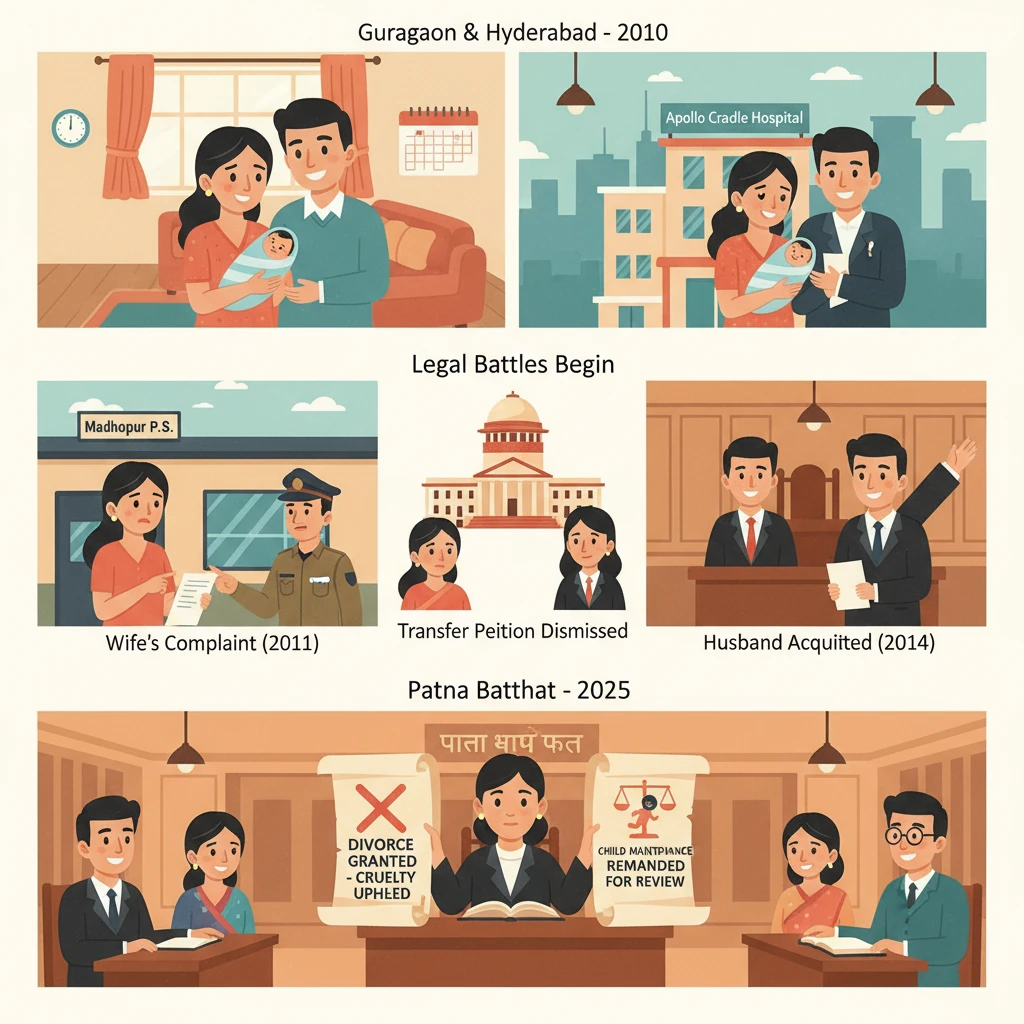
The marriage between the appellant-wife and the respondent-husband was solemnised on 09.06.2009 according to Hindu rites and ceremonies. After marriage, both were working in different cities. The husband was working in Gurgaon, and the wife was working with Bank of Baroda at Muzaffarpur.
After marriage, the wife got herself transferred to Gurgaon branch of her bank and stayed with the husband there. On 15.05.2010, a daughter, Ananya, was born at Apollo Cradle Hospital, Gurgaon.
Subsequently, the husband shifted to Hyderabad in September 2010 to join as Operations Head in M/s Spandana Sphoorty. On his request, the wife joined him at Hyderabad in October 2010 during her maternity leave.
On 31.03.2011, the wife left the matrimonial home along with their minor daughter and started living separately. On the same day, she lodged Madhopur P.S. Case No. 184 of 2011 under Section 498A of the Indian Penal Code against the husband.
The husband then filed a petition under Section 9 of the Hindu Marriage Act, 1955 for restitution of conjugal rights before the Family Court, Ranga Reddy District, Andhra Pradesh, registered as FCOP No. 1068/2011. The wife did not appear and the matter proceeded ex parte. The wife later filed Transfer Petition (T.P.) No. 695/2012 before the Supreme Court for transfer of the Section 9 case to Gaya, Bihar, but the Supreme Court dismissed the transfer petition. The case for restitution of conjugal rights was decreed in favour of the husband.
During this period, the criminal case under Section 498A I.P.C. continued. Ultimately, by judgment dated 17.06.2014, the learned IXth Metropolitan Magistrate, Kukatpally at Miyapur acquitted the husband in Madhopur P.S. Case No. 184 of 2011, observing that the prosecution had failed in all aspects to prove the guilt.
Thereafter, the husband filed Matrimonial Title Suit No. 92 of 2016 before the Principal Judge, Family Court, Gaya, under Section 13(1)(i-a)(i-b) of the Hindu Marriage Act, 1955, seeking divorce on grounds of cruelty and desertion. By judgment and decree dated 30.06.2016, the Family Court granted a decree of divorce and directed the husband to deposit Rs. 10,00,000/- as fixed deposit in favour of their minor daughter Ananya for her marriage and other purposes.
The wife, aggrieved by the judgment and decree of divorce and the directions regarding deposit, filed Miscellaneous Appeal No. 1116 of 2016 before the Patna High Court.
What the Court Examined and Decided
The Patna High Court heard both sides and examined whether the decree of divorce granted by the Family Court on grounds of cruelty and desertion required interference.
The husband’s case before the Family Court was that the marriage was without dowry, the couple lived together at Gurgaon, and that he provided all comforts during the wife’s pregnancy. He stated that the wife’s parents began interfering in their marital life and wanted to stay permanently with them. According to him, the wife threatened to take a separate house near her workplace and live there with her parents if he did not agree to keep them in his house.
He further pleaded that after they shifted to Hyderabad for his new job, his work commitments increased. Instead of understanding, the wife allegedly started suspecting his character and made baseless accusations. On the night of 04.02.2011, there was a serious quarrel in the presence of the wife’s mother, during which, according to him, abusive language was used and his character was questioned.
He alleged that on 31.03.2011, in his absence, the wife left the matrimonial home with all her belongings, the daughter, and also took away golden ornaments worth Rs. 15 lakhs belonging to his mother, along with his personal belongings. He stated that on the same day she filed a criminal case under Section 498A I.P.C. making false allegations of dowry demand and cruelty, which caused him severe mental agony.
The husband emphasised that he was acquitted in the said criminal case, and that the Court there clearly held that the prosecution had failed to prove the charge under Section 498A I.P.C. He also pointed out that he had pursued restitution of conjugal rights under Section 9 of the Hindu Marriage Act, but the wife never cooperated and did not take any steps to save the marriage.
The wife, in her written statement, painted a different picture. She stated that she was compelled to file Madhopur P.S. Case No. 184 of 2011 as the husband allegedly mercilessly assaulted her without reason, and that she left Hyderabad and returned to Gaya when she felt her life was unsafe. She also alleged that the husband concealed his earlier marriage with one Shelly Seth and that he obtained a divorce from his first wife in September 2007. She claimed that the husband had given a wrong address in the Section 9 HMA case, which led to an ex parte decree since she could not appear from Gaya.
She also alleged that the husband did not take financial responsibility for their ailing minor daughter, who, according to her, was suffering from many ailments.
The Family Court, after trial, accepted the husband’s case and granted divorce on cruelty and desertion. The Patna High Court examined how and why the Family Court reached that conclusion and whether it could be upset in appeal.
The High Court first reminded itself of the scope of a first appeal, relying on the Supreme Court decision in Jagdish Singh v. Madhuri Devi, (2008) 10 SCC 497. It noted that while a first appellate court can reappreciate both facts and law, it must bear in mind the trial court’s advantage in observing the witnesses’ demeanour and should not lightly disturb factual findings unless the approach of the trial court is erroneous or unreasonable.
On the question of cruelty, the High Court referred to Supreme Court decisions dealing with mental cruelty in marriage, including Joydeep Majumdar v. Bharti Jaiswal Majumdar, (2021) 2 RCR (Civil) 289, and Samar Ghosh v. Jaya Ghosh, (2007) 4 SCC 511. These decisions explain that mental cruelty is a state of mind and may include sustained abusive treatment, false allegations, and long separation that makes it impossible for the parties to live together.
The High Court noted that the Family Court had treated the filing of the Section 498A case and the subsequent acquittal of the husband as a vital circumstance. The Family Court relied on several Supreme Court judgments such as Jagbir Singh v. Nisha, Rishipal v. Luxmi Devi, Dharampal v. Pushpa Devi, Major Ashish Poonia v. Nilima Poonia, Mangayakarasi v. M. Yuvaraj, K. Srinivas Rao v. D.A. Deepa, and K. Srinivas v. K. Suneetha, to hold that unfounded allegations and false criminal complaints against a spouse can amount to cruelty.
On desertion, the Family Court found that the wife left the matrimonial home on 31.03.2011 and never returned. The husband attempted to restore the relationship by filing a petition under Section 9 of the Hindu Marriage Act for restitution of conjugal rights. However, the wife did not participate in that proceeding, which was eventually decreed ex parte in his favour. She herself did not file any petition for restitution of conjugal rights. The Family Court concluded that the wife had put an end to cohabitation, and her continued separation for more than two years without reasonable excuse amounted to desertion as per Section 13(1)(i-b) of the Act.
The High Court examined these findings in light of the evidence and the legal principles on cruelty and desertion. It noted that the wife had been living separately since 31.03.2011 without any reasonable excuse and that the matrimonial bond had virtually broken down beyond repair. Referring to the Supreme Court’s guidance in Samar Ghosh, it observed that where there has been long continuous separation, the marriage becomes a fiction, and refusal to sever the tie may itself cause mental cruelty.
The High Court also took note that during the pendency of the appeal, on 24.09.2024, the wife’s counsel stated, on instructions, that she would restrict her case only to seeking enhancement of permanent alimony of Rs. 10,00,000/- in favour of the daughter. The Court permitted amendment for that limited purpose. This conduct also indicated that the wife was not pressing the challenge to divorce on merits, but was essentially pressing for enhancement of financial provision for the child.
In paragraph 19 of the judgment, the High Court concluded that the husband had made out a case for dissolution of marriage on the grounds mentioned under Section 13(1)(i-a)(i-b) of the Hindu Marriage Act, 1955. In paragraph 20, it held that the Family Court had rightly granted the divorce and that there was no reason to interfere with the decree dissolving the marriage.
However, the Patna High Court found fault with the way the Family Court had fixed the amount of Rs. 10,00,000/- to be deposited for the minor daughter. It noted that neither party had filed any statement of assets and liabilities before the Family Court. Without assessing income, social and financial status, responsibilities, or existing liabilities, the Family Court had directed deposit of Rs. 10 lakhs in a rather “flimsy manner”. The basis for fixing this particular amount was not mentioned in the judgment.
The High Court emphasised that under Section 26 of the Hindu Marriage Act, the Court can pass orders regarding custody, maintenance and education of minor children, but such orders must be just and proper. It also referred to the Supreme Court decision in Rajnesh v. Neha, (2021) 2 SCC 324, and connected decisions in Aditi @ Mithi v. Jitesh Sharma, (2023) SCC OnLine SC 1451, and Pravin Kumar Jain v. Anju Jain, 2024 SCC OnLine SC 3678. These judgments lay down that in maintenance matters, both parties must disclose their assets and liabilities, and courts must consider factors such as income, status, reasonable needs, and number of dependants.
Applying these principles, the High Court held that the question of quantum of deposit/maintenance for the minor daughter Ananya had to be reconsidered by the Family Court after proper financial disclosures by both parents.
Therefore, while upholding the divorce decree, the Patna High Court remanded the matter to the Principal Judge, Family Court, Gaya, limited to deciding the correct quantum of deposit/maintenance for the minor daughter. It directed the Family Court to call upon both husband and wife to file details of their assets and liabilities in line with Rajnesh v. Neha and the other Supreme Court decisions, and thereafter to pass an appropriate order within three months from the date of the High Court judgment. Both parties were directed to cooperate, and the Family Court was authorised to pass proper orders even in case of non-appearance.
Why This Judgment Matters
This judgment is significant for two main reasons.
First, it shows that the Patna High Court will not lightly interfere with a Family Court’s findings of cruelty and desertion when there is clear long separation and failed attempts at reconciliation. Where one spouse files a criminal case and the other is acquitted, and where the complaining spouse still does not resume cohabitation despite a decree for restitution of conjugal rights, the Court may treat this as cruelty and desertion.
Second, the judgment stresses that child maintenance and financial security cannot be fixed in an arbitrary way. Courts must look at each parent’s real income, assets, liabilities, and social status before deciding the amount to be deposited or paid. This protects both the child’s rights and the fairness owed to the paying parent.
For separated spouses and single parents in Bihar, the decision clarifies that:
(a) Long, unexplained separation and refusal to live together can lead to divorce; and
(b) For maintenance of children, both sides must be ready to disclose their finances and cooperate with the Family Court.
Legal Issues and Answers
- Issue: Should the decree of divorce granted by the Family Court on grounds of cruelty and desertion be interfered with in appeal?
Answer: No. The Patna High Court held that the husband had proved cruelty and desertion under Section 13(1)(i-a)(i-b) of the Hindu Marriage Act, 1955, and upheld the dissolution of marriage. - Issue: Was the Family Court justified in directing the husband to deposit Rs. 10,00,000/- for the minor daughter without assessing assets and liabilities?
Answer: No. The High Court held that the quantum of maintenance/deposit was fixed without proper financial assessment and remanded this limited issue to the Family Court for fresh determination after obtaining asset and liability details from both parents. - Issue: What procedure must be followed by the Family Court in fixing maintenance or deposit for a minor child?
Answer: The Family Court must call for detailed disclosure of assets and liabilities from both parties and then decide the quantum by considering income, social status, needs of the child, and relevant factors in line with Supreme Court decisions, including Rajnesh v. Neha.
Cases Cited by the Court
- Jagdish Singh v. Madhuri Devi, (2008) 10 SCC 497
- Joydeep Majumdar v. Bharti Jaiswal Majumdar, (2021) 2 RCR (Civil) 289
- Samar Ghosh v. Jaya Ghosh, (2007) 4 SCC 511
- Jagbir Singh v. Nisha, (2015) 9 RCR (Civil) 873
- Rishipal v. Luxmi Devi, (2009) 4 RCR (Civil) 811
- Dharampal v. Smt. Pushpa Devi, 2004 RCR (Civil) 717
- Major Ashish Poonia v. Mrs. Nilima Poonia
- Mangayakarasi v. M. Yuvaraj, (2020) 3 SCC 786
- K. Srinivas Rao v. D.A. Deepa, (2013) 5 SCC 226
- K. Srinivas v. K. Suneetha, (2014) 16 SCC 34
- Rajnesh v. Neha, (2021) 2 SCC 324
- Aditi @ Mithi v. Jitesh Sharma, (2023) SCC OnLine SC 1451
- Pravin Kumar Jain v. Anju Jain, 2024 SCC OnLine SC 3678
- Abhilasha v. Parkash and Others (referred within Rajnesh v. Neha discussion)
Case Details
Case Number: Miscellaneous Appeal No. 1116 of 2016
Case Title: Shristi Kumari v. Sandeep Kumar Lohani
Court: High Court of Judicature at Patna
Coram: Hon’ble Mr. Justice P. B. Bajanthri and Hon’ble Mr. Justice S. B. Pd. Singh
Date of Judgment: 11.07.2025
Citation: 2025(3) PLJR 768
Advocates: Mr. Rama Kant Singh, Advocate for the appellant-wife; Mr. Shashikant Amar, Advocate for the respondent-husband
Nature of the Case: Miscellaneous Appeal against judgment and decree of divorce in Matrimonial Title Suit No. 92 of 2016 passed by the Principal Judge, Family Court, Gaya, under Section 13(1)(i-a)(i-b) of the Hindu Marriage Act, 1955, with connected issue of child maintenance/deposit under Section 26 of the Act.
Result in Appeal: Divorce decree upheld; matter remanded to Family Court, Gaya only for fresh determination of quantum of deposit/maintenance in favour of minor daughter Ananya, with directions to obtain asset and liability disclosures from both parents and decide within three months.
Link to Judgment: Click here to read the full judgment of the Patna High Court
If you found this explanation helpful and wish to stay informed about how legal developments may affect your rights in Bihar, you may consider following Samvida Law Associates for more updates.







