
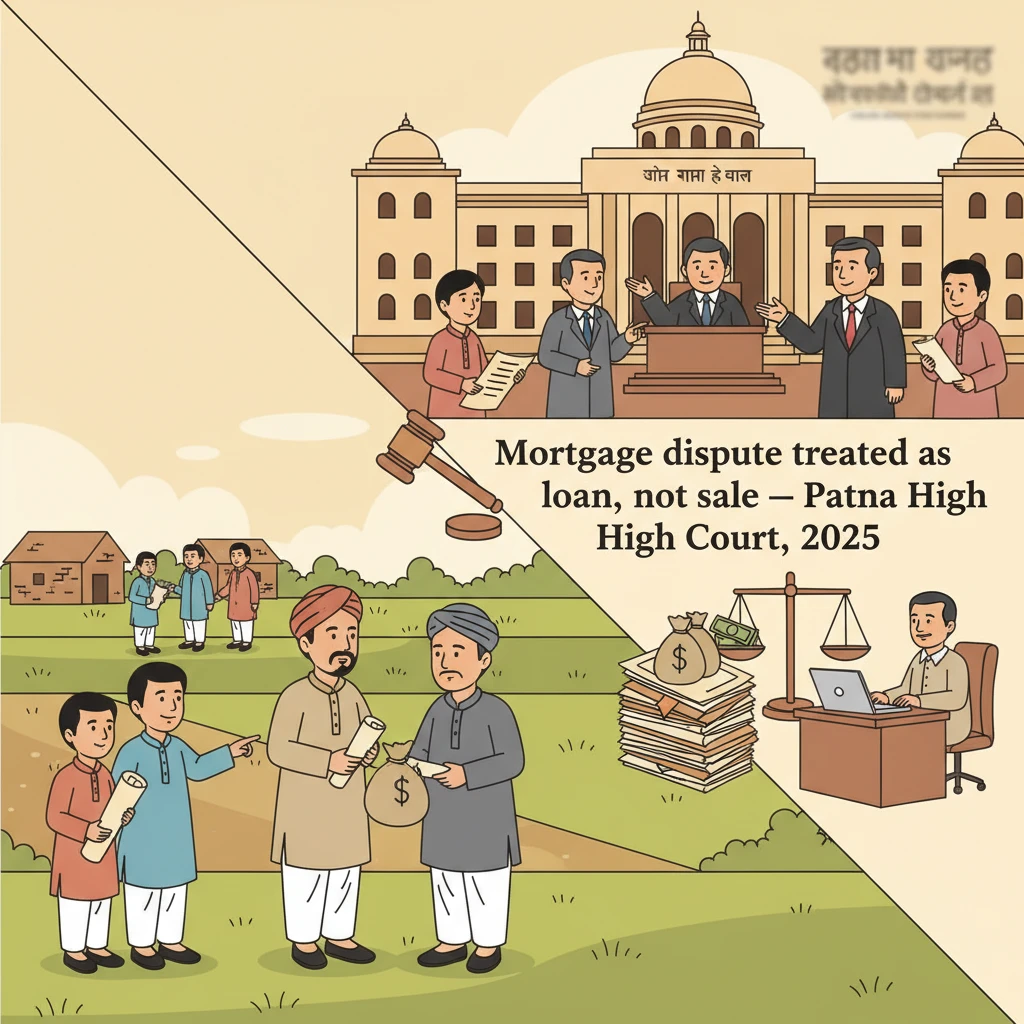
Case Background
The dispute concerns 12 kathas 9 dhurs of agricultural land under Khata No. 184, Plot Nos. 623 and 625, in West Champaran district. Defendant no. 2 executed a registered document dated 15.04.1980 in favour of defendant no. 1 for Rs. 4,000. The document was styled as a “sale with condition to re-purchase”.
According to the plaintiffs, this was not a real sale but only a mortgage by conditional sale. Defendant no. 2 had taken Rs. 4,000 as a loan and agreed that on repayment the land would be reconveyed and possession returned. No time limit was fixed and the amount payable for getting back the land was the same Rs. 4,000.
On 22.06.1981, defendant no. 5, the brother of defendant no. 2, executed two sale deeds (Exhibits A and A/1) in favour of defendant nos. 3 and 4, who are brothers of defendant no. 1, for about half of the same land. On 12.08.1981, defendant no. 2 then sold the entire 12 kathas 9 dhurs to the present plaintiffs for Rs. 10,000 by a registered sale deed (Exhibits 1 and 1/A). The plaintiffs thus claimed to have stepped into the shoes of the mortgagor.
In 1985, the plaintiffs filed Title Suit No. 80 of 1985 before the First Additional Munsif, Bettiah. They sought a declaration that the 15.04.1980 document was a mortgage by conditional sale, a direction to defendant no. 1 to accept Rs. 4,000 and execute a reconveyance (wapsinama), and delivery of possession. After learning of the sale deeds of 22.06.1981 in favour of defendant nos. 3 and 4, they amended the plaint to challenge those deeds as illegal, fraudulent and not binding.
The trial court framed eight issues, took evidence, and partly decreed the suit. It held that the plaintiffs could redeem the mortgage and treated the 15.04.1980 document as a mortgage by conditional sale. However, as to the later sale deeds in favour of defendant nos. 3 and 4 (Exhibits A and A/1), the trial court held that the suit stood abated on account of consolidation proceedings under Section 4(c) of the Bihar Consolidation of Holdings and Prevention of Fragmentation Act, 1956.
Defendant no. 1 appealed in Title Appeal No. 82 of 1991 before the Second Additional District and Sessions Judge, West Champaran, Bettiah. The plaintiffs filed a cross‑objection on the findings regarding abatement and the sale deeds. The lower appellate court framed only one point: whether the 15.04.1980 deed was a simple mortgage or a mortgage by conditional sale. It treated the document as an absolute sale deed, reversed the trial court’s decree, dismissed the suit for redemption, and dismissed the cross‑objection as not pressed.
The plaintiffs then approached the Patna High Court in Second Appeal No. 546 of 2010. On 01.03.2017, the High Court framed a substantial question of law: whether the document (Ext. C) was a transaction of mortgage or a transaction of sale. The judgment in second appeal was delivered on 26.05.2025 by Hon’ble Mr. Justice Khatim Reza.
What the Court Examined and Decided
The Patna High Court focused on the true nature of the 15.04.1980 document (Exhibit 6/Exhibit C). The central task was to decide whether this document created a mortgage by conditional sale under Section 58(c) of the Transfer of Property Act, 1882, or whether it was an outright sale with a mere option of repurchase.
The Court first reproduced and relied on Section 58(c), which defines “mortgage by conditional sale” and lays down that, to be treated as such, the condition must be embodied in the same document. The proviso inserted by the 1929 amendment was highlighted: no such transaction shall be deemed to be a mortgage unless the condition is contained in the very same document.
The plaintiffs argued that Ext. C, though titled and worded as a conditional sale (bayanama bashart wapsi), fulfilled all the ingredients of a mortgage by conditional sale. The entire arrangement was embodied in one registered document. It clearly provided that on repayment of Rs. 4,000, the buyer would reconvey the same property to the original owner and restore possession. No fresh or higher price was to be paid on reconveyance; the amount remained exactly Rs. 4,000.
The plaintiffs also relied on the surrounding circumstances. At the time of the 1980 deed, the market value of the land was about Rs. 10,000. This became clear from later transactions: within a year the plaintiffs purchased the same land for Rs. 10,000, and defendant nos. 3 and 4 bought about half of it for about Rs. 6,000. That meant the full property was valued around Rs. 12,000. The Court accepted that no reasonable person would genuinely sell land worth Rs. 10,000–12,000 for only Rs. 4,000. This price difference pointed strongly to a loan secured by land, not a true sale.
Another crucial fact was that defendant no. 1, though described as purchaser in the document, never got his name mutated in the revenue records on the basis of Ext. C. He did not act like an absolute owner. In contrast, after the later sale deeds in favour of defendant nos. 3 and 4, mutation was obtained on those deeds, not on Ext. C. According to the plaintiffs, both sides treated Ext. C in practice as a mortgage, even though its form was that of a conditional sale.
The plaintiffs further explained in the plaint why the document was drafted as a sale deed. They said it was done to avoid the effect of the Bihar Money Lenders Act, under which a mortgage with possession could be automatically redeemed after seven years without repayment. To protect defendant no. 1’s interests as lender, the parties structured the document as a conditional sale in form, but intended it as a mortgage in substance.
The defendants resisted this interpretation. Defendant no. 1 pleaded that there was no agreement to execute a wapsinama on payment of Rs. 4,000, that the transaction was a sale, and that in any case the agreement for reconveyance was void because no time limit was fixed. He also claimed that the deed was meant to cover only half the land and that its mention of 12 kathas 9 dhurs was fraudulent. Defendant nos. 3 and 4 supported his stand and further relied on their own purchase of 7 kathas 3.5 dhurs from defendant no. 5.
On the question of nature of the transaction, the High Court examined a line of Supreme Court precedents relied on by the appellants, including decisions such as Vithal Tukaram Kadam, Tulsi v. Chandrika Prasad, Bhimrao Ramchandra Khalate, Srinivasaiah, Ramvilas v. Karim Khan, and Bibi Fatima v. M. Ahmad Hussain. From these cases, the Court drew several principles:
- Title or label of the document is not conclusive; the real nature is gathered from its recitals and surrounding circumstances.
- If the document embodies in one instrument both the ostensible sale and the condition to retransfer, and reconveyance is at the same price, this strongly indicates a mortgage by conditional sale.
- Inadequacy of price compared to market value, absence of mutation in favour of the so‑called purchaser, and conduct of parties treating it as security for a loan are important indicators.
- Under the proviso to Section 58(c), where the condition of repurchase is in the same document, the court should lean towards treating it as a mortgage if the other factors support that conclusion.
Applying these principles, the Court closely read Ext. C. It noted that the deed recited payment of Rs. 4,000 as sale consideration, but immediately went on to provide that the seller could repay the same amount “whenever arranged” and, on such payment, the buyer would reconvey the land at the same price. The purchaser was only to enjoy the property till repayment. No right was given to demand any extra amount or to fix a new consideration.
The Court found this pattern inconsistent with a genuine sale with a right of repurchase, where usually (a) a fixed period is set for exercise of the option, and (b) the repurchase price is higher than the original price to reflect appreciation or benefit to the purchaser. Instead, the arrangement in Ext. C matched a typical mortgage by conditional sale: one document, same consideration both ways, and enjoyment of property merely in the interim till repayment.
The Court also emphasised that for nearly five years after 1980, until filing of the suit in 1985, there was no mutation in favour of defendant no. 1 on the basis of Ext. C. When viewed along with the extremely low consideration compared to the market value and the clause for reconveyance at the same amount, these circumstances “compelled” the conclusion that the parties intended a mortgage, not a sale.
On this basis, the Patna High Court held that the lower appellate court had erred in treating Ext. C as an absolute sale deed. It found that the lower appellate judgment was unsustainable both on facts and in law and had ignored binding principles laid down by the Supreme Court on Section 58(c).
Regarding the sale deeds dated 22.06.1981 in favour of defendant nos. 3 and 4 (Exhibits A and A/1), the High Court noted that the trial court had held the suit abated in respect of those deeds in view of Section 4(c) of the Consolidation Act, and that this finding had not been finally overturned. The plaintiffs’ cross‑objection on that point had been dismissed as not pressed. Therefore, so far as those documents were concerned, the suit stood abated and the question of their validity would be decided after issuance of notification under Section 26A of the Consolidation Act by the consolidation authorities.
Importantly, the High Court recorded that the validity of the plaintiffs’ own sale deed of 12.08.1981 was never challenged in the suit, whether by counterclaim or separate action. Thus their status as transferees from the mortgagor remained intact for the purpose of redemption.
Answering the substantial question of law in favour of the appellants, the Court set aside the lower appellate court’s judgment dated 02.05.2009 in Title Appeal No. 82 of 1991, restored and affirmed the trial court’s judgment and decree dated 19.07.1991 in Title Suit No. 80 of 1985, and allowed the second appeal. No order was made as to costs.
Why This Judgment Matters
This Patna High Court judgment is significant for landowners and small farmers who often sign documents labelled as “sale” when in reality they are giving land as security for a loan. The Court has made clear that the real intention of the parties and the surrounding facts matter more than the title of the deed.
If a document says that on repayment of the same amount the land will be returned, contains the entire arrangement in one registered deed, and the price is far less than the actual value of the land, courts can treat it as a mortgage by conditional sale. That means the borrower retains a right to redeem the property by repaying the loan.
The judgment also confirms that where consolidation proceedings cause abatement of part of a suit, that does not automatically destroy a mortgagor’s right to redeem the mortgage itself, especially when the mortgagee or subsequent purchasers have not challenged the mortgagor’s sale deed. The principle “once a mortgage, always a mortgage” is reinforced: the right of redemption does not vanish except in accordance with law.
Legal Issues and Answers
- Issue: Was the registered deed dated 15.04.1980 (Ext. C) an outright sale or a mortgage by conditional sale under Section 58(c) of the Transfer of Property Act, 1882?
Answer: The Patna High Court held that Ext. C was a mortgage by conditional sale. The deed embodied the sale and condition of reconveyance in one document, provided for return of the same land on repayment of the same amount, fixed no time limit for repayment, involved grossly inadequate price compared to market value, and was treated in conduct as a security for a loan. - Issue: What is the effect of consolidation proceedings and Section 4(c) of the Bihar Consolidation of Holdings and Prevention of Fragmentation Act, 1956, on the suit, particularly regarding the later sale deeds (Exhibits A and A/1)?
Answer: The suit was held to have abated only in respect of the challenge to Exhibits A and A/1. The validity of those deeds will be decided by consolidation authorities after notification under Section 26A. The core relief of redemption of mortgage, based on Ext. C, survived and could be granted, as the plaintiffs’ own sale deed was never challenged. - Issue: Was the lower appellate court justified in reversing the trial court’s decree for redemption and dismissing the suit?
Answer: No. The High Court held that the lower appellate court’s judgment misapplied the law on Section 58(c), failed to properly consider the deed’s recitals and surrounding circumstances, and was not sustainable. The trial court’s decree for redemption was restored.
Cases Cited by the Court
- Vithal Tukaram Kadam & Anr. v. Vamanrao Sawalaram Bhosale & Ors., (2018) 11 SCC 172
- Ganpati Babji Alamwar & Ors. v. Digambarrao Venkatrao Bhadke & Ors., (2019) 8 SCC 651
- Tulsi & Others v. Chandrika Prasad & Others, (2006) 8 SCC 322
- Bhimrao Ramchandra Khalate v. Nana Dinkar Yadav (Tanpura) & Anr., (2021) 9 SCC 45
- Srinivasaiah v. H.R. Channabasappa, (2017) 12 SCC 821
- Ramvilas & Another v. Karim Khan & Another, (2017) 1 PLJR 212 (SC)
- Bibi Fatima & Ors. v. M. Ahmad Hussain & Ors., (2017) 11 SCC 832
- Padhiyar Prahladji Chenaji v. Maniben Jagmalbhai & Others, (2022) 12 SCC 128
- Shiv Kumar & Anr. v. Union of India & Ors., (2019) 10 SCC 229
- B.K. Muniraju v. State of Karnataka & Ors., (2008) 4 SCC 451
- AIR 1962 Patna 53 (relied upon by lower appellate court and considered by High Court)
Case Details
Case Number: Second Appeal No. 546 of 2010
Case Title: Sanjay Kumar Pandey @ Abhinu Kumar Pandey & Anr. v. Rajdeo Yadav & Ors.
Trial Court: Title Suit No. 80 of 1985, before the learned First Additional Munsif, Bettiah
First Appeal: Title Appeal No. 82 of 1991, before the learned Second Additional District and Sessions Judge, West Champaran, Bettiah
Citation: 2025(3) PLJR 742
Coram: Hon’ble Mr. Justice Khatim Reza
Date of Patna High Court Judgment: 26.05.2025 (CAV; CAV date 16.01.2025)
Advocates for Appellants (Plaintiffs): Mr. Jitendra Kishore Verma, Advocate; Mr. Lal Babu Singh, Advocate; Mr. Anjani Kumar, Advocate; Mr. Ravi Raj, Advocate; Mr. Abhay Nath, Advocate; Mr. Shreyash Goyal, Advocate; Mr. Abhishek Kumar Srivastava, Advocate; Ms. Kumari Shreya, Advocate
Advocates for Respondents: Mr. J.S. Arora, Senior Advocate; Mr. Ratan Kumar Sinha, Advocate; Mr. Manoj Kumar, Advocate; Mr. Rakesh Kumar, Advocate; Mr. Himanshu Shekhar, Advocate; Mr. Ravi Bhatia, Advocate
Nature of Case: Second appeal against first appellate decree in a title suit for declaration that a deed is a mortgage by conditional sale, for redemption of mortgage and reconveyance of property, with consequential challenge (by amendment) to subsequent sale deeds; partial abatement in view of consolidation proceedings.
Link to Judgment: Patna High Court Judgment – Second Appeal No. 546 of 2010
If you found this explanation helpful and wish to stay informed about
how legal developments may affect your rights in Bihar,
you may consider following Samvida Law Associates for more updates.







