
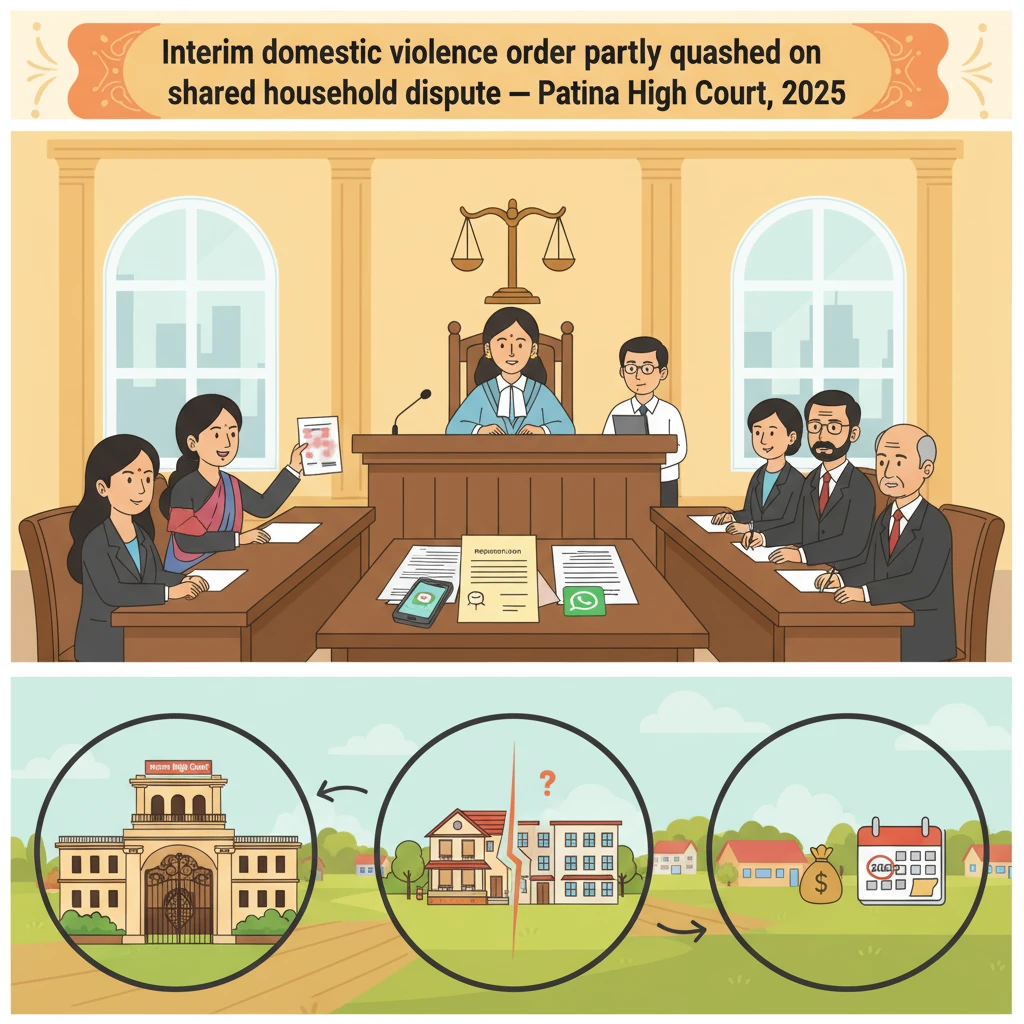
Case Background
This case arose out of a matrimonial dispute between a wife (opposite party no. 2) and her husband (petitioner no. 1), along with his family members (other petitioners). The wife had filed Domestic Violence Case No. 02/2024 before the Chief Judicial Magistrate, Gaya, under the Protection of Women from Domestic Violence Act, 2005.
In that case, the wife sought protection orders, residence orders, monetary relief and interim protection under sections 18, 19, 20 and 23 of the Domestic Violence Act. She alleged that she was subjected to physical, verbal, emotional, sexual and economic abuse by her husband and in-laws. She also claimed that certain properties in Samastipur (Bihar) and Navi Mumbai (Maharashtra) were her shared matrimonial homes.
On 28.11.2024, the Judicial Magistrate 1st Class, Gaya, allowed her application under section 23(2) of the Domestic Violence Act. The Magistrate treated the bungalow at Hemantpur, Samastipur, and Flat No. C110, National Park, Takka Panvel, Raigarh, Navi Mumbai, as shared matrimonial households. The Magistrate directed that the wife be given residence in the Navi Mumbai flat and restrained the respondents from disturbing her possession or alienating that flat. The Magistrate also directed the husband to pay an additional Rs. 15,000 per month as interim maintenance, apart from Rs. 25,000 per month already being paid in terms of an earlier High Court order in Cr.W.J.C. No. 1011/2024.
Aggrieved by this interim residence and monetary order, the husband and his family members approached the Patna High Court under Section 482 Cr.P.C. and Section 528 of the Bhartiya Nagarik Suraksha Sanhita, 2023, seeking quashing of the order dated 28.11.2024.
What the Court Examined and Decided
The matter was heard by Hon’ble Mr. Justice Chandra Shekhar Jha of the Patna High Court. The petitioners challenged the trial court’s order on three main grounds: the finding about “shared household”, the procedure followed for interim maintenance, and the quantum of maintenance without proper financial disclosure.
First, the petitioners argued that Flat No. C110, National Park, Takka Panvel, Raigarh, Navi Mumbai, is the self-acquired property of petitioner no. 2 (the husband’s father). They submitted that this flat was never used as a shared household by the wife. According to them, at the time of marriage, the husband was living in a rented premises, and the couple never stayed in the parental house at Panvel as their regular matrimonial home.
They placed on record a Leave and License Agreement dated 12.04.2023 between the landlord, one Bharat Kunvarji Maru, and petitioner no. 1, the husband. This agreement covered a rented flat at C.T.S. No. 163A, 17th Floor, Godrej Tranquil, Akurli Road, Kandivali East, Mumbai, initially from 10.04.2023 to 09.03.2024 and extended till 31.03.2025. According to them, this rented flat at Kandivali East was the place where the couple stayed together for almost two years, as it was close to their workplaces, and hence it alone had the characteristics of a shared household.
The petitioners contended that occasional visits to the parental home at Panvel or Hemantpur, Samastipur, could not make those properties “shared households”. They alleged that the wife’s claim over the Panvel flat was made with an oblique motive to get a share in the father’s property, which is not what the Domestic Violence Act provides for.
On the second issue, the petitioners submitted that the interim order under section 23(2) was passed without giving them an opportunity to file a written reply to the application dated 25.07.2024. They stressed that before granting any interim monetary protection, the court below was duty-bound to insist on financial disclosure affidavits as per the Supreme Court’s judgment in Rajnesh vs. Neha and others [(2021) 2 SCC 324].
They relied on paragraphs 128 to 132 of Rajnesh vs. Neha, where the Supreme Court had directed that affidavits of disclosure of assets and liabilities (Enclosures I, II and III) should be filed by both parties in all maintenance proceedings. According to the petitioners, the wife did not file the requisite Enclosure I and II, and the Magistrate’s failure to ensure this rendered the interim monetary order unsustainable.
Third, they pointed out that the husband was already paying Rs. 25,000 per month as ad-interim maintenance under the High Court’s order dated 02.08.2024 in Cr.W.J.C. No. 1011/2024, arising out of an FIR under Section 498A IPC. Despite this, the Magistrate directed payment of an additional Rs. 15,000 per month without considering the wife’s own income and educational status. The petitioners alleged that the wife was a law graduate, employed with companies like Kotak Mahindra and Aditya Birla Finance, earning over one lakh rupees per month, which the Magistrate ignored.
On the other side, the wife’s counsel argued that the Hemantpur bungalow in Samastipur and the Panvel flat were shared matrimonial houses. He submitted that the wife was subjected to various forms of domestic violence – physical, verbal, emotional and economic. He pointed out that the trial court had considered the Domestic Incident Report and salary slip of the husband and passed the interim order after due application of mind, including noting that she was already receiving Rs. 25,000 per month under the earlier High Court order.
It was also brought on record that, after the residence order, the Protection Officer and the Senior Police Inspector, Takka Panvel, tried to implement it. The wife went to the Panvel flat on 09.12.2024 with police support, but the flat was found locked. Neighbours and the security guard said the family had not been seen for 2–3 days. The husband then informed the police that he was not living in the Panvel flat and that his parents had gone to their village in Samastipur.
The wife claimed that after their marriage on 16.02.2022 at Bodh Gaya, she had gone to the husband’s village Hemantpur, Samastipur, for post-marriage rituals. She alleged that various festivals and family functions were celebrated at the Panvel flat, and even a reception party after marriage took place there. Based on such occasions, she asserted that the Panvel flat was a shared household.
The High Court then examined the statutory definition of “shared household” under section 2(s) of the Domestic Violence Act. It noted that a shared household is where the aggrieved person lives or at any stage has lived in a domestic relationship, whether the property is owned or tenanted by either party or by the joint family, and that ownership is not decisive.
The Court also relied on paragraph 88 of the Supreme Court judgment in Rajnesh vs. Neha, which in turn referred to Satish Chander Ahuja v. Sneha Ahuja. The guiding principle is that the woman’s right to reside in a shared household depends on the intention of the parties, the nature of their living, and the nature of the household. There must be a degree of permanence in the stay; mere fleeting or casual visits to different places do not convert them into shared households.
Applying these principles, the Patna High Court closely looked at the evidence about where the couple actually lived after marriage. It noted that:
- The wife is highly educated and was working in Mumbai with companies like Kotak Mahindra and Aditya Birla Finance.
- The Leave and License Agreement (Annexure 4/1 and 4/2) clearly showed that the Kandivali East flat at Godrej Tranquil, C.T.S. No. 163A, 17th Floor, was taken on rent by the husband from 10.04.2023 to 09.03.2024, later extended till March 2025.
- The couple lived together there for a substantial period after marriage, as this flat was convenient to both their workplaces.
- In her resignation letter to Kotak Mahindra dated 28.11.2023, the wife herself gave her address as Kandivali, Mumbai, and mentioned her matrimonial issues.
- Several online transactions and deliveries of household items were made to the Kandivali address (Annexure 6 series), reinforcing that this was their regular home.
On this basis, the High Court held that the rented flat at Kandivali East, Mumbai, had the necessary “degree of permanence” and was the real shared household under Section 2(s) of the Domestic Violence Act. In contrast, the claim that the Panvel flat and the Samastipur residence were shared households was not supported by similar evidence of permanent or continuous residence as husband and wife.
The Court observed that the wife’s stand in the complaint, projecting the Panvel flat and Samastipur house as shared household properties, prima facie suggested an intention to claim a share in the paternal property of the husband, which is outside the scope of Section 2(s). It clarified that “shared household” under the Domestic Violence Act should not be confused with “share in property” of the matrimonial home.
On the monetary issue, the High Court noted that the wife had not filed Enclosures I and II as mandated by paragraph 129 of Rajnesh vs. Neha, and this omission was also reflected in the impugned order. Without such structured financial disclosure from both sides, proper determination of interim maintenance under Section 23(2) was not possible.
In the result, the High Court partially allowed the petition. It quashed the portion of the Magistrate’s order dated 28.11.2024 which treated Flat No. C110, National Park, Takka Panvel, as a shared household. Instead, it declared that the rented Kandivali East flat at Godrej Tranquil, C.T.S. No. 163A, 17th Floor, Akurli Road, Near Ayappa Temple, Mumbai – 400101, is the shared household.
The Court directed that if this Kandivali flat is still on rent, petitioner no. 1 (the husband) must provide the wife one bedroom in that flat with all basic facilities, without any disturbance. Alternatively, if that flat is no longer available, he must arrange a one-bedroom (1 BHK) rented flat for her in Kandivali East, Mumbai, within 15 days of her request, upon proof that she is working from office.
Regarding the extra Rs. 15,000 monetary protection granted by the Magistrate, the High Court directed the trial court to pass a fresh order after the wife files Enclosures I and II in terms of Rajnesh vs. Neha. The Magistrate was asked to treat that Supreme Court judgment as a guiding note.
Importantly, the High Court clarified that the earlier ad-interim maintenance of Rs. 25,000 per month directed by a coordinate Bench in Cr.W.J.C. No. 1011/2024 will continue, unless modified in that proceeding.
Why This Judgment Matters
This judgment has practical importance for married women and their in-laws when disputes arise under the Domestic Violence Act. It shows that the Patna High Court looks carefully at the real place where the couple lived together, not just at properties owned by the husband’s family.
For women, it reinforces that they have a right to live in a shared household, even if they have no ownership in it. But the property must be one where they actually lived with their husband with some continuity, not just for occasional visits, festivals, or family functions.
For husbands and their parents, the judgment clarifies that a wife cannot, through the Domestic Violence Act, directly claim a “share” in the father-in-law’s property simply by calling it a shared household, unless the facts fit the legal definition.
The judgment also stresses that trial courts must follow the Supreme Court’s directions in Rajnesh vs. Neha for maintenance cases. Both parties should disclose their income and assets properly on affidavit. Without this, interim monetary orders may be reconsidered.
Finally, the Court has balanced the rights by protecting the wife’s right to adequate accommodation matching the standard of living she had in the true shared household area (Kandivali), while correcting an overbroad interim order on the Panvel flat.
Legal Issues and Answers
- Issue: Whether Flat No. C110, National Park, Takka Panvel, Navi Mumbai, could be treated as the wife’s “shared household” under Section 2(s) of the Domestic Violence Act.
Answer: No. The Patna High Court held that the Panvel flat was not shown to be their permanent matrimonial home. The rented flat at Kandivali East, Mumbai, where the couple actually lived together with a degree of permanence, is the real shared household. - Issue: Whether the trial court could grant additional interim monetary relief without financial disclosure affidavits as per Rajnesh vs. Neha.
Answer: The High Court held that the Magistrate must pass a fresh order on the additional Rs. 15,000 per month after the wife files Enclosures I and II, guided by Rajnesh vs. Neha. The earlier ad-interim maintenance of Rs. 25,000 per month continues. - Issue: Whether the interim order under Section 23(2) of the Domestic Violence Act, granting residence in the Panvel flat, could stand.
Answer: The Court quashed the residence direction regarding the Panvel flat and instead directed that the wife be given accommodation in the Kandivali East shared household or in an equivalent 1 BHK rented flat at Kandivali East.
Cases Cited by the Court
- Rajnesh vs. Neha and others, (2021) 2 SCC 324.
- Satish Chander Ahuja v. Sneha Ahuja, (2021) 1 SCC 414 (referred within Rajnesh vs. Neha and quoted by the High Court).
Case Details
Case Number: Criminal Miscellaneous No. 2532 of 2025 (arising out of P.S. Case No. – Year-0, District – Gaya).
Case Title: Ravi Kumar Singh & Ors. vs. The State of Bihar & Aditi Singh.
Coram: Hon’ble Mr. Justice Chandra Shekhar Jha.
Citation: 2025(3) PLJR 858.
Advocates:
For the petitioners: Mr. Ansul, Senior Advocate; Mr. Aditya Pandey, Advocate; Mr. Shyam Kishore, Advocate; Ms. Sakshi Bhatnagar, Advocate; Ms. Eashita Raj, Advocate; Ms. Ginni Priya, Advocate; Mr. Anuj Kumar, Advocate.
For the State/opposite parties: Mr. Jitendra Kumar Singh, APP; Mr. Rakesh Kr. Samendra, Advocate (for opposite party no. 2); Mr. Sanjay Kumar, Advocate.
Nature of the Case: Criminal miscellaneous petition under Section 482 Cr.P.C./Section 528 BNSS seeking quashing/modification of an interim order passed under Section 23(2) of the Domestic Violence Act, 2005, in Domestic Violence Case No. 02/2024.
Link to Judgment: Patna High Court Judgment – Criminal Misc. No. 2532 of 2025
If you found this explanation helpful and wish to stay informed about
how legal developments may affect your rights in Bihar,
you may consider following Samvida Law Associates for more updates.







