
Case Background
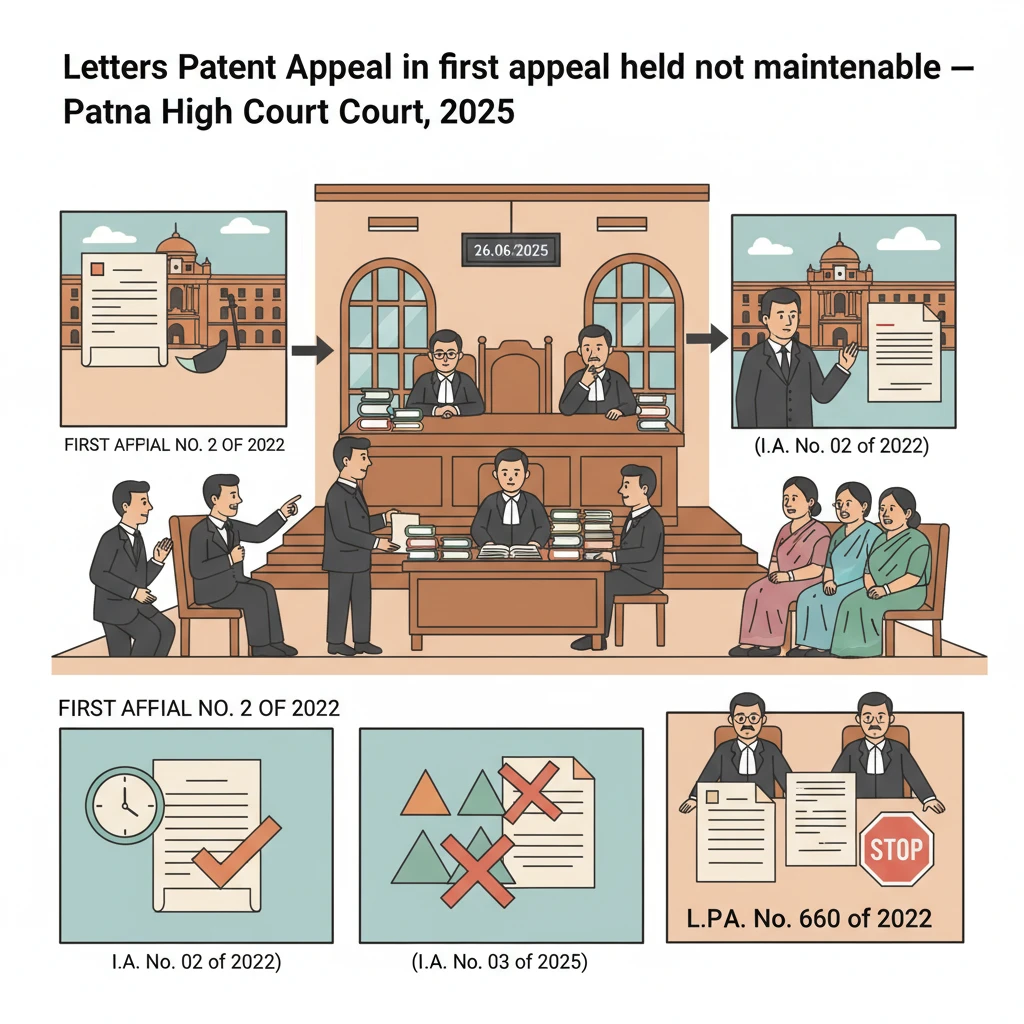
This matter arose from a family dispute that had already reached the stage of a first appeal before a Single Judge of the Patna High Court, registered as First Appeal No. 2 of 2022. The details of the original suit or decree are not recorded in this judgment.
In First Appeal No. 2 of 2022, certain interlocutory applications were filed, specifically I.A. No. 1 of 2022 and I.A. No. 3 of 2022. On 14.10.2022, the learned Single Judge passed orders on these interlocutory applications. Those orders did not dispose of the first appeal itself, which remains pending.
Feeling aggrieved by the interlocutory orders dated 14.10.2022, the appellants filed a Letters Patent Appeal (L.P.A. No. 660 of 2022) before a Division Bench of the Patna High Court. The appellants are members of the Daruka family, while the respondents include members of the Dalmia, Rataria, Daruka, Choudhary, Gupta and Thakur families, among others.
There was a delay of about 9 days in filing the LPA. The appellants filed I.A. No. 02 of 2022 seeking condonation of this delay. They also later filed I.A. No. 03 of 2025 seeking deletion of Annexure-1 to Annexure-3 from the record.
What the Court Examined and Decided
The Division Bench of the Patna High Court, comprising Hon’ble Mr. Justice P. B. Bajanthri and Hon’ble Mr. Justice S. B. Pd. Singh, first dealt with the interlocutory applications in the LPA itself.
On I.A. No. 02 of 2022, the Court noted that there was a delay of about 9 days in filing L.P.A. No. 660 of 2022. After considering the reasons stated in the application along with the supporting affidavit, the Bench condoned the delay and allowed I.A. No. 02 of 2022.
On I.A. No. 03 of 2025, the Court heard the request for deletion of Annexure-1 to Annexure-3. Again, based on the reasons in the application and affidavit, this application was also allowed.
With these preliminary applications disposed of, the Bench proceeded to hear L.P.A. No. 660 of 2022 itself for final disposal, with the consent of both sides’ counsel.
The core issue did not relate to the merits of the family dispute or the substance of the first appeal. Instead, the central question was whether a Letters Patent Appeal was legally maintainable at all against interlocutory orders passed by a Single Judge in a first appeal, in light of Section 100-A of the Code of Civil Procedure, 1908 (CPC).
Counsel for the respondents, led by Mr. J.K. Verma, raised a preliminary objection that the LPA was barred. He relied squarely on Section 100-A CPC and cited four judgments in support:
(i) Jitendra Narayan Agarwal vs. Sri Rajiv Kumar Agarwal & Anr., 2006 (2) PLJR 530 (Paragraph 4).
(ii) Balbhadra Singh @ Balbhadra Nr. Singh vs. Ram Binod Singh & Ors., 2004 (4) PLJR 879 (Paragraphs 4 and 5).
(iii) Mohd. Saud and Another vs. Dr. (Maj.) Shaikh Mahfooz and others, (2010) 13 SCC 517 (Paragraphs 9, 10 and 15).
(iv) Mohammad Ali vs. Md. Quamru Jamma & Ors., 2015 (4) PLJR 323 (Paragraphs 10 and 11).
On the other hand, counsel for the appellants could not place any contrary precedent before the Court on the interpretation of Section 100-A CPC. He argued that the bar in Section 100-A should be read as applying only to final judgments and final orders, not to interlocutory orders passed in a pending first appeal. He submitted that the words “judgment or order” in Section 100-A must be confined to final decisions. However, he did not support this argument with any judicial authority.
To resolve the issue, the Division Bench reproduced Section 100-A CPC, as amended with effect from 1 July 2002:
“[100-A. No further appeal in certain cases.— Notwithstanding anything contained in any Letters Patent for any High Court or in any instrument having the force of law or in any other law for the time being in force, where any appeal from an original or appellate decree or order is heard and decided by a single Judge of a High Court, no further appeal shall lie from the judgment and decree of such single Judge.]”
The Court observed that from a plain reading of this provision, there is a clear bar on filing a further intra-court appeal (LPA) against decrees or orders where an appeal from an original or appellate decree or order has already been heard and decided by a Single Judge.
The Bench then discussed and relied upon the cited decisions to show how Section 100-A has been understood by the Patna High Court and the Supreme Court.
In Jitendra Narayan Agarwal, a Division Bench of the Patna High Court had already held that when Section 100-A bars an LPA against a final decision of a Single Judge in an appeal, there cannot be a separate LPA only against an interlocutory order passed in that appeal. Paragraph 4 of that decision clearly rejected the argument that while a final appeal may be barred, an appeal can still lie against an interlocutory order. The Court in that case ruled that such a proposition was contrary to the amended Section 100-A.
In Balbhadra Singh @ Balbhadra Nr. Singh, the matter arose from a probate case where the appeal before the High Court was under Section 299 of the Indian Succession Act. That provision allows appeals to the High Court “in accordance with the provisions” of the CPC. The Patna High Court in that case applied Section 100-A to hold that further intra-court appeals were not maintainable, thus reinforcing the reach of Section 100-A even in probate matters routed through CPC appeal provisions.
The Division Bench then turned to the Supreme Court decision in Mohd. Saud vs. Dr. (Maj.) Shaikh Mahfooz. In paragraphs 9, 10 and 15 of that judgment, the Supreme Court upheld the constitutional validity of Section 100-A and endorsed Full Bench decisions of the Andhra Pradesh, Madhya Pradesh and Kerala High Courts. These decisions had uniformly held that after the 2002 amendment to Section 100-A, no substantive right remains to file a further appeal against a judgment or order of a Single Judge in an appeal.
The Supreme Court in Mohd. Saud also took a purposive view of the provision. It noted that the purpose of introducing Section 100-A was to reduce the number of appeals and prevent harassment of litigants through multiple tiers of intra-court appeals. The Court gave an illustration: if an LPA were allowed against interlocutory orders but not against final judgments, that would lead to an anomalous situation where two appeals could be filed against an interlocutory order of a District Judge (first to a Single Judge, then to a Division Bench), but only one appeal could be filed against a final judgment. This would be contrary to the object of Section 100-A and therefore impermissible.
Finally, the Bench referred to the Patna High Court decision in Mohammad Ali vs. Md. Quamru Jamma & Ors., which compared the unamended and amended versions of Section 100-A. Before 2002, the bar applied only to appeals arising out of appellate decrees or orders. After the amendment, the bar clearly extends to appeals arising from original as well as appellate decrees or orders, if heard and decided by a Single Judge. Paragraph 11 of Mohammad Ali emphasized that no further appeal can lie against an original or appellate order of a Single Judge, even if the Letters Patent of the High Court suggests otherwise.
Taking these authorities together, the Division Bench concluded that the law is now well settled: whether the impugned decision of the Single Judge is a final judgment, decree, or interlocutory order in an appeal from an original or appellate decree or order, no further Letters Patent Appeal is maintainable because of the bar created by Section 100-A CPC.
Applying this to the present case, the Bench noted that the impugned order dated 14.10.2022 was passed by a Single Judge in First Appeal No. 2 of 2022 on interlocutory applications I.A. No. 1 of 2022 and I.A. No. 3 of 2022. The first appeal itself remains pending. Since these were orders in an appeal heard by a Single Judge, Section 100-A squarely applied.
The appellants’ attempt to distinguish interlocutory orders from final judgments was rejected, particularly in view of the reasoning in Jitendra Narayan Agarwal and Mohd. Saud, which clarified that if no LPA lies against the final decision, there can be no LPA against intermediate or interim orders passed in the same appellate proceeding.
On this basis, the Court held that L.P.A. No. 660 of 2022 was not maintainable for want of Letters Patent jurisdiction. The appellants had therefore “not made out a case so as to interfere” with the Single Judge’s interlocutory order dated 14.10.2022. The LPA was accordingly dismissed.
Why This Judgment Matters
This judgment is significant for litigants who are already in the appellate stage before the Patna High Court. It makes clear that once an appeal from an original or appellate decree or order is before a Single Judge, parties cannot ordinarily file a further intra-court appeal to a Division Bench against that Judge’s orders, whether interim or final.
For families and individuals involved in long-running civil disputes, this ruling means that they cannot challenge every interim order of a Single Judge by filing an LPA. Instead, they must pursue their remedies within the same appeal, usually by pressing their grievances before the Single Judge or, where appropriate, by approaching the Supreme Court through the avenues provided by law.
The decision also reinforces the legislative intent behind Section 100-A CPC: to reduce multiple layers of appeals within the High Court and to prevent delays and harassment caused by repetitive challenges. The Patna High Court has aligned itself with consistent Supreme Court and High Court precedents on this point.
Legal Issues and Answers
- Issue: Is a Letters Patent Appeal maintainable before a Division Bench of the Patna High Court against interlocutory orders passed by a Single Judge in a pending first appeal, in view of Section 100-A of the Code of Civil Procedure, 1908?
Answer: No. The Court held that, in light of Section 100-A CPC and binding precedents, no further Letters Patent Appeal lies against interlocutory orders, judgments, or decrees passed by a Single Judge in an appeal from an original or appellate decree or order. L.P.A. No. 660 of 2022 was dismissed as not maintainable.
Cases Cited by the Court
- Jitendra Narayan Agarwal vs. Sri Rajiv Kumar Agarwal & Anr., 2006 (2) PLJR 530 (Patna High Court), Paragraph 4 relied upon.
- Balbhadra Singh @ Balbhadra Nr. Singh vs. Ram Binod Singh & Ors., 2004 (4) PLJR 879 (Patna High Court), Paragraphs 4 and 5 relied upon.
- Mohd. Saud and Another vs. Dr. (Maj.) Shaikh Mahfooz and others, (2010) 13 SCC 517 (Supreme Court), Paragraphs 9, 10 and 15 relied upon.
- Mohammad Ali vs. Md. Quamru Jamma & Ors., 2015 (4) PLJR 323 (Patna High Court), Paragraphs 10 and 11 relied upon.
Case Details
Case Number: Letters Patent Appeal No. 660 of 2022 in First Appeal No. 2 of 2022; I.A. No. 02 of 2022; I.A. No. 03 of 2025.
Case Title: Meera Daruka & Ors. vs. Pradhuman Bharti & Ors.
Citation: 2025 (3) PLJR 795
Coram: Hon’ble Mr. Justice P. B. Bajanthri; Hon’ble Mr. Justice S. B. Pd. Singh.
Date of Judgment: 26-06-2025.
Advocates:
- For the Appellants: Mr. Nandlal Kumar Singh, Advocate.
- For the Respondents: Mr. J.K. Verma, Advocate; Mr. Anjani Kumar, Advocate; Mr. Ravi Raj, Advocate; Mr. Shreyash Gopal, Advocate; Ms. Kumari Shreya, Advocate; Mr. Abhishek Anand, Advocate; Mr. Achyut Kumar, Advocate; Ms. Sweta Raj, Advocate.
Nature of the Case: Letters Patent Appeal challenging interlocutory orders passed in a first appeal (civil). The first appeal itself remains pending before a Single Judge.
Link to Judgment: Patna High Court official judgment link
If you found this explanation helpful and wish to stay informed about
how legal developments may affect your rights in Bihar,
you may consider following Samvida Law Associates for more updates.







