
Case Background
The petitioner was initially appointed as a Lab Incharge (Lab-bearer) at H.D. Jain College, Ara, a constituent unit under Vir Kunwar Singh University, Ara. He claims to have worked satisfactorily from the beginning of his service.
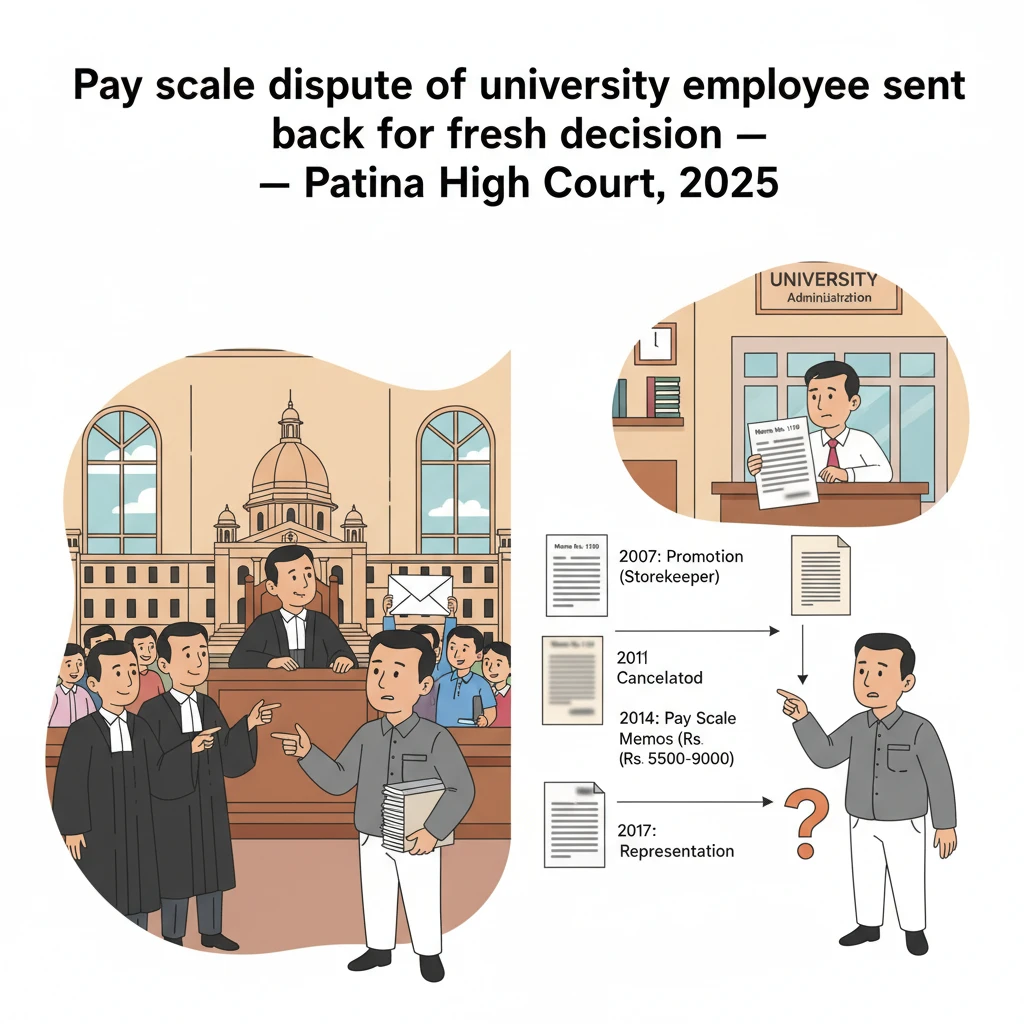
Later, by Notification contained in Memo No. 1040 dated 21.11.2007, he was said to have been promoted to the post of Storekeeper. However, this promotion was cancelled by the Vice Chancellor of Vir Kunwar Singh University through Memo No. 686 dated 20.08.2011.
The petitioner challenged that cancellation order in CWJC No. 16260 of 2011. By order dated 16.12.2011, the Patna High Court quashed the cancellation. Following this, the petitioner was restored to the post of Storekeeper. However, he was not given the higher pay scale of Rs. 5500-9000 with effect from 01.04.1997 which he claimed was due.
Separately, non-teaching employees of the universities had gone on strike. Studies in the University and its colleges were affected, and students wrote to the Chief Justice of Patna High Court. Treating the letters as a Public Interest Litigation, the High Court registered CWJC No. 17870 of 2008 and directed implementation of the commitments given by the State Government to the employees’ federation during the strike period.
The petitioner repeatedly represented to authorities for grant of pay scale but no action followed. He then filed CWJC No. 1813 of 2017. That writ petition was disposed of on 07.09.2017, directing him to file a representation and directing the competent authority to pass a reasoned order within two months from such filing.
After obtaining the certified copy, the petitioner submitted his representation. The University initially passed an order in his favour on 24.09.2018, and issued a notification on 25.09.2018 (Memo No. 2525/18) stating that payment of arrears of salary would be made after verification of necessary papers by the Pay Verification Cell of the Education Department, Government of Bihar.
However, after the matter went to the Pay Verification Cell, that Cell, by letter No. 702 dated 25.07.2019, refused to accept the higher pay scale for the petitioner. Acting on that, the University passed Memo No. 693/Estab/19/3302 dated 07.12.2019, modifying its earlier order of 24.09.2018 and also treating the notification dated 25.09.2018 as modified. The result was that the petitioner was denied the higher pay scale of Rs. 5500-9000 and the corresponding revised pay band of Rs. 9300-34800.
Aggrieved by this reversal and denial of higher pay, the petitioner filed the present writ petition, CWJC No. 4652 of 2020, challenging both the University’s Memo No. 3302 dated 07.12.2019 and the Pay Verification Cell’s letter No. 702 dated 25.07.2019. He also sought a mandamus for grant of the pay scale of Rs. 5500-9000 in terms of Memo No. 1139 dated 18.06.2014, with effect from 01.04.1997.
What the Court Examined and Decided
The core dispute was whether the petitioner, working as Storekeeper and claiming to have been promoted as Assistant, was entitled to the higher pay scale of Rs. 5500-9000 (and corresponding revised pay band), and whether the Pay Verification Cell and the University were justified in scaling down his pay without giving him a fair hearing.
The petitioner’s counsel argued that:
- The Pay Revision Committee’s recommendations and the State Government’s Memo No. 1139 dated 18.06.2014 granted the scale of Rs. 5500-9000 to employees legally working on valid sanctioned posts of Storekeeper.
- There was no minimum educational qualification prescribed to classify a Storekeeper as an Assistant, and therefore, denial of the Assistant’s pay scale was arbitrary.
- The petitioner was validly promoted and appointed on the post of Assistant from Storekeeper, and the Pay Verification Cell’s refusal was beyond jurisdiction and contrary to law laid down by the Supreme Court in State of Bihar & Ors. vs. Sunny Prakash & Ors., (2013) 3 SCC 559.
On the other hand, counsel for the University and the State presented a detailed background of the Government’s decisions following the employees’ strike and court directions.
The State’s counter explained that on 17.07.2007, an agreement was reached between the Employees’ Federation and the State Government. Among other points, the agreement included:
- Pay scale of Rs. 5500-9000 to be granted to Assistants of colleges and universities.
- Storekeeper to be treated as an Assistant and given pay scale accordingly.
In CWJC No. 10870 of 2008 (a public interest litigation), the Patna High Court directed implementation of this agreement. The State filed SLP (C) No. 22617 of 2008, which became Civil Appeal No. 516 of 2013. The Supreme Court dismissed the appeal on 18.01.2013 and directed the State of Bihar to implement the High Court’s judgment.
In compliance, the State issued Memo No. 1139 dated 18.06.2014 granting pay scale of Rs. 5500-9000, with actual payment from 01.04.1997, to employees of universities and constituent colleges who were legally working on valid sanctioned posts of Storekeeper. Similarly, Memo No. 1192 dated 23.06.2014 granted the same pay scale to those legally working on valid sanctioned posts of Assistant. Both memos clearly said they were issued in special circumstances and could not be treated as precedent.
The State stressed that agreement clause 11, which said Storekeeper may be treated as Assistant and given pay scale accordingly, applied only to those Storekeepers who had the requisite qualification for the post of Assistant. According to the State, the required qualification for Assistant was Graduation.
The University and State further pointed out:
- The petitioner was promoted to Storekeeper on 21.11.2007. He passed Madhyama in 2006 and Intermediate in 2014. There was no information about Graduation.
- He had been promoted from Class IV post (Lab-bearer) to Class III (Storekeeper/Assistant), even though there was no provision for such promotion under the Bihar State University Act, 1976.
- The Pay Verification Cell’s letter No. 702 dated 25.07.2019 stated that Memo No. 1139 dated 18.06.2014 was not applicable in the revised pay scale and was only for those duly appointed as Storekeepers with requisite qualification. Therefore, it did not accept the petitioner’s claim to pay scale Rs. 5500-9000 and its replacement pay band Rs. 9300-34800.
The State also relied on previous Patna High Court judgments, including CWJC No. 7765 of 2019 and CWJC No. 9677 of 2014 (Bishwanath Sah v. Tilkamanjhi Bhagalpur University & Ors.), where it had been held that:
- Pay scale of Assistant would only be given to Storekeepers having the requisite qualification of Graduation.
- There were two types of pay scales based on qualification — one for matriculate and another for graduates. A matriculate Storekeeper was held entitled only to Rs. 4000-6000.
- Difference in pay among employees on the same post was justified by difference in qualification, not discriminatory treatment.
In response, the petitioner’s counsel cited other Patna High Court decisions such as CWJC No. 7636 of 2014 (Dr. Kedar Nath Pandey & Ors. v. Magadh University & Ors.) and CWJC No. 16104 of 2014 (Surya Deo Paswan v. State of Bihar & Ors.). In those matters, Coordinate Benches had:
- Set aside adverse decisions of the Pay Verification Cell where employees were not heard.
- Stressed that any decision having civil consequences, such as denial of pay scale, must be taken after giving the affected person an opportunity of hearing.
- Noted that the Pay Verification Cell could not unilaterally scale down university pay scales, in view of the Supreme Court’s decision in Civil Appeal No. 516 of 2013 (State of Bihar & Ors. vs. Sunny Prakash & Ors.).
In the present case, the Court focused on two main aspects:
First, there was a factual dispute: whether the petitioner was validly appointed and promoted on sanctioned posts, and what the prescribed qualifications for Storekeeper and Assistant were at relevant points of time. The petitioner claimed that, at the time of his appointment, the minimum qualification for Storekeeper was matriculation, and that even if qualifications were later raised, his appointment and promotion could not be questioned. The University contested the very validity of his appointment/promotion and his claim that he was the only Storekeeper.
Second, and crucially, the Court examined whether the petitioner had been given a proper chance to present his case and rebut the grounds later relied on against him. Many of the grounds urged by the State and University in their counter affidavits — such as lack of requisite qualification, absence of provision for Class IV to Class III promotion, and objections raised by Director, Higher Education — were not reflected in the impugned orders themselves.
The Court found that the impugned decision to scale down the petitioner’s pay was taken without giving him an opportunity to respond to these grounds or to place supporting documents. This was in violation of the principles of natural justice and also contrary to the earlier direction of the Court in CWJC No. 1813 of 2017 to pass a “reasoned order”.
The Court held that various relevant facts had come on record only in the counter affidavits and were never put to the petitioner before the adverse decision was taken. Hence, the petitioner had been deprived of a fair opportunity to defend his entitlement to the higher pay scale.
Without itself deciding whether the petitioner actually met the qualifications for the Assistant’s pay scale or whether his appointment was valid, the Court concluded that the matter needed fresh consideration after giving him a proper hearing.
Accordingly, the Court disposed of the writ petition with directions rather than granting the pay scale directly.
The Court directed that:
- The petitioner shall submit a detailed representation with supporting documents before Respondent No. 4, the Vice Chancellor of Vir Kunwar Singh University, Ara, within two weeks from the date of the order.
- On such submission, the Vice Chancellor must give the petitioner proper hearing and pass a reasoned and speaking order strictly in accordance with law, deciding his claim regarding pay scale, within six weeks from communication of the Court’s order (or within six weeks if no representation is filed in time, after being informed through the University counsel).
- The decision must address the petitioner’s grievance that scaling down his pay was earlier done in breach of natural justice.
- If, after consideration, the petitioner’s claim is found satisfactory, the benefit of the higher pay scale shall be extended to him within one month thereafter.
With these directions and observations, the writ petition was disposed of.
Why This Judgment Matters
This decision is important for non-teaching employees of universities and constituent colleges who face reduction or denial of pay scales after pay verification by the Government.
The Patna High Court has made it clear that, even where the State or University questions an employee’s qualification or appointment, they cannot unilaterally cut down pay without first hearing the affected person. Any order that has serious financial or service consequences must be a speaking order, based on reasons that are disclosed to the employee.
For employees who feel that their pay has been reduced because of Pay Verification Cell reports, this judgment shows that the Court will insist on compliance with natural justice. The authorities must disclose the basis of objections and allow employees to submit documents and arguments before taking a final view.
At the same time, the judgment does not automatically grant higher pay scales to all Storekeepers or Assistants. The Court has left the decision on actual entitlement to the competent authority, to be taken after proper hearing and verification, and in line with existing Government memos and earlier court decisions.
Legal Issues and Answers
- Issue: Can the University and the State’s Pay Verification Cell reduce or deny the higher pay scale of Rs. 5500-9000 to a Storekeeper/Assistant without giving him a proper hearing and passing a reasoned order, especially when such decision has serious financial consequences?
Answer: No. The Court held that the petitioner was not given adequate opportunity to present his case or rebut the grounds later relied upon. This amounted to violation of principles of natural justice. The matter was remitted to the Vice Chancellor for fresh consideration after hearing the petitioner and passing a speaking order. - Issue: Did the Patna High Court itself decide whether the petitioner was entitled to the Assistant’s pay scale of Rs. 5500-9000 under Memo No. 1139 dated 18.06.2014 and related Government decisions?
Answer: No. The Court did not finally decide his entitlement. Instead, it directed that the Vice Chancellor should examine the petitioner’s qualification, appointment, and all relevant records and then take a decision in accordance with law, after giving the petitioner a full opportunity of hearing. Only if his claim is found satisfactory will the benefit be extended.
Cases Cited by the Court
- State of Bihar & Ors. vs. Sunny Prakash & Ors., (2013) 3 SCC 559 (Civil Appeal No. 516 of 2013).
- CWJC No. 10870 of 2008 (Public Interest Litigation leading to implementation of agreement with university employees’ federation).
- CWJC No. 7765 of 2019 (regarding qualification-based entitlement to Assistant’s pay scale for Storekeepers).
- CWJC No. 9677 of 2014 (Bishwanath Sah v. The Tilkamanjhi Bhagalpur University & Ors.) (two-tier pay scale based on qualification).
- CWJC No. 7636 of 2014 (Dr. Kedar Nath Pandey & Ors. v. The Magadh University & Ors.).
- CWJC No. 16104 of 2014 (Surya Deo Paswan v. The State of Bihar & Ors.).
Case Details
Case Number: Civil Writ Jurisdiction Case No. 4652 of 2020
Case Title: Md. Shahid v. The State of Bihar & Ors.
Coram: Hon’ble Mr. Justice Ajit Kumar
Citation: 2025 (4) PLJR 135
Date of Judgment: 25.08.2025
Advocates:
- For the petitioner: Mr. Sanjeev Kumar Mishra, Senior Advocate; Ms. Adya Pandey, Advocate
- For the State (Respondent Nos. 1 and 2): Smt. Binita Singh, SC-28
- For Vir Kunwar Singh University, Ara (Respondent Nos. 3 to 6): Mr. Arabind Nath Pandey, Advocate
Nature of the Case: Writ petition (civil) under Article 226 of the Constitution challenging University and Government orders relating to pay scale fixation and seeking mandamus for higher pay scale.
Link to Judgment: Click here to view full judgment of Patna High Court
If you found this explanation helpful and wish to stay informed about
how legal developments may affect your rights in Bihar,
you may consider following Samvida Law Associates for more updates.







