
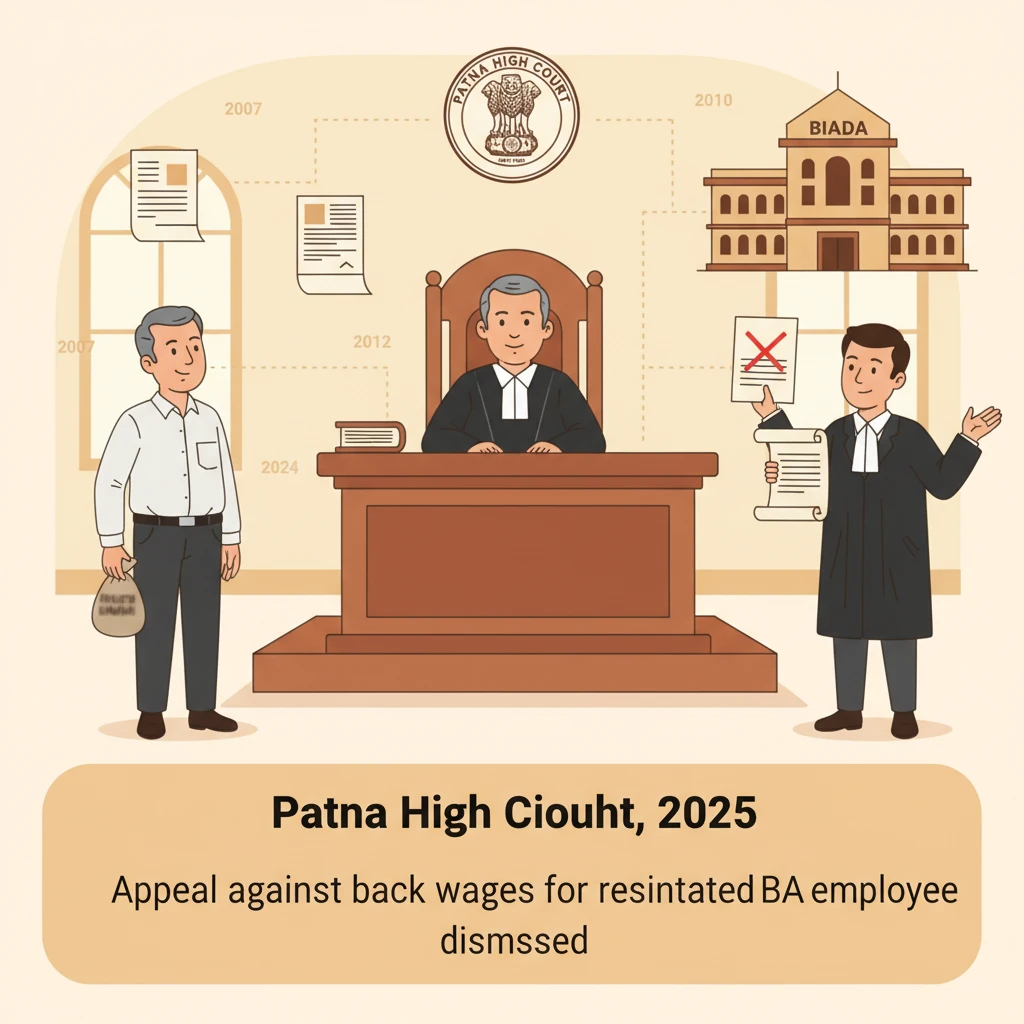
Case Background
The case concerns an employee of the Bihar Industrial Area Development Authority (BIADA), who was working as a Routine Clerk.
By Memo No.923 dated 30 April 2007, he was transferred as Area In-charge to Industrial Area, Buxar.
While serving as Area In-charge, he received two applications addressed to the Executive Director, BIADA, Patna.
One application was from a unit named Tractor Engineers. That firm stated it was unable to run its unit and requested permission to transfer the unit, along with all movable and immovable assets, to Minakshi Industries.
The second application was from Arun Kumar Mishra, Proprietor of M/s Minakshi Industries, also requesting transfer of the unit in his name.
Acting in his capacity as Area In-charge, the employee forwarded both applications by communication dated 06.09.2007.
A dispute then arose regarding this transfer issue. Subsequently, the employee was suspended by Memo No.3889 dated 21.09.2007 and departmental proceedings were initiated against him.
After conclusion of the departmental proceedings, the Managing Director of BIADA, acting as disciplinary authority, imposed the punishment of compulsory retirement by order dated 03.11.2007.
The employee filed an appeal before the Chairman, BIADA. That appeal remained pending for almost two years.
Due to this delay, he approached the Patna High Court in CWJC No.18332 of 2009. On 14.01.2010, the High Court directed the Chairman, BIADA to decide the appeal within a specified time.
Thereafter, the Chairman dismissed the appeal by order dated 18.01.2010.
The employee then challenged this dismissal in CWJC No.10507 of 2010. By order dated 08.07.2010, the Patna High Court set aside the order dated 18.01.2010 and remitted the matter back to the Chairman, BIADA with a direction to hear the appeal afresh within a stipulated period.
Following this remand, the Chairman, BIADA passed a fresh appellate order on 03.02.2012. In that order, the appellate authority held that the punishment of compulsory retirement was disproportionate and set aside the order dated 03.11.2007.
The appellate authority ordered reinstatement and further observed that BIADA may issue a warning to the employee that, if he repeated a similar mistake in future, his services could be terminated without any show-cause notice.
After this order, the employee was reinstated. However, BIADA did not grant him back wages for the period between the order of compulsory retirement and his reinstatement.
Aggrieved by the denial of back wages, he filed CWJC No.19779 of 2015 before the Patna High Court.
By judgment dated 15.01.2024, the learned Single Judge allowed the writ petition and directed BIADA to pay arrears of salary from 03.11.2007 to 10.02.2012.
BIADA and its officials, as original respondents, then filed the present Letters Patent Appeal (L.P.A. No.317 of 2024) challenging the Single Judge’s direction on back wages.
What the Court Examined and Decided
The Division Bench of the Patna High Court, comprising Hon’ble the Chief Justice and Hon’ble Mr. Justice Partha Sarthy, first dealt with an interlocutory application (I.A. No.01 of 2024) filed under Section 5 of the Limitation Act.
This application sought condonation of a 43-day delay in filing the Letters Patent Appeal.
After hearing both sides and considering the reasons mentioned in the interlocutory application, the Court found that the appellants had shown sufficient cause for the delay.
The delay of 43 days was condoned, and the interlocutory application was allowed. The Court then proceeded to hear the appeal on merits.
On merits, the central question was whether the employee, whose compulsory retirement had been set aside by the BIADA appellate authority leading to reinstatement, was entitled to back wages for the period from 03.11.2007 to 10.02.2012.
The learned counsel for the appellants (BIADA and its officers) attacked the Single Judge’s judgment mainly on two grounds.
First, they argued that the learned Single Judge had wrongly relied on Rule 97 of the Bihar Service Code. According to the appellants, the employee had not been “fully exonerated” by the appellate authority, and therefore, under Rule 97, he could not claim full back wages.
Second, they contended that the direction to pay back wages was erroneous in law. To support their stand, they relied on the Supreme Court decision in Deepali Gundu Surwase v. Kranti Junior Adhyapak Mahavidyalaya (D.ED) & Ors., (2013) 10 SCC 324, especially paragraph 38.3.
On the other side, counsel for the respondent (original writ petitioner) supported the Single Judge’s decision.
They pointed out that the BIADA appellate authority itself had set aside the order of compulsory retirement on 03.02.2012 on the ground that the punishment was disproportionate and had ordered reinstatement.
Importantly, this appellate order had never been challenged by BIADA before the High Court. Therefore, BIADA could not now seek to avoid the financial consequences flowing from that order.
The respondent’s counsel argued that, once the order of compulsory retirement was set aside and reinstatement was ordered, the natural consequence was restoration of salary for the intervening period, particularly when the employer did not plead or prove that the employee was gainfully employed elsewhere.
They, too, relied on the Supreme Court decision in Deepali Gundu Surwase, and additionally on a recent decision of the Patna High Court in Rakesh Roshan Gupta v. The Chairman-cum-Managing Director, State Bank of India & Ors., reported in 2025 (2) PLJR 120.
The Division Bench carefully reviewed the litigation history and the orders passed at each stage.
It noted that departmental proceedings had ended in the disciplinary authority imposing compulsory retirement, which was then challenged in appeal before the Chairman, BIADA.
In the first round, the appeal was delayed, leading to CWJC No.18332 of 2009. The High Court then directed that the appeal be decided within a specified time.
When the appeal was dismissed by order dated 18.01.2010, the High Court, in CWJC No.10507 of 2010, set aside that appellate order and remanded the matter.
In the second round, the appellate authority, by order dated 03.02.2012, set aside the punishment of compulsory retirement as disproportionate and directed reinstatement, adding only that BIADA could issue a warning for future conduct.
The Division Bench specifically noted that BIADA had not challenged this 03.02.2012 appellate order by filing any writ petition before the High Court.
This meant the appellate order had attained finality, including its finding that the punishment of compulsory retirement was not justified and the direction to reinstate the employee.
The Bench then examined Rule 97 of the Bihar Service Code, which deals with pay and allowances when a government servant who has been dismissed, removed, or suspended is reinstated, and how the intervening period is treated.
Sub-rule (2) provides that where the competent authority is of the opinion that the government servant has been fully exonerated, or in case of suspension that it was wholly unjustified, full pay and allowances are to be given.
Sub-rule (3) covers “other cases,” where a proportion of pay and allowances may be granted.
The appellants argued that the case fell in the “other cases” category, as the employee was not fully exonerated and a warning had been contemplated.
The Division Bench, however, held that Rule 97 did not assist the appellants in the facts and circumstances of this case.
The key consideration was that the appellate authority had already set aside the compulsory retirement order, and that order was not challenged.
In effect, the disciplinary order that severed the employee’s service was undone, and he was restored to service.
The Court then turned to the Supreme Court’s judgment in Deepali Gundu Surwase.
It quoted paragraph 22, where the Supreme Court explained that reinstatement, after a finding that the employer’s action is illegal or contrary to statutory provisions or natural justice, normally entitles the employee to claim full back wages.
The Supreme Court further held that, if the employer wants to deny back wages or contest consequential benefits, it must specifically plead and prove that the employee was gainfully employed during the intervening period and was earning similar emoluments.
Otherwise, denial of back wages would amount to indirectly punishing the employee for the employer’s illegal act and rewarding the employer by relieving it from paying dues.
The Patna High Court Bench also noted that, in cases of gross violation of statutory provisions or principles of natural justice, courts are justified in directing full back wages, and superior courts should not lightly interfere with such directions.
The Division Bench referred to its own similar approach in Rakesh Roshan Gupta’s case.
On the facts of this case, the Bench highlighted that the employee had clearly stated in paragraph 1(i) and paragraph 17 of his writ petition that he was not in gainful employment during the period in question.
Crucially, the original respondents (BIADA and others) did not deny or controvert these averments in their counter affidavit.
Thus, there was no material on record to show that the employee earned any salary elsewhere during the period of compulsory retirement.
Taking all this into account, the Division Bench upheld the Single Judge’s reasoning.
It concluded that the Single Judge had not committed any error in directing BIADA to pay back wages for the period from 03.11.2007 to 10.02.2012.
Accordingly, the Letters Patent Appeal was dismissed. Any pending interlocutory applications were also disposed of.
Why This Judgment Matters
This judgment is significant for employees of statutory bodies and similar authorities in Bihar, including those working in organizations like BIADA.
It reinforces that when an order of compulsory retirement or similar major punishment is set aside in appeal and the employee is reinstated, the employer cannot casually deny back wages.
If the employer wants to avoid paying salary for the intervening period, it must specifically plead and prove that the employee was working elsewhere and earning adequately during that time.
Merely claiming that the employee was not fully exonerated, or pointing to a warning in the appellate order, is not enough to defeat a claim for back wages when the core punishment has been set aside.
The judgment also underlines that if an employer does not challenge an appellate order setting aside the punishment, it must accept not only reinstatement but also the financial consequences that naturally follow, in line with the Supreme Court’s ruling in Deepali Gundu Surwase.
For workers who face wrongful disciplinary action, this decision shows that the Patna High Court is willing to protect their right to full relief, including salary arrears, when the employer’s action is found unsustainable and when there is no proof of gainful alternative employment.
Legal Issues and Answers
-
Issue: Whether BIADA could deny back wages to an employee whose compulsory retirement was set aside by the appellate authority, resulting in reinstatement, on the ground that he was not fully exonerated under Rule 97 of the Bihar Service Code.
Answer: No. The Court held that, since the punishment of compulsory retirement was set aside and BIADA did not challenge that appellate order, and as there was no proof of gainful alternative employment, the employee was entitled to back wages for the relevant period. -
Issue: Whether the learned Single Judge erred in directing payment of back wages from 03.11.2007 to 10.02.2012 to the reinstated employee.
Answer: No. The Division Bench found no error in the Single Judge’s reliance on Rule 97 of the Bihar Service Code and the Supreme Court’s decision in Deepali Gundu Surwase. The direction to pay back wages was affirmed and the appeal was dismissed.
Cases Cited by the Court
- Deepali Gundu Surwase v. Kranti Junior Adhyapak Mahavidyalaya (D.ED) & Ors., (2013) 10 SCC 324
- Rakesh Roshan Gupta v. The Chairman-cum-Managing Director, State Bank of India & Ors., 2025 (2) PLJR 120
Case Details
Case Number: Letters Patent Appeal No.317 of 2024 in Civil Writ Jurisdiction Case No.19779 of 2015
Case Title: The Bihar Industrial Area Development Authority & Ors. v. Subhash Singh
Coram: Hon’ble the Chief Justice; Hon’ble Mr. Justice Partha Sarthy
Date of Judgment: 11.08.2025
Citation: 2025 (4) PLJR 33
Court: High Court of Judicature at Patna
Advocates:
- For the Appellants: Mr. Kumar Priya Ranjan, Advocate; Mr. Sudarshan Bharadwaj, Advocate
- For the Respondent: Mr. Prashant Sinha, Advocate; Mr. Shirish Anurag, Advocate; Mr. Amar Kumar Singh, Advocate
Nature of the Case: Letters Patent Appeal against a Single Judge order in a writ petition (service matter – claim for back wages after reinstatement following setting aside of compulsory retirement)
Link to Judgment: Patna High Court Judgment Link
If you found this explanation helpful and wish to stay informed about
how legal developments may affect your rights in Bihar,
you may consider following Samvida Law Associates for more updates.







