
Case Background
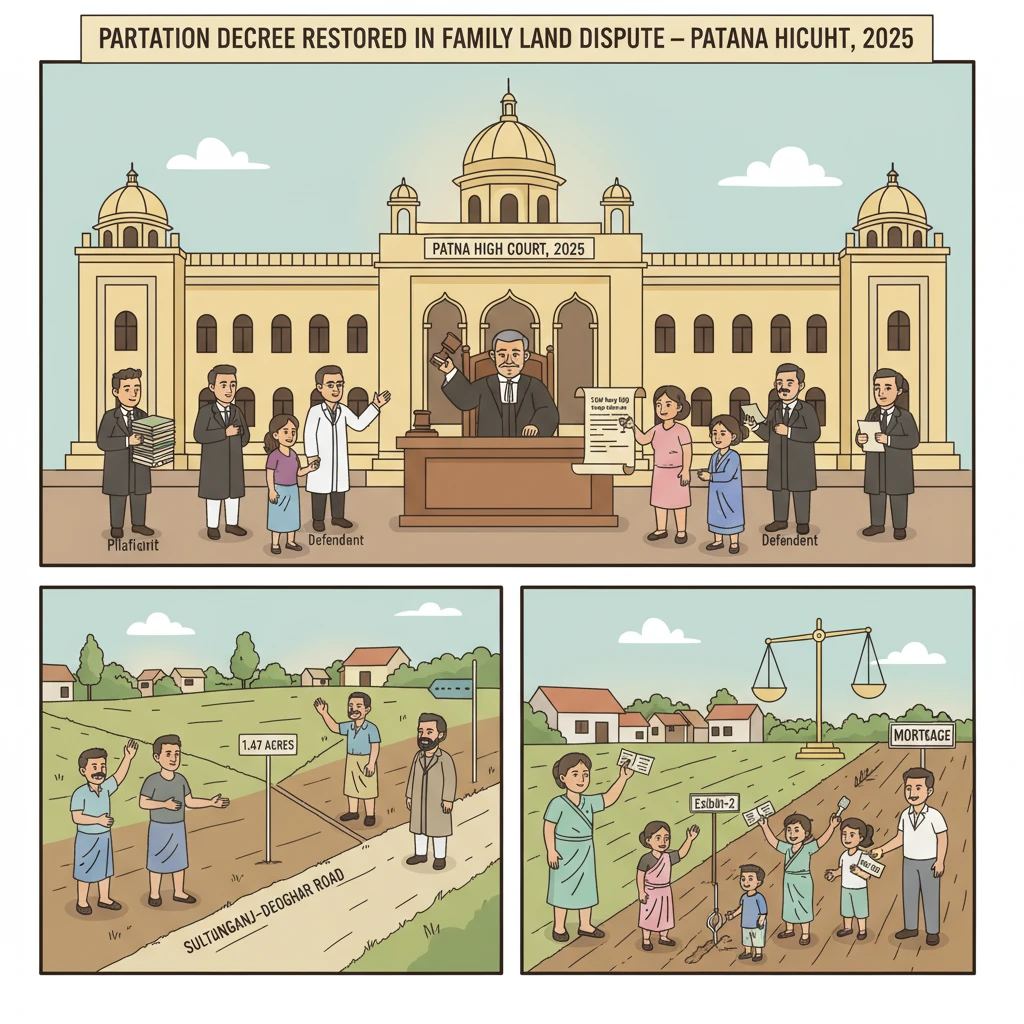
This case arises from a long-running family dispute over ancestral agricultural land situated in village Khesar, P.S. Belhar, District Banka, particularly land under Khata No. 161, C.S. Plot No. 680 measuring 1.47 acres, located along the Sultanganj–Deoghar road.
Both sides are descendants of a common ancestor, Mahipal Bhagat, who had five sons. One of his sons, Patiram Bhagat, had a son named Sini Ram @ Shivnandan Bhagat. The parties before the Court belong to the branch of Sini Ram Bhagat. He had two wives: from the first wife came Mahadev Bhagat; from the second wife came Jagdish Bhagat. The original plaintiffs represent the branch of Jagdish Bhagat; the main contesting defendants represent the branch of Mahadev Bhagat.
According to the plaintiffs, there was an oral family partition in 1929 between Patiram and Sini Ram, in which each got 1.47 acres out of a total 2.94 acres of land (Schedule-I). The land that fell to Sini Ram’s share became the suit land (described in Schedule-II of the plaint). Sini Ram died around 1938 in a state of jointness with his sons Mahadev and Jagdish, who jointly inherited the suit land.
The plaintiffs’ case is that, after Sini Ram’s death, the movable and other immovable properties were partitioned in 1942, but the suit land remained joint between the two branches. A separate Jamabandi was later created in the name of Mahadev and in the name of Tara Devi (wife of Jagdish), but the plaintiffs say this was only on paper and no partition by metes and bounds of the suit land ever took place.
During survey and consolidation operations, the plaintiffs allege that the authorities, in collusion with defendants, broke up the suit land into several new plots and wrongly recorded the front, road-side portion in the names of defendants, leaving the plaintiffs with the back portion. They challenge the separation of Jamabandi and survey entries as illegal and not binding.
A proceeding under Section 144 Cr.P.C. regarding the suit land was converted into a proceeding under Section 145 Cr.P.C. Both sides led evidence. The Magistrate, and later the revisional court (Additional District Judge-1st, Banka by order dated 01.09.1995), held that both parties were in joint possession of the suit land.
The plaintiffs had earlier filed a civil suit for permanent injunction during the pendency of survey and consolidation proceedings, which was dismissed for default. Because of recurring interference by the defendants, the plaintiffs then filed Title Suit No. 22 of 1997 before the Sub-Judge-1, Banka, seeking partition of half share in the suit land and appointment of a survey knowing pleader commissioner.
The defendants (mainly first and second party and minor defendants) appeared and filed written statements. The third party defendant (wife of Jagdish) did not file any written statement, nor did the fourth party defendants, who were said to be purchasers from defendants 1st and 2nd party. The defendants raised objections to maintainability and denied jointness, asserting that the land had already been partitioned in 1942 by a written family arrangement (Ekrarnama) and that both sides had been in separate possession since then.
What the Court Examined and Decided
The trial court framed six issues, of which Issue Nos. 2, 3 and 5, relating to unity of title and possession, validity of the alleged partition, and entitlement to partition, were crucial. It decreed the suit, holding that the parties were co-sharers with unity of title and possession in the suit land and that the plaintiffs were entitled to 8 annas (half) share.
The trial court carefully examined the Ekrarnama dated 1349 Fasli (1942), marked as Exhibit-7/Exhibit-A, and the usufructuary mortgage deed, Exhibit-2 (also referred as Exhibit-B), along with oral evidence. It found that Exhibit-7 did not contain any specific boundary allotment for the suit land to any branch and that the mortgage (Exhibit-2) did not prove a partition by metes and bounds of the disputed agricultural land in village Khesar.
The trial court concluded that the survey and consolidation records were not final so as to bar a civil suit on title, and held that the plaintiffs could claim their share in the more valuable, road-side portion; a co-sharer could not be deprived of valuable land merely because of survey entries. On this basis, it passed a preliminary decree declaring the plaintiffs’ half share.
On appeal, however, the Additional District & Sessions Judge, F.T.C.-3rd, Banka, in Title Appeal No. 60 of 2010, reversed the decree by judgment and decree dated 21.02.2011. The appellate court reasoned that both Exhibit-7 (Ekrarnama) and Exhibit-2 (mortgage deed) were admitted by both parties and showed that there had been severance of joint status and partition. It further held that plaintiffs were trying to challenge only part of the partitioned land, based on alleged disadvantage in location, which was impermissible. It found no unity of title or possession in the suit property and dismissed the suit.
In the Second Appeal before the Patna High Court, a substantial question of law was framed: whether the lower appellate court had correctly interpreted Exhibit-7 (Ekrarnama) and Exhibit-2 (usufructuary mortgage deed) to conclude that there had been partition by metes and bounds of the suit properties.
On behalf of the appellants (plaintiffs), it was argued that Exhibit-7 itself showed that while house properties were partitioned, the agricultural land in village Khesar (including the suit land in Khata No. 161) and some other lands were kept joint. They stressed that in Exhibit-7, the movable properties had already been divided, but the recital clearly stated that the agricultural lands and “Lahna” remained joint and that the produce was to be shared equally each year, with rent also paid half and half.
The appellants pointed out that Exhibit-2, the mortgage deed executed by Mahadev Bhagat in favour of Tara Devi (wife of Jagdish Bhagat), described 73.5 decimals – exactly half of 1.47 acres – of C.S. Plot No. 680, Khata No. 161 as mortgaged, and used the word “half” without any specific internal boundaries. They argued that if the land had already been divided by metes and bounds, the document would have shown distinct boundaries of Mahadev’s exclusive share; instead, the boundary mentioned in Exhibit-2 is of the entire 1.47 acres (North – Kamli Bhagat, South – Hospital, East – Chhotelal Bhagat, West – District Board road), not of a separated half.
The appellants also relied on the principle that joint family members can divide some properties and keep others joint, and that mere survey entries cannot take away substantive rights of co-sharers.
In reply, the respondents emphasised that the Ekrarnama (Exhibit-7/Exhibit-A) was a memorandum of partition in which, according to them, all movable and immovable properties had been divided, with nothing left joint. They argued that separate Jamabandi and separate rent receipts in the names of Mahadev and Tara Devi, along with the mortgage deed and consolidation proceedings, showed that there was long-standing separation.
They further submitted that Jagdish had earlier filed Consolidation Case No. 1 of 1978–79 under Section 8A of the Consolidation of Holdings and Prevention of Fragmentation Act for partition of the disputed property, which was dismissed on the ground that partition already took place in 1942. The appeal against the consolidation order was dismissed on 29.08.1983; the revision (No. 1948 of 1983) was dismissed on 24.04.1986. Since those orders were not challenged before the High Court, the respondents argued that the findings of partition attained finality and the civil court should not take a contrary view.
The High Court, after analysing the wording of Exhibit-7, noted that the document clearly made two important distinctions. First, it recorded that movable properties such as cash, ornaments and grains had already been divided half and half. Second, regarding immovable properties, it separately dealt with houses and agricultural land.
For the houses, the Ekrarnama clearly set out specific boundaries for the portions allotted respectively to Mahadev and to Sulochani with her sons. One house at Sadar Bazar near Mahaveer Sthan was divided with definite four-side boundaries for each share. Another house where Jagarnath Bhagat resided was similarly divided. These descriptions showed partition by metes and bounds of the house properties.
However, for the agricultural land at Mauza Khesar, the recitals were different. The document recorded that the land standing in the name of Mahadev, measuring 2 bigha 7 katha, was held in equal share by both branches. It further stated that the produce (usufruct) would be divided each year half and half and that both parties would pay government rent equally. The Ekrarnama also specifically recorded that except the land and “Lahna”, nothing remained joint, and that income from the joint land and Lahna would be divided every year.
From this, the High Court concluded that, by express wording, the agricultural lands, including the suit land, were deliberately kept joint. Only the houses were partitioned by metes and bounds. There was no recital that the agricultural lands had been divided into specific physical shares, nor any separate boundaries for any divided portion of the suit land.
Turning to Exhibit-2, the Court noted that it was an intra-family transaction: Mahadev mortgaging 73.5 decimals (half of 1.47 acres) of the suit plot to Tara Devi for a loan of Rs. 1,000/-. The boundary mentioned in Exhibit-2 matched the boundary of the whole 1.47-acre plot, even though only half was mortgaged. Crucially, the document used “half” without demarcating which half and without mentioning Jagdish or other co-sharers in the boundary. The Court treated this as consistent with joint ownership, where each co-sharer has a right in every inch of joint property, and not as proof of a physical partition into distinct parcels.
The High Court also referred to the oral evidence of P.W.-2, P.W.-3 and P.W.-6, who supported the plaintiffs’ case that the suit land (item 2 of Schedule-II) had not been partitioned.
On this basis, the Court held that the lower appellate court had misread and misinterpreted Exhibits 7 and 2. Instead of recognising that the Ekrarnama expressly kept agricultural land joint, the appellate court had wrongly inferred a complete partition by metes and bounds. Likewise, it had attributed to Exhibit-2 a legal effect it did not bear.
The High Court emphasised that a mere entry in survey records or Jamabandi cannot, by itself, destroy the substantive rights of co-sharers where the underlying family arrangement shows that the land remained joint. There is a presumption that family properties are joint, and that presumption had not been rebutted by cogent evidence in this case.
Consequently, the substantial question of law was answered in favour of the appellants. The High Court set aside the appellate court judgment dated 21.02.2011 in Title Appeal No. 60 of 2010, restored and affirmed the trial court’s judgment and decree dated 20.05.2010 in Title Suit No. 22 of 1997, and allowed the Second Appeal without any order as to costs.
Why This Judgment Matters
This judgment is important for families in Bihar and elsewhere who share ancestral land and face disputes after old oral or written family arrangements. The Patna High Court has clearly held that if a family document like an Ekrarnama shows that agricultural land was kept joint, later entries in Jamabandi or survey records cannot be used to deny a co-sharer’s right.
For villagers and small landholders, this means that even if the official records show separate names or front–back division of plots, the real question will be: what did the family actually agree in their partition document, and did they really divide the land by clear boundaries?
The decision also shows that when only houses are divided with boundaries, and the agricultural land is to be cultivated jointly with produce shared year to year, the Court will treat the agricultural land as still joint. Co-sharers cannot be pushed to the less valuable side (away from the road) merely by survey manipulation if the family arrangement keeps the land common.
Finally, the judgment underlines that appellate courts must read family documents carefully. They cannot lightly overturn trial court findings when documents plainly state that some properties remain joint.
Legal Issues and Answers
- Issue: Did the family Ekrarnama of 1942 (Exhibit-7) and the usufructuary mortgage deed (Exhibit-2) prove that the suit agricultural land in village Khesar had been partitioned by metes and bounds between the two branches of the family?
Answer: No. The Patna High Court held that Exhibit-7 expressly kept the agricultural land joint with equal shares and only partitioned the houses; Exhibit-2 merely showed an intra-family mortgage of an undivided half share without specific boundaries and did not establish partition by metes and bounds. - Issue: Was the lower appellate court justified in setting aside the trial court’s preliminary decree for partition on the basis of its interpretation of Exhibits 7 and 2?
Answer: No. The High Court found that the lower appellate court had wrongly interpreted these documents, ignored their clear recitals about joint agricultural land, and thereby erred in reversing the trial court. The trial court’s decree was restored.
Cases Cited by the Court
- The judgment records that counsel referred to several decisions, including Smt. Bijay Laxmi Kumar & Ors. v. Most. Shyama Devi & Ors. (2012) 4 PLJR 769, Pata Sahu and Another v. Hiru Sahu & Others AIR 1991 Pat 276, Sheikh Haider Zan v. Md. Yusuf Ansari & Another 2000 (2) PLJR 338, Ram Bahadur Nath Tiwary v. Kedar Nath Tiwary and Others AIR 1977 Pat 59, and Girijanandini Devi & Ors. v. Bijendra Narain Choudhary AIR 1967 SC 1124. The High Court’s core reasoning in this judgment, however, is drawn directly from the language of Exhibit-7 and Exhibit-2 and the evidence on record.
Case Details
Case Number: Second Appeal No. 238 of 2011
Case Title: Ranjana Devi @ Ranjan Devi & Ors. v. Shanti Devi & Ors.
Citation: 2025(3) PLJR 436
Court: High Court of Judicature at Patna
Coram: Hon’ble Mr. Justice Khatim Reza
Date of Judgment: 26-05-2025
Nature of the Case: Second Appeal arising out of a partition suit (Title Suit No. 22 of 1997), against the first appellate judgment in Title Appeal No. 60 of 2010.
Trial Court: Sub-Judge-1, Banka, in Title Suit No. 22 of 1997 (judgment and decree dated 20.05.2010)
First Appellate Court: Additional District & Sessions Judge, F.T.C.-3rd, Banka, in Title Appeal No. 60 of 2010 (judgment and decree dated 21.02.2011)
Appellants’ Advocates: Mr. Jitendra Prasad Singh, Senior Advocate; Mr. Manish, Advocate
Respondents’ Advocates: Mr. Shashi Shekhar Dwiwedi, Senior Advocate; Mr. Parth Gaurav, Advocate; Mr. Govind Raj Shalu, Advocate; Mr. Ashutosh Pandey, Advocate
Link to Judgment: Click here to read the full judgment of the Patna High Court
If you found this explanation helpful and wish to stay informed about
how legal developments may affect your rights in Bihar,
you may consider following Samvida Law Associates for more updates.







