
Simplified Explanation of the Judgment
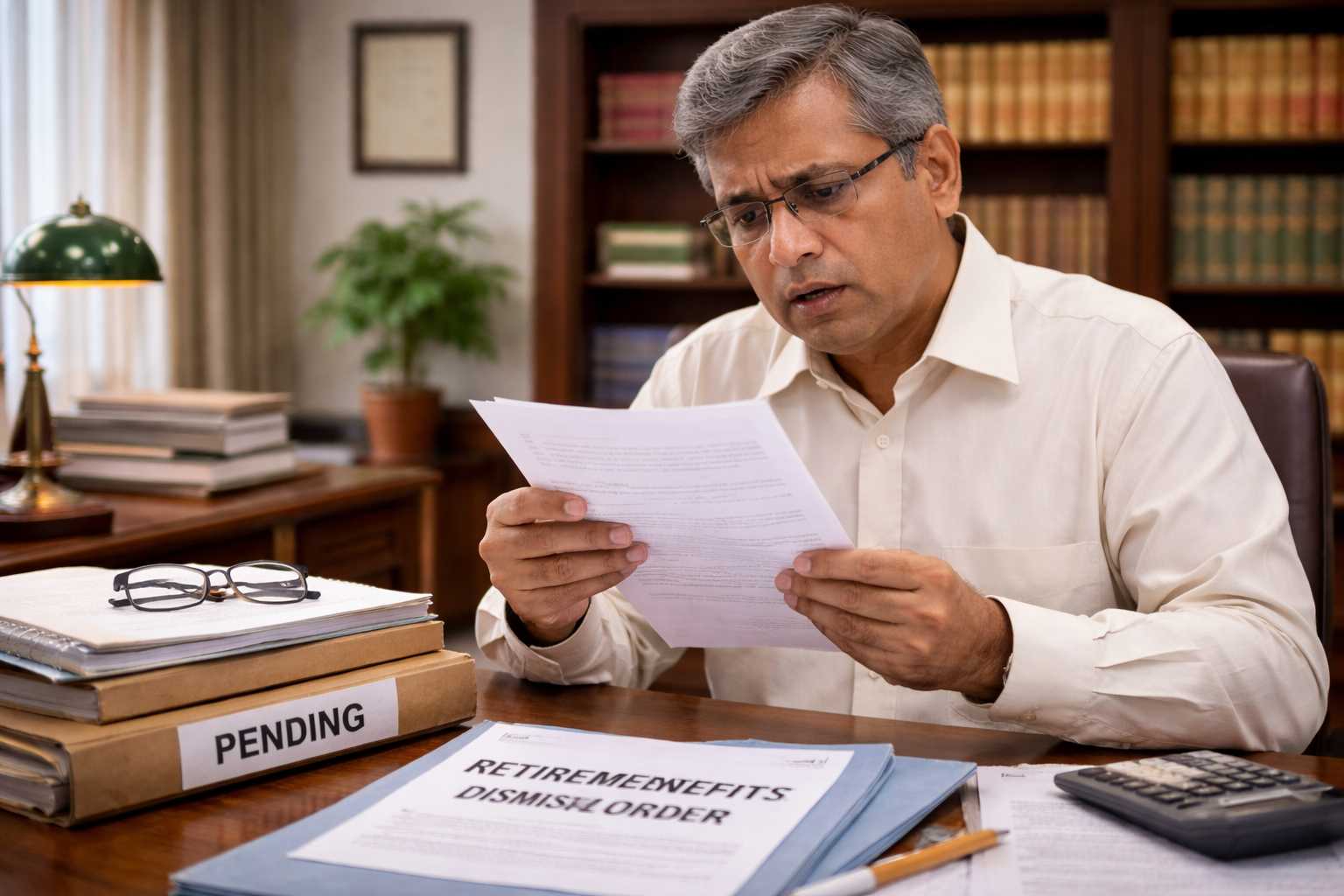
This judgment of the Patna High Court deals with a crucial service law issue concerning disciplinary action against a retired bank employee and the legality of imposing the penalty of dismissal after superannuation. The Court clearly held that once an employee retires from service, the employer cannot impose the punishment of dismissal unless the applicable service rules expressly permit such action.
The case was filed by a retired Scale-I officer of a regional rural bank, who approached the High Court after his retiral benefits such as gratuity, leave encashment, and retirement dues were withheld on the basis of disciplinary proceedings that culminated in an order of dismissal passed after his retirement.
The petitioner argued that the bank deliberately prolonged disciplinary proceedings even after his retirement, only to delay and deny payment of post-retiral benefits. According to him, the action of dismissal was not only illegal but also contrary to the Uttar Bihar Gramin Bank (Officers and Employees) Service Regulations, 2010.
The Patna High Court examined whether the bank had the authority to dismiss a retired employee and whether such dismissal could legally deprive the petitioner of his retirement benefits.
Factual Background of the Case
The petitioner was working as a Branch Manager in the respondent bank. While in service, he was served with charge memoranda dated 29.06.2013 and 28.05.2014, alleging certain misconduct. The petitioner submitted his explanations, but the disciplinary authority was not satisfied and proceeded with a departmental inquiry.
Important factual aspects noted by the Court were:
- The petitioner retired from service on 29.06.2013 on attaining the age of superannuation.
- Despite his retirement, the departmental inquiry was continued.
- The Inquiry Officer submitted a report holding the charges to be proved.
- The order of dismissal from service was passed on 22.10.2014, i.e., after the petitioner had already retired.
- The appellate authority confirmed the dismissal.
The petitioner challenged the entire disciplinary action, especially the dismissal order, and sought release of his retiral dues with interest.
Petitioner’s Main Legal Contentions
The petitioner raised the following key arguments before the High Court:
- Once an employee retires, the relationship of master and servant comes to an end, and the penalty of dismissal becomes meaningless and impermissible.
- Under the Service Regulations, 2010, there is no provision authorising dismissal of a retired employee.
- The bank could not rely on disciplinary rules meant for serving employees to impose a major penalty after superannuation.
- The Inquiry Officer’s report was not supplied to him in advance, thereby denying him a proper opportunity to respond.
- The entire exercise was intended only to delay payment of gratuity and other retiral benefits.
Stand of the Bank Authorities
The respondent bank justified its action by relying on Regulation 45 of the Service Regulations, 2010, which deals with disciplinary proceedings after retirement. The bank argued that:
- Even after retirement, disciplinary proceedings can continue.
- Regulation 45 permits passing of final orders after conclusion of the inquiry.
- Therefore, the dismissal order was valid.
The bank also filed an affidavit asserting that disciplinary proceedings can legally be continued even after retirement.
Issues Examined by the High Court
The central issue before the Court was:
Whether the disciplinary authority had the power under the Service Regulations, 2010 to impose the penalty of dismissal from service on a retired employee?
To answer this, the Court undertook a close examination of the relevant regulations.
Interpretation of Service Regulations by the Court
The Court analysed Regulation 1(3) of the Service Regulations, 2010, which clearly states that the regulations apply to officers and employees of the bank. The Court noted that once an employee retires, he no longer falls within the category of “officer or employee” unless the regulations specifically provide otherwise.
The Court also examined Regulation 45, which permits continuation of disciplinary proceedings after retirement. However, the Court made an important distinction:
- Regulation 45 allows continuation and conclusion of disciplinary proceedings.
- It does not automatically authorise imposition of all penalties, particularly the penalty of dismissal, after retirement.
The Court observed that dismissal is a penalty relevant only to a serving employee, as it severs the employer-employee relationship. Once that relationship has already ended by superannuation, dismissal becomes legally unsustainable unless expressly provided for.
Reliance on Supreme Court Principles
The High Court reiterated the settled principle that service law judgments must be interpreted strictly in light of the applicable service rules. In the absence of an express provision authorising dismissal of a retired employee, such a penalty cannot be inferred or implied.
The Court emphasised that disciplinary powers cannot be exercised beyond the scope of the governing regulations, even if misconduct is alleged.
Findings of the Patna High Court
After analysing the regulations and facts, the Court recorded the following findings:
- The Service Regulations, 2010 do not apply to retired employees for the purpose of imposing dismissal.
- The bank failed to show any provision permitting dismissal after superannuation.
- The dismissal order passed on 22.10.2014, after the petitioner’s retirement, was without authority of law.
- Consequently, the confirmation of dismissal by the appellate authority was also unsustainable.
Final Decision and Directions
Based on the above reasoning, the Patna High Court:
- Quashed the charge memoranda and dismissal order issued against the petitioner.
- Held that the disciplinary action taken after retirement was illegal.
- Directed the respondent bank to settle and release all retiral dues, including gratuity and leave encashment.
- Ordered that the entire payment be made within three months from receipt of the judgment.
- Directed payment of interest at 6% per annum if the dues were not released within the stipulated period.
Significance or Implication of the Judgment
This judgment has wide importance for bank employees and public sector personnel:
- It protects retired employees from illegal disciplinary penalties imposed after superannuation.
- It reinforces that retiral benefits cannot be withheld arbitrarily by continuing proceedings without statutory backing.
- It clarifies that continuation of inquiry does not automatically mean power to dismiss.
- It ensures dignity and financial security of retired employees.
For employers, the ruling serves as a caution that disciplinary powers must strictly flow from service rules and cannot be exercised on assumptions.
Legal Issue(s) Decided and the Court’s Decision
- Can a retired employee be dismissed from service?
➤ No, unless expressly permitted by service regulations. - Does Regulation 45 allow dismissal after retirement?
➤ No, it only permits continuation of proceedings, not imposition of dismissal. - Are retiral benefits liable to be released?
➤ Yes, once dismissal is held illegal.
Judgments Referred by Parties (with citations)
- Nair Service Society v. Dr. T. Beermasthan, (2009) 5 SCC 545
Judgments Relied Upon or Cited by Court (with citations)
- Nair Service Society v. Dr. T. Beermasthan, (2009) 5 SCC 545
Case Title
Retired Bank Officer v. Uttar Bihar Gramin Bank & Others
Case Number
Civil Writ Jurisdiction Case No. 12297 of 2014
Citation(s)
2023 (1) PLJR 612
Coram and Names of Judges
Hon’ble Mr. Justice P. B. Bajanthri
Names of Advocates and who they appeared for
- For the Petitioner:
Mr. Santosh Kumar Sinha, Advocate
Mr. Uttam Kumar Mishra, Advocate - For the Respondents:
Mr. Prashant Vedasen, Advocate
Mr. Pawan Kumar, Advocate
Link to Judgment
MTUjMTIyOTcjMjAxNCMxI04=-AtYCbkzffx0=
If you found this explanation helpful and wish to stay informed about how legal developments may affect your rights in Bihar, you may consider following Samvida Law Associates for more updates.







