
- Simplified Explanation of the Judgment
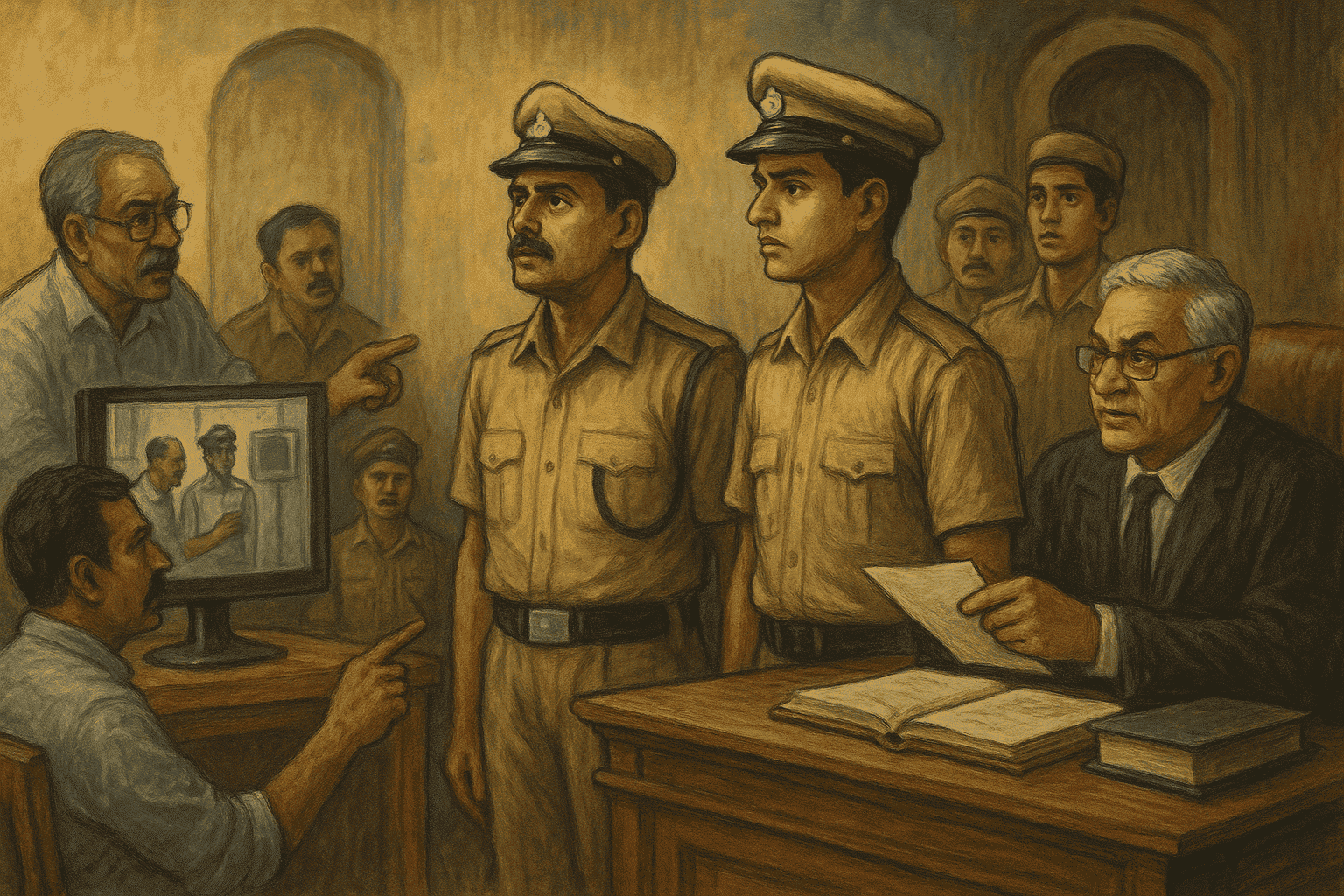
This Patna High Court judgment concerns two writ petitions filed by two newly recruited Police Sub Inspectors of Bihar who were dismissed from service during their basic training period on allegations of tampering with a CCTV camera installed at the training centre. The Court examined whether the departmental enquiry leading to their dismissal complied with the Bihar Government Servants (Classification, Control & Appeal) Rules, 2005 and basic principles of natural justice.
Both petitioners had been selected as Police Sub Inspectors and joined service on 01.06.2019. In February 2021, they were sent for basic training at the Bihar Special Armed Police Force-04, Dumraon, under the Bihar Police Academy, Rajgir. After completing their outdoor training and successfully clearing outdoor tests, they were scheduled to appear in internal examinations between 31.05.2021 and 14.06.2021.
According to the department, two days prior to the internal examination, when CCTV cameras were being installed in the examination hall, both petitioners along with another person allegedly tampered with the CCTV camera. Based on this allegation, they were debarred from appearing in the final examination and disciplinary proceedings were initiated.
Initially, a show-cause notice was issued and the petitioners submitted their replies, denying any tampering and stating that they had not even touched the CCTV camera. They also pointed out that several other trainees were present in the room at the relevant time. Despite this, the department proceeded to frame a charge memo and appointed an enquiry officer and presenting officer. During enquiry, in one case 5 departmental witnesses were examined; in the other, 7 witnesses were examined. Eventually the enquiry officer held the charges proved, and on that basis, the disciplinary authority passed orders dismissing both petitioners from service in April 2022. Their departmental appeals and memorials were also rejected, prompting them to approach the High Court.
Before the Court, the petitioners raised two main grounds:
- First, that the charge memo did not contain any list of witnesses proposed to be examined, contrary to Rule 17(3) of the 2005 Rules, which mandates that along with the articles of charge, a statement of imputations must be supplied, including a list of documents and a list of witnesses by whom the charges are proposed to be sustained.
- Second, that the most crucial witness – the operator of the CCTV camera – was neither cited nor examined, and none of the witnesses actually claimed to have seen the petitioners tampering with the camera. At best, the evidence only showed that the petitioners were present in the room and appeared in the CCTV footage, along with other trainee officials.
The State, on the other hand, argued that there was sufficient material on record for the enquiry officer to conclude that the petitioners had tampered with the CCTV camera and that the dismissal orders were justified.
The Court carefully examined Rule 17(3) of the 2005 Rules. The Rule clearly states that when a major penalty enquiry is proposed, the disciplinary authority must draw up:
- definite and distinct articles of charge; and
- a statement of imputations containing all relevant facts, along with a list of documents and a list of witnesses by whom the articles of charge are proposed to be sustained.
On perusing the charge memo issued to the petitioners, the Court found that no list of witnesses had been prepared or supplied to them. This deficiency was admitted in the counter affidavit filed by the respondents. The Court therefore held that there was a clear violation of Rule 17(3), rendering the enquiry procedurally defective.
Regarding the second ground, the Court noted that the CCTV operator, Rahul Kumar, who had allegedly shown the relevant footage to others, was never examined. The witnesses who did depose merely stated that, according to the CCTV footage shown by the operator, the petitioners were seen in the room. None of the witnesses stated that they saw the petitioners tampering with or touching the CCTV camera. Further, the other trainee officials present in the room at the time were also not examined.
The Court held that these individuals – the CCTV operator and the other trainees present – were the most crucial witnesses who could have proved whether the CCTV camera was tampered with and, if so, by whom. The non-examination of such key witnesses created a serious gap in the evidence. The material on record only established that the petitioners were present in the room and appeared in the CCTV footage, which by itself did not prove tampering. Suspicion based merely on presence could not substitute legal proof of misconduct.
In support of this reasoning, the Court referred to the Supreme Court’s decision in Roop Singh Negi v. Punjab National Bank & Others, (2009) 2 SCC 570. The Supreme Court had held that disciplinary and appellate orders, having severe civil consequences, must be supported by reasons and based on some legally admissible evidence, and that mere surmises, conjectures, or suspicion, however strong, cannot replace proof.
Applying these principles, the Patna High Court concluded that:
- Rule 17(3) was violated because no list of witnesses was supplied with the charge memo; and
- On merits, there was no reliable evidence to establish that the petitioners had actually tampered with the CCTV camera.
Consequently, the Court held the entire disciplinary proceedings in both cases to be illegal. It quashed the enquiry reports dated 05.03.2022, the punishment orders dated 05.04.2022, the appellate orders dated 06.06.2023, and the orders passed in memorial dated 09.01.2024. The Court directed that both petitioners be reinstated to their posts with all consequential benefits, to be given within three months from receipt/production of the order.
- Significance or Implication of the Judgment (For General Public or Government)
This judgment is important for government employees and departments in Bihar, especially in the police force, for several reasons:
- It reinforces that departmental enquiries, particularly those leading to major penalties like dismissal, must strictly comply with the procedural safeguards in the Bihar Government Servants (CCA) Rules, 2005.
- It clarifies that simply alleging misconduct based on CCTV footage or suspicion is not enough. The evidence must be properly proved through the right witnesses, and key persons such as CCTV operators or eye-witnesses cannot be bypassed.
- It sends a message to disciplinary authorities and training institutions that decisions affecting a person’s livelihood and career must not be based on incomplete or weak evidence.
- For government servants, it underscores that if an enquiry is conducted without following mandatory rules—such as providing a list of witnesses or documents—such proceedings can be challenged before the High Court.
- For the general public, it shows the Court’s role in protecting procedural fairness and natural justice, even in internal service matters of the police, which have significant public impact.
Overall, the judgment strengthens due process standards in departmental proceedings and serves as a reminder that “suspicion is not proof” even in internal disciplinary matters.
- Legal Issue(s) Decided and the Court’s Decision with Reasoning
- Whether non-supply of a list of witnesses with the charge memo violates Rule 17(3) of the Bihar Government Servants (CCA) Rules, 2005.
- The Court held that Rule 17(3) expressly requires that, along with the charges and statement of imputations, a list of documents and a list of witnesses must be supplied.
- In this case, no list of witnesses was prepared or served on the petitioners, a fact admitted by the respondents.
- Therefore, the Court found a clear violation of Rule 17(3), rendering the enquiry procedurally defective.
- Whether the departmental findings that the petitioners tampered with the CCTV camera were supported by reliable evidence.
- The most material witness, the CCTV operator, was not cited or examined.
- Other trainees present at the relevant time were also not examined.
- The witnesses examined only stated that the petitioners appeared in the CCTV footage; none claimed to have seen them tampering with or touching the camera.
- The Court held that mere presence in the room and appearance in CCTV footage cannot, without more, prove tampering.
- Standard of proof and application of principles of natural justice in departmental enquiries.
- Relying on Roop Singh Negi v. Punjab National Bank & Others, the Court reiterated that disciplinary orders must be based on some legally admissible evidence and must be supported by reasons.
- Suspicion, assumptions, or conjectures cannot substitute legal proof, particularly where orders entail severe civil consequences like dismissal from service.
- Validity of the punishment and appellate orders.
- Since the enquiry itself was vitiated by violation of mandatory rule and lack of reliable evidence, the punishment orders, appellate orders, and memorial orders could not stand.
- Accordingly, the Court quashed all such orders and directed reinstatement with all consequential benefits.
- Judgments Referred by Parties
- Roop Singh Negi v. Punjab National Bank & Others, (2009) 2 SCC 570.
- Judgments Relied Upon or Cited by Court
- Roop Singh Negi v. Punjab National Bank & Others, (2009) 2 SCC 570.
- Case Title
- Manish Prajapati v. The State of Bihar & Others
- Skant Kumar Gupta v. The State of Bihar & Others
- Case Number
- Civil Writ Jurisdiction Case No. 1638 of 2024
- Civil Writ Jurisdiction Case No. 1111 of 2024
- Citation(s)
2025 (2) PLJR 293
- Coram and Names of Judges
- Hon’ble Mr Justice Arvind Singh Chandel
- Names of Advocates and Who They Appeared For
- For the petitioners (in both writ petitions):
- Mr. Vinay Ranjan, Advocate
- For the respondents/State (in CWJC No. 1638 of 2024):
- Mr. Government Pleader 5
- For the respondents/State (in CWJC No. 1111 of 2024):
- Mr. Government Pleader 23
- Link to Judgment
MTUjMTYzOCMyMDI0IzEjTg==-N3WAQOXE8UM=
If you found this explanation helpful and wish to stay informed about how legal developments may affect your rights in Bihar, you may consider following Samvida Law Associates for more updates.







