
Act No.: Bihar Act 22 of 1954
Year: 1954
Last Updated (article): 12 November 2025
Official Clean PDF: https://drive.google.com/file/d/1TD-tE_k5EccdwTrn6P-UWv6e8UfbCKyu/view?usp=share_link
Introduction
The Bihar Bhoodan Yagna Act, 1954 was enacted to legally support the Bhoodan movement inspired by Acharya Vinoba Bhave. It creates a statutory framework for accepting voluntary donations of land, vesting such land in a public committee, and granting it to landless persons (and, in some cases, to village communities, Gram Panchayats, or co-operative societies). The Act also sets up procedures for objections, appeals, ejectment of unlawful occupants, and recovery of dues as public demands.
Structure of the Act
| Part/Chapter | Subject | What it deals with |
|---|---|---|
| Chapter I | Preliminary | Short title, extent/commencement, and definitions (e.g., “Bhoodan Yagna,” “Committee,” “landless person,” “Revenue Officer”). |
| Chapter II | The Bihar Bhoodan Yagna Committee | Establishment, powers, composition, terms, business, and dissolution of the Committee. |
| Chapter III | Donation, Vesting & Grant of Land | How land is donated (Danpatra), publication and inquiry, vesting in the Committee, and grant to landless persons with restrictions. |
| Chapter IV | Revenue, Appeals & Penalties | Appeals/revisions, division of holding and rent assessment, protection to grantees, ejectment processes, recovery as public demand, penalties. |
| Chapter V | Miscellaneous | Regulation- and rule-making powers. |
If the official text uses “Jharkhand Bhoodan Yagna Act” in Section 1 due to later state reorganization copies, the extent clause for this edition covers Bihar; substantive Bihar provisions remain as extracted.
Key Provisions Explained
Section 3 – Bihar Bhoodan Yagna Committee
- The State establishes a statutory Committee (body corporate) to receive and manage Bhoodan lands and to grant them according to the Act’s purposes. It has perpetual succession, can hold property, sue and be sued, and perform contracts necessary for the Act.
Sections 4–9 – Composition, Functioning & Dissolution
- Chairman (with 4–9 members), appointment/publication in Gazette, four-year term, meeting/quorum rules, and power of the State to dissolve the Committee and temporarily assume its functions in specified contingencies.
Section 10 – Donation of Land (Bhoodan Yagna Danpatra)
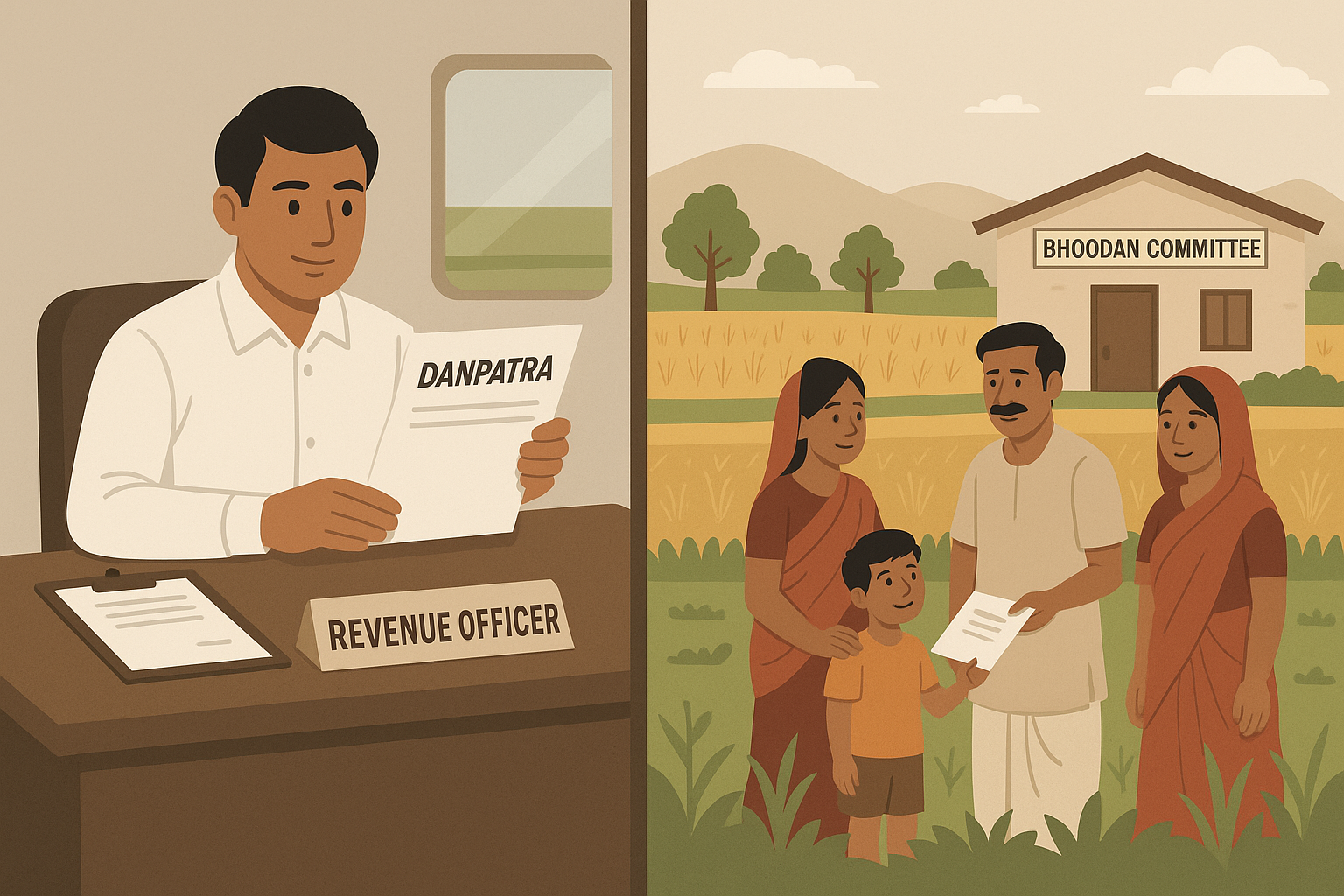
- Any owner may donate by a written Danpatra; certain categories (e.g., cremation grounds, service tenures, notified forests, mineral lands) cannot be donated. Danpatra must be filed before the Revenue Officer.
Example (Bihar): A raiyat donates 1 acre of cultivable land via Danpatra at the Circle Office; the Revenue Officer receives and processes it.
Section 11 – Publication, Objections & Inquiry
- After receipt, the Revenue Officer publishes the Danpatra inviting objections (30 days), conducts summary inquiry into the donor’s title/competency, hears parties if objections are filed, and either supersedes (wholly/partly) or confirms the Danpatra. Civil-court powers are conferred for summoning evidence; proceedings are deemed judicial.
Sections 12–13 – Special Cases & Vesting
- Declarations made by ex-proprietors/tenure-holders (post-vesting under the Bihar Land Reforms Act, 1950) can be treated as Danpatras. On confirmation, the donor’s right, title and interest vest in the Committee from the date of donation.
Section 14 & 14A – Grant to Landless Persons and Protection
- The Committee (or its delegate) grants vested land to landless persons (or village community/Gram Panchayat/co-op). The grantee ordinarily acquires the same interest as the donor, but with safeguards: no sub-letting/transfer (except exchange with prior written permission), and other prescribed conditions. Limited mortgage to banks/co-ops for agricultural loans is permitted. Section 14A protects grantees from unlawful ejectment and enables summary restoration.
Example: A landless agricultural worker in Gaya receives 50 decimals and is recorded as Bhoodan tenant; she cannot sell it but can obtain a crop loan by simple mortgage to a scheduled bank.
Section 16 – Interim Settlement Before Distribution
- Between vesting and final grant, the Committee may temporarily settle land for cultivation by a suitable person; no occupancy right accrues and the settlee is liable to ejectment on expiry. If the original donor continues in possession, he may be deemed a temporary settlee and owes rent for the interim period.
Section 17, 17A & 17B – Appeals, Record-Call & Superintendence
- Appeals lie within 60 days from Revenue Officer’s orders to the prescribed authority/Collector/Commissioner (as applicable), with limited civil-suit remedy (within six months). The Board/Commissioner may call for records to examine legality/propriety; Revenue Officers act under general control of Collector/Commissioner/Board.
Sections 18–20 – Rent, Tenancy Entry & Exemptions
- Division of holdings, assessment of rent, and recording the grantee as Bhoodan tenant in rent-rolls; Danpatras and Bhoodan grants are exempt from stamp duty and registration.
Sections 21, 22 & 22A – Determination & Ejectment
- Breach of grant conditions can lead to determination and restoration of possession to the Committee. Unlawful occupants of confirmed Bhoodan land can be ejected suo motu or on application; Section 22A prescribes notice to deliver possession or show cause, followed by forcible removal if needed, with recorded reasons.
Section 22B – Recovery as Public Demand
- Any amount payable to the Committee/State under the Act or rules is recoverable as a public demand (i.e., via certificate proceedings).
Section 23A – Penal Provision
- Disobedience or obstruction of lawful orders under 14A/22A is punishable with imprisonment up to one year or fine up to ₹2,000, or both; prior written sanction of the District Collector is required for cognizance.
Sections 24–25 – Regulations & Rules
- The Committee may frame regulations (form of Danpatra; grant conditions; scheme; max/min grant areas; interim settlement terms). The State Government may frame rules on procedures (inquiries, notices, confirmation/supersession, etc.).
Practical Implications in Bihar
- Donors: Only eligible lands can be donated. Expect public notice and a title/competency check before confirmation. Once confirmed, ownership vests in the Committee from the donation date.
- Landless households: Grants are heritable/occupancy-type interests (subject to tenancy laws) but are non-transferable (except exchange with permission). Protection from unlawful ejectment is available through the Revenue Officer.
- Gram Panchayats/Co-ops: May receive grants for community-centred cultivation or allied purposes, subject to the Act and regulations.
- Administration: Appeals lie within 60 days; further civil suit is permitted within six months in defined situations. Dues under grants/regulations are recoverable as public demand.
FAQs – Real Questions People Ask
1) Can all lands be donated under Bhoodan?
No. Certain categories (e.g., cremation grounds, notified forests, mineral lands, service tenures, etc.) are excluded from donation.
2) How long do objectors have to oppose a Danpatra?
30 days from publication; the Revenue Officer then holds a summary inquiry and may confirm or supersede the Danpatra.
3) Can a grantee sell the Bhoodan land?
No sale/gift/transfer is allowed; only exchange is permitted with the Committee’s prior written permission. Limited mortgage to banks/co-ops for agricultural loans is allowed.
4) I was thrown out from Bhoodan land I cultivate. What can I do?
Apply to the Revenue Officer under Section 14A for restoration; the officer can order delivery of possession and restrain unlawful ejectment.
5) Who hears appeals against the Revenue Officer’s orders?
Depending on the section and rank of the original officer: Collector/Commissioner/prescribed authority, within 60 days; limited civil-court suit within six months may also lie.
6) How are arrears/dues recovered under Bhoodan grants?
Amounts payable to the Committee/State are recoverable as public demand, enabling certificate proceedings.
Summary
The Bihar Bhoodan Yagna Act, 1954 transforms voluntary land-gift ideals into a complete legal process: donation via Danpatra, public notice and summary inquiry, followed by vesting of the donor’s interest in a statutory Committee and grant to landless persons or community institutions. Grants carry use-and-occupancy rights tailored to agrarian reform, are non-transferable, and benefit from ejectment protection and targeted access to agricultural credit. Administration is streamlined through defined appeals/revision, with civil-court oversight in a narrow window, and public-demand recovery powers to enforce obligations. For Bihar’s citizens, the message is practical: verify title before donation; for aspiring grantees, comply with grant conditions and use restoration mechanisms if dispossessed; for officials, follow the publication-inquiry-confirmation chain and record grantees as Bhoodan tenants with proper rent assessment.
Case Laws & Examples
- Protection of Grantees: Bihar courts have repeatedly emphasized using Section 14A/22A mechanisms (notice, restoration, show-cause, and recorded reasons) when grantees face dispossession, and have upheld the Committee/Revenue Officer’s statutory route over self-help.
- Public-Demand Recovery: Orders recognizing Section 22B allow recovery of sums payable under grants/regulations through the certificate process, aligning Bhoodan dues with other statutory recoveries.
(Illustrative principles drawn from the Act’s text; for specific citations, consult Patna High Court/Supreme Court judgments on Sections 14A, 22, 22A and 22B.)
Related Laws
- Bihar Land Reforms Act, 1950 – interacts with vesting/tenancy status in Sections 12 & 14.
- Bihar and Orissa Public Demands Recovery Act, 1914 – referenced conceptually via Section 22B (public demand recovery).
Conclusion & Disclaimer
🗣️ This article is part of Samvida Law Associates’ effort to simplify Bihar’s laws for public understanding. For individual legal problems, it is always advisable to consult a qualified advocate.
Disclaimer: This post is for informational purposes only and does not constitute legal advice.







