
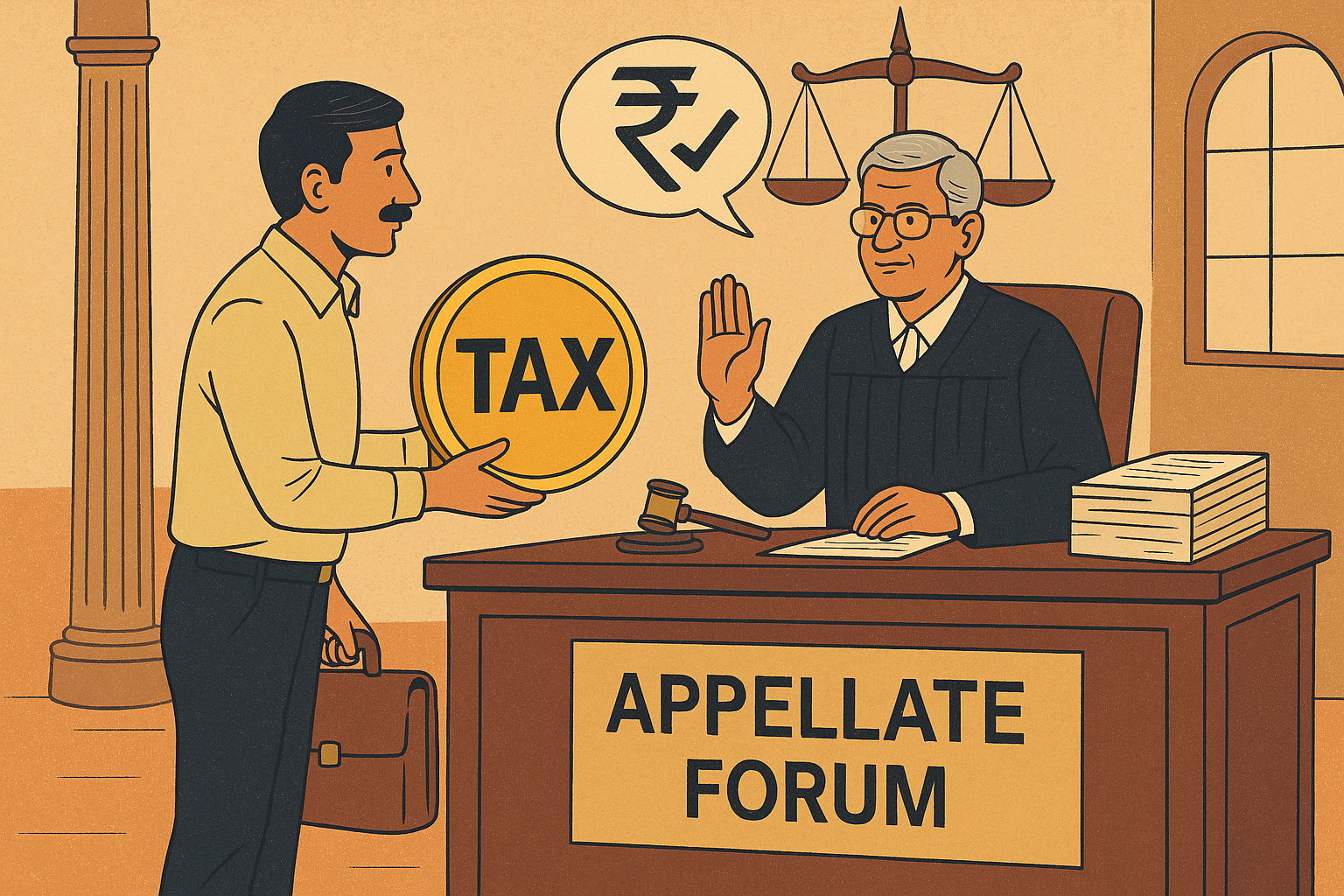
The Patna High Court, in a writ petition concerning a tax demand under the GST regime, permitted the petitioner to withdraw the writ and pursue the statutory appellate remedy before the Customs, Excise and Service Tax Appellate Tribunal (CESTAT). While doing so, the Court protected limitation by noting the Supreme Court’s pandemic-related extension and imposed a condition of depositing half of the principal demand within one month; failure would allow the department to proceed in accordance with law.
Simplified Explanation of the Judgment
This case arose from a tax demand raised by the central tax authorities against a registered entity. The aggrieved person initially approached the Patna High Court under Article 226 of the Constitution and obtained an interim order. As arguments progressed, counsel for the petitioner requested permission to withdraw the writ petition so that an appeal could be filed before the competent appellate forum, i.e., CESTAT. The High Court accepted this course.
A key hurdle in such situations is limitation—whether the time for filing an appeal has already expired. The High Court carefully addressed this. It recorded that the original order challenged by the petitioner was dated 22 February 2021, while the writ petition was filed on 29 January 2022. The Court then took judicial note of the Supreme Court’s suo motu directions extending limitation periods across the country due to COVID-19 disruptions. Specifically, the extension protected filings up to 90 days from 28 February 2022, thereby covering the petitioner’s window to pursue appellate remedies. In other words, the time that would ordinarily have counted against the petitioner was statutorily excluded by the Supreme Court’s blanket orders on limitation during the pandemic.
Having recognized that the appeal would still be within time because of the Supreme Court’s extension, the Patna High Court allowed the petitioner to switch tracks—from writ jurisdiction to the statutory appeal before CESTAT. However, the Court balanced equities. It noted that the matter had remained pending for a considerable period with an interim stay operating in the petitioner’s favour. To ensure fairness to the revenue and to discourage undue delay in pursuing the regular appellate channel, the Court directed the petitioner to deposit 50% of the principal amount demanded within one month. The Court further directed that the appellate papers be filed within one month from the date of deposit. This ensured that the shift to the appellate route would be genuine and time-bound.
Importantly, the High Court clarified that it had expressed no opinion on the merits of the tax dispute. This is consistent with settled practice: when a High Court relegates a litigant to a statutory remedy, it ordinarily refrains from deciding substantive issues. The Appellate Tribunal is left free to adjudicate the matter independently. The Court also specified consequences for non-compliance: if the deposit is not made or the appeal is not filed within the stipulated period, the department would be at liberty to proceed in accordance with law.
This order is concise but significant. It emphasizes that (i) High Courts will normally encourage litigants to utilize statutory appellate forums in tax matters; (ii) pandemic-era extensions declared by the Supreme Court continue to safeguard bona fide litigants where events fell within the protected period; and (iii) interim protections granted during writ proceedings may be tempered with conditions—such as a partial deposit—when litigants are redirected to the appropriate forum.
In practical terms, the petitioner now has a clear, time-bound pathway: deposit half of the principal demand within one month and then file the CESTAT appeal within one month from that deposit. If these steps are followed, the Tribunal will consider the matter afresh, without being influenced by any observation from the High Court, because none were made on merits.
Significance or Implication of the Judgment (For general public or government)
• For taxpayers: The order reassures taxpayers whose disputes originated during the pandemic that the Supreme Court’s limitation extensions may still protect their right to appeal, provided their timelines align with the protected windows. It also underscores that High Courts often prefer that tax disputes be resolved by specialized appellate bodies like CESTAT, which are equipped to examine factual records and apply sector-specific jurisprudence.
• For government and revenue authorities: The decision strikes an equitable balance. While permitting recourse to the statutory appellate channel, the Court guarded the revenue’s interest by directing a 50% deposit of the principal demand and by imposing clear timelines. This ensures that appellate remedies are pursued promptly and that stays obtained in writ proceedings do not unduly impede recovery.
• For legal practitioners: The order is a reminder to evaluate limitation through the lens of the Supreme Court’s pandemic orders whenever an impugned action or potential filing date falls between early 2020 and early 2022. It also signals that, absent exceptional circumstances, High Courts will avoid adjudicating merits if a specialized remedy exists, and may impose reasonable conditions when granting liberty to pursue that remedy.
Legal Issue(s) Decided and the Court’s Decision with reasoning
• Whether the petitioner should be permitted to withdraw the writ petition and avail the statutory appellate remedy before CESTAT.
Decision: Yes. The Court allowed withdrawal and granted liberty to file an appeal before CESTAT, recognizing that the dispute lies within the specialized appellate framework.
• Whether the appeal would be within limitation in light of the Supreme Court’s COVID-19 extension orders.
Decision: Yes. Since the impugned order (22.02.2021) and the filing of the writ petition (29.01.2022) fell within the period protected by the Supreme Court’s extension (90 days from 28.02.2022), the petitioner could pursue the appeal.
• What conditions, if any, should apply while permitting the shift to the appellate route.
Decision: The petitioner must deposit half of the principal demand within one month and file the appeal within one month from the date of deposit; failing this, the department may proceed in accordance with law. The Court recorded that no observations were made on merits, preserving the Tribunal’s independent adjudicatory role.
Case Title
M/S Sriwas Consultants Vs. The Union of India
Case Number
Civil Writ Jurisdiction Case No. 1623 of 2022.
Coram and Names of Judges
Hon’ble the Chief Justice (K. Vinod Chandran) and Hon’ble Mr. Justice Rajiv Roy.
Names of Advocates and who they appeared for
• For the petitioner: Mrs. Archana Shahi, Advocate; Mr. Alok Kumar, Advocate.
• For the Union of India/CGST & Central Excise: Dr. K.N. Singh, ASG; Mr. Anshuman Singh; Mr. Shivaditya Dhari Sinha, JC to ASG.
• For the public sector bank respondents: Mr. Rakesh Kumar Singh, Advocate.
• For the housing finance company respondent: Mr. Lakshman Lal Pandey, Advocate.
Link to Judgment
MTUjMTYyMyMyMDIyIzEjTg==-FTuUINSKPSo=
If you found this explanation helpful and wish to stay informed about how legal developments may affect your rights in Bihar, you may consider following Samvida Law Associates for more updates.







