
Simplified Explanation of the Judgment
This case arises from a petition filed under Section 482 of the Code of Criminal Procedure seeking to quash the order of the Sub-Divisional Judicial Magistrate, Purnea, who had taken cognizance under Section 7 of the Essential Commodities Act, 1955 (“EC Act”) in connection with the alleged illegal storage of domestic subsidized LPG cylinders. The Patna High Court, per Hon’ble Justice Shailendra Singh, dismissed the quashing petition on 27 February 2025.
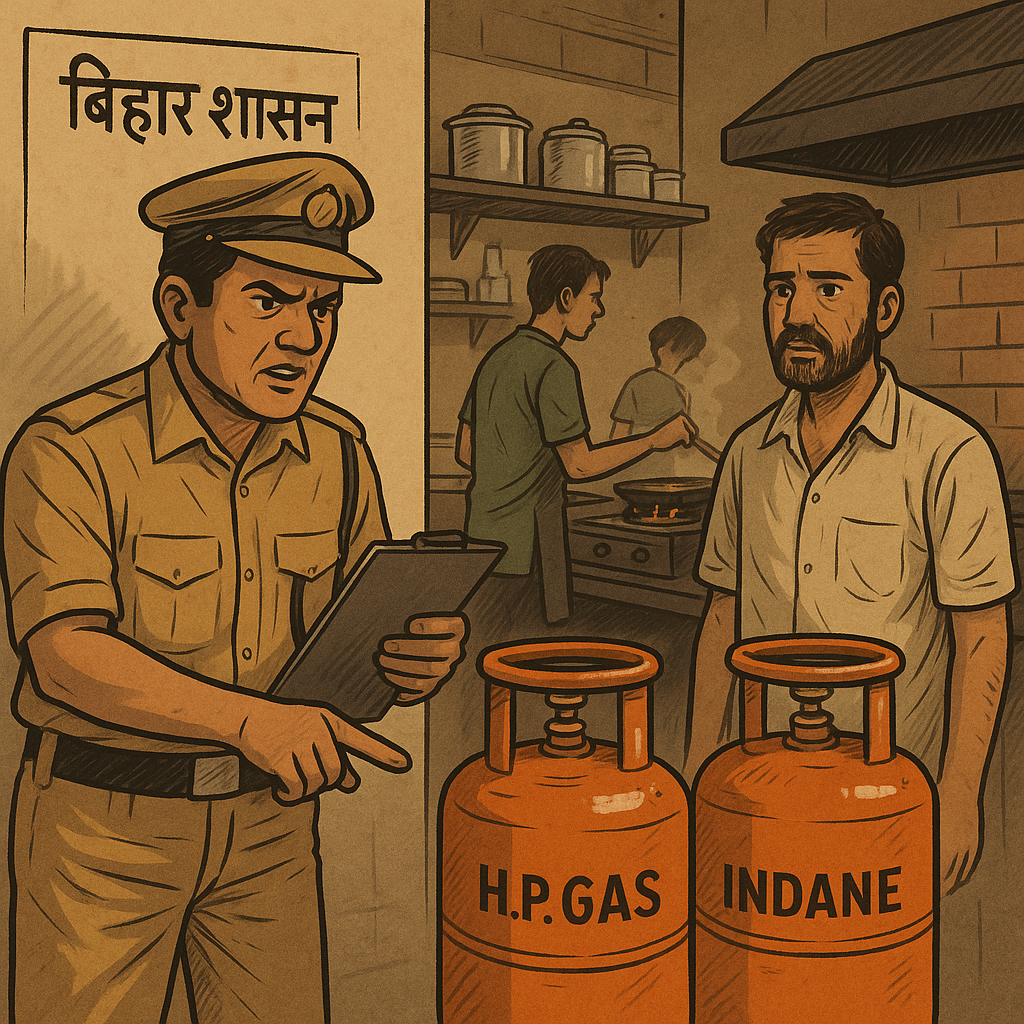
Background facts were straightforward. A team led by an Assistant District Supply Officer (ADSO) conducted a raid at a restaurant run by the petitioner. Eleven domestic subsidized LPG cylinders were found in a room adjacent to the kitchen—eight were full and three were empty; the cylinders bore markings of well-known oil companies. This seizure formed the basis of the FIR and subsequent cognizance by the Magistrate.
The petitioner advanced three principal grounds for quashing:
- Lack of authority to raid and search: It was argued that neither the Block Supply Officer (informant) nor any member of the raiding team was duly authorized to enter and search the premises under Clause 13 of the Liquefied Petroleum Gas (Regulation of Supply and Distribution) Order, 2000 (“LPG Order, 2000”). On this premise, the petitioner contended that the entire prosecution and investigation were vitiated. Reliance was placed on two Jharkhand High Court decisions: Sheela Sharma v. State of Jharkhand (Cr.M.P. No. 1046 of 2013) and Kanchan @ Kanchan Kumar Singh v. State of Jharkhand (Cr.M.P. No. 3153 of 2013).
- Liability restricted to PDS agents/dealers: The petitioner submitted that, being a private person, he could not be prosecuted under Section 7 of the EC Act, citing observations of this Court in Arvind Kumar v. State of Bihar (Cr. Misc. No. 21936 of 2011).
- Factual defence about ownership/use: The petitioner claimed the cylinders belonged to employees or relatives and were merely kept in a room adjacent to the kitchen, not used for commercial purposes.
The State opposed the petition. It maintained that there was no violation of Clause 13 of the LPG Order, 2000 since the informant’s rank was not below Inspector and, more importantly, Assistant District Supply Officers were empowered—citing a State notification (G.S.R.I. dated 18 January 2008 under the Motor Spirit and High Speed Diesel Order, 2005). The State also argued that the Arvind Kumar decision was inapplicable because it addressed kerosene black-marketing, not LPG. Finally, the State emphasized that recovery of a large quantity of domestic subsidized cylinders was an admitted fact and the petitioner’s factual defences were matters for trial.
The Court’s analysis proceeded in two steps. First, on the legal principle, the Court acknowledged that if a raid/search is conducted by an officer lacking authority under Clause 13 of the LPG Order, 2000, the proceedings are liable to be struck down. In support, the Court referred to the Supreme Court’s decision in Avtar Singh & Anr. v. State of Punjab, 2023 SCC OnLine SC 319, which underscores that action by an unauthorized officer vitiates proceedings under the relevant Control Orders.
Second, applying the principle to the facts, the Court found that in this case the raid was led by the ADSO, Sadar, Purnea, and that the Block Supply Officer was part of the team. Crucially, a Bihar Government notification dated 30 July 2005 (Extraordinary Gazette No. 413) specifically empowered the listed officers—including the ADSO—to conduct search and seizure under the LPG Order, 2000. The Court noted that although the State had inadvertently annexed a different notification relating to the Motor Spirit and High Speed Diesel Order, 2005, the correct notification was traced with the assistance of the Court’s office, and it supported the State’s position on authorization.
With authority established, the Court held that the seizure (eleven domestic subsidized cylinders) and supporting statements of prosecution witnesses in the case diary created a prima facie case under Section 7 of the EC Act. Therefore, the order taking cognizance suffered from no illegality. The petition was dismissed, leaving the petitioner’s factual defences—such as who owned the cylinders and how they were kept—for adjudication at trial.
Finally, the Court directed that an explanation be called from the Block Supply Officer, Purnea, for filing an irrelevant copy of a Gazette Notification despite giving correct details in the affidavit, and listed the matter for the explanation after four weeks.
In short, the High Court reaffirmed a key procedural threshold in EC Act prosecutions under the LPG Order, 2000: authorization is indispensable—but once authorization is shown from the appropriate Government notification, a quashing petition will not succeed merely by contesting facts that properly belong to trial.
Significance or Implication of the Judgment (For general public or government)
This ruling offers important guidance for both enforcement authorities and businesses:
• For enforcement authorities: The decision reinforces that raids and seizures under the LPG Order, 2000 must be carried out by officers specifically empowered by Government notification. When the authorization exists (and can be demonstrated), cognizance and prosecution are sustainable. Errors in annexing the correct notification can create avoidable confusion; the Court’s call for an explanation to the officer underscores the need for diligence when placing notifications on record.
• For businesses and restaurateurs: Domestic subsidized LPG cylinders are meant for household consumption and not for commercial use. Possession of multiple domestic subsidized cylinders within business premises—especially when discovered during a lawfully authorized raid—can furnish sufficient grounds for prosecution under Section 7 of the EC Act. Whether the cylinders belonged to employees/relatives, or were not used for business, are defences to be tested during trial, not at the threshold in a quashing proceeding.
• For the broader public: The judgment clarifies that the integrity of subsidized fuel distribution is treated seriously. Courts will insist on lawful authorization for enforcement actions, but once that box is ticked, prosecutions aimed at curbing diversion/misuse of subsidized LPG will proceed to trial instead of being short-circuited at the cognizance stage.
Legal Issue(s) Decided and the Court’s Decision with reasoning
• Whether the raid, search, and seizure were invalid for lack of authorization under Clause 13 of the LPG Order, 2000? — No. The Court located and relied on the correct Bihar Government notification (Extraordinary Gazette No. 413 dated 30.07.2005), which empowered the Assistant District Supply Officer to conduct search and seizure. Hence, the entry, search, and seizure did not violate the LPG Order, 2000.
• Whether cognizance under Section 7 of the EC Act should be quashed at the threshold in view of factual defences (ownership/use of cylinders) and the argument that only PDS dealers/agents are liable? — No. The existence of eleven domestic subsidized cylinders at the restaurant and supporting witness statements created a prima facie case; the petitioner’s factual explanations are matters for trial. The earlier observation in Arvind Kumar (relied on by the petitioner) was found inapplicable on facts.
• What is the effect of an unauthorized officer conducting search in EC Act/LPG Order cases? — While an unauthorized search would vitiate proceedings, as clarified by the Supreme Court in Avtar Singh (2023 SCC OnLine SC 319), that principle did not assist the petitioner because authorization existed here.
Judgments Referred by Parties
• Sheela Sharma v. State of Jharkhand, Cr.M.P. No. 1046 of 2013 (Jharkhand High Court).
• Kanchan @ Kanchan Kumar Singh v. State of Jharkhand, Cr.M.P. No. 3153 of 2013 (Jharkhand High Court).
• Arvind Kumar v. State of Bihar, Cr. Misc. No. 21936 of 2011 (Patna High Court).
Judgments Relied Upon or Cited by Court
• Avtar Singh & Another v. State of Punjab, 2023 SCC OnLine SC 319.
Case Title
Manoj Kumar Sah v. State of Bihar & Another
Case Number
Criminal Miscellaneous No. 24421 of 2016
Citation(s)
2025 (2) PLJR 198
Coram and Names of Judges
Hon’ble Mr. Justice Shailendra Singh
Names of Advocates and who they appeared for
• For the petitioner: Mr. Raj Kumar, Advocate; Mr. Vijay Kumar, Advocate.
• For the State: Mr. Binod Kumar No. 3, APP.
Link to Judgment
NiMyNDQyMSMyMDE2IzEjTg==-d2I5CfkBSng=
If you found this explanation helpful and wish to stay informed about how legal developments may affect your rights in Bihar, you may consider following Samvida Law Associates for more updates.







