
Simplified Explanation of the Judgment
The Patna High Court was asked to examine whether the District Transport Officer (DTO), Jehanabad, was justified in demanding an additional ₹63,000 from the petitioner after his tractor had already been seized and a mining penalty of ₹35,650 had been imposed and deposited.
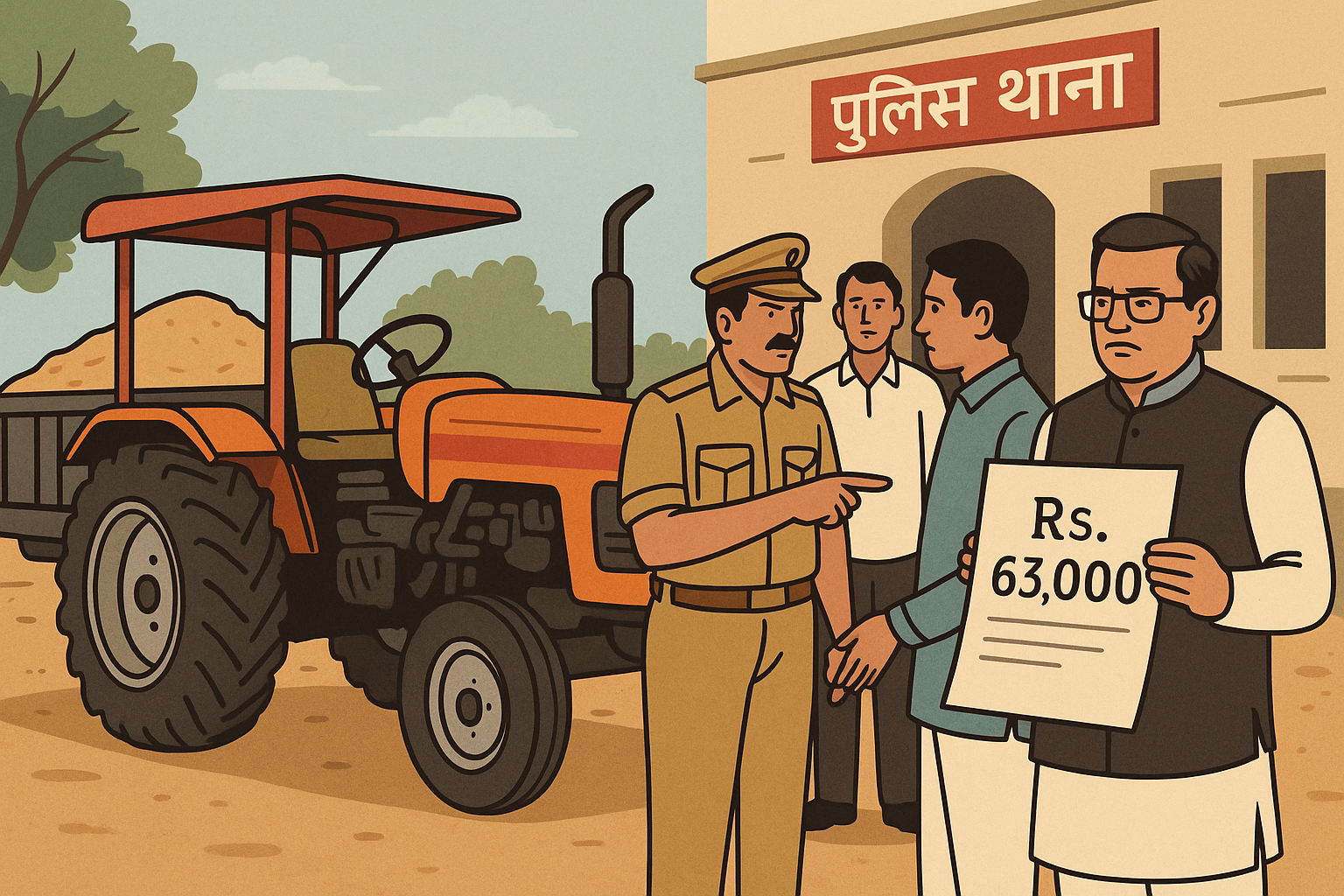
The case started when a tractor loaded with sand was intercepted in May 2024 in Jehanabad district. According to the prosecution, a Mines Inspector received information from the local police station that a tractor without a registration number was found parked in the police station premises. The driver had allegedly run away on seeing the police. On inspection, the Mines Inspector found that the tractor (identified through chassis and model details) was carrying sand and did not display its registration number. He therefore imposed a penalty of ₹35,650 under the Bihar Minerals (Concession, Prevention of Illegal Mining, Transportation & Storage) Rules, 2019 (“2019 Rules”). He also requested the police to register a criminal case under Sections 379 and 411 of the Indian Penal Code (theft/receiving stolen property) and the relevant provisions of the 2019 Rules. A formal FIR, Hulasganj P.S. Case No. 136 of 2024 dated 25.05.2024, was registered.
The petitioner, who was stated to be the owner of the tractor and who claimed that it was ordinarily used for agricultural purposes, paid the mining penalty of ₹35,650 in the District Mining Office, Jehanabad. After taking the payment, the District Mining Officer even wrote to the Chief Judicial Magistrate (CJM), Jehanabad in July 2024 saying that the amount had been deposited and that there was no objection to the release of the tractor.
However, when the petitioner approached the CJM court for release of his vehicle, the trial court did not release it. Instead, the court directed him to first deposit an additional amount of ₹63,000 before the District Transport Officer (DTO), Jehanabad. Since that amount was not paid, the application for release of the tractor was rejected by order dated 25.07.2024.
This rejection is what the petitioner challenged before the Patna High Court in Criminal Miscellaneous No. 63017 of 2024. He argued that once the Mines Department had seized the vehicle and imposed a penalty under the 2019 Rules, and once he had paid that mining penalty, the Transport Department could not, at that later stage, step in and impose a separate transport-related fine when the vehicle was already in the custody of the police/mine authorities. He further submitted that the vehicle was not caught plying on a public road by the transport authority so as to attract a separate Motor Vehicles Act penalty.
The State, through its counsel, defended the DTO’s action and said that the tractor was being used for transporting sand without proper papers, and that the amount of ₹63,000 was a statutory liability because relevant transport/registration documents were not produced. A counter affidavit was also filed on behalf of the DTO to say that the mining penalty (₹35,650) and the transport penalty (₹63,000) were for two different violations — one under the mining rules and the other under the Motor Vehicles Act, 1988.
The High Court examined the factual situation very closely. It noted an important aspect: this was not a case where the tractor was found running on the road by the traffic police or the DTO and seized then and there for violation of transport/motor vehicle laws. Instead, this was a case where the vehicle had already been seized and was lying in the police station premises after action by the Mines Department. Only after the seizure did the DTO get involved.
The Court said that once the vehicle was already in the custody of the police/Mines authority, the subsequent action of the DTO to levy ₹63,000 appeared “unwarranted”. The Court also noted that the District Mining Officer himself had no objection to the release of the tractor after payment of the mining penalty. In such a situation, insisting on a separate transport penalty of ₹63,000 became excessive and without legal basis on the facts of this case.
The Court, therefore, held that the order of the CJM, Jehanabad dated 25.07.2024 — which made the petitioner’s release of vehicle conditional on depositing ₹63,000 — could not stand. That part of the order, and the DTO’s demand, were quashed.
The Court relied on the well-known principle laid down by the Supreme Court in Sunderbhai Ambalal Desai v. State of Gujarat, (2002) 10 SCC 283, where the Supreme Court emphasized that seized vehicles should not be allowed to lie in the police station for a long time and that courts should ordinarily pass release orders promptly on suitable terms. That principle, the Patna High Court felt, fully applied here — especially as the petitioner had already deposited the mining penalty and the Mines authority itself had no objection to release.
In the result, the High Court allowed the quashing application and directed the trial court/concerned court to release the tractor of the petitioner forthwith, if it was not needed in any other case, and to do so on such sureties and conditions as the court considered proper.
3. Significance or Implication of the Judgment (For general public or government)
- The judgment draws a clear line between mining penalty and transport/motor vehicle penalty and says that transport authorities cannot mechanically impose a separate heavy fine when the vehicle is already in lawful custody due to mining action.
- It protects small vehicle owners (especially tractor owners in rural Bihar) from double or overlapping penalties when the core illegality (illegal sand carriage) has already been dealt with by the competent mining authority.
- It reaffirms that subordinate courts should follow the Sunderbhai principle and should not keep seized vehicles in police stations for months, since vehicles deteriorate and the owner suffers.
- For the administration, it is a reminder that inter-departmental coordination is necessary — one department’s concluded action should not be undermined by another department’s belated demand without clear statutory backing.
- For transport and mining officials, it sends a message that penalties must be case-specific and seizure-stage-specific — not retrospective or opportunistic.
4. Legal Issue(s) Decided and the Court’s Decision with reasoning
- Whether the District Transport Officer could impose ₹63,000 as transport/Motor Vehicles Act-related penalty after the vehicle had already been seized by the Mines Department and was in police custody.
- Court’s decision: No. Since the vehicle was already in police station premises after mining seizure, this was not a case of road-side interception by transport authorities. The DTO’s action was “unwarranted,” and the demand was illegal.
- Whether the CJM, Jehanabad was right in insisting on payment of ₹63,000 as a pre-condition for release of the vehicle.
- Court’s decision: No. The CJM’s order dated 25.07.2024, to the extent it required the petitioner to deposit ₹63,000, was quashed.
- Whether the vehicle should be released to the petitioner.
- Court’s decision: Yes. The trial/concerned court was directed to release the vehicle forthwith, if not needed in any other case, on suitable sureties and conditions.
- Principle applied: Courts should follow the Supreme Court’s view in Sunderbhai Ambalal Desai that seized vehicles should not remain idle in police stations and should ordinarily be released on terms to the rightful claimant.
5. Judgments Referred by Parties
- Sunderbhai Ambalal Desai v. State of Gujarat, (2002) 10 SCC 283 — relied upon by the petitioner to argue that the vehicle should be released promptly and that unnecessary financial burdens should not be imposed at the stage of release.
6. Judgments Relied Upon or Cited by Court
- Sunderbhai Ambalal Desai v. State of Gujarat, (2002) 10 SCC 283.
7. Case Title
- Lalan Kumar Vs. The State of Bihar
8. Case Number
- Criminal Miscellaneous No. 63017 of 2024
(Arising out of Hulasganj P.S. Case No. 136 of 2024, District – Jehanabad)
9. Citation(s)
- 2025 (2) PLJR 143
10. Coram and Names of Judges
- Hon’ble Mr. Justice Chandra Shekhar Jha
11. Names of Advocates and who they appeared for
- For the petitioner: Mr. Sanjay Kumar, Advocate; Mr. Jay Prakash Singh, Advocate
- For the State / opposite parties: Mr. Shyam Kumar Singh, APP
- (DTO, Jehanabad was opposite party no. 3 and a counter affidavit was on record.)
12. Link to Judgment
If you found this explanation helpful and wish to stay informed about how legal developments may affect your rights in Bihar, you may consider following Samvida Law Associates for more updates.







