
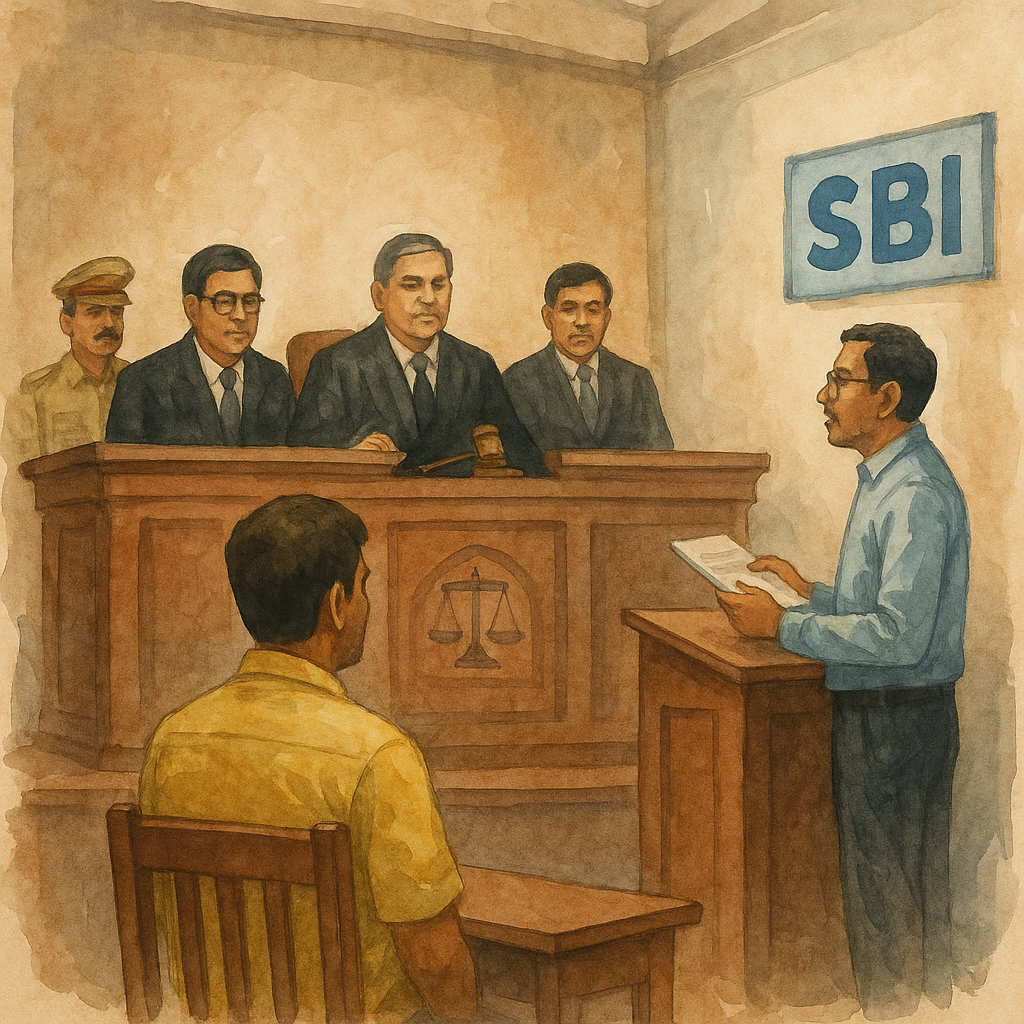
The Patna High Court (Division Bench) in 2025 has quashed the punishment imposed by the State Bank of India (SBI) on an officer who was proceeded against departmentally for alleged unauthorised debit of a customer’s account, opening of a bank account without disclosure, and unauthorised absence. The Court restored all consequential benefits to the aggrieved officer from the date of his first dismissal i.e. 06.02.2015, and also set aside the earlier judgment of the learned Single Judge which had upheld the punishment. The Bench comprised Hon’ble the Acting Chief Justice and Hon’ble Mr. Justice Partha Sarthy, who authored the CAV judgment dated 04.03.2025.
Simplified Explanation of the Judgment
This case arose out of a long-standing departmental dispute between a bank officer (the appellant) and the State Bank of India. The officer was then posted as Assistant Branch Manager in SBI’s Munger Branch. In 2013, an FIR was lodged against him at Saharsa Sadar P.S. Case No. 341 of 2013 for alleged offences under Sections 406 and 420 of the Indian Penal Code. However, after investigation, the police filed final form (closure report), and the criminal court accepted it on 24.02.2016, bringing the criminal case to an end. Despite this, the Bank continued the departmental proceedings separately, which is permissible in service law because departmental proceedings and criminal trials operate on different standards of proof.
The bank framed three charges under Rule 68(1) of the State Bank of India Officers’ Service Rules, 1992:
- that on 15.03.2013 the officer unauthorisedly debited ₹50,000 from a customer’s savings bank account and credited it to his own SBI account, and later reversed the amount;
- that on 13.03.2013 he opened another savings account in his own name under the “Personal Public – Others” segment without permission and without disclosing his SBI identity; and
- that he remained unauthorisedly absent from duty from 10.05.2013 to 05.06.2013.
An Enquiry Officer was appointed, who submitted his report on 06.05.2014. Interestingly, the Enquiry Officer found that Charge No. 1 — the most serious allegation of unauthorised debit — was not proved, because the debit and credit entries were supported by double-entry vouchers carrying the customer’s confirmation, and therefore could not be straightaway treated as “unauthorised transactions.” However, he held Charge Nos. 2 and 3 (opening account without permission and absence from duty) to be proved. The problem, as later noticed by the High Court, was that no prosecution witness was examined at all in the departmental enquiry; the Bank merely relied on documents without properly proving them.
Despite this, the disciplinary/appointing authority disagreed with the Enquiry Officer on Charge No. 1. By issuing a second show-cause notice, the authority said it did not accept the finding that the debit was authorised, and ultimately imposed the major penalty of dismissal on 06.02.2015. The officer challenged this first dismissal order before the High Court in CWJC No. 4163 of 2015, but that writ petition was withdrawn. Later, in another writ (CWJC No. 19743 of 2015), the Single Judge set aside the dismissal and the appellate order, directed reinstatement with all consequential benefits, and permitted the Bank to proceed again from the stage of second show-cause notice. That is how the departmental matter reached its “second round.”
After reinstatement in July 2018, SBI again issued a fresh notice (21.02.2019) stating why it disagreed with the Enquiry Officer on Charge No. 1. The officer replied. Then the appointing authority proposed removal from service (01.06.2019), heard him, and finally passed the order dated 07.06.2019 imposing a different but still major penalty: reduction to the post of Award Staff and fixing his basic pay at ₹21,240 per month, along with a direction that the suspension period would be treated as “not on duty.” The departmental appeal was rejected on 20/21.11.2019. The officer filed CWJC No. 1323 of 2020 challenging both these orders, but the learned Single Judge dismissed the writ petition on 23.02.2024. Against this dismissal, he filed the present Letters Patent Appeal (LPA No. 283 of 2024), which has now been allowed.
The Division Bench identified two fundamental defects in the Bank’s action:
- Lack of Evidence in the Enquiry: The Court noted that no oral evidence was led, no witness was examined to prove the documents, and the Enquiry Officer simply accepted documents referred in the charge-sheet. This, in the Court’s view, attracted the principle laid down by the Supreme Court in Roop Singh Negi v. Punjab National Bank and later in Satyendra Singh v. State of U.P., that even in a domestic enquiry — more so when a major penalty is contemplated — the department must prove the charges by at least some reliable evidence. Mere production of documents without proving their contents cannot form the basis of punishment. In fact, it becomes a “case of no evidence.” The Patna High Court said that is exactly what happened here.
- Wrong Procedure under Rule 68.3 of SBI Rules, 1992: The Court then examined Rule 68.3(iii) and held that when the disciplinary authority disagrees with the Enquiry Officer and wants to impose a major penalty listed in Rule 67(e) to (j), it must itself record reasons and proceed in the manner laid down. In this case, instead of the disciplinary authority doing so at its own level, the matter was sent to the appointing authority, which issued the 21.02.2019 notice and finally imposed penalty on 07.06.2019. The Bench said this was not in accordance with Rule 68.3, and therefore the punishment order stood vitiated on this procedural ground as well.
Because of these two defects — (i) absence of legally acceptable evidence in the enquiry, and (ii) non-compliance with the SBI Rules while differing with the Enquiry Officer — the Division Bench concluded that the Single Judge’s order could not be sustained and the punishment had to be set aside. It therefore allowed the appeal, quashed the punishment order dated 07.06.2019 and the appellate order dated 20/21.11.2019, and restored the officer with all consequential benefits from 06.02.2015, i.e. from the date of his first dismissal. The Court also directed the Bank to pay these dues within three months of receiving the order.
Significance or Implication of the Judgment
- This judgment is significant for bank employees and public sector employees facing departmental enquiries in Bihar and elsewhere. It reiterates that even in a departmental proceeding, the employer must prove charges with some minimum level of evidence, especially when a serious penalty (reduction in rank, removal, dismissal) is being considered.
- The Court has reaffirmed that domestic enquiries cannot be converted into a mere paperwork exercise; documents have to be proved and the delinquent employee must get a fair chance to contest them.
- For employers like SBI, this judgment is a reminder that internal service rules (here, Rule 68.3 of SBI Officers’ Service Rules, 1992) must be followed strictly. Deviation from the procedure — even if the employee is suspected of financial irregularity — can lead to the punishment being quashed.
- For the general public, especially bank customers, it clarifies that the Court is not against banks disciplining erring officers; it only insists that this must be done in a legal, transparent, and fair manner.
- For government departments and PSUs, this decision can be cited to show that acquittal in criminal case does not bar departmental action, but departmental action still has to stand on its own legs with proper evidence.
Legal Issue(s) Decided and the Court’s Decision with Reasoning
- Whether SBI could sustain a major penalty when no oral evidence was led in the departmental enquiry?
- Decision: No. The enquiry became a case of “no evidence” because documents were neither properly exhibited nor proved by any witness. Reliance was placed on Roop Singh Negi v. PNB and Satyendra Singh v. State of U.P. to hold that charges, especially those inviting major penalty, must be supported by some evidence.
- Whether the disciplinary/appointing authority followed Rule 68.3 of the SBI Officers’ Service Rules while differing with the Enquiry Officer’s finding?
- Decision: No. Rule 68.3(iii) lays down how and when the disciplinary authority can disagree with the Enquiry Officer and when the matter can go to the appointing authority. Here, the procedure was not followed, and therefore the final order dated 07.06.2019 was vitiated.
- Whether departmental proceedings could continue even after criminal proceedings ended in closure?
- Decision: Yes. The Court accepted the settled position that criminal and departmental proceedings are distinct, but it still struck down the punishment for want of evidence and procedural lapse, not because departmental action was barred.
- Whether the Single Judge was right in upholding the punishment?
- Decision: No. The Division Bench held that the Single Judge did not fully appreciate the lack of evidence and the violation of Rule 68.3 and hence set aside the Single Judge’s judgment.
- What relief was ultimately granted?
- Decision: The LPA was allowed; punishment and appellate orders were quashed; the officer was granted reinstatement with all consequential benefits from 06.02.2015, to be paid within three months.
Judgments Referred by Parties
- Roop Singh Negi v. Punjab National Bank, (2009) 2 SCC 570.
- Deputy General Manager (Appellate Authority) & Ors. v. Ajai Kumar Srivastava, (2021) 2 SCC 612.
- Satyendra Singh v. State of Uttar Pradesh & Anr., 2024 SCC OnLine SC 3325.
(These were cited by the employee’s side to show that unproved documents and absence of oral evidence can vitiate the enquiry.)
Judgments Relied Upon or Cited by Court
- Roop Singh Negi v. Punjab National Bank, (2009) 2 SCC 570.
- Satyendra Singh v. State of Uttar Pradesh & Anr., 2024 SCC OnLine SC 3325.
- The Court also noticed and distinguished bank-management authorities such as:
- Karnataka Power Transmission Corpn. Ltd. v. C. Nagaraju, (2019) 10 SCC 367.
- State of Karnataka v. Umesh, (2022) 6 SCC 563.
- State Bank of India v. Tarun Kumar Banerjee, (2000) 8 SCC 12.
- General Manager (P), Punjab & Sind Bank v. Daya Singh, (2010) 11 SCC 233.
- State Bank of India v. Narendra Kumar Pandey, (2013) 2 SCC 740.
- State Bank of India v. Ramesh Dinkar Punde, (2006) 7 SCC 212.
- S.N. Mukherjee v. Union of India, (1990) 4 SCC 594.
(These were referred to show that departmental proceedings are not bound by strict rules of the Evidence Act, but still must have some evidentiary foundation.)
Case Title
- Rakesh Roshan Gupta Vs. The Chairman-cum- Managing Director, State Bank of India
Case Number
- Letters Patent Appeal No. 283 of 2024
- In CWJC No. 1323 of 2020
- Earlier related matters: CWJC No. 19743 of 2015; order of dismissal dated 06.02.2015; punitive order dated 07.06.2019; appellate order dated 20/21.11.2019.
Citation(s)
- 2025 (2) PLJR 120
Coram and Names of Judges
- Hon’ble the Acting Chief Justice
- Hon’ble Mr. Justice Partha Sarthy (Author of the judgment)
Names of Advocates and who they appeared for
- For the appellant (aggrieved bank officer):
- Mr. Mrigank Mauli, Senior Advocate
- Mr. Rakesh Kumar Sharma, Advocate
- Mr. Sanket, Advocate
- Mr. Navin Kumar Singh, Advocate
- Mr. Amresh Kumar, Advocate
- For the respondents (SBI authorities):
- Mr. Sanjiv Kumar, Advocate
Link to Judgment
MyMyODMjMjAyNCMxI04=-s7ASvJveIG8=
If you found this explanation helpful and wish to stay informed about how legal developments may affect your rights in Bihar, you may consider following Samvida Law Associates for more updates.







