
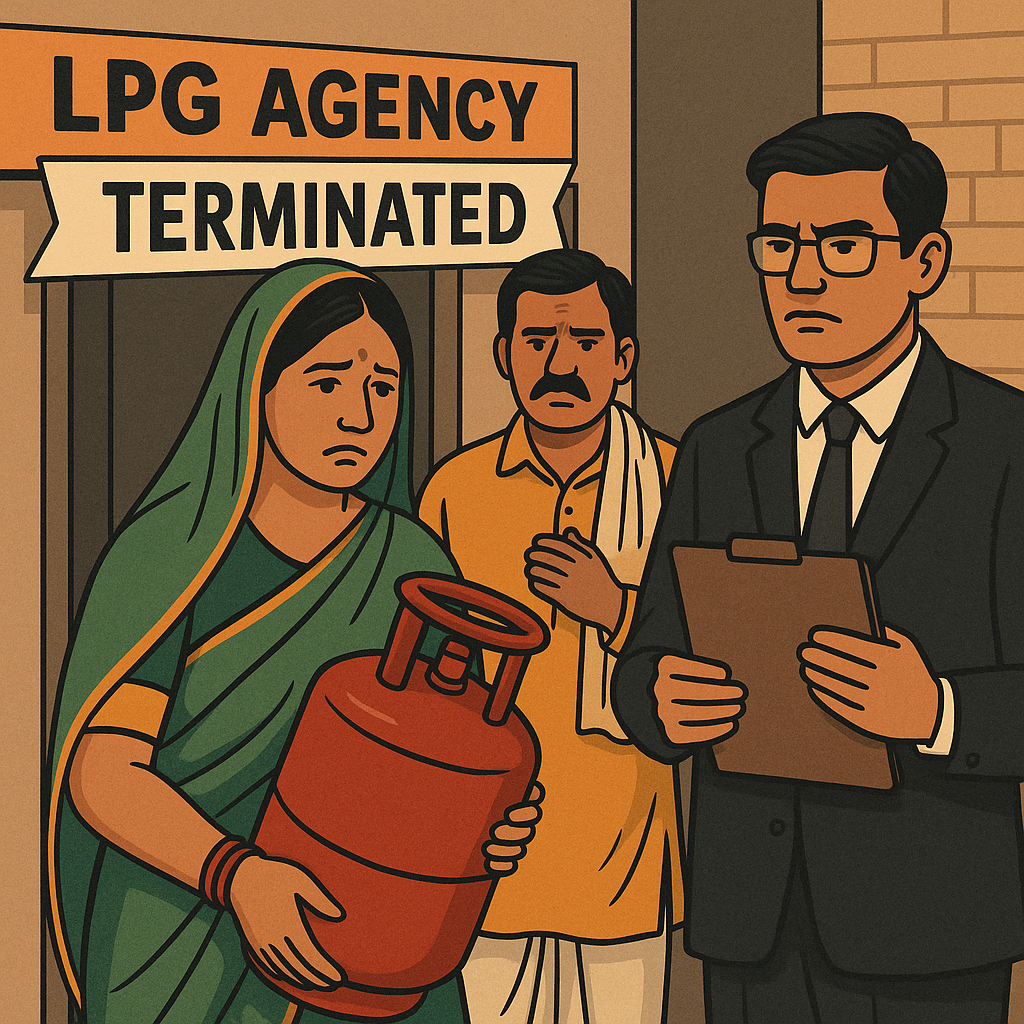
Simplified Explanation of the Judgment
This Patna High Court decision concerns an appeal filed by an LPG distributor against the termination of its Bharat Gas distributorship. The distributor argued that the Oil Marketing Company (OMC) acted unfairly by not sharing inspection reports and by first imposing monetary penalties and only later issuing a show-cause notice to terminate the distributorship. The distributor also claimed the alleged irregularities were really the OMC’s responsibility under the Pradhan Mantri Ujjwala Yojana (PMUY).
The Division Bench (Hon’ble the Chief Justice and Hon’ble Mr. Justice Harish Kumar) dismissed the appeal on 2 May 2024, affirming the Single Judge’s order that had already refused to interfere with the termination. In simple terms, the Court found that:
• Natural justice was not violated. Even if the underlying inspection reports were not supplied, the show-cause notices reproduced the allegations word-for-word. The distributor received detailed notice of the issues and had opportunities to reply. The Court further recorded that the distributor never actually asked for those inspection reports, and no prejudice was shown.
• The OMC’s earlier penalty order did not “waive” the right to terminate later. The penalty order expressly reserved the OMC’s right to take further, stricter action under the distributorship agreement and the Marketing Discipline Guidelines (MDG). Because of that reservation, the Company could issue a subsequent show-cause notice proposing termination.
• The irregularities were serious and largely admitted. The record showed thousands of PMUY connections were installed contrary to guidelines, many allegedly diverted to third parties instead of the approved beneficiaries. Photographs and documentation were missing in many cases, and activities extended outside the allotted area. In replies to the notices, the distributor attempted to blame the OMC’s software and PMUY verification process—but the Court emphasized the core allegation was not “wrong identification” by the OMC, but diversion and installation to persons other than the approved beneficiaries. That core allegation was not convincingly answered.
• Double jeopardy does not apply. The amounts earlier directed to be paid included outstanding dues and compensation under the agreement and PMUY norms. Imposing those financial consequences did not preclude a later termination, especially when the penalty order itself warned that repeat or serious irregularities could invite “more stringent action,” such as termination.
Background in brief: Two separate inspections (one by a team from the Ministry of Petroleum & Natural Gas, and another by the OMC’s Ujjwala Coordinator and Sales Officer) led to two detailed show-cause notices. The first notice alleged, among other things, that out of more than twenty thousand PMUY connections released, several thousand were installed contrary to PMUY guidelines and, crucially, to third parties instead of the listed beneficiaries. It also flagged the absence of installation photographs and incomplete documentation. The second notice recorded further irregularities, such as running extension counters outside the distributor’s notified area and charging extra amounts from PMUY beneficiaries. The distributor replied, but the replies were considered “evasive” or amounted to admissions with attempts to shift blame.
After considering those replies, the OMC issued a penalty order requiring payment of (i) a quantified amount, (ii) compensation to affected customers, and (iii) clearance of outstanding dues. Importantly, the penalty order stated that it was “without prejudice” to other rights and specifically warned that further or repeated irregularities could lead to more stringent action under the agreement and the MDG. The distributor did not challenge that penalty order in court. Later, the OMC issued a third show-cause notice proposing termination, relying on the earlier findings and the reservation clause. The distributorship was then terminated. The Single Judge rejected the distributor’s challenge and left the parties to their contractual arbitration remedy if they wished. On appeal, the Division Bench agreed that there was no procedural illegality or unfairness warranting interference and upheld the termination.
In summary, the Patna High Court concluded that the OMC followed the contract and the MDG framework, gave adequate notice of allegations, considered replies, reserved stricter action in its penalty order, and then terminated based on the gravity and scale of irregularities and the resulting loss to the public exchequer. The appeal was dismissed, with parties to bear their own costs.
Significance or Implication of the Judgment (For general public or government)
• For OMCs and public authorities: The judgment reinforces that OMCs can escalate sanctions—from financial consequences to termination—when the contract and MDG explicitly allow it and when notices disclose the material, even if underlying reports are not separately furnished. Where “without prejudice” reservations are recorded, termination can follow later based on the same body of misconduct if the circumstances warrant.
• For distributors and contractors under government welfare schemes: Compliance is not optional. Documentation, installation protocols, area restrictions, and beneficiary targeting under PMUY must be strictly followed. Attempts to shift blame to software or to the OMC’s verification do not answer allegations of diversion or unauthorized installations.
• For consumers/beneficiaries: The ruling protects the integrity of PMUY by holding distributors to account where connections intended for eligible households are diverted, or where extra charges and procedural lapses occur.
• For courts and future litigation: The case clarifies that non-supply of inspection reports will not automatically vitiate action if the essence of the material is fully disclosed in the show-cause and the party is heard, and if no prejudice is shown. It also distinguishes between multiple consequences (dues/compensation vs. termination) and rejects “double jeopardy” arguments in a contractual/disciplinary setting.
Legal Issue(s) Decided and the Court’s Decision with reasoning
• Natural justice—Were inspection reports required to be furnished separately?
Decision: No violation. The show-cause notices reproduced the allegations verbatim; the distributor never demanded the reports; and no prejudice was demonstrated.
• Waiver/estoppel—Did the earlier penalty order bar later termination?
Decision: No. The penalty order expressly reserved the OMC’s right to proceed further and warned of stricter action (including termination) for recurrence/serious misconduct under the MDG and the contract.
• Double jeopardy—Did monetary consequences preclude later termination?
Decision: No. Contractual consequences like paying compensation and clearing outstanding dues do not immunize a distributor from termination when grave irregularities are established. These are different, compatible consequences under the agreement/MDG.
• Merits—Were the irregularities serious and attributable to the distributor?
Decision: Yes. The Court noted large-scale diversion of connections, missing photographs, deficient documentation, extra charges, and activities outside the allotted area; attempts to shift blame to OMC/software were unconvincing, as the core allegation was diversion/unauthorized installation, not beneficiary identification errors.
Case Title
Appellant (LPG Distributor) v. Oil Marketing Company & Ors. — Letters Patent Appeal arising from Civil Writ Jurisdiction Case No. 330 of 2019.
Case Number
Letters Patent Appeal No. 49 of 2021 in CWJC No. 330 of 2019. Date of Judgment: 02-05-2024. CAV Date: 25-04-2024.
Citation(s)
2025 (1) PLJR 284
Coram and Names of Judges
• Hon’ble the Chief Justice K. Vinod Chandran
• Hon’ble Mr. Justice Harish Kumar
Names of Advocates and who they appeared for
• For the appellant (distributor): Mr. Sanjeev Ranjan, Advocate; Ms. Astha Ananya, Advocate
• For the respondents (OMC): Mr. Siddhartha Prasad, Advocate; Mr. Om Prakash Kumar, Advocate
Link to Judgment
MyM0OSMyMDIxIzEjTg==-VMKUS57KPrI=
If you found this explanation helpful and wish to stay informed about how legal developments may affect your rights in Bihar, you may consider following Samvida Law Associates for more updates.







