
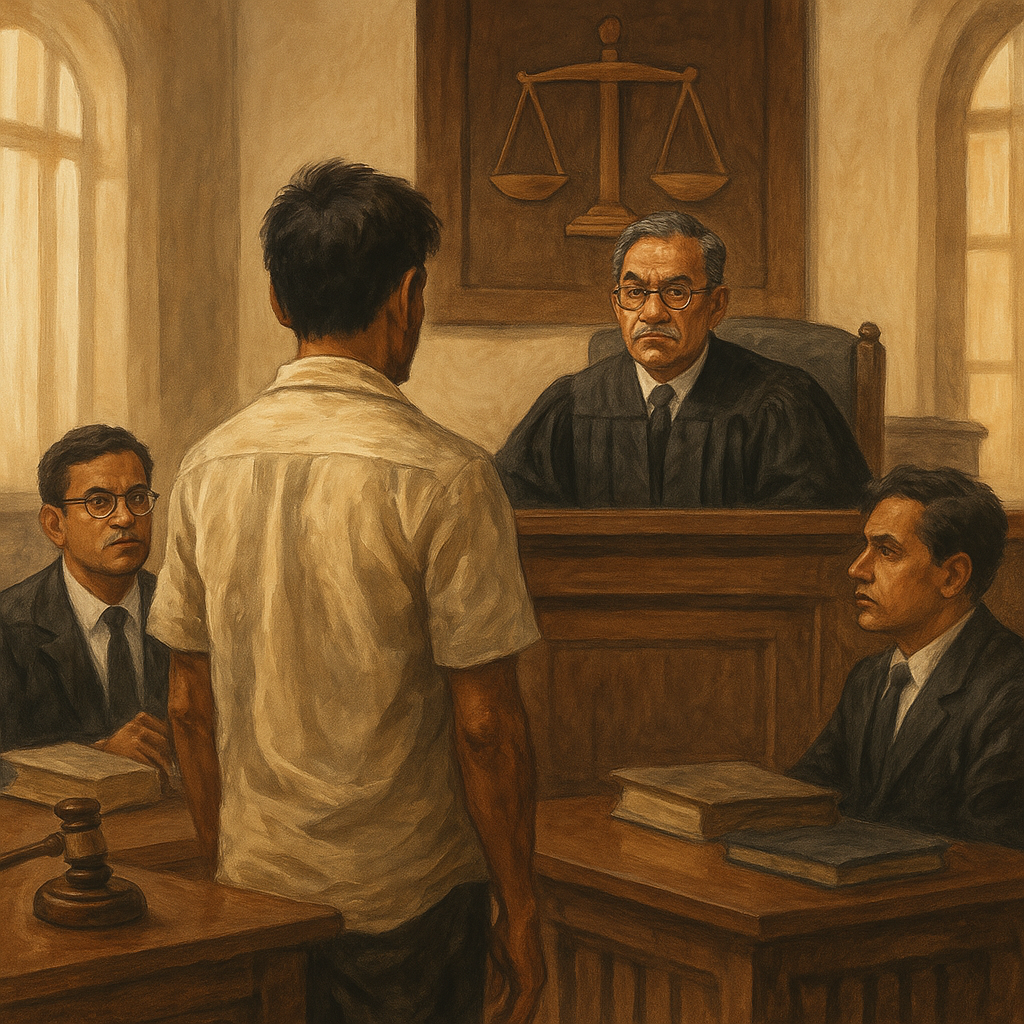
Simplified Explanation of the Judgment
The Patna High Court recently delivered its verdict in a criminal appeal arising from a murder case that took place in the village of Bhatoria, Bhagalpur district, Bihar, in 1992. The case involved the brutal killing of a man named Sheikh Riyasat, who was attacked at night while sleeping on the veranda of his house. Several individuals were accused and later convicted by the trial court under Sections 302/149 of the Indian Penal Code, with some also facing charges under the Arms Act.
The High Court heard three appeals together, filed by seven different appellants. One of the accused had died during the appeal process, and the appeal against him was abated. The others challenged their conviction, arguing that the prosecution’s case was weak, unreliable, and based solely on contradictory testimonies from family members of the deceased.
The original prosecution case was built on the fardbeyan (first information report) given by the deceased’s brother, who claimed to have seen a group of armed men enter their house at around 1 AM and attack the deceased. However, this key witness and three other relatives who were initially cited as eyewitnesses turned hostile during the trial and denied having seen the assailants. This dealt a significant blow to the prosecution’s case.
The only two witnesses who supported the prosecution during the trial were the wife and daughter of the deceased. They testified that they were present at the scene and saw the accused attack the deceased with firearms and sharp weapons. However, the defense argued that these witnesses were not even present at the house on the night of the incident and had come the next day from their maternal village after hearing of the murder.
The High Court carefully reviewed the evidence and found multiple inconsistencies and contradictions. For instance, although the wife of the deceased claimed to have witnessed the entire attack and even sustained injuries herself, there was no medical evidence or injury report to support her claims. Additionally, she gave her statement much later, while the fardbeyan was lodged by another family member who had not even claimed she was present at the scene.
Furthermore, the investigating officer admitted that only one cot was found at the veranda, despite the wife and daughter claiming two cots were present. No lantern (allegedly used to identify the assailants at night) was seized as evidence, weakening their claims of visual identification in the dark. The inquest report also stated that the dead body was found in the courtyard, not the veranda, which contradicted the testimonies of the supposed eyewitnesses.
Considering these substantial doubts and discrepancies, the High Court ruled that the prosecution failed to prove its case beyond a reasonable doubt. The judgment emphasized that in criminal law, conviction cannot be based on uncertain, doubtful, or fabricated evidence.
Significance or Implication of the Judgment
This judgment reinforces the principle that criminal convictions must rest on solid, credible evidence. The High Court’s careful scrutiny highlights the importance of ensuring due process and fair trial, especially in cases where life imprisonment is imposed. For the general public, the decision serves as a reminder of the safeguards in the legal system meant to prevent miscarriage of justice. For law enforcement, it underscores the necessity of thorough, timely, and consistent investigation.
Legal Issue(s) Decided and the Court’s Decision
- Whether the prosecution proved the guilt of the accused beyond a reasonable doubt?
- Court’s Decision: No. The High Court found multiple inconsistencies and declared the evidence insufficient for conviction.
- Whether the testimonies of the wife and daughter of the deceased were reliable?
- Court’s Decision: No. The Court found their presence at the scene doubtful and their statements contradictory.
- Whether the place and manner of occurrence were conclusively proved?
- Court’s Decision: No. There were contradictions between witness statements and the inquest report.
Case Title
Sk. Jabir & Others vs The State of Bihar
Case Number
Criminal Appeal (DB) No. 114 of 1995 (with Criminal Appeal (DB) Nos. 120 & 158 of 1995)
Citation(s)
2020 (1) PLJR 27
Coram and Names of Judges
Hon’ble Mr. Justice Hemant Kumar Srivastava
Hon’ble Mr. Justice Rajendra Kumar Mishra
Names of Advocates and who they appeared for
- Mr. Zeyaul Hoda, Advocate – For Appellants (Appeal No. 114/1995)
- Mr. Baxi S.R.P. Sinha, Sr. Advocate and Mr. Zeyaul Hoda – For Appellant (Appeal No. 158/1995)
- Mr. Ansul, Advocate – For Appellant (Appeal No. 120/1995)
- Mr. Dilip Kumar Sinha, Mr. S.N. Prasad, Mr. S.C. Mishra, APP – For State
Link to Judgment
https://patnahighcourt.gov.in/viewjudgment/NSMxMTQjMTk5NSMxI04=-a3FfckAgn0I=
If you found this explanation helpful and wish to stay informed about how legal developments may affect your rights in Bihar, you may consider following Samvida Law Associates for more updates.







