
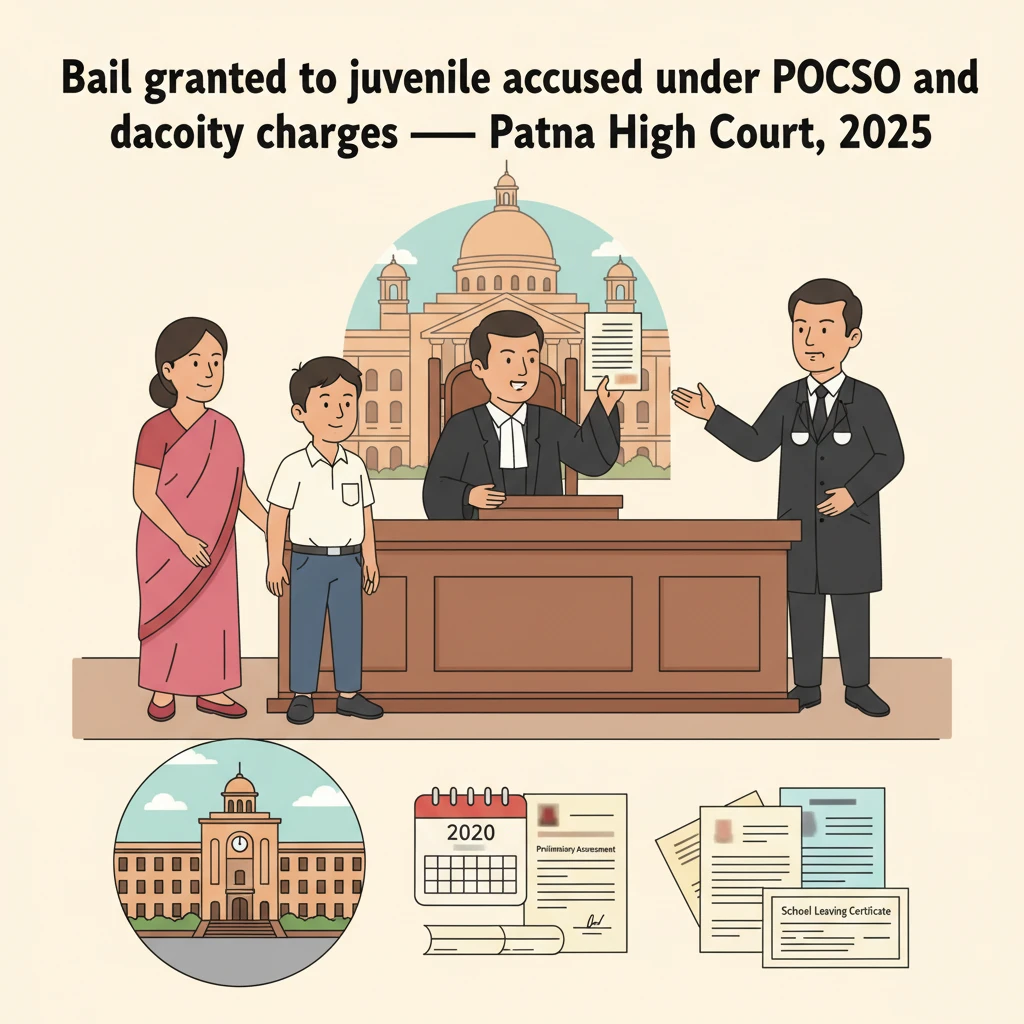
Case Background
The case started with a fardbeyan given by one informant, Gopal Sao, on 14.06.2018. Based on this, Konch P.S. Case No. 195 of 2018 was registered the same day in District Gaya. The FIR was lodged against ten unknown persons.
The offences were serious. The police registered the case under Sections 395, 376D, 397, 376(3) and 376(DA) of the Indian Penal Code and Section 6 of the POCSO Act, 2012. These provisions relate to dacoity, gang rape, use of deadly weapons, aggravated forms of rape and aggravated penetrative sexual assault on a child.
After investigation, the police submitted charge-sheet no. 192 of 2018 dated 06.09.2018 in the POCSO Court. The charge-sheet was filed against twelve accused persons, including the present petitioner. Initially, the case proceeded before the POCSO Court as if he were an adult.
The petitioner then applied before the POCSO Court to be treated as a juvenile. Along with his application, he filed a xerox copy of his School Leaving Certificate. On this basis, by order dated 15.12.2018, the POCSO Court sent his record to the Juvenile Justice Board (J.J. Board), Gaya, for determination of his age.
The J.J. Board examined the admission register of his school. It recorded his date of birth as 17.08.2001. Since the alleged occurrence took place on 13.06.2018, the Board calculated that he was 16 years, 9 months and 26 days old on the date of occurrence. On that basis, the petitioner was declared a juvenile.
Later, on 28.01.2020, the J.J. Board took cognizance of offences under Sections 395, 376D, 397, 376(3), 376(DA) IPC and Section 6 of the POCSO Act against him. The case was then fixed for preliminary assessment of his capacity to commit such offences in view of his age and the nature of allegations.
On 22.02.2020, the Board conducted the preliminary assessment. It concluded that the petitioner was capable of committing the alleged offences and understood the nature and consequences of his acts. Therefore, the Board transferred the matter to the Children Court, Gaya, for his trial as an adult. Charges were framed, and the trial is now at the stage of prosecution evidence.
What the Court Examined and Decided
The main issue before the Patna High Court was not about guilt or innocence. It was about bail for a child in conflict with law. The petitioner had been in custody and had repeatedly sought release on bail.
First, the J.J. Board, Gaya, rejected his bail application by order dated 28.03.2019. The Board noted the sections involved, including serious offences under the IPC and POCSO Act. It recorded that in the case diary, the informant and the victim, in their statements under Section 164 Cr.P.C., had supported the allegations, including group rape. Certain witnesses were stated to have taken the petitioner’s name.
The Board also referred to the Social Investigation Report (SIR). It concluded that there was lack of proper control by his guardian, that the petitioner was in the company of wrong people, and that he was in the habit of taking his own decisions. It also observed that he had actively supported his friend. The Board feared that if released on bail, he might be exposed to physical and psychological danger due to hatred in society. On this basis, it refused bail.
The petitioner then filed Criminal Appeal (Juvenile) No. 32 of 2019 before the Special Judge (Children Court), Gaya. On 16.12.2020, the Children Court dismissed the appeal and again refused bail.
The Children Court summarised the allegations that the accused, including the petitioner, intercepted the informant while he was travelling with his wife and daughter on a motorcycle, threatened him, committed rape on his wife and daughter, and robbed cash and ornaments.
The Children Court emphasised that in juvenile cases, the prime consideration is the reasonable estimation of physical and psychological threat to the child if released on bail. It looked into the case diary and noted that one country-made pistol and two live cartridges were allegedly recovered from the petitioner’s house during investigation. It also stated that other accused were well-known to him and that he had been actively participating in their illegal activities.
The Children Court went further and commented on the “brutality and professionalism” shown in committing the crime. It concluded that the accused, including the petitioner, were habitual offenders and that the petitioner had bad company. It also noted that other co-accused had criminal antecedents and that the petitioner’s father had been to jail. On the basis of the SIR, it described the petitioner as belonging to an uneducated family, having left education, being “a man of negative thinking” in bad company, and without proper guardianship.
On this reasoning, the Children Court held that releasing him on bail would defeat the ends of justice and would not help his reformation. It found that there was risk of moral, physical, and psychological danger to him if released, and therefore declined to grant bail.
Aggrieved by this appellate order, the petitioner approached the Patna High Court through the present Criminal Revision No. 233 of 2021.
Before deciding on the facts, the Patna High Court examined Section 12 of the Juvenile Justice (Care and Protection of Children) Act, 2015. The Court reproduced Section 12 in full and highlighted that it overrides the bail provisions in the Code of Criminal Procedure and other laws.
The Court underlined a key principle: for a juvenile, bail is the rule and refusal is the exception. A child in conflict with law can be denied bail only on three specific grounds mentioned in the proviso to Section 12(1):
First, if there are reasonable grounds to believe that release is likely to bring the child into association with any known criminal. Second, if release is likely to expose the child to moral, physical, or psychological danger. Third, if the child’s release would defeat the ends of justice.
The Court clearly stated that the seriousness of the alleged offence or the age of the juvenile (even where the child is above 16 and accused of a heinous offence) are not independent grounds for denying bail under Section 12. Section 12 applies uniformly to all children in conflict with law, without any classification.
The Court referred to the object and purpose of the J.J. Act. It cited the Preamble, which makes it clear that the Act is aimed at care, protection, development, treatment, social reintegration and rehabilitation of children, not punishment. It also quoted Section 3, which lays down the fundamental principles like the “best interest” of the child, the “principle of safety”, positive measures, non-stigmatising language, and the “principle of family responsibility”.
The Court stressed that the “ends of justice” in the J.J. Act context is different from criminal law generally. Under the J.J. Act, the goal is reform and rehabilitation. If keeping the child in custody actually helps in the child’s development, rehabilitation or protection, only then can it be said that release would defeat the ends of justice. Otherwise, custody should not be continued.
The Court noted that institutionalisation in an observation home is a measure of last resort. The family is treated by law as the primary and best institution to care for the child. The Act supports early reunion of the child with the family, unless it is not in the child’s best interest.
Turning back to the facts, the Patna High Court closely examined the Social Investigation Report and the statement of the petitioner’s mother, Sugi Devi, recorded during the age inquiry. She had stated that she has three children, that the petitioner is the eldest, and that he dropped out of school after Class V to help her in cultivation.
From the SIR, the Court found that the petitioner belongs to a poor, uneducated Scheduled Caste family. Due to poverty, he had to leave school after Class V to support the family in cultivation for sustenance. He is unmarried and the eldest son. Importantly, the SIR recorded that he has no criminal antecedents.
The Court found that the observations by the J.J. Board and the Children Court that he was involved in illegal activities, or that he was in bad company, were “based on conjecture and surmises without any basis.” No concrete material or specific details were given in the SIR to support the claim of bad company.
The Court also noted that the petitioner was not named in the FIR, which was against unknown persons. There was no specific allegation against him in the FIR itself. The High Court observed that “the whole case is based on suspicion without any cogent evidence” to show his involvement.
On the question whether release would expose him to moral, physical or psychological danger, the Court held that there was nothing on record to suggest such risk. There was also no material to show that he was part of any criminal gang, or that his release would bring him into association with known criminals.
On the contrary, the Court found that the petitioner had been acting as a responsible member of his family. Despite his young age, he was helping his mother to maintain the family. He left school due to financial hardship, not because of delinquent behaviour.
Although it had come on record that his father had criminal antecedents and was in jail, there was no such stigma against his mother. She was a housewife engaged in cultivation to sustain the family. The boy was helping her in that effort.
In this background, the Patna High Court concluded that no valid ground existed under Section 12 to deny bail. Instead, releasing him on bail and enabling his education and welfare would be in his “best interest”, consistent with the J.J. Act.
The Court therefore held that both the order dated 28.03.2019 of the J.J. Board, Gaya, and the judgment dated 16.12.2020 of the Special Judge (Children Court), Gaya, were not sustainable in law. The revision was allowed.
The Court directed that the petitioner be released on bail on furnishing a bail bond of Rs. 10,000/- by his mother. She must also file an affidavit undertaking that he will not come into contact with any criminal, will restart his education through open school or otherwise, his developmental needs will be taken care of, and he will attend the J.J. Board and courts whenever required.
Along with bail, the Court issued strong welfare directions. The District Magistrate, Gaya, was directed to ensure that the petitioner’s family has ration card and Aadhaar card and receives subsidised food grains under government schemes. The District Magistrate was also asked to see that, if the family qualifies, it gets financial assistance for house construction or loans for animal husbandry.
The Secretary, Gaya District Legal Services Authority (DLSA), was directed to assist the petitioner in obtaining ration card, Aadhaar card, and financial assistance, in coordination with the District Magistrate. The Secretary, DLSA, must also help him get admission in open school or other educational institutions so that he can restart his education.
Finally, the Court ordered that a copy of this judgment be circulated among Presiding Officers of J.J. Boards and Children Courts across Bihar, and sent to the Bihar Judicial Academy for discussion in training programmes.
Why This Judgment Matters
This judgment is important for children in conflict with law, their families, and practitioners dealing with juvenile cases in Bihar.
First, it reinforces that under Section 12 of the Juvenile Justice Act, bail for a juvenile is the rule, and refusal is a narrow exception. Courts cannot deny bail only because the charges are serious or the offence is “heinous”. They must show clear, recorded reasons relating to association with criminals, danger to the child, or real defeat of the ends of justice.
Second, the Patna High Court showed that Social Investigation Reports must be read carefully. Vague comments about bad company or negative thinking, unsupported by specific facts, cannot be the basis to keep a child in detention.
Third, the judgment gives a clear message that poverty, lack of education, or the criminal record of a parent cannot automatically be used against a child. Here, the Court viewed the boy’s role in helping his mother and family as a positive factor justifying his release.
Fourth, the Court went beyond bail and connected juvenile justice with social welfare. By directing the District Magistrate and DLSA to help with ration cards, housing assistance, animal husbandry loans and education, the Court recognised that real reform and rehabilitation require support to the family and access to schemes.
Finally, by circulating this judgment to all J.J. Boards, Children Courts, and the Bihar Judicial Academy, the Patna High Court aims to influence how lower courts across the State apply Section 12 and the principles of the J.J. Act. This can help other similarly placed juveniles who might otherwise be kept in custody on the basis of assumptions and stigma.
Legal Issues and Answers
- Issue: Can a child in conflict with law, accused of serious offences under IPC and POCSO, be denied bail under Section 12 of the Juvenile Justice Act only on the basis of seriousness of charges, poverty, alleged bad company and family background?
Answer: No. The Patna High Court held that bail is the rule under Section 12, and refusal is justified only if there are reasonable grounds that release will bring the child into association with known criminals, expose him to moral, physical or psychological danger, or defeat the ends of justice. In this case, none of these grounds were made out on the record. - Issue: Were the orders of the Juvenile Justice Board and the Children Court rejecting bail in consonance with the Juvenile Justice Act and the Social Investigation Report?
Answer: No. The Court found that both authorities relied on conjectures and assumptions about illegal activities and bad company that were not supported by the Social Investigation Report or other material. Their orders were held unsustainable and were set aside. - Issue: What relief and directions did the Patna High Court grant to ensure the best interest and rehabilitation of the juvenile?
Answer: The Court granted bail on a bond to be executed by the mother, with conditions to keep him away from criminals and restart his education. It also directed the District Magistrate and DLSA, Gaya, to secure ration and Aadhaar cards, subsidised food, possible financial assistance for house and animal husbandry, and help in admission to open school or other educational institutions.
Cases Cited by the Court
- Lalu Kumar @ Lal Babu vs. State of Bihar, 2019 (6) BLJ 2016.
- Abhishek vs. State, 205 CriLJ (NOC) 115 (Delhi).
- Manoj vs. State (NCT of Delhi), 2006 CriLJ 4759.
Case Details
Case Number: Criminal Revision No. 233 of 2021; arising out of Konch P.S. Case No. 195 of 2018, District Gaya.
Case Title: Nitish Kumar vs. The State of Bihar.
Coram: Hon’ble Mr. Justice Jitendra Kumar.
Citation: 2025(3) PLJR 421.
Advocates:
- For the Petitioner: Mr. Manish Kumar No. 2, Advocate; Mr. Ram Kumar, Advocate; Mr. Rohit Priyadarshi, Advocate.
- For the State: Ms. Sangeeta Sharma, APP.
Narration of Proceedings / Nature of Case: Criminal revision petition filed by a juvenile (child in conflict with law) challenging the judgment dated 16.12.2020 passed by the Special Judge (Children Court), Gaya, in Criminal Appeal (Juvenile) No. 32 of 2019 (C.I.S), affirming rejection of bail by the Juvenile Justice Board, Gaya, in a case under Sections 395, 376D, 397, 376(3), 376(DA) IPC and Section 6 of the POCSO Act, 2012.
link to judgement ; https://patnahighcourt.gov.in/viewjudgment/NyMyMzMjMjAyMSMxI04=-ZSlwZDgLq5I=
If you found this explanation helpful and wish to stay informed about
how legal developments may affect your rights in Bihar,
you may consider following Samvida Law Associates for more updates.







