
Case Background
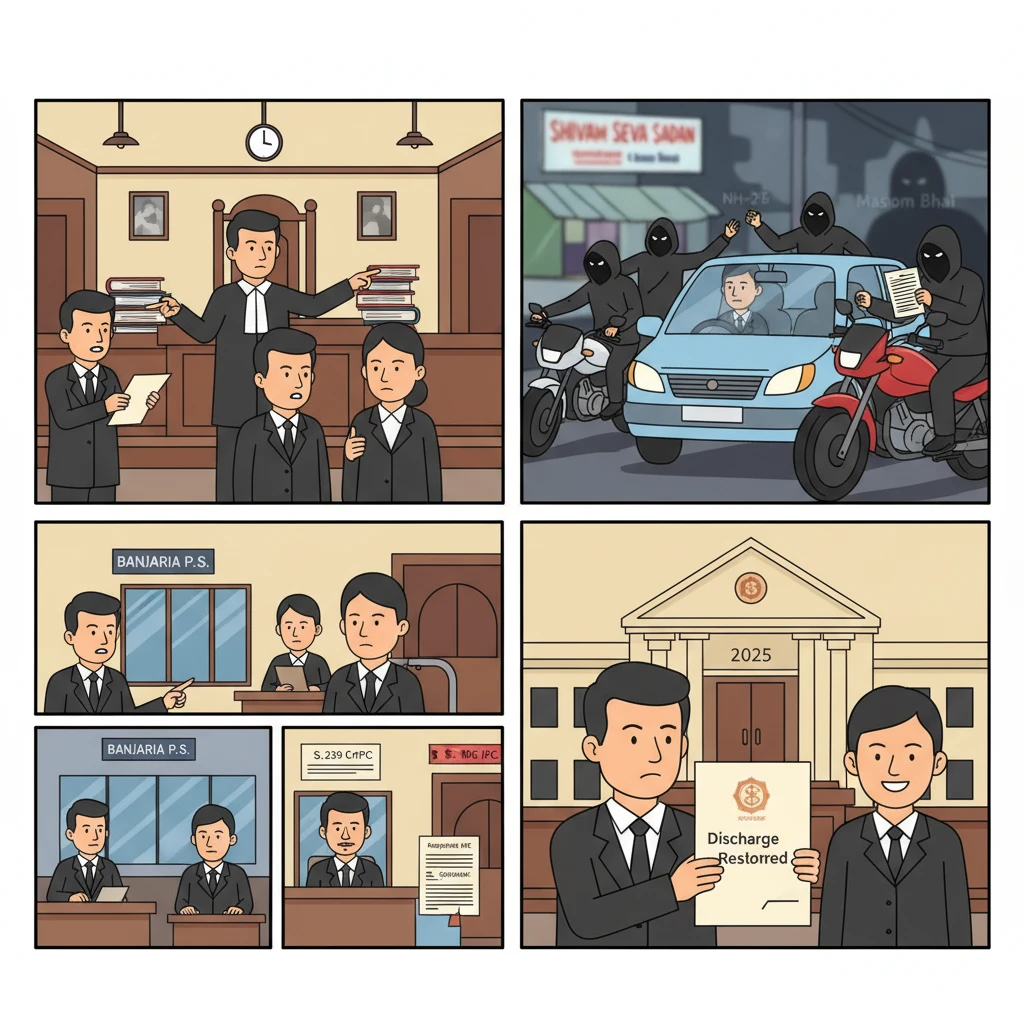
This case began with a written complaint given on 06.03.2021 by a lady doctor, an ex-Nagar Parishad member and District President (Mahila) of a political party in East Champaran. She claimed that unknown men on motorcycles stopped her car and demanded a large amount of money in the name of a local political figure.
She alleged that on 05.03.2021, at about 7:45 PM, while returning from her nursing home “Shivam Seva Sadan” near NH-28, Singhia Sagar Morh, to her residence at Badhai Tola, four unknown persons on two number-plate-less motorcycles surrounded her car. They allegedly demanded Rs. 50,00,000 as extortion, saying this was the “farman” (mandate) of “Masoom Bhai” (the petitioner). They allegedly threatened to blow up her clinic and kidnap her children if the demand was not met in five days, and warned her against going to the police.
On this written information, Banjariya P.S. Case No. 193 of 2021 was registered under Sections 341, 354B, 386, 387, and 34 of the Indian Penal Code. After investigation, the police submitted a charge-sheet. The Chief Judicial Magistrate, Motihari, took cognizance and transferred the case to the Judicial Magistrate, 1st Class, Motihari, where it was numbered as Trial No. 1031/2022.
After receiving police papers under Section 207 CrPC, the petitioner filed an application under Section 239 CrPC seeking discharge on the ground that the case against him was “groundless”. On 16.12.2022, the Judicial Magistrate rejected this discharge petition, holding that there were triable issues.
The petitioner also filed a criminal revision against the cognizance order before the Additional District and Sessions Judge-XIV, Motihari. On 27.07.2022, the revisional court partly allowed the revision and set aside cognizance for the offence under Section 386 IPC, but left other offences intact.
Aggrieved by the rejection of his discharge application, the petitioner approached the Patna High Court in Criminal Miscellaneous No. 5086 of 2023, seeking quashing of the order dated 16.12.2022 and the consequential criminal proceedings against him.
What the Court Examined and Decided
The Patna High Court, through Hon’ble Mr. Justice Chandra Shekhar Jha, closely examined whether there was enough material to even justify a criminal trial against the petitioner or whether the case against him was based only on suspicion and political rivalry.
The petitioner’s senior counsel argued that there was no “strong suspicion” against the petitioner to frame charges. Under Section 239 CrPC, if the Magistrate finds the charge to be “groundless” after considering the police report, accompanying documents, examining the accused if necessary, and hearing both sides, the accused must be discharged with reasons recorded.
The defence highlighted that the FIR itself showed that the petitioner was not present at the place of occurrence. The unknown assailants were never arrested, and there was no confession or statement from them linking the petitioner with the alleged extortion. The only connection made in the FIR was that the informant “became sure” that the petitioner was behind the attack, mainly because of past political rivalry and earlier cases in which he had already been exonerated.
The petitioner pointed out that the FIR stated in Hindi: “मुझे पूरा यकीन हो गया कि यह वही मासूम खान है”, which shows the implication was based on her belief, not on any direct act seen or proved on the spot. The Court noted that the FIR narration clearly suggested only suspicion arising out of political rivalry.
The petitioner’s counsel also relied on case diaries and supervision reports in related cases:
- In Motihari Town P.S. Case No. 95/2017 (Trial No. 3815/2019), the petitioner had already been discharged.
- In Motihari P.S. Case No. 01/2018, where one Lal Saheb allegedly gave a confession, police supervision report dated 19.01.2019 recorded that the petitioner was out of India (as per his passport) from 15.09.2017 to 13.06.2018 and was not present in the country at the time of the alleged occurrence. The investigating officer did not find his involvement and did not send him up for trial, despite protest petitions by the informant.
- In Turkauliya P.S. Case No. 1060/2022, lodged by the informant’s maid, the petitioner was again not sent up for trial. The investigation revealed that he was named at the instance of the same informant (Opposite Party No. 2).
- In Chhatauni P.S. Case No. 42/2023 under the IT Act, the informant sought to add the petitioner’s name six months after the FIR. The supervision report again recorded political rivalry between the parties.
The High Court treated these materials as “unimpeachable documents” of “sterling nature” showing a pattern of attempts by the informant to rope in the petitioner in various cases, with the investigating agencies repeatedly finding no basis to prosecute him.
The petitioner’s counsel also argued that since the petitioner was not present at the scene, he could not have used any criminal force to disrobe the informant (Section 354B IPC) or to wrongfully restrain her (Section 341 IPC). There was also no material to show any agreement or meeting of minds between him and the unknown assailants to attract Section 120B IPC (criminal conspiracy). There was no direct evidence tying him to the extortion threats under Section 387 IPC or to offences under Sections 504 and 506 IPC.
The informant’s senior counsel broadly supported the Magistrate’s view that there were triable issues and that a detailed evaluation was not possible at the discharge stage. However, he could not dispute the existence of long-standing political rivalry and repeated failed attempts to implicate the petitioner, nor the fact that the informant herself faced criminal cases of murder and attempt to murder (Chhatauni P.S. Case Nos. 53/2015 and 64/2023), as recorded by the High Court.
The High Court then referred extensively to Supreme Court decisions on discharge and quashing, including:
- Vishnu Kumar Shukla v. State of Uttar Pradesh (2023 SCC Online SC 1582), explaining that at the stage of framing charge, the court must see if there is a prima facie case and “strong suspicion” based on material that can become evidence at trial.
- State of Gujarat v. Dilipsinh Kishorsinh Rao (discussed within Vishnu Kumar Shukla), clarifying that while the accused cannot generally produce defence material at charge stage, the court must still apply its judicial mind to prosecution material and cannot act as a post office.
- The State of U.P. v. Dr. Sanjay Singh (1994 Supp (2) SCC 707), stating that suspicion of motive alone cannot justify framing of charges in the absence of material showing that the motive translated into action connected with the accused.
- Kanchan Kumar v. State of Bihar (2022) 9 SCC 577, reaffirming that a strong suspicion must be based on material and not merely on the judge’s subjective moral notions.
- State of Orissa v. Debendra Nath Padhi (AIR 2005 SC 359), which holds that the accused normally cannot insist on producing documents at the stage of framing charge, but also clarifies the scope of Section 91 CrPC and the role of High Court powers under Section 482 CrPC.
- State of Karnataka v. L. Muniswamy and the celebrated Bhajan Lal guidelines (1992 Supp (1) SCC 335) on when criminal proceedings can be quashed, including where cases are manifestly attended with mala fide and aimed at vengeance.
Applying these principles, the High Court stressed that Section 239 CrPC is a safeguard against innocent persons being dragged into trial. The Magistrate must:
- Consider the police report and documents under Section 173 CrPC.
- Make such examination of the accused as necessary.
- Give both sides an opportunity of being heard.
- Record clear reasons while deciding whether the charge is “groundless” or not.
The Court found that the Magistrate’s order was mechanical. It simply stated that prima facie materials existed and that there were “triable issues”, without specifying what material, if unrebutted, could reasonably lead to conviction. The Magistrate relied merely on the fact that cognizance had been taken earlier, without independently testing whether a “grave suspicion” truly arose from the record against this particular petitioner.
The High Court held that the FIR and case materials only showed motive and suspicion based on political rivalry, not a strong or grave suspicion that the petitioner had conspired with unknown assailants or directed them to commit the crime. The absence of any arrest or confession of the unknown assailants, the petitioner’s non-presence at the spot, the doubtful WhatsApp screenshots (not backed by Section 65B certification), and the repeated exonerations in related cases all weighed heavily.
In these circumstances, the Court concluded that continuing the criminal proceedings against the petitioner would amount to misuse of the process of the court, fitting within the Bhajan Lal category of cases lodged with mala fide or personal vendetta.
Therefore, the High Court allowed the petition, quashed the Magistrate’s order dated 16.12.2022 in Trial No. 1031/2022 arising out of Banjariya P.S. Case No. 193 of 2021, and set aside all consequential proceedings against the petitioner. A copy of the judgment was directed to be sent to the trial court.
Why This Judgment Matters
This decision is important for people in Bihar and elsewhere who may face false criminal complaints due to political rivalry or personal grudges. The Patna High Court has clearly said that mere suspicion, political enmity, or past disputes are not enough to drag someone into a criminal trial.
The judgment shows that at the discharge stage, the trial court must carefully examine whether there is any real, concrete material that, if unrebutted, could lead to conviction. If the case is based only on doubt or on the complainant’s belief, without supporting evidence, the accused should not be forced to undergo the trauma of a criminal trial.
The Court has also underlined that Section 239 CrPC is not a rubber stamp stage. Magistrates must apply their mind, look at all the materials collected by police, and record specific reasons about why they think the charge is or is not “groundless”. Blindly proceeding to trial just because an FIR was lodged and a charge-sheet filed is not acceptable.
For victims of false implication, especially in politically charged environments, this judgment offers a clear example of how higher courts can step in to prevent abuse of criminal law.
Legal Issues and Answers
- Issue: Whether the materials in Banjariya P.S. Case No. 193 of 2021 created a strong or grave suspicion justifying framing of charges against the petitioner under Sections 341, 354B, 387, 120B, 504, 506 IPC.
Answer: No. The Patna High Court held that the FIR and case materials only indicated suspicion and political rivalry, with no direct or reliable link between the petitioner and the alleged crime, and therefore the charges against him were groundless. - Issue: Whether the Magistrate’s order rejecting discharge under Section 239 CrPC was lawful and properly reasoned.
Answer: No. The High Court found the order to be mechanical and lacking specific reasoning on what material could lead to conviction, and therefore quashed it along with all consequential proceedings against the petitioner. - Issue: Whether the case fell within the category of mala fide prosecutions warranting interference under the Bhajan Lal principles.
Answer: Yes. Based on a pattern of failed attempts to implicate the petitioner and clear political rivalry, the Court held that the proceeding against the petitioner was attended with mala fide and deserved to be quashed.
Cases Cited by the Court
- State of Orissa v. Debendra Nath Padhi, AIR 2005 SC 359
- Vishnu Kumar Shukla and Anr. v. State of Uttar Pradesh and Anr., 2023 SCC Online SC 1582
- State of Gujarat v. Dilipsinh Kishorsinh Rao, 2023 INSC 894 (as referred in Vishnu Kumar Shukla)
- The State of Uttar Pradesh through the Central Bureau of Investigation v. Dr. Sanjay Singh & Ors., 1994 Supp (2) SCC 707
- Century Spinning & Manufacturing Co. Ltd. v. State of Maharashtra, (1972) 3 SCC 282 : 1972 SCC (Cri) 495 : AIR 1972 SC 545
- State of Karnataka v. L. Muniswamy, (1977) 2 SCC 699 : 1977 SCC (Cri) 404 : AIR 1977 SC 1489
- State of Tamil Nadu v. R. Soundirarasu and Ors., 2022 SCC Online SC 1150
- Kanchan Kumar v. State of Bihar, (2022) 9 SCC 577
- M/s Karnataka Emta Coal Mines Limited and Anr. v. Central Bureau of Investigation, 2023 SCC Online SC 2250
- Ram Prakash Chadha v. The State of Uttar Pradesh, 2023 SCC Online SC 1709
- State of Haryana v. Bhajan Lal, 1992 Supp (1) SCC 335 : 1992 SCC (Cri) 426 (referred as Bhajan Lal’s case)
Case Details
Case Number: Criminal Miscellaneous No. 5086 of 2023, arising out of Banjariya P.S. Case No. 193 of 2021, Trial No. 1031/2022
Case Title: Masum Khan @ Masoom Khan @ Sabih Ahmed v. The State of Bihar & Anr.
Citation: 2025(3) PLJR 321
Court: High Court of Judicature at Patna
Coram: Hon’ble Mr. Justice Chandra Shekhar Jha
Date of Judgment: 07.04.2025 (C.A.V.; CAV Date: 12.02.2025; Uploading/Transmission Date: 07.04.2025)
Advocates:
- For the Petitioner: Mr. Amit Shrivastava, Senior Advocate; Mr. Ali M. Ahmad, Advocate; Mr. A. Akhtar, Advocate; Mr. Shahbaj Alam, Advocate; Mr. Shailesh Kumar, Advocate
- For the State: Mr. Zainul Abedin, APP
- For the Informant/Opposite Party No. 2: Mr. Ansul, Senior Advocate; Mr. Karandeep, Advocate
Nature of the Case: Petition under Section 482 CrPC (criminal miscellaneous) seeking quashing of order rejecting discharge under Section 239 CrPC and connected criminal proceedings in a police case alleging extortion, wrongful restraint, outraging modesty, criminal conspiracy, and criminal intimidation.
Link to Judgment: https://patnahighcourt.gov.in/viewjudgment/NiM1MDg2IzIwMjMjMSNO-ZBEHSHasoKc=
If you found this explanation helpful and wish to stay informed about
how legal developments may affect your rights in Bihar,
you may consider following Samvida Law Associates for more updates.








Thank you for your valuable information