
Case Background
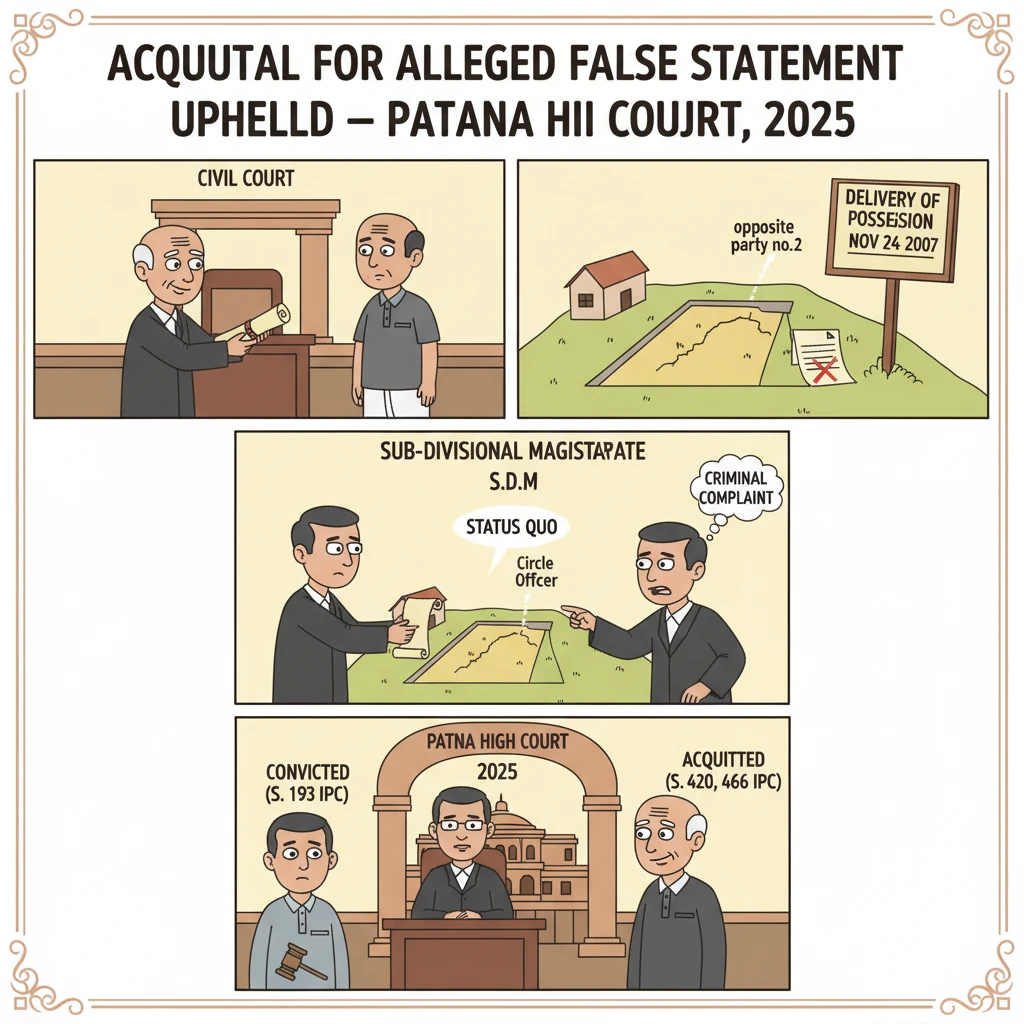
The dispute started from a long-standing civil case over land. A title suit bearing number 71 of 1968 was filed in the Civil Court, Gopalganj regarding the land in question.
In that title suit, a decree was passed in favour of the present revision petitioner. Based on this decree, delivery of possession of the land to the petitioner was fixed for 24.11.2007.
The opposite party no.2, who was on the losing side in the civil case, filed Civil Appeal No. 27 of 2007 in the District Civil Court against the decree. In that appeal, he also sought a stay order against the decree in favour of the petitioner, but the stay was not granted.
Just two days before the scheduled date of delivery of possession, opposite party no.2 approached the Sub-Divisional Magistrate (S.D.M.) by filing a petition for preventive action. He alleged that the petitioner was bent upon making construction over the disputed land, which might cause a breach of public peace.
Acting on this petition, the learned S.D.M. initially directed that status quo be maintained on the land. Later, the S.D.M. came to know that delivery of possession was already to be made in favour of the petitioner under the civil court decree.
On learning this, the S.D.M. vacated the status quo order. He also ordered an inquiry into the statements made by opposite party no.2 in his petition before him. After receiving an inquiry report from the Circle Officer, the S.D.M. directed that a criminal complaint be lodged under Sections 420, 466 and 193 of the Indian Penal Code.
On the basis of this complaint, a criminal case (G.C. No. 11 of 2008, corresponding to Trial No. 584 of 2017) was instituted before the court of the learned Judicial Magistrate. After trial, the learned Additional Chief Judicial Magistrate-XVI, Gopalganj found opposite party no.2 guilty under Section 193 IPC and acquitted him of the charges under Sections 420 and 466 IPC.
Opposite party no.2 challenged his conviction under Section 193 IPC in Criminal Appeal No. 06 of 2018 before the learned Additional Sessions Judge-I, Gopalganj. The appellate court allowed the appeal and set aside the conviction and sentence dated 18.12.2017.
Aggrieved by this acquittal, the decree-holder of the civil suit (the present petitioner) filed Criminal Revision No. 44 of 2019 before the Patna High Court challenging the appellate judgment dated 18.09.2018.
What the Court Examined and Decided
The Patna High Court, through Hon’ble Mr. Justice Jitendra Kumar, heard the revision petition. The Court considered submissions from the learned counsel for the petitioner, the learned APP for the State, and the learned counsel for opposite party no.2.
The petitioner’s main challenge was to the reasoning adopted by the appellate court while acquitting opposite party no.2 of the offence under Section 193 IPC. According to the petitioner, the appellate court held that no inquiry under Section 340 of the Code of Criminal Procedure had been conducted before lodging the complaint. The petitioner argued that this finding was contrary to the records.
The petitioner’s counsel submitted that, in fact, the S.D.M. had directed the complaint to be lodged after an inquiry under Section 340 Cr.P.C. Therefore, he argued, the ground taken by the appellate court—that there was no such inquiry—was not sustainable.
On the factual aspect of alleged false evidence, the petitioner’s counsel argued that opposite party no.2 had made a wrong statement in his petition before the S.D.M. in order to obtain a favourable order. According to the petitioner, this act attracted Section 193 IPC (punishment for giving or fabricating false evidence), and therefore the acquittal under this section was not justified.
On the other side, the learned APP for the State and counsel for opposite party no.2 supported the appellate court’s decision. They submitted that there was no illegality or impropriety in the judgment of the appellate court. They pointed out that, for Section 193 IPC to apply, there must first be a “wrong statement” made before a court.
They argued that a reading of the petition filed before the S.D.M. for preventive measures showed no such wrong statement. At best, there might be concealment of some material facts, but concealment alone does not amount to giving false evidence under Section 193 IPC.
The Patna High Court examined the records and the petition filed by opposite party no.2 before the S.D.M. The Court focused on whether any statement in that petition was actually contrary to established or undisputed facts.
On close reading, the Court found that opposite party no.2 had not made any statement in his petition that was false in the sense of contradicting the known or undisputed facts. However, the Court did note that opposite party no.2 had not disclosed all relevant material facts related to the civil proceedings.
The Court observed that there was no wrong statement regarding the civil suit, the decree passed therein, the execution proceedings, or the appeal against the decree. What opposite party no.2 had concealed was that his application for stay had already been rejected by the civil appellate court.
He also failed to disclose that execution proceedings for delivery of possession in favour of the petitioner were already underway. Thus, the problem in his petition before the S.D.M. lay in non-disclosure of certain facts, not in an incorrect or false statement about the existing legal position.
The Court then discussed the purpose of Section 193 IPC. It held that Section 193 is meant to maintain the purity of judicial proceedings. For this reason, parties are bound not to give wrong statements before the court. The offence targets deliberate falsehoods placed on record, which can mislead the court and undermine justice.
The Court made it clear that merely concealing some facts, without making a positive false statement, does not automatically fall within the ambit of Section 193 IPC. The Court described the idea of punishing someone under Section 193 IPC purely for concealment of some facts as “far stretching.”
In other words, there is a legal difference between lying to the court and omitting to mention certain facts. While such concealment can have other consequences in law, it does not by itself amount to the specific offence of giving false evidence under Section 193 IPC, unless it is coupled with an actual false statement.
The Court took an important step in its reasoning. It assumed, for the sake of argument, that the appellate court’s view on Section 340 Cr.P.C. was not correct. Even on that assumption, the High Court held that the conviction under Section 193 IPC could not stand on the merits of the case because the core ingredient of a false statement was missing.
Thus, the High Court concluded that “even if the ground given by learned Appellate Court for setting aside the conviction under Section 193 IPC is not sustainable, the conviction of the Opposite Party No.2 under Section 193 IPC was not sustainable on merit.”
Having considered the rival submissions and the material on record, the Court held that Section 193 IPC was not applicable to the facts of this case. As there was neither any infirmity nor any illegality in the acquittal of opposite party no.2 under Section 193 IPC, the Court refused to interfere in revision.
Accordingly, the Patna High Court dismissed Criminal Revision No. 44 of 2019 on 14.02.2025, confirming the acquittal of opposite party no.2 from the charge under Section 193 of the Indian Penal Code.
Why This Judgment Matters
This judgment is important for people involved in court disputes, especially where one side accuses the other of lying to the court.
The Patna High Court draws a clear line between making a false statement and hiding or not mentioning some facts. For Section 193 IPC to apply, there must be a clearly false statement before the court, not just incomplete disclosure.
For litigants, this means that while hiding key facts from a court can still hurt their case and may have other legal consequences, it will not always amount to the criminal offence of giving false evidence.
The decision also shows that in criminal revision, the High Court will not lightly interfere with an acquittal, especially where the basic legal ingredients of the offence are not met on the face of the record.
Legal Issues and Answers
- Issue: Does concealment of material facts in a petition before a Magistrate amount to “giving false evidence” punishable under Section 193 IPC?
Answer: No. The Court held that Section 193 IPC requires a wrong or false statement before the court. Mere concealment of some facts, without any statement contrary to established or undisputed facts, does not attract Section 193 IPC. - Issue: Was there any infirmity or illegality in the appellate court’s order acquitting opposite party no.2 of the offence under Section 193 IPC?
Answer: No. The Patna High Court held that, irrespective of the appellate court’s reasoning on Section 340 Cr.P.C., the conviction under Section 193 IPC was itself unsustainable on merits. Therefore, the acquittal required no interference.
Cases Cited by the Court
- No prior judgments or case law have been cited or relied upon in the text of this judgment.
Case Details
Case Number: Criminal Revision No. 44 of 2019 (arising out of G.C. No. 11 of 2008, Trial No. 584 of 2017)
Case Title: Ishwar Chandra Pandey v. State of Bihar & Anr.
Citation: 2025(3) PLJR 465
Coram: Hon’ble Mr. Justice Jitendra Kumar
Advocates:
- For the Petitioner: Mr. Ranjeet Kumar Pandey, Advocate
- For the State: Mr. Akhileshwar Dayal, APP
- For Opposite Party No.2: Mr. Shashank Shekhar, Advocate
Nature of the Case: Criminal revision against an appellate judgment setting aside conviction under Section 193 IPC (with prior acquittal under Sections 420 and 466 IPC)
Date of High Court Judgment: 14.02.2025
Court: High Court of Judicature at Patna
link to judgement; https://patnahighcourt.gov.in/viewjudgment/NyM0NCMyMDE5IzEjTg==-dO3UAiKFg10=
If you found this explanation helpful and wish to stay informed about how legal developments may affect your rights in Bihar, you may consider following Samvida Law Associates for more updates.







