
Case Background
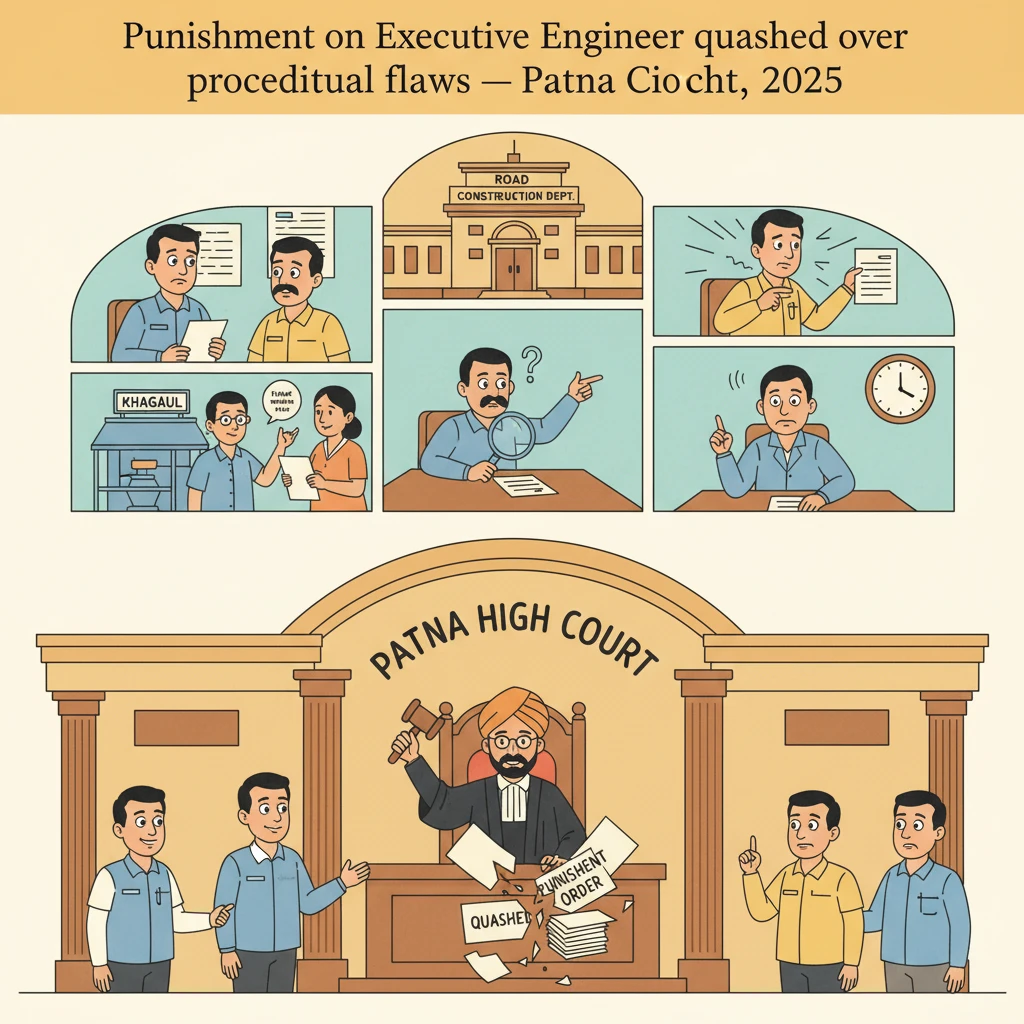
The petitioner was working as Executive Engineer in the Mechanical Division at Muzaffarpur. He was also given additional charge of the National Highway Mechanical Division, Muzaffarpur.
By office order dated 12.05.2009, the Hot Mix Plant at Khagaul of Tantiya was attached with the National Highway Mechanical Division, Muzaffarpur. This meant that the plant came under the administrative control of the division of which the petitioner had additional charge.
On 29.08.2009, one Time Keeper, Subhash Kumar Das, was deputed to work at the Hot Mix Plant, Khagaul. He did not comply with this deputation order. Instead, a complaint dated 31.08.2009 was filed through his wife, alleging harassment by the petitioner.
The complaint mainly alleged that the petitioner had refused paternity leave applied for on 17.08.2009 and had illegally deputed Subhash Kumar Das as Night Guard at the Hot Mix Plant, Khagaul. This complaint was sent to the Superintending Engineer, National Highway Road Circle, Patna, for inquiry.
After conducting an inquiry, the Superintending Engineer submitted his report on 17.11.2009. He found that the allegations against the petitioner were incorrect and false. He also recommended that departmental proceedings be initiated against Subhash Kumar Das for using objectionable language against the petitioner.
Even before this inquiry report was received, the Deputy Secretary, Road Construction Department, issued a show cause notice to the petitioner on 13.10.2009. The petitioner replied to this notice on 19.10.2009, denying the allegations.
Thereafter, by letter dated 23.02.2010, an order of punishment was passed against the petitioner. Later, by letter dated 31.05.2011 issued by the Special Secretary, Road Construction Department, the punishment was finalised as “censure” effective for three years and withholding of four annual increments with non-cumulative effect.
The petitioner challenged this punishment order in CWJC No. 6844 of 2010. That writ petition was disposed of on 03.08.2010, giving him liberty to submit a representation before the Secretary, Road Construction Department, and directing the authorities to decide it expeditiously.
The petitioner filed a representation before the Secretary. Not getting any response, he also submitted another representation before the Chief Minister, stated to be the final authority for Class-I Government servants. As no relief was granted, he filed the present writ petition assailing the punishment order dated 31.05.2011.
What the Court Examined and Decided
The Patna High Court, through Hon’ble Mr. Justice Partha Sarthy, examined both the factual background and the legality of the disciplinary process followed against the petitioner.
First, the Court noted the two main allegations made in the complaint by the wife of Subhash Kumar Das: refusal of paternity leave and illegal deputation to the Hot Mix Plant at Khagaul.
On the issue of paternity leave, the petitioner’s case was that an order dated 18.08.2009 had been issued by the District Magistrate, Muzaffarpur. By this order, all leave of officers and staff posted in Muzaffarpur stood cancelled due to Vidhan Sabha elections, PACS elections, and relief work in flood-affected areas.
The District Magistrate’s order further stated that only in the most urgent cases could leave be granted, that too with prior permission of the District Magistrate. The petitioner asserted that, since there was no sanction or prior permission from the District Magistrate in favour of Subhash Kumar Das, he could not grant paternity leave.
On the deputation to the Hot Mix Plant, the petitioner argued that he was holding additional charge of the N.H. Mechanical Division, Muzaffarpur, and the Hot Mix Plant at Khagaul had been attached to this division by memo dated 12.05.2009 issued by the Chief Engineer. Therefore, both Muzaffarpur and Khagaul locations were within his jurisdiction and he had authority to post or depute staff there. According to him, there was no illegality in deputing Subhash Kumar Das to Khagaul.
The Court also took note of the inquiry conducted by the Superintending Engineer, National Highway Road Circle, Patna. The Superintending Engineer had considered all materials, including the show cause filed by the petitioner, and in his report dated 17.11.2009 found the allegations against the petitioner to be false and incorrect. He even recommended departmental proceedings against Subhash Kumar Das.
Despite this, the Deputy Secretary, Road Construction Department, had already issued a show cause notice on 13.10.2009 to the petitioner, asking him to reply within seven days. This was done without awaiting the Superintending Engineer’s inquiry report.
At this stage, the petitioner raised two main legal objections to the disciplinary process.
First, he relied on Rules 6 and 7 of the Bihar Government Servants (Classification, Control and Appeal) Rules, 2005. He argued that as an Executive Engineer belonging to Group-A service, the show cause notice initiating proceedings against him was required to be issued by the Government itself, not by a subordinate officer.
It was pointed out that in this case the show cause notice had initially been issued by the Superintending Engineer and later by the Deputy Secretary, Road Construction Department. The respondents did not place any material on record to show that the Government had issued a valid delegation order authorising these officers to issue show cause notice to a Group-A officer like the petitioner.
The Court examined Rules 6, 7, 15 and 16 of the 2005 Rules. Rule 15 provides that the Government may impose any of the penalties specified in Rule 14 on any Government servant. Rule 16 states that the Government or appointing authority or any authority to which the appointing authority is subordinate, or any other authority empowered by general or special order of the Government, may institute disciplinary proceedings.
In absence of proof of delegation by the State Government, the Court concluded that subordinate authorities like the Superintending Engineer and the Deputy Secretary could not validly initiate proceedings against the petitioner.
The Court found support for this view in earlier case law. It referred to:
Dinesh Prasad Singh v. State of Bihar; 2019 (3) PLJR 687.
State of Bihar v. Arvind Kumar; 2013 (4) PLJR 482.
Union of India v. B.V. Gopinath; (2014) 1 SCC 351.
Based on these authorities, the Court held that the requirements of Rule 6 of the 2005 Rules had not been followed. The disciplinary proceedings against a Group-A officer like the petitioner had been initiated by a subordinate authority and not with the approval of the State Government. Therefore, the initiation of the proceedings itself was without jurisdiction and not sustainable in law. On this ground alone, the order of punishment was liable to be set aside.
The second legal objection concerned Rule 19(1)(a) of the 2005 Rules. This provision states that before a disciplinary authority imposes a minor penalty, it must inform the government servant in writing about the proposed action and the grounds of misconduct or misbehaviour on which that action is proposed.
The petitioner argued that the show cause notice dated 13.10.2009 did not fulfil these mandatory requirements. The Court examined the contents of this show cause notice. It found that the notice did not clearly intimate to the petitioner the proposed action to be taken against him, nor did it properly set out the grounds of misconduct on which action was proposed.
The Court held that even when a minor penalty is to be imposed, the delinquent must be told what action is proposed under the Rules so that he can give an effective reply. Since this was not done in the present case, the show cause notice was defective.
In this context, the Court relied on its earlier judgment dated 22.08.2017 in CWJC No. 5327 of 2016 (Indrajeet Kumar Arya v. State of Bihar & Ors.), where it was held that non-compliance with Rule 19(1)(a) renders the punishment unsustainable.
Combining these two major defects—lack of jurisdiction in initiation of the proceedings and failure to comply with Rule 19(1)(a)—the Court held that the punishment order dated 31.05.2011 could not stand.
Accordingly, in paragraph 22, the Court quashed and set aside the punishment order dated 31.05.2011 issued under the signature of the Special Secretary, Road Construction Department, Government of Bihar, Patna. The Court further held that the petitioner is entitled to all consequential benefits which were denied to him as a result of the impugned order.
Finally, in paragraph 23, the writ application was allowed.
Why This Judgment Matters
This judgment is significant for government servants, especially Group-A officers in Bihar, who face departmental proceedings.
First, the Patna High Court clearly reaffirms that disciplinary proceedings against Group-A officers must be initiated by the competent authority as per the Bihar Government Servants (Classification, Control and Appeal) Rules, 2005. A subordinate officer cannot start such proceedings without valid delegation from the State Government.
Second, the judgment stresses that even when only a minor penalty like censure or withholding of increments is proposed, the disciplinary authority must strictly comply with Rule 19(1)(a). The government servant must be properly informed of the proposed action and the exact grounds of misconduct.
If these basic safeguards are not followed, the punishment can be struck down, as happened in this case.
For officers who are posted in sensitive or high-pressure assignments, this decision underlines that they cannot be punished on the basis of defective show cause notices or proceedings initiated by officers lacking proper authority.
The ruling also reassures honest officers that if an independent inquiry exonerates them, higher authorities cannot ignore that report and continue with punishment without a proper legal basis.
Legal Issues and Answers
- Issue: Whether disciplinary proceedings and punishment against a Group-A Executive Engineer could validly be initiated and pursued by subordinate authorities like the Superintending Engineer and the Deputy Secretary, without proof of delegation from the State Government.
Answer: No. The Court held that under the 2005 Rules, proceedings against a Group-A officer must be initiated by the Government or by an authority duly empowered by it. In absence of proof of valid delegation, the initiation was without jurisdiction and the punishment could not stand. - Issue: Whether a show cause notice for imposing a minor penalty, which does not specify the proposed action and clear grounds of misconduct, satisfies Rule 19(1)(a) of the Bihar Government Servants (Classification, Control and Appeal) Rules, 2005.
Answer: No. The Court found that the show cause notice dated 13.10.2009 did not comply with Rule 19(1)(a), as it failed to inform the petitioner about the proposed action and detailed grounds. Therefore, the punishment based on such notice was unsustainable. - Issue: Whether the punishment order dated 31.05.2011 imposing censure and withholding of four increments on the petitioner could be upheld in light of the above defects.
Answer: No. The Court quashed the punishment order and granted all consequential benefits to the petitioner, holding the entire proceeding to be vitiated by lack of jurisdiction and violation of Rule 19(1)(a).
Cases Cited by the Court
- Dinesh Prasad Singh v. State of Bihar; 2019 (3) PLJR 687
- State of Bihar v. Arvind Kumar; 2013 (4) PLJR 482
- Union of India v. B.V. Gopinath; (2014) 1 SCC 351
- Indrajeet Kumar Arya v. State of Bihar & Ors.; CWJC No. 5327 of 2016, judgment dated 22.08.2017 (Patna High Court)
Case Details
Case Number: Civil Writ Jurisdiction Case No. 10846 of 2011
Case Title: Ajay Kumar Singh v. The State of Bihar & Ors.
Citation: 2025 (4) PLJR 674
Court: High Court of Judicature at Patna
Coram: Hon’ble Mr. Justice Partha Sarthy
Date of Judgment: 03.11.2025
Parties: Petitioner – Ajay Kumar Singh, Executive Engineer (Mechanical Division), Muzaffarpur (with additional charge of N.H. Mechanical Division, Muzaffarpur); Respondents – State of Bihar and officers of the Road Construction Department.
Advocates: For the Petitioner – Mr. Prabhu Nath Pathak, Advocate; For the Respondents – Mr. Rajeev Kr. Singh, GP 15
Nature of the Case: Writ petition under civil writ jurisdiction challenging departmental punishment order (censure and withholding of four annual increments) imposed on a Group-A Government servant.
Impugned Order: Letter dated 31.05.2011 issued under the signature of the Special Secretary, Road Construction Department, Government of Bihar, Patna, awarding “censure” effective for three years and withholding of four annual increments with non-cumulative effect.
Final Outcome: Punishment order dated 31.05.2011 quashed and set aside; petitioner held entitled to all consequential benefits; writ petition allowed.
Link to Judgment: Click here to read the full judgment of the Patna High Court
If you found this explanation helpful and wish to stay informed about
how legal developments may affect your rights in Bihar,
you may consider following Samvida Law Associates for more updates.







