
Case Background
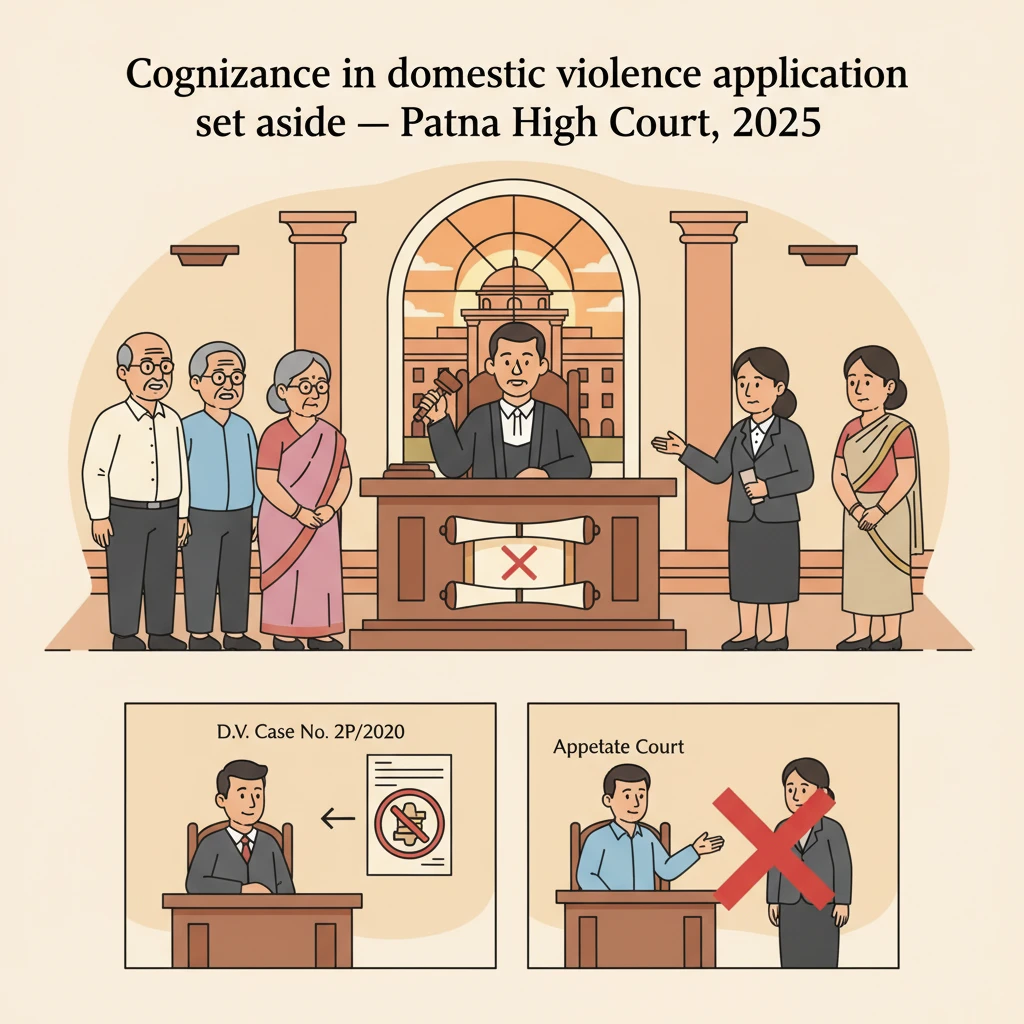
The case arose from a domestic violence proceeding filed as D.V. Case No. 2P/2020. The aggrieved woman, opposite party no. 2, moved an application under Section 12 of the Protection of Women from Domestic Violence Act, 2005.
She sought various reliefs under Sections 17, 18, 19, 20 and 22 of the Domestic Violence Act, 2005. The respondents in that case were her husband and his parents, who are the petitioners in the present criminal revision.
On 21.01.2020, the learned Chief Judicial Magistrate, Begusarai, passed an order taking cognizance on the application filed under Section 12 of the Act. Instead of simply fixing a hearing and issuing notice, the Magistrate treated the application as if it were a criminal complaint requiring cognizance.
Feeling aggrieved, the husband and his parents challenged this order in Criminal Appeal No. 44/2023 before the learned Additional Sessions Judge-II, Begusarai. On 27.06.2024, the appellate court dismissed the appeal. It held that the order dated 21.01.2020 passed in D.V. Case No. 2P/2020 was legal, valid and proper.
The petitioners then approached the Patna High Court by filing Criminal Revision No. 657 of 2024. They questioned whether the Magistrate was right in taking cognizance on an application under Section 12 of the Domestic Violence Act.
What the Court Examined and Decided
Hon’ble Mr. Justice Bibek Chaudhuri heard the criminal revision. The central question was narrow but important: Is an application under Section 12 of the Protection of Women from Domestic Violence Act, 2005 a “complaint” within the meaning of Section 200 of the Code of Criminal Procedure, 1973, or Section 223 of the Bharatiya Nagarik Suraksha Sanhita (BNSS)?
If it is a complaint, then the Magistrate is required to take cognizance as in a normal criminal case. If it is not, then the Magistrate should follow the special procedure given in the Domestic Violence Act, without taking criminal cognizance.
The Court began by looking at the text of Section 12 of the Domestic Violence Act, 2005. This provision allows an aggrieved person, a Protection Officer, or any other person on behalf of the aggrieved person to present an application to the Magistrate seeking one or more of the reliefs under the Act.
Section 12(1) states that such an application can be made and, before passing any order, the Magistrate must consider any domestic incident report received from the Protection Officer or service provider. Section 12(2) clarifies that the relief may include compensation or damages, in addition to the right to file a separate civil suit.
Section 12(3) mandates that every application shall be in such form and contain such particulars as may be prescribed. Section 12(4) requires the Magistrate to fix the first date of hearing, which shall not ordinarily be beyond three days from the date of receipt of the application. Section 12(5) directs the Magistrate to endeavour to dispose of every application within sixty days from the date of first hearing.
The Court also referred to Section 2(i) of the Domestic Violence Act, which defines “Magistrate” as a Judicial Magistrate of the first class or Metropolitan Magistrate exercising jurisdiction under the Code of Criminal Procedure in the area where the aggrieved person resides, the respondent resides, or the domestic violence is alleged to have taken place.
In exercise of its rule-making power under Section 37 of the Act, the Government framed the Protection of Women from Domestic Violence Rules, 2006. Rule 6(1) of these Rules says that every application made under Section 12 shall be in Form II appended to the Rules.
The Patna High Court then relied heavily on a recent Supreme Court judgment: Shaurabh Kumar Tripathi vs. Vidhi Rawal, reported in 2025 SCC OnLine SC 1158. The Supreme Court had directly addressed whether a Section 12 application is a criminal complaint.
Quoting paragraphs 18 and 19 of that decision, the Patna High Court noted that the Supreme Court clearly held that an application under Section 12 of the Domestic Violence Act, 2005 is not a complaint under Section 200 of the Cr.P.C. or Section 223 of the BNSS.
The Supreme Court pointed out that, for a complaint under Section 200 Cr.P.C., the Magistrate must examine the complainant and witnesses, if any, to verify the truth of the allegations before taking cognizance and issuing process. Under Section 223(2) BNSS, cognizance cannot be taken without giving the accused an opportunity of being heard.
By contrast, in a Section 12 application under the Domestic Violence Act, the Magistrate has a different role. Under Section 12(4), the Magistrate must fix the first date of hearing within three days of receipt of the application. Section 13(1) requires service of notice of that date on the respondent, following the modes of service laid down in Rule 2 of the Domestic Violence Rules, 2006.
On this basis, the Supreme Court had concluded that the Domestic Violence Act creates a special scheme. It is not the same as launching a criminal prosecution by way of complaint. Therefore, the Magistrate does not “take cognizance” in the sense used in Section 200 Cr.P.C. or Section 223 BNSS.
Adopting this reasoning, the Patna High Court held that an application under the Domestic Violence Act, 2005 is not a complaint within the meaning of Section 200 of the Cr.P.C. or Section 223 of the BNSS.
Because of this, the Court said there is no need to take cognizance upon such an application. The proper legal step for the Magistrate is straightforward: on receiving an application under Section 12, the Magistrate should only fix a date for hearing within three days as mandated by Section 12(4) and then issue notice to the respondents in the manner provided in Section 13(1) and Rule 2 of the 2006 Rules.
Applying this understanding to the facts of the present case, the Court found that both the Chief Judicial Magistrate and the Additional Sessions Judge had proceeded on an incorrect legal basis. The Chief Judicial Magistrate, Begusarai, had taken cognizance on the Section 12 application in D.V. Case No. 2P/2020. The Additional Sessions Judge-II, Begusarai, had then affirmed this approach while dismissing Criminal Appeal No. 44/2023.
The High Court held that both orders were bad in law. Neither court had properly considered the legal position arising from Sections 12 and 13 of the Domestic Violence Act, 2005 and the Supreme Court’s interpretation.
Consequently, the Patna High Court set aside both the order of cognizance passed by the learned Magistrate and the appellate order dismissing the appeal.
However, the Court did not dismiss the underlying domestic violence case itself. Instead, it directed the learned Judicial Magistrate, Begusarai, to proceed in accordance with the correct procedure laid down in the Act.
Specifically, the Court directed the Magistrate to issue notice upon the present petitioners in D.V. Case No. 2(P)/2020 for hearing of the application under Section 12 of the Domestic Violence Act, 2005. The notice must be served in terms of Rule 2 of the Domestic Violence Rules, 2006, following the modes and means of service for notices issued under Section 13(1) of the Act.
With these directions, the criminal revision was disposed of. The Court did not make any order as to costs.
Why This Judgment Matters
This judgment is important for both victims of domestic violence and those accused in such cases. It clarifies how Magistrates in Bihar must handle applications under Section 12 of the Domestic Violence Act.
The Patna High Court has made it clear that a Section 12 application is not a criminal complaint like one under Section 200 Cr.P.C. This means the Magistrate should not talk of “cognizance” in the usual criminal sense when dealing with domestic violence applications.
Instead, the Magistrate must swiftly fix a hearing date within three days and ensure proper notice is served on the respondent. This helps aggrieved women by speeding up the process and ensuring the focus stays on quick civil-style reliefs like residence, protection and maintenance.
At the same time, the judgment protects respondents from being treated as criminal accused at the initial stage of a Section 12 application. The procedure is more regulated and follows the special framework of the Domestic Violence Act.
For lawyers and trial courts in Bihar, this decision, relying on the Supreme Court’s ruling in Shaurabh Kumar Tripathi vs. Vidhi Rawal, acts as a binding reminder to follow the special procedure under Sections 12 and 13 of the Act and the 2006 Rules.
Legal Issues and Answers
- Issue: Is an application under Section 12 of the Protection of Women from Domestic Violence Act, 2005 a “complaint” within the meaning of Section 200 Cr.P.C. or Section 223 BNSS, requiring the Magistrate to take cognizance?
Answer: No. Following the Supreme Court’s decision in Shaurabh Kumar Tripathi vs. Vidhi Rawal, the Patna High Court held that an application under Section 12 of the Domestic Violence Act, 2005 is not such a complaint. The Magistrate is not required to take cognizance; instead, the Magistrate must fix a hearing date under Section 12(4) and issue notice under Section 13(1) read with Rule 2 of the 2006 Rules. - Issue: Were the orders of the Chief Judicial Magistrate taking cognizance and the Additional Sessions Judge dismissing the appeal against that order legally valid?
Answer: No. The Patna High Court held that both orders were bad in law because they treated the Section 12 application as a complaint requiring cognizance, contrary to the scheme of the Domestic Violence Act and the Supreme Court’s interpretation.
Cases Cited by the Court
- Shaurabh Kumar Tripathi vs. Vidhi Rawal, 2025 SCC OnLine SC 1158.
Case Details
Case Number: Criminal Revision No. 657 of 2024; arising out of D.V. Case No. 2P/2020 and Criminal Appeal No. 44/2023.
Case Title: Prashat Kumar & Ors. vs. The State of Bihar & Anr.
Citation: 2025(3) PLJR 284
Coram: Hon’ble Mr. Justice Bibek Chaudhuri
Date of Judgment: 23.06.2025 (Uploading Date 25.06.2025)
Advocates: For the petitioners: Dr. Anjani Pd. Singh, Advocate. For the respondents: Ms. Renu Kumari, APP.
Nature of the case: Criminal revision against dismissal of criminal appeal challenging an order passed in proceedings under Section 12 of the Protection of Women from Domestic Violence Act, 2005.
Link to Judgment:https://patnahighcourt.gov.in/viewjudgment/NyM2NTcjMjAyNCMxI04=-Hwkzn6Q3afY=
If you found this explanation helpful and wish to stay informed about how legal developments may affect your rights in Bihar, you may consider following Samvida Law Associates for more updates.







