
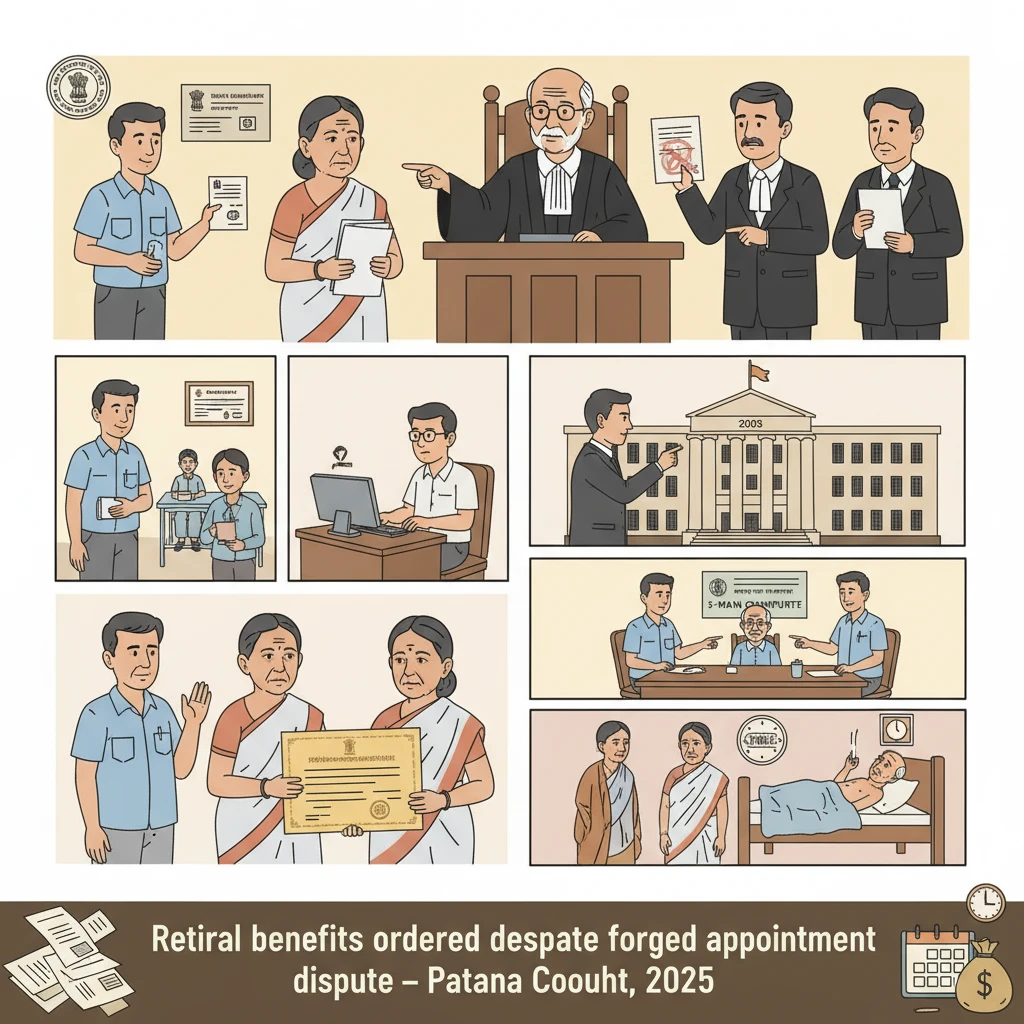
Case Background
The writ case began with a government health worker approaching the Patna High Court. He sought a direction to the Health Department and other authorities to fix and pay his retiral benefits such as pension, gratuity, leave encashment, provident fund, group insurance, ACP/MACP and any other legal dues.
He claimed that his entire period of service from 18.01.1981 to 30.06.2014 should be counted. During the pendency of the case, the original petitioner died on 12.10.2024. On 05.12.2024, the Court allowed substitution and his wife, Mulmul Devi, continued the case as petitioner.
The admitted facts on record show that the petitioner’s husband was appointed as Male Family Welfare Worker by the Civil Surgeon-cum-Chief Medical Officer, Ranchi under Memo No.88 dated 15.01.1981. He joined on 18.01.1981 at the Primary Health Centre, Palkot, Ranchi. He was later transferred to Primary Health Centre, Birpur, Saharsa and relieved on 04.01.1982.
His services, along with others, were confirmed by Memo No.3330 dated 27.12.1990 issued by the Civil Surgeon-cum-Chief Medical Officer, Saharsa. After completion of ten years of service, he was granted first time bound promotion under Finance Department Resolution No.10770 dated 30.12.1981. He also passed the Hindi Noting and Drafting Examination in 1997.
While working on the said post, his service was abruptly terminated by order in Memo No.514 dated 30.04.2003 issued by the Civil Surgeon-cum-Chief Medical Officer, Supaul. The ground was that his appointment was declared illegal on the basis of a forged appointment letter. He challenged that termination in C.W.J.C. No.5707 of 2003.
The writ was allowed and the High Court directed his reinstatement, while giving liberty to the State to identify such cases and take disciplinary action after enquiry and hearing. The State filed L.P.A. No.984 of 2003 against this order. The Division Bench then directed the Health Department to reconsider the cases of all affected employees in light of paragraph 44 of Secretary, State of Karnataka and Others v. Uma Devi (3) and Others [(2006) 4 SCC 1].
Pursuant to this, a Five Men Committee was constituted to examine the nature and status of these appointments. After enquiry, the committee again opined that his appointment was forged. This report and order, to the extent terming his appointment illegal and forged, were challenged in C.W.J.C. No.16924 of 2009.
That writ was allowed. The High Court set aside the termination and directed his reinstatement with all consequential benefits. He was eventually reinstated, but consequential benefits were not paid. He then filed a contempt petition, M.J.C. No.4124 of 2012.
In the meantime, he superannuated, but no pre or post retiral benefits were released. The State had filed L.P.A. No.364 of 2014 against the order dated 13.09.2011 in C.W.J.C. No.16924 of 2009. The Division Bench finally disposed of the LPA directing the appellate authority to consider his case in the light of State of Bihar and Others v. Devendra Sharma [(2020) 15 SCC 466].
On this basis, the petitioner’s husband submitted a detailed representation before the Director-in-Chief (Administration), Health Services, Bihar, Patna. However, his claim for post retiral benefits and dues was rejected by Memo No.2161 dated 04.08.2022 issued by the Civil Surgeon-cum-Chief Medical Officer, Supaul. This rejection order was also brought under challenge by way of an interlocutory application (I.A. No.1 of 2023) in the present writ.
While this writ was pending, the State challenged certain orders dated 25.07.2023 and 12.10.2023 passed in C.W.J.C. No.6382 of 2017 by filing L.P.A. No.1273 of 2023. The Division Bench observed that those orders were based on alleged non-compliance and direction for personal appearance of Director-in-Chief (Administration). It set aside both orders and directed that the writ be placed before the appropriate roster Bench, resulting in the present decision.
What the Court Examined and Decided
The single judge of the Patna High Court, Hon’ble Mr. Justice Harish Kumar, heard counsel for the petitioner, the State, and the Accountant General. The central question was whether the petitioner’s late husband, whose appointment was later described by authorities as forged and void ab initio, could be denied retiral and death-cum-retiral benefits without a full-fledged departmental enquiry.
The Court first noted the petitioner’s main grounds. Counsel argued that the rejection Memo No.2161 dated 04.08.2022 was without jurisdiction. The Division Bench in L.P.A. No.364 of 2014 had directed the “appellate authority” to consider the case in light of Devendra Sharma. According to the petitioner, this meant the Director-in-Chief (Administration) Health Services, Bihar, Patna.
Instead of the appellate authority, the Civil Surgeon-cum-Chief Medical Officer, Supaul, who was only the disciplinary authority, passed the rejection order. The petitioner argued such an order was void on this ground alone.
The petitioner also highlighted that similarly placed Basic Health Workers, including persons named in the judgment such as Surendra Prasad, Arvind Kumar, Parmeshwar Yadav and Khursid Alam, had been given full retiral benefits and ACP/MACP, whereas her husband was singled out.
Another important argument was that her husband was not a party in Civil Appeal No.7879 of 2019 and analogous cases or Civil Appeal No.8649 of 2018 and analogous cases before the Supreme Court. Therefore, judgments in those matters could not automatically label his appointment as forged.
The petitioner stressed that “forgery” is a serious allegation and a question of fact, which must be proved in a properly constituted departmental proceeding. No such proceeding, with charges, evidence and opportunity to defend, was ever held against the original petitioner, despite his decades of service.
The Court recorded that he had been appointed in 1981, had served for over 35 years, and had continuously received benefits like confirmation, time bound promotion, increments and pay revisions as a regular government employee. In this background, calling his appointment forged only after his superannuation, without enquiry, was strongly attacked as unfair.
To support these submissions, the petitioner cited several decisions including Punjab State Electricity Board and Others v. Leela Singh [(2007) 12 SCC 146]; Subodh Kumar Prasad v. State of Bihar and Others [2001(3) PLJR (SC) 187]; Sitendra Kumar Singh with Analogous Cases v. State of Bihar and Others [2003 (4) PLJR 282]; Rajendra Kamti and Another v. Lalit Narayan Mishra University & Others [2006 (3) PLJR 83]; State of Bihar v. Purendra Sulan Kit and another analogous cases [2006 (3) PLJR 386]; Ram Krishna Dubey v. State of Bihar and Others [2008 (1) PLJR 841]; State of Bihar and Others v. Indra Mohan Rai [2009 (2) PLJR 869]; and Rohit Raj v. The State of Bihar and Others [2023 (1) PLJR 257].
On the other side, the State argued that the case was part of a large batch of illegal or forged appointments made by regional health authorities, ignoring constitutional norms. It claimed the petitioner’s husband failed to show that his engagement followed lawful procedure. According to the State, his appointment was void ab initio and his length of service could not cure this illegality.
Relying on Supreme Court decisions in Devendra Sharma and The State of Bihar and Others v. Kirti Narayan Prasad [Civil Appeal No.8649 of 2018], the State submitted that where appointments are void ab initio, the appointees are not civil servants. Hence, protection under Article 311 of the Constitution, including holding of departmental proceedings, does not arise. On this basis, the State justified denying retiral benefits and asserted that the impugned order was in tune with those Supreme Court rulings.
The Court then turned to the legal principles. It reaffirmed that rule of law is against arbitrariness and illegality, and courts must neutralise arbitrary state action. It referred to the Full Bench decision in Ram Sevak Yadav and another analogus cases v. The State of Bihar and Others [2013 SCC OnLine Pat 67], which, following Uma Devi (2006) 4 SCC 1, held that illegal appointments void ab initio cannot be regularised.
However, the Court emphasised that Article 311 protects civil servants from arbitrary dismissal or removal by requiring that they be informed of charges and given reasonable opportunity to be heard, subject to limited exceptions. While this protection may not technically apply if a person is not a civil servant, the Court held that where a person was duly appointed, allowed to work for more than two or three decades and treated as an employee, it cannot simply be said that there is no semblance of civil service status unless that position is disproved in accordance with law.
The Court underscored that forgery allegations cast stigma and must be dealt with through fair procedure, proper enquiry, reasonable opportunity of defence and a reasoned order, as recognised in Leela Singh. It also recalled Supreme Court decisions like Roshni Devi and Others v. State of Haryana and Others [(1998) 8 SCC 59], Union of India and Others v. Kishorilal Bablani [(1999) 1 SCC 729], and Roshni Lal and Others v. International Airport Authority of India and Others [1980 Supp SCC 449/1981 SCC (L&S) 303], which indicated that where employees have continued for a long time, their appointments may be protected on equitable considerations.
The Court distinguished between irregular and forged appointments but held that even to declare an appointment forged, some opportunity of hearing is essential. Termination without any enquiry could not be sustained.
It relied on Subodh Kumar Prasad to note that obtaining service on the strength of a fake appointment letter is a matter for disciplinary action, implying the need for proper proceedings. It referred to Division Bench judgments in Ram Krishna Dubey and Indra Mohan Rai, which held that services of employees who were continued for long and regularised or treated as regular cannot be terminated suddenly for initial irregularities without following Article 311(2) procedure.
The Court cited its own earlier judgment in Rohit Raj, where it had held that Supreme Court rulings in Kirti Narayan Prasad and Devendra Sharma on forged appointments did not apply where no departmental enquiry was ever held, and it also noted that departmental proceedings abate on the death of an employee.
Turning to the facts, the Court highlighted that the petitioner’s husband was appointed in 1981, his services were twice terminated and both times the terminations were set aside by this Court, with liberty to proceed afresh in accordance with law. Yet, on neither occasion did the authorities conduct a full-fledged departmental enquiry with proper hearing.
The Court also discussed Basudeo Tiwary v. Sido Kanhu University & Ors. [(1998) 8 SCC 194], where the Supreme Court held that even if a statute allows termination of appointments made contrary to law, the authority must first record a finding, reached after enquiry and giving notice to the employee, that the appointment was indeed contrary to the Act, rules, etc. This implies an inherent requirement of hearing.
Applying these principles, the Court found that in the present case no such enquiry was held against the petitioner’s husband. Moreover, the Division Bench in L.P.A. No.364 of 2014 had directed the “appellate authority” to consider his case, but instead the Civil Surgeon, who was not the appellate authority, passed the impugned order dated 04.08.2022. The Court held this order to be wholly without jurisdiction.
The Court also took note that the petitioner’s husband had superannuated in 2014, that similarly placed employees had been granted pre and post retiral benefits, and that the original employee had died. In such circumstances, sending the matter back to the department to initiate fresh proceedings would not arise.
In conclusion, the Court set aside the impugned Memo No.2161 dated 04.08.2022 issued by respondent no.3 (Civil Surgeon-cum-Chief Medical Officer, Supaul). It directed the concerned respondents to ensure payment of all admissible death-cum-retiral and outstanding dues to the petitioner within eight weeks from receipt or production of the order. The writ petition was allowed to that extent, with no order as to costs.
Why This Judgment Matters
This judgment is important for long-serving government employees whose appointments are later labelled “illegal” or “forged” without any proper enquiry. The Patna High Court has made clear that even if the State alleges that an appointment is void ab initio, it cannot bypass basic fairness and due process, especially after decades of recognised service.
For widows and families of such employees, the decision shows that denial of pension and other retiral benefits can be challenged where no departmental proceedings, charges, or opportunities to defend were given. The Court has also emphasised that orders meant to be passed by a higher appellate authority cannot be substituted by subordinate authorities.
In practical terms, the ruling directs prompt payment of death-cum-retiral dues to the petitioner. More broadly, it signals to departments in Bihar that they must strictly follow legal procedure before branding appointments as forged and withholding retirement benefits.
Legal Issues and Answers
- Issue: Can the State deny pension and other retiral benefits by treating a decades-old appointment as forged and void ab initio, without holding a proper departmental enquiry?
Answer: No. The Court held that allegations of forged appointment require a fair and proper enquiry with opportunity of hearing. Without such proceedings, the appointment cannot simply be treated as forged to deny retiral dues. - Issue: Was Memo No.2161 dated 04.08.2022 valid when it was passed by the Civil Surgeon instead of the appellate authority directed by the Division Bench?
Answer: No. The Court held that the impugned order was without jurisdiction because the Division Bench had specifically directed the appellate authority to consider the case, and any order by a subordinate authority had no sanction in law. - Issue: Should the matter be remitted again to the department for fresh action after the employee’s death and long delay in payment?
Answer: No. Considering that the employee had already superannuated in 2014, similarly placed persons had received benefits, and the employee was now deceased, the Court declined to remit the matter and instead directly directed payment of all admissible dues.
Cases Cited by the Court
- Secretary, State of Karnataka and Others v. Uma Devi (3) and Others [(2006) 4 SCC 1]
- State of Bihar and Others v. Devendra Sharma [(2020) 15 SCC 466]
- The State of Bihar and Others v. Kirti Narayan Prasad [Civil Appeal No.8649 of 2018 arising out of SLP(C) No.24782 of 2012]
- Ram Sevak Yadav and another analogus cases v. The State of Bihar and Others [2013 SCC OnLine Pat 67]
- Punjab State Electricity Board and Others v. Leela Singh [(2007) 12 SCC 146]
- Subodh Kumar Prasad v. State of Bihar and Others [2001(3) PLJR (SC) 187]
- Sitendra Kumar Singh with Analogous Cases v. State of Bihar and Others [2003 (4) PLJR 282]
- Rajendra Kamti and Another v. Lalit Narayan Mishra University & Others [2006 (3) PLJR 83]
- State of Bihar v. Purendra Sulan Kit and another analogous cases [2006 (3) PLJR 386]
- Ram Krishna Dubey v. State of Bihar and Others [2008 (1) PLJR 841]
- State of Bihar and Others v. Indra Mohan Rai [2009 (2) PLJR 869]
- Rohit Raj v. The State of Bihar and Others [2023 (1) PLJR 257]
- Roshni Devi and Others v. State of Haryana and Others [(1998) 8 SCC 59]
- Union of India and Others v. Kishorilal Bablani [(1999) 1 SCC 729]
- Roshni Lal and Others v. International Airport Authority of India and Others [1980 Supp SCC 449/1981 SCC (L&S) 303]
- State of M.P. and Others v. Lalit Kumar Verma [(2007) 1 SCC 575]
- Basudeo Tiwary v. Sido Kanhu University & Ors. [(1998) 8 SCC 194]
- D.T.C. Mazdoor Sabha v. D.T.C. [1991 Supp (1) SCC 600 : 1991 SCC (L&S) 1213 : AIR 1991 SC 101]
Case Details
Case Number: Civil Writ Jurisdiction Case No.6382 of 2017
Case Title: Mulmul Devi v. The State of Bihar & Others
Citation: 2025(3) PLJR 275
Court: High Court of Judicature at Patna
Coram: Hon’ble Mr. Justice Harish Kumar
Date of Judgment: 19.06.2025
Advocates:
For the petitioner: Mr. Shiv Kumar, Advocate
For the respondents/State: Mr. Kamlesh Kishore, AC to SC-12
For the Accountant General, Bihar: Mr. Ram Kinker Choubey, Advocate
Nature of the case: Writ petition under civil writ jurisdiction seeking direction for fixation and payment of retiral and post-retiral benefits, including pension, gratuity, leave encashment, provident fund, group insurance, ACP/MACP and other legal dues.
Link to judgment:https://patnahighcourt.gov.in/viewjudgment/MTUjNjM4MiMyMDE3IzEjTg==-9JYPcLmoCdM=
If you found this explanation helpful and wish to stay informed about how legal developments may affect your rights in Bihar, you may consider following Samvida Law Associates for more updates.







