
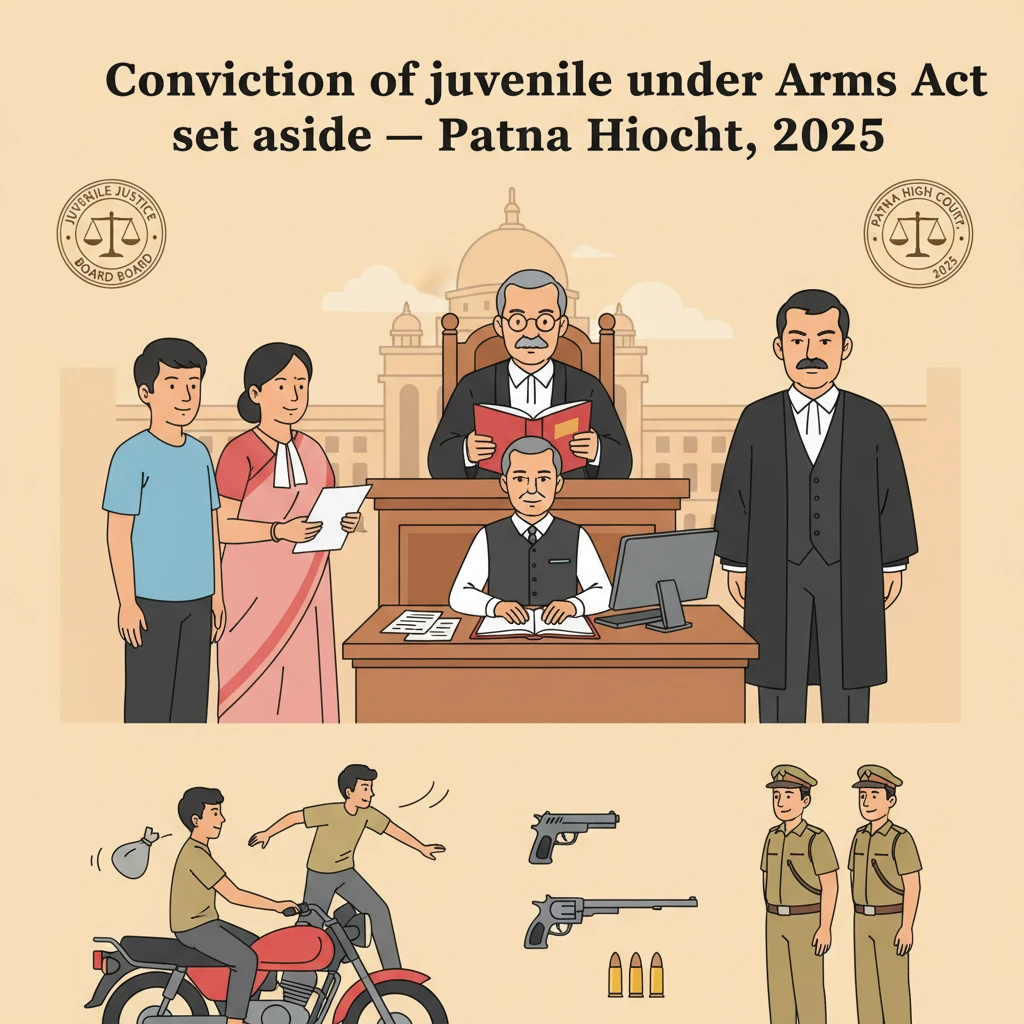
Case Background
The case began with a written report by a Police Sub-Inspector of Chanpatia police station, District West Champaran. On 06.06.2012, Chanpatia P.S. Case No. 146 of 2012 was registered under Sections 25(1-B)(a) and 26/35 of the Arms Act against the petitioner and two others.
According to the written report dated 06.06.2012, the police received secret information that three criminals were moving from Tikulia Chowk towards the railway station on a red motorcycle to commit a crime. Acting on this tip, the police team went near the old High School at Chanpatia and noticed three persons on a motorcycle.
On seeing the police, the three allegedly tried to flee. One of them escaped after throwing his bag. The police claim that two persons, including the petitioner, were apprehended. The police further alleged that one 9 mm pistol made in Italy (no. 2000) and one country-made pistol loaded with .315 bore cartridges were recovered from the petitioner, and country-made pistols were recovered from the two other accused, namely Prince Kumar and Munna Singh. Seizure lists were prepared, and the arms and cartridges were said to have been seized.
After investigation, charge-sheet No. 103 of 2012 dated 04.08.2012 was filed against all three FIR-named accused for offences under Section 25(1-B)(a) and Section 26 read with Section 35 of the Arms Act in the Court of the Chief Judicial Magistrate, Bettiah. Cognizance was taken, and by order dated 06.09.2012, the petitioner was declared a juvenile based on school records showing his date of birth as 15.09.1995.
On the date of occurrence, 06.06.2012, his age was assessed as 16 years, 8 months and 20 days. The case was then transferred to the Juvenile Justice Board, Bettiah, for inquiry and disposal.
Before the Juvenile Justice Board, nine prosecution witnesses were examined, including the informant, investigating officer, driver, and other police personnel, as well as a seizure list witness and the Sergeant Major who provided the forensic report. Several documents were exhibited, including the written report, seizure lists, sanction order for prosecution, charge-sheet, and forensic reports. Material exhibits included country-made pistols and live cartridges.
No defence witness was examined on behalf of the petitioner.
On 16.03.2013, the Juvenile Justice Board found the petitioner guilty under Sections 25(1-B)(a) and 26 read with Section 35 of the Arms Act. He was ordered to be sent to the Special Home, Patna, for three years, subject to adjustment of the period he had already spent in detention.
The petitioner filed Criminal Appeal No. 37 of 2013 before the District and Sessions Judge, Bettiah. On 13.09.2018, the appellate court dismissed the appeal and upheld the conviction and sentence. Against this, the petitioner approached the Patna High Court in Criminal Revision No. 359 of 2019.
What the Court Examined and Decided
The Patna High Court, presided over by Hon’ble Mr. Justice Jitendra Kumar, heard the criminal revision petition challenging both the Juvenile Justice Board’s order dated 16.03.2013 and the appellate judgment dated 13.09.2018.
Counsel for the petitioner argued that the prosecution had failed to prove its case beyond reasonable doubt. He submitted that the entire case rested on the alleged seizure of arms and ammunition from the petitioner, and that this seizure itself was doubtful.
He pointed out that there were two seizure list witnesses, but only one, Sekh Abdullah (P.W. 7), was examined. The other witness, Md. Nurul Hoda Ansari, was not examined at all. Further, P.W. 7 did not support the prosecution’s version. Instead, he stated that when he had gone to the police station for a character certificate, the police made him sign on a plain paper. He denied witnessing any recovery of arms and ammunition from the petitioner.
The petitioner’s counsel also argued that there was no reliable evidence about sealing of the seized arms and ammunition. Only P.W. 5 deposed in cross-examination that the seized arms and cartridges were sealed in a sack, but he did not state who sealed them or where they were sealed. There was no evidence that the arms were sealed separately with proper identification, deposited in the Malkhana, and then sent for ballistic examination in a manner that could link specific weapons to specific accused.
On these grounds, he contended that the alleged recovery from the petitioner was highly doubtful and could not be the basis of conviction. He further submitted that even the sentencing order was not in line with the object, spirit and provisions of the Juvenile Justice (Care and Protection of Children) Act, 2000, which governed the case.
On the other hand, the learned APP for the State defended the orders of the Juvenile Justice Board and the appellate court. He submitted that there was no illegality or infirmity in the findings and that the petitioner had been rightly convicted and ordered to be sent to the Special Home, Patna, for three years, with adjustment of the period already undergone.
The High Court carefully considered the rival submissions and examined the evidence on record. It noted that the entire allegation against the petitioner was based on the alleged seizure of arms and ammunition from his possession. The Court scrutinised the prosecution evidence led before the Juvenile Justice Board.
The Court found that the very seizure and recovery of arms and ammunition from the petitioner was “highly doubtful”. Out of the two seizure witnesses, only one was examined as P.W. 7, and even he did not support the case of seizure in his presence. Instead, he stated that he had been made to sign on a plain paper when he went to the police station for a character certificate.
The Court further observed that there was no evidence that the seized arms and ammunition were sealed on the spot, deposited in the Malkhana with identification marks and then sent for ballistic examination in a manner that could connect specific weapons to the petitioner. The only evidence in this regard was from P.W. 5, who merely said that all arms and ammunition seized from the petitioner and other accused were sealed in one sack, without any details of who sealed them and where.
The Court held that sealing all the arms and ammunition recovered from all three accused in a single sack clearly showed that the prosecution could not even establish which specific arms and ammunition were recovered from the petitioner. In such a situation, the prosecution failed to prove the seizure and recovery from the petitioner beyond reasonable doubt.
The Court observed that it would be a “travesty of justice” to uphold the petitioner’s guilt on such evidence. Accordingly, it held that the conviction recorded by the Juvenile Justice Board and affirmed by the appellate court was not sustainable.
The Court then turned to the question of sentence under the Juvenile Justice (Care and Protection of Children) Act, 2000. It first clarified that since the occurrence took place on 06.06.2012, the Juvenile Justice Act, 2000 as amended in 2006 applied, despite its repeal by the Juvenile Justice (Care and Protection of Children) Act, 2015. This was because Section 25 of the 2015 Act saves pending proceedings, directing that such cases continue under the old Act.
The Court discussed the object and spirit of the Juvenile Justice Act, 2000. It noted that the Act is based on the belief that children are the future of society and, when they come into conflict with law, they should be reformed and rehabilitated, not punished. A punitive approach to juveniles is described as self-destructive for society.
The Court quoted the preamble of the Act, which emphasises proper care, protection, treatment, child-friendly adjudication and ultimate rehabilitation. It referred to the definitions of “juvenile” or “child” in Section 2(k) and “juvenile in conflict with law” in Section 2(l).
The Court then reproduced Section 15 of the 2000 Act, which lists the orders that may be passed regarding a juvenile in conflict with law. These include allowing the juvenile to go home after advice or admonition, group counselling, community service, payment of fine in certain circumstances, release on probation of good conduct under the care of parents, a fit person or fit institution, and, in suitable cases, sending the juvenile to a Special Home for up to three years with recorded reasons.
The Court also emphasised Section 15(2), which requires the Board to obtain a social investigation report from a probation officer or recognised voluntary organisation and to consider its findings before passing an order.
Next, the Court discussed Section 16 of the 2000 Act, which prohibits sentencing a juvenile to death or imprisonment for life, or committing them to prison in default of fine or security. It underlined the special provision allowing, in rare cases of serious offences by juveniles above 16 years, placement in a “place of safety” on State Government orders, but still within the maximum period allowed under Section 15.
The Court then referred to Rule 3 of the Juvenile Justice (Care and Protection of Children) Rules, 2007, setting out fundamental principles for administration of the Act. It highlighted the “principle of best interest”, which requires that the primary consideration in all decisions about a juvenile in conflict with law is his or her welfare, with a shift from retribution to rehabilitation and restoration.
The Court explained that Rule 3 also stresses family responsibility and says that institutionalisation of a child or juvenile should be a last resort and for the minimum possible duration. It also mentions the principles of repatriation and restoration, and “fresh start”, which promotes erasure of past records and non-judicial measures wherever possible.
From the combined reading of Sections 15 and 16 of the 2000 Act and Rule 3 of the 2007 Rules, the Court held that the Juvenile Justice Board or court must consider the social investigation report and the fundamental principles before passing any order against a juvenile in conflict with law. The inquiry is not only to determine guilt or innocence, but also to explore the social and family background that may have led to the alleged offence, with an aim to reform, rehabilitate and reintegrate the juvenile.
The Court cited the Supreme Court judgment in Salil Bali v. Union of India and Another, 2013 (7) SCC 705, noting that the essence of the Juvenile Justice Act, 2000 and the 2007 Rules is restorative, not retributive. It also referred to Subramanian Swamy & Others v. Raju, (2014) 8 SCC 390, where the Supreme Court explained differences between the juvenile justice system and the regular criminal justice system, emphasising reform and post-trial rehabilitation.
Coming back to the facts, the High Court looked at the Social Investigation Report of the Probation Officer on record. The report stated that the petitioner had no criminal antecedents. Co-villagers described him as of very good conduct and a bright student. He had secured 75% marks in his matriculation examination and wished to pursue B.Tech in Chennai, where his elder brother was already studying B.Tech.
The report showed that the petitioner belonged to a joint family with his grandparents, parents and two elder brothers. His father was a farmer cultivating about five bigha of land. One brother was doing B.Tech in Chennai and the other was pursuing an ITI course.
According to the social investigation report, on the date of the alleged incident, the petitioner had gone to Chanpatia Block for paddy seeds. There he met co-accused Prince, who was known to him, and they started having tea. Prince allegedly had a stolen motorcycle and was carrying a bag. When people at the chowk started questioning Prince about the motorcycle, he fled, leaving behind his motorcycle and the bag. The crowd then started beating the petitioner, considering him a friend of Prince. The police arrived and apprehended the petitioner.
The Court found that, despite this social investigation report, the Juvenile Justice Board and the appellate court did not consider what was in the petitioner’s best interest while passing the sentence under Section 15 of the 2000 Act. By sending him to a Special Home for three years, they acted against his best interest, depriving him of an appropriate opportunity to pursue his studies and development.
In view of the shaky seizure evidence and the failure to apply the proper juvenile justice principles, the High Court held that both the conviction and the sentencing order were unsustainable in law.
Accordingly, the criminal revision petition was allowed. The Court set aside the judgment of conviction and order of sentence passed by the Juvenile Justice Board and the appellate court, and acquitted the petitioner of all charges.
The Court also directed that a copy of this judgment be circulated among Presiding Officers of Juvenile Justice Boards and Children’s Courts in Bihar, and that it be sent to the Bihar Judicial Academy for discussion in training programmes. Lower court records were ordered to be sent back.
Why This Judgment Matters
This judgment of the Patna High Court is important for juveniles and their families, especially in Bihar. It shows that when a child is accused of a serious offence like illegal possession of arms, the courts must still insist on reliable evidence.
If the core evidence is the recovery of weapons, the prosecution must prove the seizure properly, with trustworthy seizure witnesses and proper sealing, marking, storage and testing of seized arms. Where these steps are missing or doubtful, a juvenile cannot be convicted merely on police claims.
The judgment also reinforces that the Juvenile Justice Act, 2000 is about reform and rehabilitation, not punishment. Before deciding to send a juvenile to a Special Home for three years, the Board or court must consider the social investigation report, the child’s background, education, family support and long-term welfare.
For families of juveniles in conflict with law, this case underlines that courts are willing to look closely at procedural lapses and the child’s best interest. It also serves as guidance to Juvenile Justice Boards and Children’s Courts that institutionalisation should be a last resort and that reasons must be recorded for such harsh measures.
Legal Issues and Answers
- Issue: Whether the prosecution proved beyond reasonable doubt the seizure and recovery of arms and ammunition from the juvenile petitioner so as to sustain his conviction under Sections 25(1-B)(a) and 26/35 of the Arms Act?
Answer: No. The Patna High Court held that the seizure and recovery were highly doubtful due to non-supportive seizure witness evidence, lack of proof of proper sealing and identification of weapons, and mixing of all seized arms in one sack, making it impossible to reliably link specific arms to the petitioner. - Issue: Whether the sentence of three years in a Special Home, imposed under Section 15 of the Juvenile Justice (Care and Protection of Children) Act, 2000, was in conformity with the object, spirit and provisions of the Act?
Answer: No. The Court found that the Juvenile Justice Board and the appellate court failed to consider the social investigation report and the “best interest” principle, and thereby passed a sentence contrary to the rehabilitative and restorative objectives of the Act. - Issue: Which juvenile justice legislation applied to the case, given that the Juvenile Justice Act, 2015 had come into force by the time of revision?
Answer: The Juvenile Justice (Care and Protection of Children) Act, 2000 as amended in 2006 applied, because the occurrence was on 06.06.2012 and Section 25 of the 2015 Act preserves the application of the 2000 Act to pending proceedings.
Cases Cited by the Court
- Salil Bali v. Union of India and Another, 2013 (7) SCC 705 – cited to highlight that the Juvenile Justice Act, 2000 and the 2007 Rules are restorative, not retributive, focusing on rehabilitation and reintegration of children in conflict with law.
- Subramanian Swamy & Others v. Raju, (2014) 8 SCC 390 – cited to explain key differences between the juvenile justice system and the adult criminal justice system, particularly the focus on reform, best interest and post-trial support for juveniles.
Case Details
Case Number: Criminal Revision No. 359 of 2019, arising out of Chanpatia P.S. Case No. 146 of 2012
Case Title: Diwakar Singh @ Mithu Singh v. The State of Bihar
Citation: 2025(3) PLJR 17
Court: High Court of Judicature at Patna
Coram: Hon’ble Mr. Justice Jitendra Kumar
Date of High Court Judgment: 13.05.2025
Impugned Orders: Judgment and order dated 16.03.2013 of Juvenile Justice Board, Bettiah, West Champaran in G.R. Case No. 2277 of 2012 (J.J.B. No. 255 of 2013); Judgment dated 13.09.2018 of District and Sessions Judge, Bettiah, West Champaran in Criminal Appeal No. 37 of 2013 (CIS No. 563 of 2014)
Statutes Involved: Arms Act, 1959 – Sections 25(1-B)(a), 26 read with Section 35; Juvenile Justice (Care and Protection of Children) Act, 2000 (as amended in 2006) – Sections 2(k), 2(l), 15, 16; Juvenile Justice (Care and Protection of Children) Act, 2015 – Section 25; Juvenile Justice (Care and Protection of Children) Rules, 2007 – Rule 3
Advocates:
For the Petitioner: Mr. Bimlesh Kumar Pandey, Advocate
For the State: Mr. Jai Narain Thakur, APP
Nature of the Case: Criminal revision against dismissal of criminal appeal and affirmation of conviction and sentence by Juvenile Justice Board under the Arms Act, concerning a juvenile in conflict with law.
Link to Judgment: https://patnahighcourt.gov.in/viewjudgment/NyMzNTkjMjAxOSMxI04=-ILPHKUJLPjE=
If you found this explanation helpful and wish to stay informed about how legal developments may affect your rights in Bihar, you may consider following Samvida Law Associates for more updates.







