
Case Background
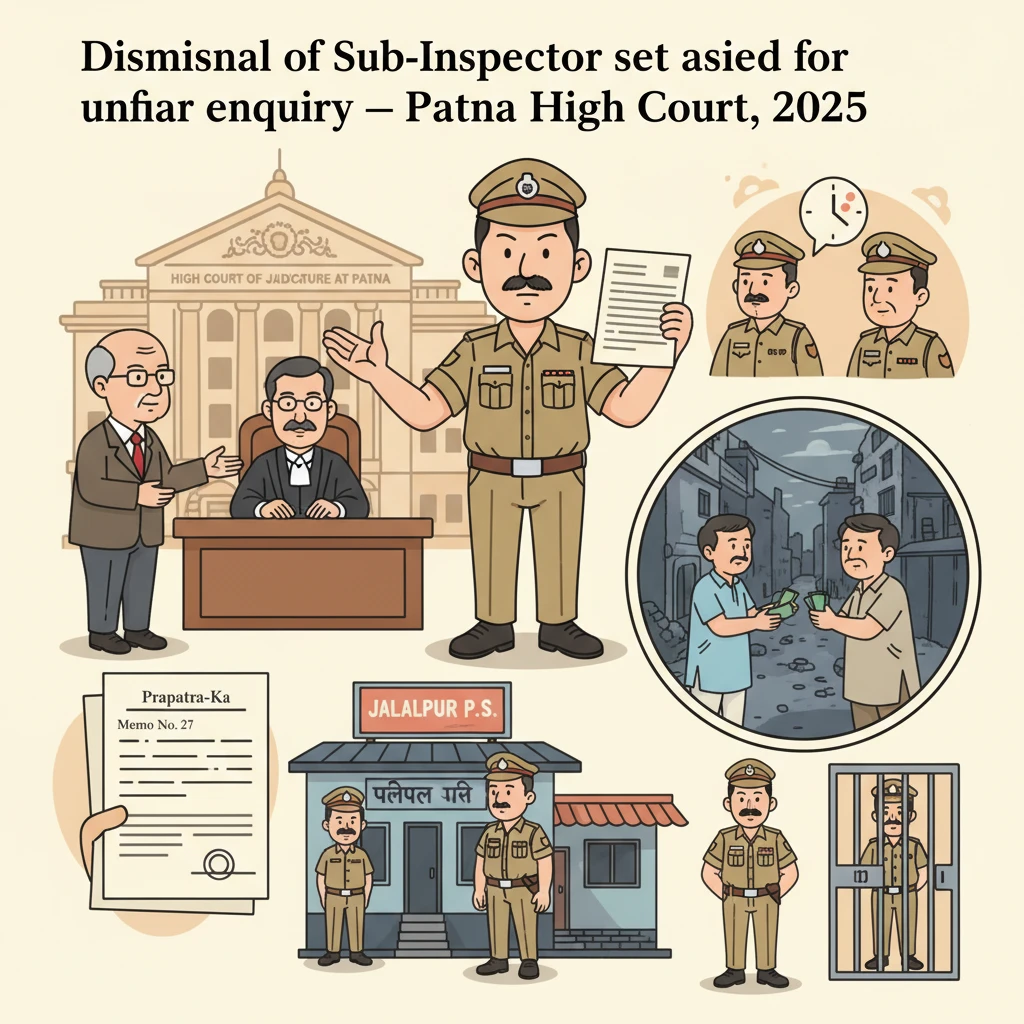
The petitioner was appointed as a Sub Inspector of Police on 18.02.2009. At the relevant time, he was posted at Jalalpur Police Station in Saran district. He was investigating Jalalpur P.S. Case No. 112 of 2014 registered under Section 420 of the Indian Penal Code against a Headmaster of a Government school and others.
On 18.11.2014, the husband of an accused (Rajani Dubey) lodged a written complaint before the Superintendent of Police, Vigilance Bureau, Patna. He alleged that the Station House Officer (SHO) of Jalalpur P.S., Manish Kumar, had demanded Rs. 30,000 for sending the case diary to the court where the bail application of his wife was pending.
On this complaint, verification was conducted on 19.11.2014. A trap team was then constituted by the Vigilance Investigation Bureau, Patna. On 21.11.2014, a raid was carried out and the petitioner was apprehended while allegedly accepting a bribe of Rs. 20,000. Vigilance P.S. Case No. 90 of 2014 was registered under Sections 7/13(2) read with Section 13(1)(d) of the Prevention of Corruption Act, 1988.
After the FIR, the petitioner was placed under suspension. A departmental proceeding (Prapatra-Ka) was initiated under Memo No. 27 dated 03.01.2015. At that time, the petitioner was in judicial custody. He was released on 16.01.2015.
Following his release, the petitioner filed a show cause on 09.03.2015, asking specifically that he be allowed to cross-examine all witnesses who would depose in the departmental enquiry. He later filed his detailed defence statement before the Conducting Officer on 24.09.2018, and requested supply of necessary documents related to the charges.
Meanwhile, under Memo No. 5793 dated 19.12.2017 issued by the Superintendent of Police, a Presenting Officer was appointed in the enquiry. The Conducting Officer submitted his enquiry report to the Superintendent of Police under Memo No. 578 dated 27.09.2018, holding all charges to be proved.
Based on this report, a show cause notice was issued to the petitioner proposing dismissal from service. He filed an exhaustive reply, repeating his defence taken in the enquiry and relying also on affidavits, including that of an independent seizure-list witness from the trap case.
Despite this, by Memo No. 3340 dated 17.11.2018, the Deputy Inspector General of Police, Saran Range, Chapra, passed the order dismissing the petitioner from the post of Sub Inspector of Police. This was communicated to him through consequential orders in Memo No. 4989 dated 24.11.2018 and Memo No. 2488 dated 29.11.2018.
During the pendency of the departmental proceedings, the petitioner had filed CWJC No. 15117 of 2018 requesting that the departmental enquiry be kept in abeyance till disposal of the vigilance criminal case. However, as the dismissal order was passed in the meantime, that writ became infructuous.
The petitioner then filed CWJC No. 9534 of 2019 challenging the dismissal, which was disposed of on 12.11.2020 with a direction to the authorities to decide his pending statutory appeal. Acting on this direction, the Additional Director General of Police (Law and Order) rejected the appeal by order dated 16.02.2021. Consequential orders were issued under Memo No. 1498 dated 13.03.2021 and Memo No. 595 dated 23.03.2021.
Aggrieved by the original dismissal order, the appellate order, and all related consequential orders, the petitioner approached the Patna High Court in the present Civil Writ Jurisdiction Case No. 12321 of 2021.
What the Court Examined and Decided
The Patna High Court, presided over by Hon’ble Mr. Justice Harish Kumar, heard detailed arguments from both sides. The focus was not on re-assessing the vigilance trap as a criminal matter, but on testing whether the departmental enquiry and punishment were conducted lawfully and fairly.
The petitioner’s counsel raised several key points. First, he argued that the Superintendent of Police, Saran, who issued the memo of charge and drove the disciplinary process, was not the appointing or disciplinary authority for a Sub Inspector. Hence, initiation and recommendation of dismissal were said to be without jurisdiction.
Second, he pointed to alleged violations of Rules 16, 17(2) and 18 of the Bihar Government Servants (Classification, Control and Appeal) Rules, 2005 (CCA Rules, 2005). A major emphasis was on Rule 17(5)(c), which requires appointment of a Presenting Officer to present the department’s case in an enquiry.
From the record, it was clear that the memo of charge dated 03.01.2015 was issued while the petitioner was in judicial custody, and that at that time no Presenting Officer had been appointed. The Presenting Officer was actually appointed much later, on 19.12.2017, after some witnesses had already been examined by the Conducting Officer.
The petitioner asserted that this meant the Conducting Officer himself acted like the Presenting Officer, which is impermissible. He further claimed he was not given a real chance to cross-examine witnesses, despite repeated written requests, and that he was not notified or heard when prosecution witnesses were being examined.
The petitioner also attacked the enquiry report and punishment orders as non-speaking and one-sided. According to him, the enquiry officer and disciplinary authority did not deal with his defence, including an affidavit of an independent seizure-list witness in the trap case, and did not explain why his version was rejected.
He highlighted that the original complaint of demand for a bribe of Rs. 30,000 was against the SHO, Manish Kumar, not against him. Yet, while the SHO allegedly received only a “black mark” (a warning), he was visited with the extreme penalty of dismissal.
To support these contentions, the petitioner relied on several binding precedents, particularly:
- State of U.P. v. Saroj Kumar Sinha (2010) 2 SCC 772, on the role of the Enquiry Officer as an independent, quasi-judicial authority who must not act as prosecutor and judge.
- Upendra Pandit v. State of Bihar, 2023 (4) PLJR 568, where non-appointment of a Presenting Officer under Rule 17 was treated as a serious procedural defect.
- Md. Giaaul Hak v. State of Bihar, 2024 (1) BLJ 94, holding that if the Enquiry Officer does what the Presenting Officer should do, the enquiry is vitiated.
- M/s Kranti Associates Pvt. Ltd. v. Masood Ahmed Khan, (2010) 9 SCC 496, on the necessity of giving reasons in quasi-judicial orders.
- Decisions like T. Subramanian v. State of Tamil Nadu and B. Jayaraj v. State of Andhra Pradesh, on the need to prove demand and voluntary acceptance of illegal gratification, even if those were criminal law cases.
The State’s counsel, on the other hand, argued that the disciplinary proceedings were validly initiated pursuant to directions from the Director General of Police. It was said that the petitioner had been given full opportunity to defend himself, including supply of documents and the chance to file a detailed written defence.
The State submitted that a Presenting Officer was appointed on 19.12.2017 and that after his appointment, witnesses were examined with notice to the petitioner. The departmental record of Proceeding No. 2 of 2015 was produced in Court to support this. The State maintained that the trap team members and other witnesses deposed in the enquiry and their statements, along with documentary evidence, proved the charge of accepting Rs. 20,000 as bribe.
It was also argued that once the Enquiry Officer found the charges proved and the disciplinary authority accepted this finding, the Court, exercising writ jurisdiction under Article 226, should not act as an appellate forum to re-appreciate evidence. Reliance was placed on State of Rajasthan v. Bhupendra Singh, 2024 SCC OnLine SC 1908, and earlier Supreme Court judgments like P. Gunasekaran, to stress the limited scope of judicial review.
The Court then undertook a careful analysis of the governing legal principles. It recognised that a charge of corruption is very serious and, if proved, can justify severe punishment. It referred to Supreme Court decisions such as Secretary, Ministry of Defence v. Prabhash Chandra Mirdha (AIR 2012 SC 2250) and Brajendra Singh Yambem v. Union of India (2016) 9 SCC 20, which stress that courts should not lightly interfere with findings in corruption-related departmental proceedings.
However, the Court underlined that even in serious cases, the State must strictly follow the prescribed statutory procedure, and disciplinary authorities cannot act merely on the “seriousness” of the charge. Fairness, adherence to rules, and observance of natural justice are mandatory.
Reviewing the facts, the Court noted:
- The complaint of demand was specifically against the SHO, Manish Kumar, not against the petitioner.
- The memo of charge was served while the petitioner was in custody.
- The Presenting Officer was appointed only on 18/19.12.2017, whereas at least two key witnesses – both Deputy Superintendents of Police associated with the trap – had already been examined by the Conducting Officer himself.
- The Inspector General of Police had, by Memo No. 235 dated 20.12.2017, issued clear directions to all Superintendents of Police to strictly appoint Presenting Officers in departmental enquiries, and specified their role in detail under Rule 17(5)(c) CCA Rules, 2005.
- The enquiry report (Annexure-9) merely mentioned, in one line, that a Presenting Officer was “deputed to help” in the proceeding, but did not detail what work he actually did.
- The report simply narrated the depositions of departmental witnesses and reproduced the petitioner’s written defence, without any meaningful discussion or reasons explaining why the petitioner’s defence was rejected.
The Court found this approach contrary to the law laid down in Saroj Kumar Sinha and Kranti Associates. An Enquiry Officer must act like an independent adjudicator, not as a departmental representative, and must demonstrate in the report that the defence has been understood, weighed, and then rejected with cogent reasons, especially when the consequence is dismissal from service.
On the question of Presenting Officer, the Court held that even though an appointment order was eventually issued, the late appointment, coupled with the Conducting Officer himself examining earlier witnesses and the near-total absence of any shown role of the Presenting Officer thereafter, amounted to a serious breach of Rule 17(5)(c) of the CCA Rules, 2005. The Inspector General’s own circular (Memo No. 235) made it clear that the duties of the Presenting Officer and the Enquiry Officer are separate, and overlapping them vitiates the enquiry.
The Court reiterated that “justice is not only to be done but must be seen to be done.” In a case where the petitioner sought cross-examination opportunities and supply of documents, and where the enquiry report was lengthy but reasonless, the Court found that the petitioner had not been given a fair and meaningful opportunity of defence.
On the corruption allegation itself, the Court acknowledged that, in disciplinary matters, proof is based on “preponderance of probabilities” and not “beyond reasonable doubt” as in criminal trials. Yet, it held that even on this lesser standard, the department had to show that the petitioner voluntarily accepted money knowing it to be a bribe. In the absence of adequate discussion of the defence and proper reasoning in the enquiry report, the Court was not satisfied that this legal requirement had been fairly assessed.
The Court also noted the disparity in treatment: the SHO, against whom the original demand complaint was made, had been punished only with a “black mark” (equivalent to a warning), whereas the petitioner faced the extreme penalty of dismissal. This added to the overall impression of arbitrariness.
In view of the above, and applying the principles of limited but meaningful judicial review laid down by the Supreme Court, the Patna High Court held that the disciplinary proceedings in this case were vitiated by non-compliance with statutory rules and violation of natural justice. The deficiency, in the Court’s view, crossed the threshold required for interference under Article 226.
Consequently, the Court allowed the writ petition. It set aside Memo No. 3340 dated 17.11.2018 (dismissal order), the appellate order dated 16.02.2021, and all consequential orders including Memo Nos. 4989 dated 24.11.2018, 2488 dated 29.11.2018, 1498 dated 13.03.2021 and 595 dated 23.03.2021.
On the question of back wages, the Court relied on Deepali Gundu Surwase v. Kranti Junior Adhyapak (2013) 10 SCC 324, which states that reinstatement with continuity of service and back wages is the normal rule in cases of wrongful dismissal, subject to various factors. Balancing these considerations, the Court directed that the petitioner be reinstated with continuity of service, but limited his back wages to half of his salary for the period he remained out of service.
Why This Judgment Matters
This judgment is important for police personnel and all government employees facing departmental enquiries, especially in Bihar. It shows that even in corruption cases, the State cannot ignore the basic rules of fair procedure.
The Patna High Court has made it clear that:
- A Presenting Officer must be properly appointed and must actually perform his role. The Enquiry Officer cannot function as prosecutor and judge at the same time.
- Employees must be given a real opportunity to defend themselves, including cross-examining witnesses and receiving all relevant documents.
- Enquiry reports and punishment orders must give reasons. Merely copying statements and then declaring charges as “proved” is not enough.
For officers who feel they have been unfairly dismissed based on one-sided departmental enquiries, this case shows that the Patna High Court will step in where there is clear violation of statutory rules and natural justice.
The judgment also highlights that unequal treatment of similarly placed officers, without explanation, will be looked at seriously, particularly when one is given a minor warning and another is dismissed from service on related allegations.
Legal Issues and Answers
-
Issue: Whether the departmental enquiry and dismissal of the petitioner from the post of Sub Inspector of Police were conducted in accordance with the CCA Rules, 2005 and principles of natural justice.
Answer: No. The Patna High Court held that there was non-compliance with Rule 17(5)(c) regarding appointment and functioning of a Presenting Officer, inadequate opportunity to the petitioner to defend himself, and an enquiry report lacking proper reasoning, thereby violating statutory rules and natural justice. -
Issue: Whether the High Court, in writ jurisdiction, could interfere with the findings and punishment imposed in a departmental proceeding relating to corruption charges.
Answer: Yes, in this case. While recognising that courts generally do not re-appreciate evidence in writ jurisdiction, the Court held that due to serious procedural defects and violation of natural justice in the enquiry process, the threshold for interference under Article 226 was met. -
Issue: What relief the petitioner was entitled to after quashing of the dismissal and appellate orders, particularly regarding reinstatement and back wages.
Answer: The Court directed reinstatement of the petitioner with continuity of service and awarded 50% of salary as back wages for the period he remained out of service.
Cases Cited by the Court
- Secretary, Ministry of Defence & Ors. v. Prabhash Chandra Mirdha, AIR 2012 SC 2250.
- Brajendra Singh Yambem v. Union of India & Anr., (2016) 9 SCC 20.
- Associated Provincial Picture Houses Ltd. v. Wednesbury Corporation, (1948) 1 KB 223; (1947) 2 All ER 680 (CA).
- Union of India & Ors. v. P. Gunasekaran, (2015) 2 SCC 610.
- Bharti Airtel Limited v. A.S. Raghavendra, (2024) 6 SCC 418.
- State of Andhra Pradesh v. S. Sree Rama Rao, AIR 1963 SC 1723.
- State of Andhra Pradesh v. Chitra Venkata Rao, (1975) 2 SCC 557.
- State Bank of India v. S.K. Sharma, (1996) 3 SCC 364.
- State of Rajasthan & Ors. v. Bhupendra Singh, 2024 SCC OnLine SC 1908.
- Boloram Bordoloi v. Lakhimi Gaolia Bank, (2021) 3 SCC 806.
- State of U.P. & Ors. v. Saroj Kumar Sinha, (2010) 2 SCC 772.
- M/s Kranti Associates Pvt. Ltd. & Anr. v. Masood Ahmed Khan & Ors., (2010) 9 SCC 496.
- Deepali Gundu Surwase v. Kranti Junior Adhyapak & Ors., (2013) 10 SCC 324.
- Uday Pratap Singh v. State of Bihar & Ors., 2017 (4) PLJR 195.
- Upendra Pandit v. State of Bihar & Ors., 2023 (4) PLJR 568.
- Md. Giaaul Hak v. State of Bihar, 2024 (1) BLJ 94.
- Shaughnessy v. United States, 345 US 206 (1953) (Jackson J).
- Kumayu Mandal Vikas Nigam Limited v. Girija Shankar, (2001) 1 SCC 182 (cited by petitioner).
- T. Subramanian v. State of Tamil Nadu, AIR 2006 SC 836 (cited by petitioner).
- B. Jayaraj v. State of Andhra Pradesh, (2014) 13 SCC 55 (cited by petitioner).
Case Details
Case Number: Civil Writ Jurisdiction Case No. 12321 of 2021
Case Title: Manoj Kumar Ram v. The State of Bihar & Ors.
Citation: 2025 (2) PLJR 561
Coram: Hon’ble Mr. Justice Harish Kumar
Advocates:
- For the Petitioner: Mr. Sanjay Kumar Giri, Advocate; Mr. Mritunjay Harsh, Advocate.
- For the State/Respondents: Mr. Md. Nadim Seraj, Government Pleader 5; Mr. Dhurendra Kumar, Assistant Counsel to Government Advocate 5.
Nature of the Case: Writ petition under Article 226 of the Constitution challenging dismissal from service and rejection of departmental appeal (service/disciplinary matter involving allegation of corruption in vigilance trap).
Link to Judgment: Patna High Court Judgment – CWJC No. 12321 of 2021
If you found this explanation helpful and wish to stay informed about
how legal developments may affect your rights in Bihar,
you may consider following Samvida Law Associates for more updates.







