
Case Background
The petitioner’s father was working as a Store Keeper in Shershah College, Sasaram, a constituent unit under Veer Kunwar Singh University, Ara. He died in harness on 14.08.2007.
After his father’s death, the petitioner applied for compassionate appointment. The Compassionate Appointment Committee of the University, by its decision dated 08.03.2008, recommended his appointment. Acting on this, the Registrar of Veer Kunwar Singh University issued an appointment order vide Memo No. 282 dated 29.03.2008.
The petitioner joined service on 02.04.2008 as Store Keeper in Shershah College, Sasaram. This post is a Class-III non-teaching post under the University system.
Later, the State Government and the University issued several circulars and resolutions regarding pay scales of non-teaching employees, including Store Keepers. According to the petitioner, these circulars entitled him to the higher pay scale given to other Store Keepers.
When this benefit was not extended to him, he earlier filed CWJC No. 13580 of 2017 before a co-ordinate Bench of the Patna High Court. That writ was disposed of on 05.03.2019, with a direction to submit a detailed representation before the Registrar of the University.
The petitioner then submitted a representation on 01.04.2019. The Registrar rejected his claim through Memo No. 19 dated 20.05.2019, which was communicated to him and to other office bearers. Aggrieved by this rejection, the petitioner approached the Patna High Court again by filing CWJC No. 5999 of 2021.
What the Court Examined and Decided
The petitioner’s main grievance was that he was not being paid the pay scale applicable to the post of Store Keeper, even though he was appointed to that very post and had the requisite qualifications.
He challenged the Registrar’s Memo No. Legal\60\19\Estab.\585\19\1383\Estab.\19 dated 14.05.2019/20.05.2019, by which it was held that he was not entitled to the pay scale of Rs. 5500-9900. He pointed out that this pay scale was being given to other Store Keepers, including those at Shershah College, Sasaram.
On this basis, he sought a writ of certiorari to quash the Registrar’s order and a writ of mandamus directing payment of the higher pay scale of Rs. 9300-34800 with Grade Pay of 4600, along with arrears and 18% interest on the dues.
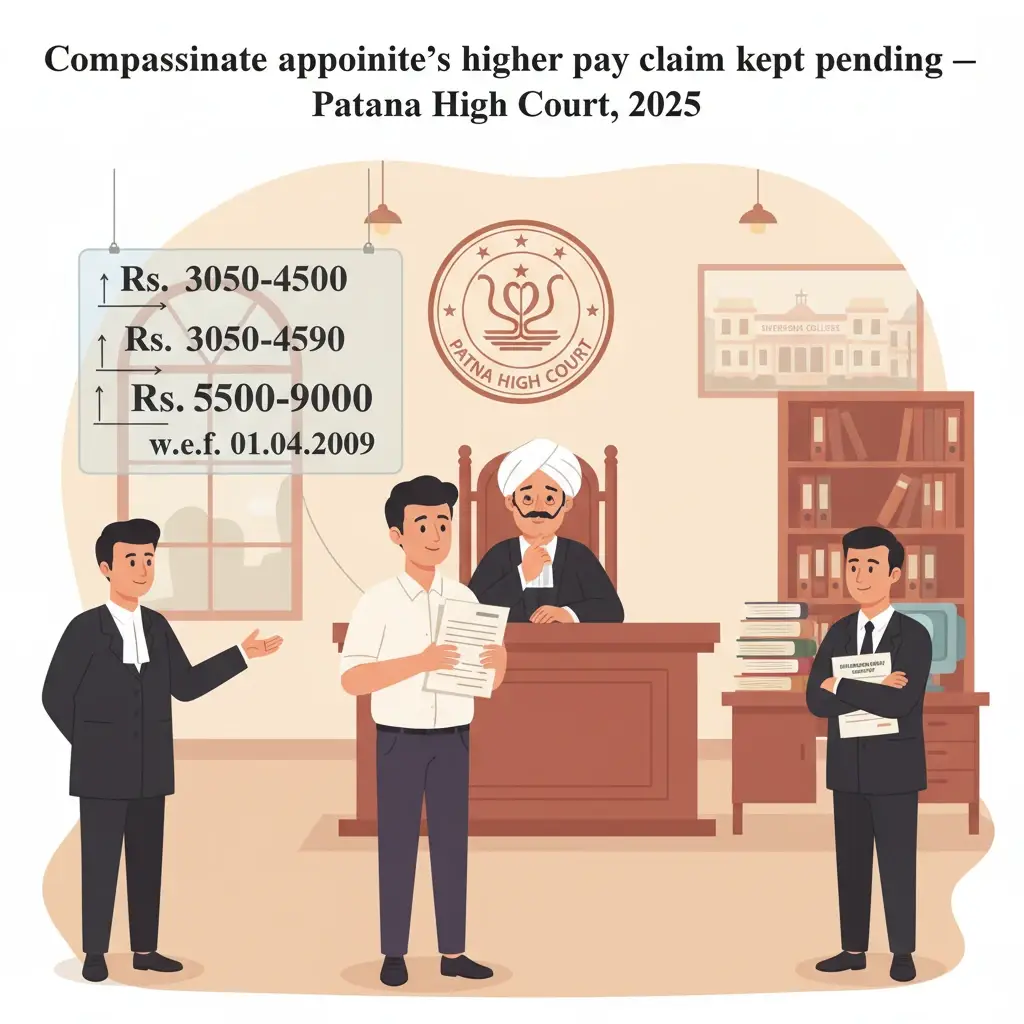
His counsel argued that although he was appointed on compassionate ground on 02.04.2008, the relevant Government Circular dated 20.12.2000 governed his case. That circular stipulated that all fresh appointments made after 20.12.2000 would be in the pay scale of Rs. 3050-4500.
The counsel further relied on the State Government’s Letter No. 3385 dated 20.06.2001, as noted in paragraph 7 of the State’s counter affidavit, which prescribed the pay scale of Rs. 3050-4590 for employees appointed on compassionate grounds after 20.12.2000.
The petitioner also referred to Memo No. 1972 dated 12.10.2004, by which the State Government implemented pay revision with effect from 01.01.1996 for non-teaching employees of universities and colleges. Even in this resolution, the pay scale of Class-III employees appointed on compassionate grounds was fixed at Rs. 3050-4590.
However, the petitioner’s stance was that the later decisions of the Education Department, particularly Memo No. 1139 dated 18.06.2014 issued by the Joint Secretary to all Registrars of Bihar Universities, granted Store Keepers the pay scale of Rs. 5500-9000 with effect from 01.04.2009.
Pursuant to that Government letter, Veer Kunwar Singh University issued its own notification vide Memo No. 665 dated 22.08.2014, providing the pay scale of Rs. 5500-9000 with effect from 01.04.1997 to Store Keepers who were validly appointed with requisite qualifications against sanctioned posts.
The petitioner argued that since he was appointed as Store Keeper with proper qualifications and against a sanctioned post, he should also receive the same scale which the University was paying to other Store Keepers. Denying him this benefit, he claimed, violated Article 14 of the Constitution of India by treating him unequally among similarly placed employees.
On the other hand, counsel for the University submitted that the petitioner’s pay had been correctly fixed in the scale of Rs. 3050-4590, strictly following the applicable Government resolutions.
The University relied upon Memo No. 3385 dated 20.06.2001 issued by the Personnel and Administrative Reforms Department, Government of Bihar. As the petitioner’s father died on 14.08.2007, the then prevailing resolution dated 20.12.2000 governed the compassionate appointment, fixing the pay scale for such appointments at Rs. 3050-4590.
The University also pointed to Memo No. 2693 dated 27.08.2010, whereby the State Government extended the 6th Pay Revision benefits to non-teaching employees of universities and constituent colleges. Clause 4 of that resolution provided that the pay fixation of employees appointed on compassionate ground against unsanctioned posts would be made in the pay scale of Rs. 3050-4590 after their adjustment against sanctioned and vacant posts.
According to the University, after introduction of the 6th Pay Revision, the petitioner became entitled only to a revised scale of Rs. 5030-4590, and not the higher scale of Rs. 5500-9000. It was submitted that the Pay Verification Cell had properly considered and approved his pay fixation, and there was no infirmity in the decision.
The State Government adopted the submissions of the University and relied upon its counter affidavit, particularly paragraphs 7 to 11, to contend that the writ petition had no merit.
The Court then examined the legal position governing compassionate appointment and pay entitlement. A key judgment relied upon was that of the Supreme Court in Secretary to Government, Department of Education (Primary) & Others v. Bheemesh alias Bheemappa, Civil Appeal No. 7758 of 2021 (arising out of SLP (C) No. 1564 of 2021), decided on 16.12.2021.
In that case, as the Patna High Court noted, the Supreme Court held that the crucial and fixed factor for applying a scheme relating to compassionate appointment is the date of death of the employee in harness, and not any later date such as when the application is considered. The Court quoted paragraphs 17 to 20 of Bheemesh alias Bheemappa, where the Supreme Court emphasized that:
- Compassionate appointment is an exception to the usual recruitment process and is not a vested right.
- Benefits under schemes are to be interpreted with reference to a determinate factor like the date of death, not variable factors like date of application.
- Modified schemes giving higher benefits after death do not automatically apply to those whose cause arose earlier, unless expressly provided.
Applying this principle, the Patna High Court held that, in the present case, the State Government’s guidelines for compassionate appointment contained in the Circular dated 20.12.2000, which were in force on the date of the petitioner’s father’s death (14.08.2007), would govern. That circular prescribed the pay scale of Rs. 3050-4590 for such Class-III compassionate appointments.
The Court also noted that the petitioner had not given any clear pleading or information about the exact pay scale his father was drawing at the time of death or the particular rules governing his pay. This absence of factual clarity further constrained the Court in determining whether the petitioner could claim the same pay as his late father.
The Court also referred to Memo No. 1192 dated 23.06.2014 and observed that paragraph 2 clearly distinguished those appointed on compassionate grounds on Class-III posts, providing them the pay scale of Rs. 3050-4590.
In light of these facts and the Supreme Court’s law in Bheemesh alias Bheemappa, the Court held that the State Government’s resolution on compassionate appointment applicable as on the date of death of the petitioner’s father would apply to the petitioner’s appointment and pay.
The Court then reiterated settled principles on compassionate appointment by referring to the Supreme Court judgment in Umesh Kumar Nagpal v. State of Haryana and Others, (1994) 4 SCC 138. It noted that compassionate appointment is a one-time measure to relieve immediate hardship of the family and cannot be used to repeatedly claim higher benefits on the basis of comparison with others.
The judgment of a Division Bench of the Patna High Court in CWJC No. 10441 of 2010, Smt. Mosarat Arra Khanam and Others v. State of Bihar and Others, was also referred to. It had held that an appointee on compassionate grounds cannot claim “compassion upon compassion” by demanding a higher pay scale simply on a perceived parity with other employees.
The Court further noted that a coordinate Bench in CWJC No. 23831 of 2018 (Ravi Shankar Kumar v. State of Bihar & Others), judgment dated 01.10.2021, had found a conflict between the earlier Division Bench judgment in Mosarat Arra Khanam and a subsequent Division Bench judgment in L.P.A. No. 167 of 2016 (Avinash Kumar Chakerworty and Others v. State of Bihar and Others).
In Avinash Kumar Chakerworty, the Division Bench allowed a higher pay scale of Rs. 4000-6000 to persons appointed on compassionate grounds, based on parity in pay. Since the earlier decision in Mosarat Arra Khanam was not considered there, the coordinate Bench in Ravi Shankar Kumar referred the matter to the Hon’ble Chief Justice for decision by a larger Bench.
In the present case, the parties informed the Court that the larger Bench was already hearing that reference. Given this pending authoritative decision on the pay scale of compassionate appointees, the Patna High Court in the present case decided that the petitioner’s relief would be subject to the outcome of the larger Bench in CWJC No. 23831 of 2018, Ravi Shankar Kumar.
Accordingly, while recognizing that the governing rule is the State’s resolution as on the date of death, the Court did not finally grant or deny the specific higher pay relief. Instead, it disposed of the writ petition by making the petitioner’s claim contingent upon the final decision of the larger Bench in Ravi Shankar Kumar.
Why This Judgment Matters
This judgment is important for families of government and university employees in Bihar who receive compassionate appointment after a death in service.
First, it reinforces that the applicable rule and pay scale for a compassionate appointee will normally be determined by the date of death of the employee, not by later circulars, pay revisions, or internal university notifications.
Second, it underlines that compassionate appointment is not meant to give the same or higher financial benefits as the deceased employee, but to provide minimal financial support to the family. Demands for higher pay based purely on what is paid to others may not automatically succeed.
Third, the judgment shows that in Bihar, there is an ongoing legal debate on whether compassionate appointees can claim higher pay on parity with regular appointees. That issue is now before a larger Bench in the Ravi Shankar Kumar case.
Finally, the Court’s approach gives a clear signal to similarly placed employees: until the larger Bench decides, claims for higher pay scale on parity will remain uncertain and may be made subject to that final ruling.
Legal Issues and Answers
- Issue: Whether a compassionate appointee Store Keeper, appointed after his father’s death in 2007, is entitled to the higher pay scale of Rs. 5500-9000 (and claimed Rs. 9300-34800 with Grade Pay 4600) on parity with other Store Keepers.
Answer: The Court held that the State Government’s compassionate appointment resolution in force on the date of death (20.12.2000 circular prescribing Rs. 3050-4590) applies. The petitioner’s claim to higher pay is to be governed by that rule and, in view of conflicting High Court judgments, will ultimately depend on the decision of a larger Bench in CWJC No. 23831 of 2018 (Ravi Shankar Kumar). - Issue: Can later circulars and pay revision notifications granting higher scales to Store Keepers automatically enhance the pay scale of a person appointed on compassionate grounds after an earlier death in harness?
Answer: Relying on the Supreme Court’s decision in Bheemesh alias Bheemappa, the Court indicated that the determinative factor is the date of death, not subsequent modified schemes granting higher benefits. Therefore, such later benefits do not automatically apply to a compassionate appointee whose claim arose earlier. - Issue: Whether a compassionate appointee can claim a higher pay scale under Article 14 of the Constitution by comparing himself with similarly placed employees.
Answer: The Court, referring to Umesh Kumar Nagpal and Mosarat Arra Khanam, emphasized that compassionate appointment is a one-time concession and cannot be used to claim “compassion upon compassion” for higher pay based solely on parity. However, the final position on parity in pay scales is pending before a larger Bench, and the petitioner’s relief is made subject to that outcome.
Cases Cited by the Court
- Secretary to Government, Department of Education (Primary) & Others v. Bheemesh alias Bheemappa, Civil Appeal No. 7758 of 2021, arising out of SLP (C) No. 1564 of 2021, judgment dated 16.12.2021 (Supreme Court of India).
- Umesh Kumar Nagpal v. State of Haryana and Others, (1994) 4 SCC 138 (Supreme Court of India).
- Smt. Mosarat Arra Khanam and Others v. State of Bihar and Others, CWJC No. 10441 of 2010 and analogous cases (Patna High Court).
- Avinash Kumar Chakerworty and Others v. State of Bihar and Others, L.P.A. No. 167 of 2016 (Patna High Court).
- Ravi Shankar Kumar v. State of Bihar & Others, CWJC No. 23831 of 2018, judgment dated 01.10.2021 (Patna High Court; matter referred to larger Bench).
Case Details
Case Number: Civil Writ Jurisdiction Case No. 5999 of 2021
Case Title: Rajesh Kumar v. The State of Bihar & Others
Citation: 2025 (2) PLJR 814
Court: High Court of Judicature at Patna
Coram: Hon’ble Mr. Justice Purnendu Singh
Date of Judgment: 25.03.2025
Nature of the Case: Writ petition (civil) challenging fixation of pay scale of a compassionate appointee non-teaching employee (Store Keeper) in a constituent college under a State university.
Advocates:
- For the Petitioner: Mr. Ashok Kumar Garg, Advocate
- For the State of Bihar: Mr. Madhaw Prasad Yadav, GP-23; Ms. Meera Singh, AC to GP-23
- For Veer Kunwar Singh University: Mr. Rajesh Kumar Chaudhary, Advocate
Link to Judgment: https://patnahighcourt.gov.in/viewjudgment/MTUjNTk5OSMyMDIxIzEjTg==-AvH80pPlnhc=
If you found this explanation helpful and wish to stay informed about
how legal developments may affect your rights in Bihar,
you may consider following Samvida Law Associates for more updates.







