
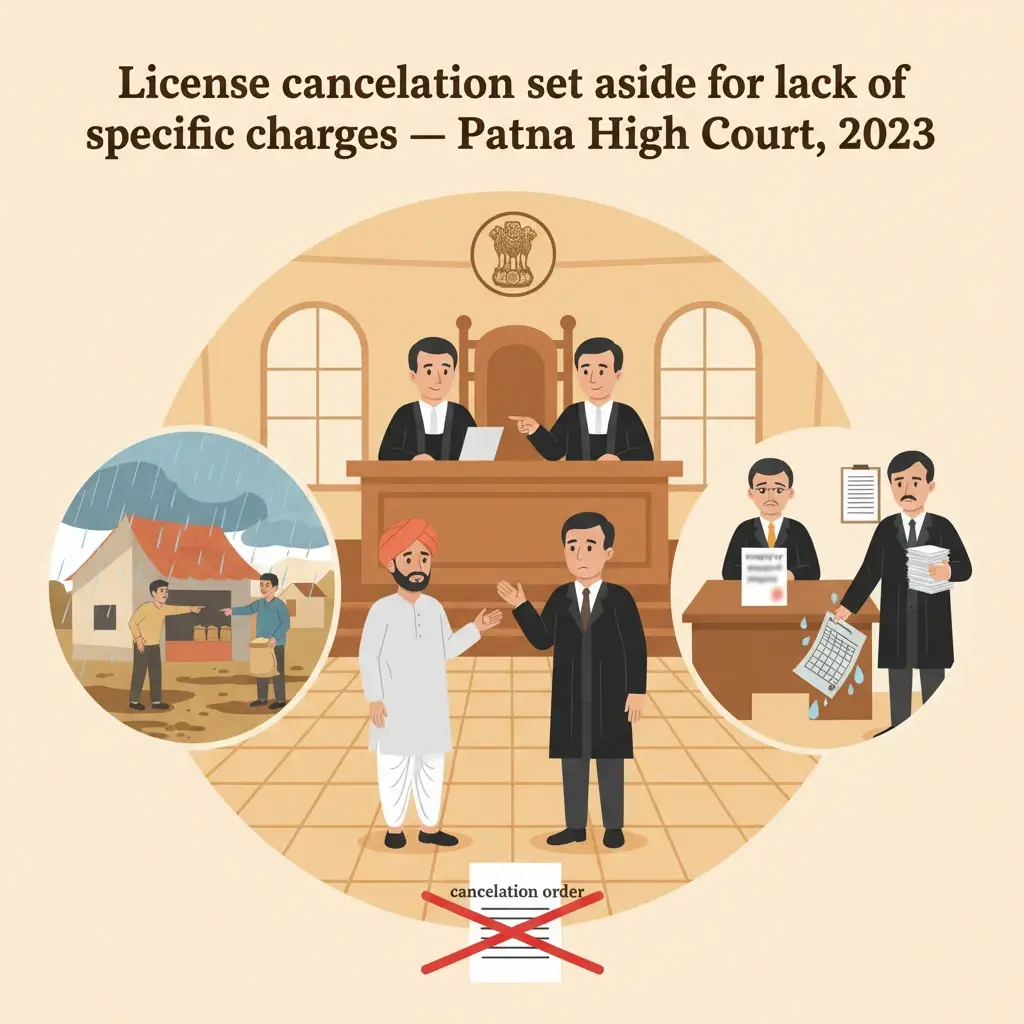
Case Background
The case arose from Civil Writ Jurisdiction Case No. 7911 of 2019 before the Patna High Court.
The petitioner was a fair price shop licensee. During a period when he was getting a new house and shop constructed, a complaint was lodged by one of the beneficiaries attached to his shop.
This complainant alleged that, during the construction period, the distribution of foodgrains to the targeted beneficiaries under the public distribution system was highly irregular.
Significantly, the judgment records that except for this one complainant, none of the other beneficiaries attached to the shop made any complaint about the distribution.
On receipt of the complaint, the authorities conducted an enquiry. A report was prepared, which noted two main things: first, that the petitioner had indeed constructed a new house and shop; and second, that due to excessive rains during that period, the register of receipts and disbursal for one year had been misplaced.
On the basis of this enquiry report and the opinion of the Block Development Officer, the licensing authority cancelled the petitioner’s licence to run the fair price shop.
Feeling aggrieved, the petitioner approached the Patna High Court under its writ jurisdiction, challenging the cancellation of his licence.
What the Court Examined and Decided
The Division Bench of the Patna High Court, comprising Hon’ble Mr. Justice Ashutosh Kumar and Hon’ble Mr. Justice Satyavrat Verma, heard the matter. The oral judgment was delivered by Hon’ble Mr. Justice Ashutosh Kumar on 02-01-2023.
Counsel for the petitioner, Md. Najmul Hodda, argued that even if the two facts found in the enquiry report were accepted as correct—namely, that the petitioner had constructed a new house and shop, and that the register for one year was misplaced due to heavy rains—these facts alone could not justify the conclusion that foodgrain disbursement had been irregular.
He submitted that irregular disbursement is a serious allegation and requires specific charges to be framed. According to him, the petitioner was never given any specific, clear allegation of when, how, and to what extent the disbursement had been irregular during the construction period.
On the other side, the State was represented by Mr. Anisul Haque, Assistant Counsel to AAG-5. The judgment does not set out the detailed submissions of the State, but it is clear that the State action being examined was the cancellation order based on the enquiry report and the Block Development Officer’s opinion.
The Court closely examined the material that led to the cancellation. It noted that the enquiry report referred to only two aspects: first, that the petitioner had got a new house and shop constructed; and second, that due to heavy rains, the register of receipts and disbursal for one year had got misplaced.
The Court also took note of the fact that only one beneficiary had complained about irregular disbursement, and that no other beneficiary from the list of targeted beneficiaries attached to the petitioner’s shop had raised any complaint.
After going through the record, the Bench made a key observation: there was no specific accusation against the petitioner regarding irregular disbursal of foodgrains during the period of construction.
In other words, while the authorities had drawn an inference that, because of construction and a missing register, the distribution must have been irregular, there was no concrete, clearly framed allegation supported by particulars.
The Court stated that the order cancelling the licence appeared to have been passed solely on inferences without any proper basis.
The Bench emphasized an important procedural safeguard. For an order cancelling a licence on the ground of irregular disbursement to be legally sustainable, the authority must:
First, frame a specific charge about alleged irregularities in distribution. That charge must clearly state what the licensee is alleged to have done wrong.
Second, give the licensee an opportunity to respond to that specific charge, by seeking a reply from him within a reasonable time.
The Court underlined that this minimum requirement had not been met in the petitioner’s case. The licensing authority had not framed a distinct, clear charge of irregular disbursal, nor had it sought a proper reply from the petitioner on such a charge before cancelling his licence.
Because of this, the Bench found no good reason to sustain the cancellation order. The absence of specific charges and proper opportunity to reply made the order unsustainable.
Accordingly, the Court set aside the order cancelling the petitioner’s licence.
However, rather than finally closing the matter, the Court chose to remit the case back to the licensing authority. It gave clear directions on how the authority must proceed in a fair and lawful manner.
The Court directed the licensing authority to issue a fresh notice to the petitioner. This notice must contain specific and distinct charges of irregular disbursal of foodgrains to beneficiaries during the period when the construction of the house and shop was underway.
The licensing authority was further directed to grant the petitioner reasonable time to file his reply to these specific allegations.
After receiving the reply, the licensing authority has to pass a final, reasoned order within 60 days from the receipt of such reply.
The Court also directed that the order so passed by the licensing authority be made available to the petitioner forthwith.
With these directions and observations, the writ petition was allowed.
This approach by the Patna High Court balanced two concerns. On one side, it protected the rights of the licensee by insisting on specific charges and an opportunity to be heard. On the other side, it allowed the licensing authority to proceed afresh and take appropriate action, if warranted, but only after following due process.
Why This Judgment Matters
This judgment of the Patna High Court is important for fair price shop dealers and other license holders under government schemes.
It makes clear that a licence, which is often the primary source of livelihood, cannot be cancelled based only on suspicion, inference, or a general allegation.
Authorities must clearly state the specific acts of irregularity or misconduct and give the licensee a fair chance to explain or defend himself.
For beneficiaries and the public, the decision shows that while complaints will be taken seriously, the law also requires fairness towards the person accused. One complaint, without clear particulars and without proper inquiry and notice, cannot by itself justify harsh action like cancellation.
For administrative authorities, the judgment works as a reminder that cancellation orders must be based on concrete charges, proper evidence, and adherence to principles of natural justice. Orders passed without these safeguards are likely to be struck down in writ proceedings.
Legal Issues and Answers
- Issue: Can a fair price shop licence be cancelled on the basis of an enquiry report and inferences of irregular disbursal, without framing specific charges and seeking a reply from the licensee?
Answer: No. The Patna High Court held that in the absence of specific accusations of irregular distribution and without giving the licensee an opportunity to reply to such distinct charges, the cancellation order cannot be sustained. - Issue: What procedure must the licensing authority follow when alleging irregular disbursal of foodgrains by a licensee?
Answer: The authority must issue a fresh notice containing specific and distinct charges of irregular disbursal, grant reasonable time to the licensee to submit a reply, and then pass a final order within a stipulated period, providing the order to the licensee.
Cases Cited by the Court
- The judgment does not mention or rely on any specific cited case law.
Case Details
Case Number: Civil Writ Jurisdiction Case No. 7911 of 2019
Case Title: Ram Krishna Singh v. The State of Bihar & Ors.
Coram: Hon’ble Mr. Justice Ashutosh Kumar, Hon’ble Mr. Justice Satyavrat Verma
Citation: 2023 (1) PLJR 759
Advocates:
For the petitioner: Md. Najmul Hodda, Advocate
For the respondents/State: Mr. Anisul Haque, AC to AAG-5
Nature of the case: Writ petition challenging cancellation of a fair price shop licence by the licensing authority.
Judgement Link ; https://patnahighcourt.gov.in/viewjudgment/MTUjNzkxMSMyMDE5IzEjTg==-HUcEt7NdNcU=
If you found this explanation helpful and wish to stay informed about how legal developments may affect your rights in Bihar, you may consider following Samvida Law Associates for more updates.







