
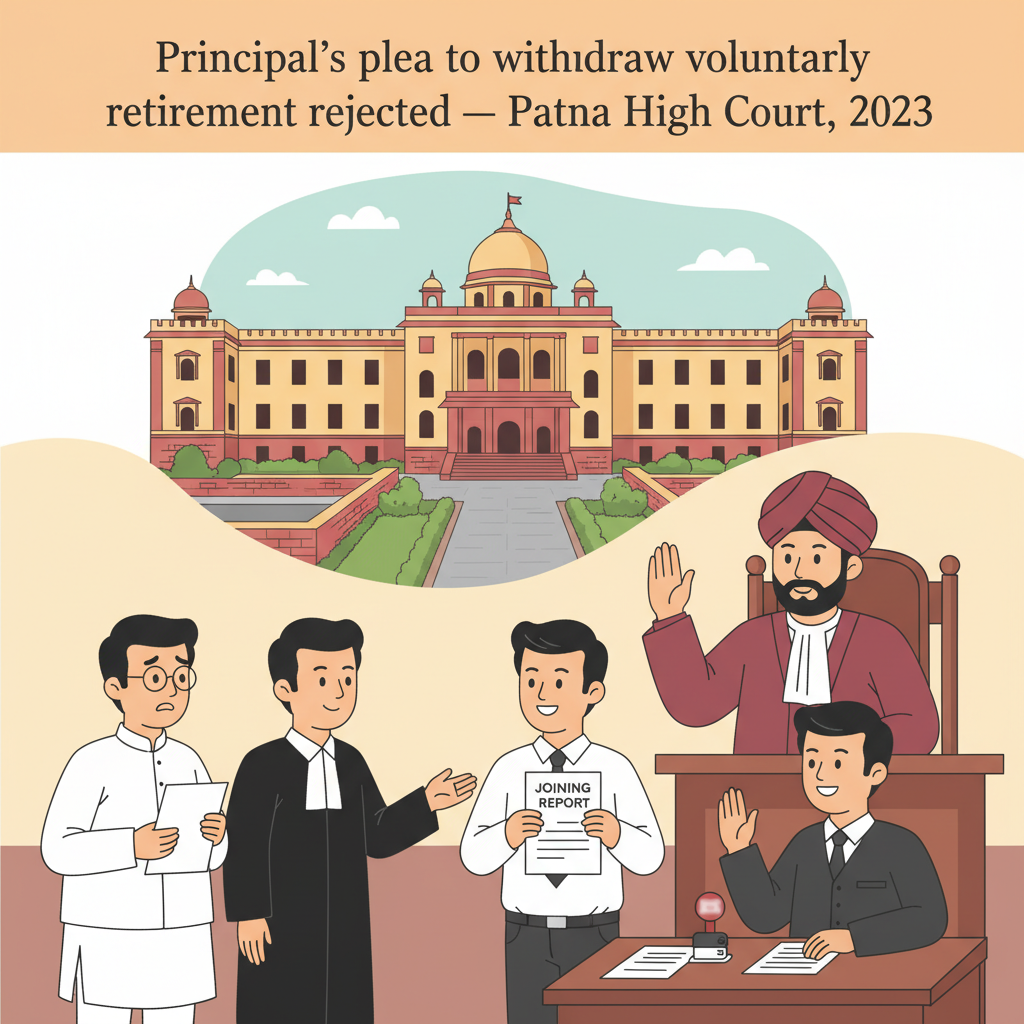
Case Background
The petitioner was appointed as Principal of Sriswami Parankushacharya Adarsh Sanskrit Mahavidyalaya on 22 February 1990. He continued to serve on this post for several decades.
The college is an Adarsh Sanskrit Mahavidyalaya receiving financial assistance under a Central Government scheme. The Central Sanskrit University acts as the nodal agency for the Ministry of Education, which provides funds to such institutions.
Under Clause 61 of the Revised Adarsh Scheme, 2012, an employee may resign from service by giving one month’s written notice. The appointing authority, however, has discretion to waive this one-month notice period.
On 12 November 2021, the petitioner submitted an online application to the Vice-Chancellor of the Central Sanskrit University seeking voluntary retirement from his post as Principal. On the same day, the Vice-Chancellor communicated his consent to the Chairperson of the college’s Managing Committee and advised that the senior-most teacher be appointed as Principal.
The Managing Committee treated the petitioner’s voluntary retirement as accepted on 12 November 2021. The college then proceeded to appoint respondent no. 7 as Principal, who joined on 13 November 2021.
On 14 November 2021, the petitioner sent a letter to the Vice-Chancellor withdrawing his voluntary retirement, stating that the retirement age had been increased to 65 years and he wished to continue. This withdrawal letter was forwarded by the University to the Managing Committee on 16 November 2021, with a request that a decision be taken.
The petitioner later filed this writ petition before the Patna High Court seeking directions to accept his withdrawal of voluntary retirement and allow him to function again as Principal.
What the Court Examined and Decided
Justice Sanjeev Prakash Sharma first heard arguments on maintainability. The college and the Central Sanskrit University argued that the institution was a private body run by a private managing committee and therefore not amenable to writ jurisdiction under Article 226.
The Court referred to the seven-judge Bench judgment in Pradeep Kumar Biswas v. Indian Institute of Chemical Biology, (2002) 5 SCC 111. That judgment held that the key question is whether a body is financially, functionally and administratively dominated by, or under the control of, the Government, and whether that control is pervasive.
Applying this test, the Court noted that the Sanskrit college is affiliated to the Central Sanskrit University and governed by the Adarsh Scheme, 2012, promulgated by the Central Government through the Ministry of Education. The scheme lays down the conditions of employment and the Government provides the funds.
On this basis, the Court held that there is administrative, financial and overall control of the Union of India, acting through the Central Sanskrit University, over the college. Though individual appointments are made by the governing body, it must follow the Adarsh Scheme norms.
Accordingly, the Patna High Court rejected the objection that the writ petition was not maintainable.
On the merits, the Court called for and examined the original records. It was undisputed that the petitioner had applied for voluntary retirement on 12 November 2021 to the Vice-Chancellor. The University received this letter and, on the same day, its in-charge officer wrote to the Chairman of the Managing Committee, conveying that the Vice-Chancellor had agreed to the voluntary retirement and directing the Chairman to consider and sanction it in terms of paragraph 31 of the regulations.
The records showed no proof that the 12 November 2021 University letter was sent to the college by email or fax. However, on that same date, the Chairman issued a notification stating that the Vice-Chancellor had accepted the voluntary retirement and appointing respondent no. 7 as Principal.
On 14 November 2021, the petitioner sent an email withdrawing his voluntary retirement. The University received this withdrawal mail and noted it on 15 November 2021. On 16 November 2021, the in-charge officer of the University wrote again to the Chairman, with a copy to the petitioner, asking the Chairman to take a decision on the withdrawal application and to take further action as per rules.
The Managing Committee later held a meeting on 30 November 2021 and recorded that the petitioner’s voluntary retirement had been accepted. The minutes of this meeting were themselves approved on 21 December 2021. The Court noted that the withdrawal application dated 14 November 2021 was not placed before the Managing Committee when it considered the matter.
The agenda placed before the Managing Committee on 21 December 2021 referred only to the appointment of respondent no. 7 as Principal upon voluntary retirement of the petitioner. It did not mention the petitioner’s withdrawal of his voluntary retirement or the University’s communication regarding that withdrawal.
The Court then examined the Chairman’s notification dated 12 November 2021. This notification stated that the Vice-Chancellor had accepted the voluntary retirement in terms of paragraph 31 of the rules, and, based on that, respondent no. 7 was appointed as Principal.
The Court found that this was legally faulty. The Central Sanskrit University had specifically stated that the Vice-Chancellor was not the appointing authority and could not accept the petitioner’s voluntary retirement. Under the scheme, the appointing authority was the Managing Committee through its Chairman.
Therefore, the Court held that the Chairman’s notification could not be treated as his own acceptance of the voluntary retirement. It wrongly projected that the Vice-Chancellor had accepted the petitioner’s voluntary retirement, when in fact the Vice-Chancellor had only forwarded the application for decision by the competent authority.
The Court agreed with the petitioner’s contention that the voluntary retirement was being used as a pretext to remove him from his post. It noted that the Chairman later refused to accept the withdrawal on the ground of alleged financial irregularity and corruption by the petitioner. The Court clearly observed that such allegations could not be a valid ground to reject the withdrawal of a voluntary retirement application.
Justice Sharma then reviewed the law on withdrawal of resignations and voluntary retirement. He cited the Constitution Bench decision in Union of India v. Gopal Chandra Mishra, (1978) 2 SCC 301, which held that in the absence of a legal or contractual bar, a prospective resignation can be withdrawn any time before it becomes effective. It becomes effective when it actually terminates the employment or office tenure.
He also relied on Union of India v. Wing Commander T. Parthasarthi, (2001) 1 SCC 158, where the Supreme Court held that, in the absence of a specific statutory bar, an employee can withdraw a premature retirement request before it becomes effective. In that case, acceptance had been granted with effect from a future date, and the withdrawal before that date was held valid.
The Court referred to several other Supreme Court decisions such as J.N. Srivastava v. Union of India, State of Haryana v. S.K. Singhal, State Bank of India v. P. Chakravorty, Srikantha S.M. v. Bharat Earth Movers Ltd., and New Victoria Mills v. Shrikant Arya, all reinforcing the principle that resignation or voluntary retirement can be withdrawn before it is effectively accepted and implemented, depending on the relevant rules and facts.
On the facts of this case, the Court held that the petitioner’s voluntary retirement application was not validly accepted on 12 November 2021. The Chairman had not accepted it in his own right; he merely recorded that the Vice-Chancellor had accepted it, which the Vice-Chancellor had no power to do.
The Managing Committee actually accepted the voluntary retirement only on 30 November 2021, and its minutes were approved on 21 December 2021. Both these dates are after 14 November 2021, when the petitioner had already withdrawn his voluntary retirement application, and after the University had forwarded that withdrawal to the Chairman on 16 November 2021.
Thus, in line with the Supreme Court precedents, the petitioner had a clear right to withdraw his voluntary retirement before it was validly accepted. The Court held that the respondents’ action in proceeding to accept and approve the voluntary retirement despite the prior withdrawal was “bad in law” and liable to be set aside.
However, the Court then turned to the question of what relief could actually be given. It noted an important additional fact: the petitioner was a non-Ph.D. holder. Under the applicable UGC Regulations, teachers retire at 62 years. A university or college may re-employ a superannuated teacher up to 65 years only as per UGC guidelines, and additional benefits up to three years are tied to possession of a Ph.D.
The Court recorded that, as per the by-laws and UGC regulations, the age of superannuation for a Principal who is not a Ph.D. holder is 62 years. There was no re-employment order in favour of the petitioner. Despite that, the petitioner had continued to function as Principal even after crossing 62 years of age.
Relying on Balbir Singh Negi v. Union of India, (1996) 8 SCC 283, the Court observed that even if an employee has a legal right to withdraw voluntary retirement, no practical relief can be given if he has already reached normal superannuation age and would, in any event, have had to retire.
Applying that logic, Justice Sharma held that, while the acceptance of voluntary retirement after its withdrawal was illegal, the petitioner could not be reinstated or continued in service because he had already crossed the age of 62 and had no Ph.D. or re-employment order.
The Court concluded that at best, the petitioner could be treated as having continued in service until the date on which he was relieved and the charge was handed over to respondent no. 7, since he had in fact worked up to that point. He would be entitled to receive salary up to that date and his retiral benefits.
On this basis, the Court disposed of the writ petition by directing the respondents to release the retiral benefits of the petitioner, if any, but declined the prayer for reinstatement or further continuation as Principal.
Why This Judgment Matters
This judgment is important for employees of grant-in-aid educational institutions and other bodies controlled by the Government. It confirms that such institutions, even if run by private managing committees, can be subject to writ jurisdiction of the High Court when the Government’s control is pervasive.
For employees, especially principals and teachers, the judgment reaffirms that a voluntary retirement request can be withdrawn before it is legally accepted by the competent authority. Internal actions taken on the basis of an incompetent authority’s “consent” do not cut off this right.
At the same time, the Patna High Court makes it clear that even if the acceptance of voluntary retirement is illegal, the Court will not grant reinstatement where the employee has already crossed the lawful age of retirement and has no right to re-employment under the rules.
The practical consequence is that an employee in such a situation may secure salary and retiral dues up to the date he actually worked, but cannot expect to be put back into service beyond the prescribed age of superannuation.
Legal Issues and Answers
- Issue: Is a writ petition maintainable against a privately managed Sanskrit college receiving Central Government funds through the Central Sanskrit University?
Answer: Yes. The Court held the college is under pervasive financial, administrative and functional control of the Union of India through the Central Sanskrit University and the Adarsh Scheme, 2012, so writ jurisdiction is available. - Issue: Could the petitioner validly withdraw his voluntary retirement request after submitting it but before the competent authority had properly accepted it?
Answer: Yes. The Court held that the voluntary retirement was not validly accepted on 12 November 2021 and was actually accepted by the Managing Committee only later. Since the petitioner had already withdrawn the request on 14 November 2021, the subsequent acceptance was bad in law. - Issue: Despite the illegality in accepting voluntary retirement after its withdrawal, was the petitioner entitled to reinstatement and continuation as Principal?
Answer: No. As a non-Ph.D. teacher, he had already crossed the superannuation age of 62 years and had no re-employment order. The Court held he must be treated as retired from the date he was relieved, with entitlement only to salary up to that date and retiral benefits.
Cases Cited by the Court
- Pradeep Kumar Biswas v. Indian Institute of Chemical Biology & Others, (2002) 5 SCC 111
- Union of India v. Gopal Chandra Mishra, 1978 (2) SCC 301
- Union of India v. Wing Commander T. Parthasarthi, (2001) 1 SCC 158
- J.N. Srivastava v. Union of India & Another, (1998) 9 SCC 559
- State Bank of India v. P. Chakravorthy, AIR 1999 SC 2282
- State of Haryana & Others v. S.K. Singhal, (1999) 4 SCC 293
- Shrikantha S.M. v. Bharat Earth Movers Ltd., (2005) 8 SCC 314
- New Victoria Mills & Others v. Shrikant Arya, 2021 SCC OnLine SC 808
- Balbir Singh Negi v. Union of India & Others, (1996) 8 SCC 283
- Balram Gupta v. Union of India & Another, AIR 1987 SC 2354 (cited by petitioner)
Case Details
Case Number: Civil Writ Jurisdiction Case No. 38 of 2022
Case Title: Hareramacharya v. Union of India & Others
Citation: 2023 (1) PLJR 676
Coram: Hon’ble Mr. Justice Sanjeev Prakash Sharma
Date of Judgment: 11-01-2023
Advocates:
For the petitioner: Mr. Ramakant Sharma, Senior Advocate; Mr. Rajesh Kumar, Advocate
For the Union of India and Central authorities: Dr. K.N. Singh, Assistant Solicitor General
For respondent nos. 4 and 7 (Managing Committee and newly appointed Principal): Mr. P.K. Shahi, Senior Advocate; Mr. Mukesh Kumar-I, Advocate
Nature of the case: Writ petition (civil) challenging acceptance of voluntary retirement and seeking direction to allow withdrawal of voluntary retirement and continuance as Principal.
If you found this explanation helpful and wish to stay informed about how legal developments may affect your rights in Bihar, you may consider following Samvida Law Associates for more updates.







