
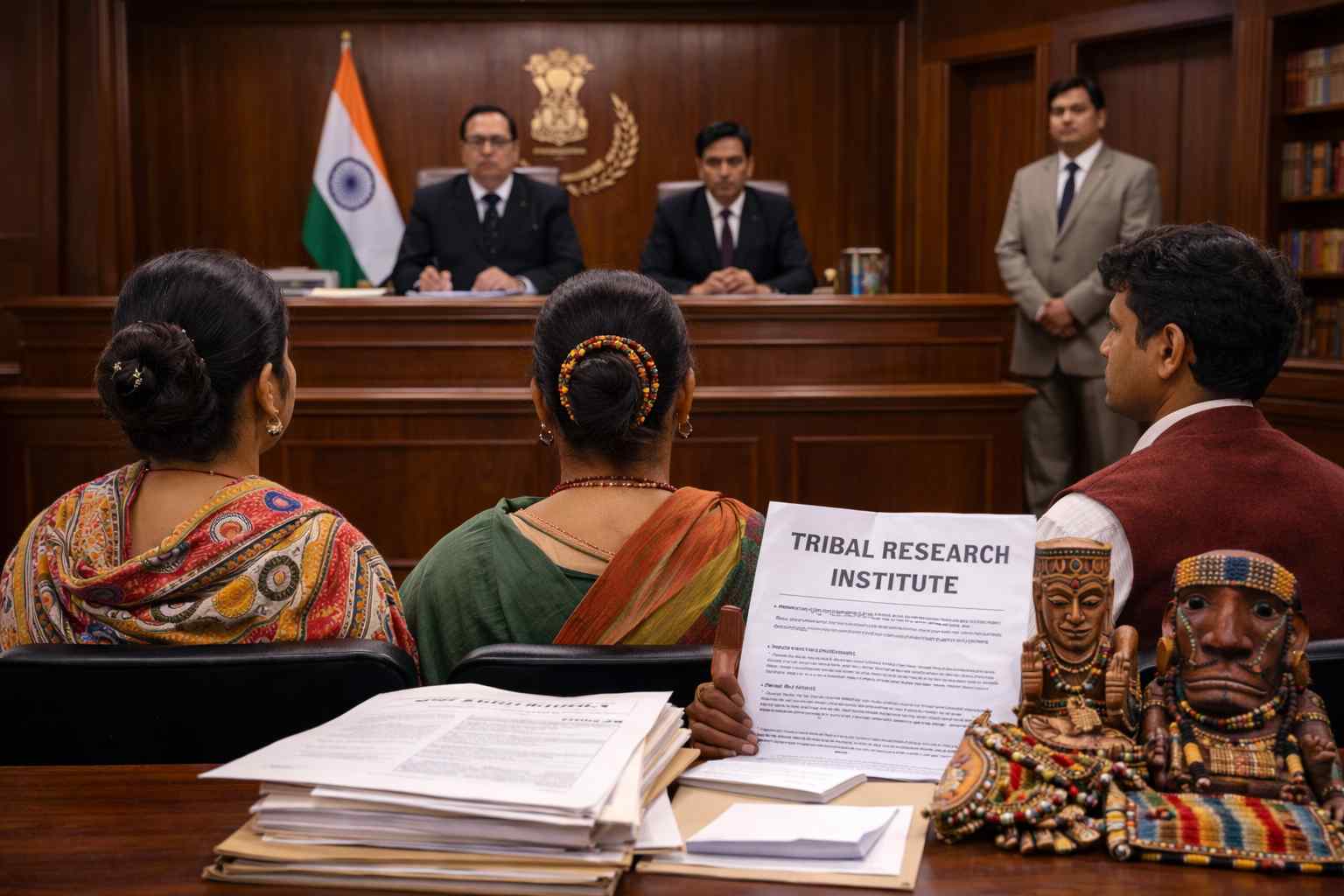
Simplified Explanation of the Judgment
This judgment of the Patna High Court addresses a long-pending and sensitive issue concerning the constitutional and statutory obligations of the State of Bihar and the Union of India towards Scheduled Tribes. The Court dealt with a Public Interest Litigation (PIL) seeking directions for the establishment of a Tribal Research Institute (TRI) in Bihar, in accordance with guidelines issued by the Ministry of Tribal Affairs, Government of India.
The petition was filed by a public-spirited organisation working for tribal rights, highlighting that despite a central communication dated 14 December 2017, Bihar had failed to establish a Tribal Research Institute for more than four years. This delay was particularly serious because the scheme for TRIs is fully funded by the Central Government (100% grant-in-aid), and several other States had already set up such institutions.
The High Court noted that Tribal Research Institutes are not merely administrative bodies but are meant to function as knowledge and research hubs focusing on tribal welfare, preservation of tribal culture, socio-economic development, evidence-based policy planning, and capacity building of tribal communities.
Earlier, the Court had already passed interim orders expressing concern over the inaction of the State Government. It recorded that funding was not an obstacle and that an Apex Committee was already constituted at the national level. Still, Bihar had failed to move forward, which prompted the Court to remind the authorities of their constitutional responsibilities under Articles 15(4), 16(4), 46, and the Directive Principles of State Policy.
During the course of hearing, affidavits were filed by the State Government assuring the Court that steps would now be taken for establishing the Institute. A detailed timeline was submitted explaining the administrative steps required, including creation of posts, framing of service rules, cabinet approvals, budgetary heads, and financial sanctions.
The Court accepted the assurances but made it clear that it was doing so with caution and constitutional concern, emphasising that tribal development cannot remain a matter of empty promises or indefinite delay.
Constitutional Context Emphasised by the Court
A major part of the judgment is devoted to reiterating the constitutional philosophy regarding Scheduled Tribes. The Court relied upon several landmark Supreme Court judgments to underline that:
- Scheduled Tribes have historically remained outside the mainstream due to geographical, social, and economic disadvantages.
- The Constitution mandates special care and protection for their educational, economic, and cultural interests.
- Development must take place without destroying tribal identity, heritage, and traditional ways of life.
The Court extensively referred to Supreme Court decisions explaining social justice, equality, dignity, and the role of the State in uplifting marginalised communities.
Role and Importance of a Tribal Research Institute
The Court highlighted that a Tribal Research Institute is expected to function as:
- A think tank for tribal development,
- A research body documenting tribal language, culture, customs, art, folklore, and traditional knowledge,
- A training and capacity-building centre for tribal representatives and officials,
- A platform for monitoring and evaluating government schemes relating to Scheduled Tribes,
- A body for promoting awareness, education, and preservation of tribal heritage.
The Court noted that establishment of such an institution is not a discretionary policy choice but a logical extension of constitutional duties.
Assurances Given by the State Government
The State Government placed before the Court a detailed time-bound action plan, stating that:
- Posts required for the Institute would be created after due approval,
- Rules governing appointments would be framed and vetted,
- Budgetary heads would be created through the Finance Department,
- Proposals would be sent to the Central Government within the stipulated time.
The Central Government, through its counsel, assured the Court that once the proposal is received, a decision would be taken expeditiously and in accordance with law.
Final Directions Issued by the Patna High Court
While disposing of the PIL, the Patna High Court issued the following important directions:
- The Government of Bihar must strictly adhere to the timelines furnished for establishment of the Tribal Research Institute.
- A detailed proposal must be forwarded to the Ministry of Tribal Affairs, Government of India without delay.
- The Central Government must act expeditiously upon receipt of the proposal.
- Liberty was reserved to any public-spirited individual or organisation to approach the Court again if there is continued non-compliance or future cause of action.
- A copy of the judgment was directed to be communicated to the Chief Secretary, Government of Bihar and other concerned authorities.
With these observations and directions, the writ petition was disposed of.
Significance or Implication of the Judgment
This judgment carries deep significance for tribal welfare governance in Bihar:
- It reinforces that tribal development is a constitutional mandate, not an administrative option.
- It puts accountability on both State and Central Governments for delay in implementing welfare institutions.
- It strengthens the role of Public Interest Litigation in ensuring implementation of social justice measures.
- It underscores that budgetary excuses cannot justify inaction when full central funding is available.
For the general public, especially tribal communities, the judgment promises a structured institutional mechanism for research-driven, culturally sensitive, and inclusive development.
Legal Issue(s) Decided and the Court’s Decision
- Whether the State of Bihar can indefinitely delay establishment of a Tribal Research Institute despite central guidelines and funding?
➤ No. Such delay violates constitutional obligations. - Whether the Court can issue directions in a PIL to enforce tribal welfare measures?
➤ Yes. The Court has a duty to ensure compliance with constitutional mandates. - Whether establishment of a TRI is integral to tribal development goals?
➤ Yes. It is essential for holistic and sustainable tribal welfare.
Judgments Referred by Parties (with citations)
- Madhuri Patil v. Commissioner, Tribal Development, (1994) 6 SCC 241
- Sudhakar Vithal Kumbhare v. State of Maharashtra, (2004) 9 SCC 481
Judgments Relied Upon or Cited by Court (with citations)
- Madhuri Patil v. Commissioner, Tribal Development, (1994) 6 SCC 241
- Samatha v. State of A.P., (1997) 8 SCC 191
- Minerva Mills Ltd. v. Union of India, (1980) 3 SCC 625
- D.S. Nakara v. Union of India, (1983) 1 SCC 305
- P. Rami Reddy v. State of A.P., (1988) 3 SCC 433
Case Title
Public Interest Litigation v. Union of India & Others
Case Number
Civil Writ Jurisdiction Case No. 3749 of 2022
Citation(s)
2023 (1) PLJR 594
Coram and Names of Judges
- Hon’ble the Chief Justice Sanjay Karol
- Hon’ble Mr. Justice S. Kumar
Names of Advocates and who they appeared for
- For the Petitioner: Mr. Vikash Kumar Pankaj, Advocate
- For the Union of India: Dr. K.N. Singh, ASG; Ms. Prakritita Sharma, Advocate
- For the State of Bihar: Mr. Prashant Pratap, GP-2; Mr. Tuhin Shankar, Advocate
Link to Judgment
MTUjMzc0OSMyMDIyIzEjTg==-HPlT–am1–luUUVs=
If you found this explanation helpful and wish to stay informed about how legal developments may affect your rights in Bihar, you may consider following Samvida Law Associates for more updates.







