
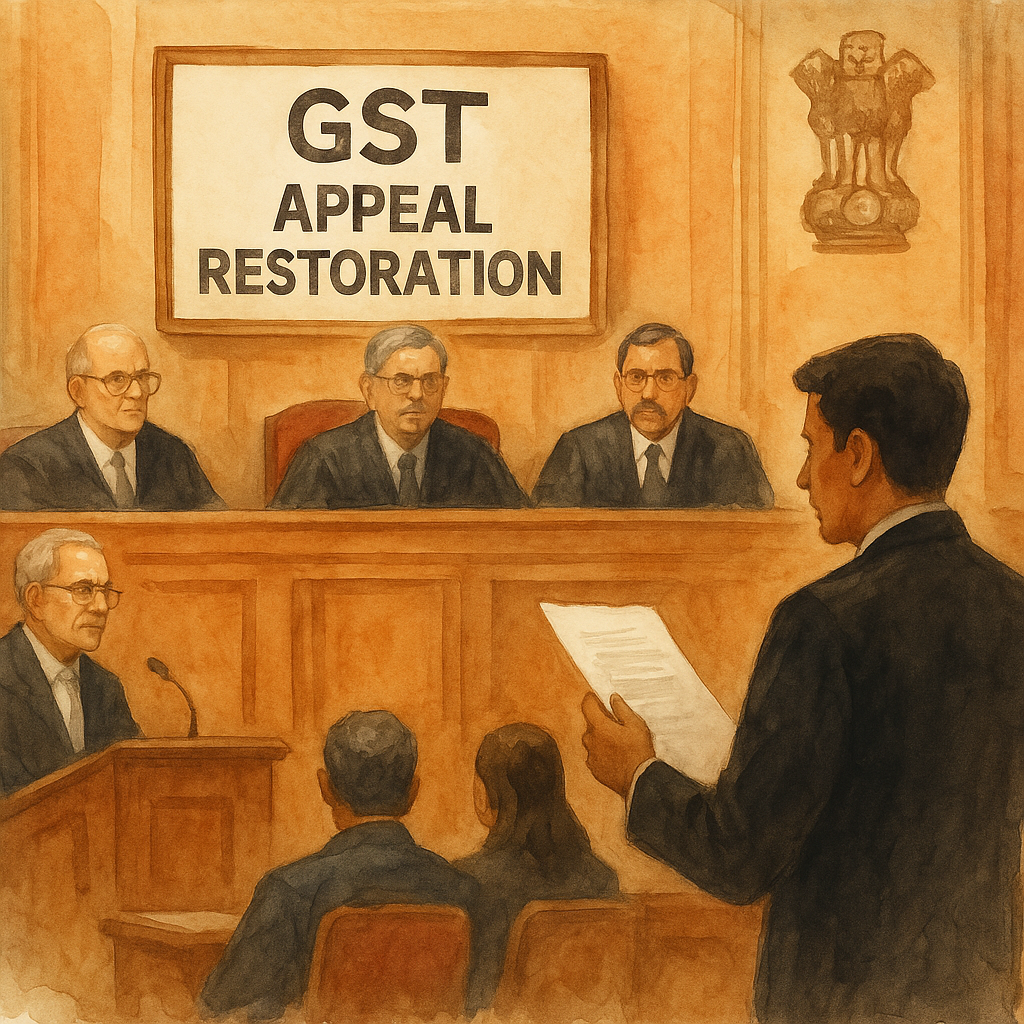
Simplified Explanation of the Judgment
This judgment of the Patna High Court deals with a very common and practical problem faced by small business owners under the Goods and Services Tax (GST) regime — cancellation of GST registration due to non-filing of returns and procedural lapses.
In this case, the petitioner was a small business entity whose GST registration had been cancelled by the tax authorities. The cancellation effectively stopped the petitioner from carrying on lawful business, issuing tax invoices, or participating in the GST system. Without a valid GST registration, continuing business becomes almost impossible, especially when dealing with suppliers, customers, and government departments.
The petitioner approached the Patna High Court by filing a writ petition. The main grievance was not that the petitioner wanted to avoid compliance, but that the GST registration had been cancelled without providing a meaningful opportunity to restore it. Before the Court, the petitioner clearly stated that she was ready and willing to comply with all legal requirements, including filing pending GST returns and paying any outstanding tax dues.
The petitioner requested the Court to direct the GST authorities to restore the GST registration immediately. She also assured the Court that all formalities, returns, and dues would be completed within a reasonable time if the registration was restored.
On the other hand, the respondents were officers of the Central GST department, represented by senior law officers. The case was heard by a Division Bench of the Patna High Court comprising the Hon’ble Chief Justice and another Hon’ble Judge.
After hearing both sides, the Court adopted a balanced and practical approach. Instead of directly ordering restoration, the Court provided a structured solution. It permitted the petitioner to file an application for restoration of GST registration before the competent authority. The Court then directed the GST authority to consider that application promptly and pass appropriate orders strictly in accordance with law.
Most importantly, the Court protected the petitioner from technical hurdles. It clearly stated that the issue of limitation (delay) should not come in the way of deciding the application on merits. This observation is crucial because many GST restoration applications are rejected solely on the ground of delay, without examining whether the taxpayer is genuinely willing to comply.
The Court also recorded the petitioner’s undertaking to pay all outstanding taxes and dues within four weeks from the date of the authority’s decision. With these directions, the writ petition was disposed of.
Through this judgment, the Patna High Court reinforced that the GST law is meant to facilitate lawful business and revenue collection, not to permanently shut down businesses for procedural defaults, especially when the taxpayer is willing to rectify mistakes.
Significance or Implication of the Judgment
This judgment is significant for small traders, entrepreneurs, and service providers across Bihar and India. It sends a clear message that GST compliance should be enforced fairly and reasonably.
For taxpayers, the judgment provides relief and hope. It clarifies that cancellation of GST registration is not the end of the road if the taxpayer is willing to comply. Courts are inclined to support restoration when there is bona fide intent to file returns and pay dues.
For tax authorities, the judgment acts as a reminder that procedural laws should not be applied mechanically. Authorities must consider restoration applications on merits and not reject them solely on technical grounds like limitation, especially when compliance is assured.
For the general public and business community, the judgment promotes trust in the legal system and encourages voluntary compliance rather than fear-based enforcement.
Legal Issue(s) Decided and the Court’s Decision with Reasoning
- Issue: Whether a GST registration cancelled due to non-compliance can be restored when the taxpayer is ready to fulfill all statutory obligations.
Decision: Yes. The Court allowed the petitioner to apply for restoration and directed the authority to decide the application on merits. - Issue: Whether delay or limitation can be used to reject restoration applications outright.
Decision: No. The Court expressly held that limitation should not obstruct consideration on merits. - Issue: Whether the Court should directly order restoration of GST registration.
Decision: The Court chose a balanced approach by directing the competent authority to decide within a fixed time frame. - Reasoning: The Court recognized the petitioner’s willingness to comply, the importance of GST registration for business continuity, and the need for fair administrative action.
Case Title
M/S MAI ENTEREPRISE Vs. The Union of India
Case Number
Civil Writ Jurisdiction Case No. 15345 of 2022
Coram and Names of Judges
Hon’ble the Chief Justice
Hon’ble Mr. Justice Partha Sarthy
Names of Advocates and Who They Appeared For
- Advocate for the Petitioner: Ms. Archana Sinha @ Archana Shahi
- Advocates for the Respondents:
- Dr. K. N. Singh, ASG
- Dr. Anshuman Singh, Senior Standing Counsel, CGST & CX
- Mr. Abhijeet Gautam, Advocate
Link to Judgment
MTUjMTUzNDUjMjAyMiMxI04=-WZR40kd2ri8=
If you found this explanation helpful and wish to stay informed about how legal developments may affect your rights in Bihar, you may consider following Samvida Law Associates for more updates.







