
Simplified Explanation of the Judgment
This judgment of the Patna High Court is an important ruling under the Motor Vehicles Act, 1988, dealing with the calculation of compensation, the duty of insurance companies, and the consequences of unjustified delay in payment of awarded compensation.
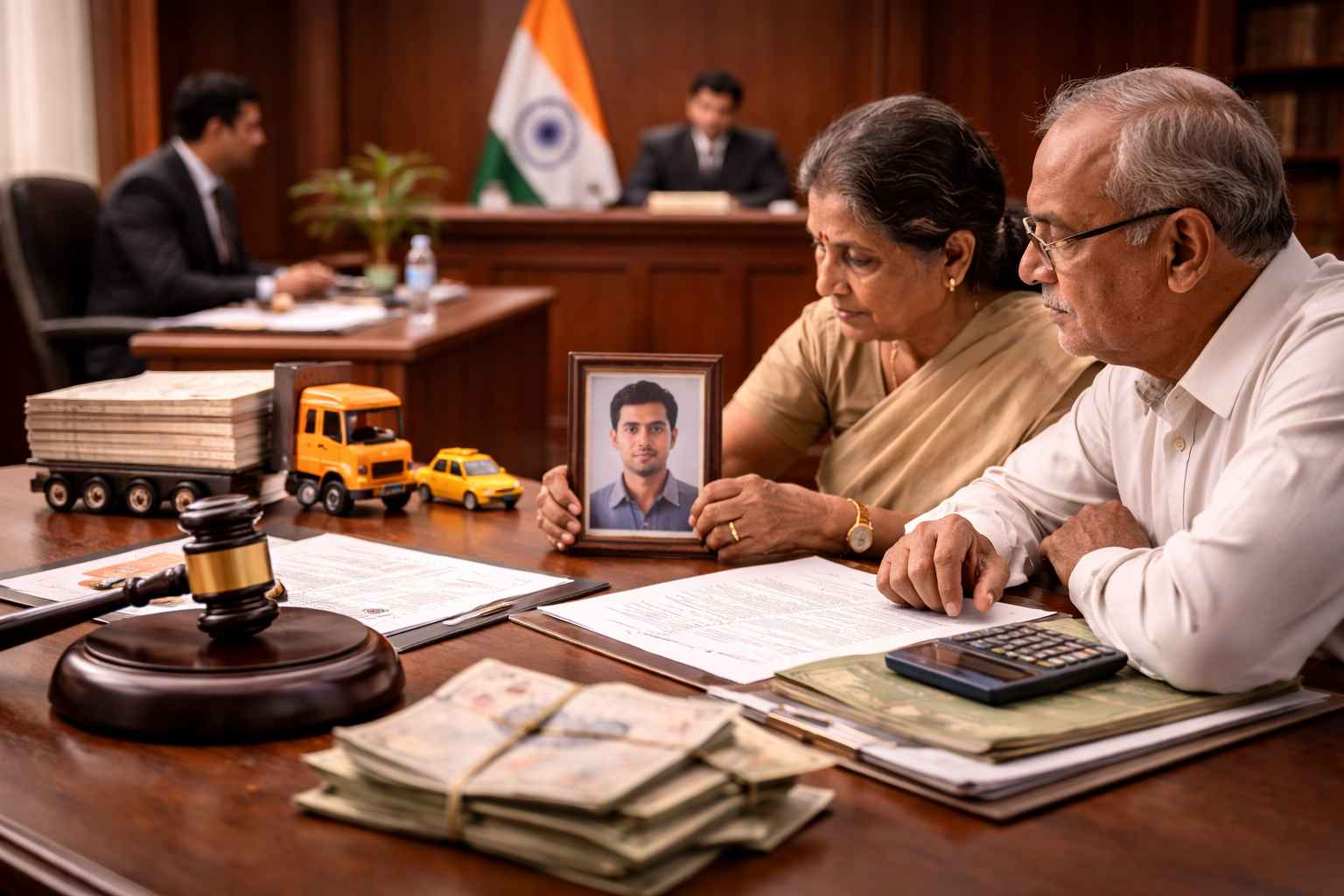
The case arose out of a fatal road accident in which a young man, aged about 25 years, lost his life. His parents filed a claim petition before the Motor Accident Claims Tribunal (MACT), Munger, seeking compensation for the death of their unmarried son.
The Tribunal, by judgment dated 12.06.2015, awarded a total compensation of ₹7,89,500/- along with 9% interest from 21.02.2012 and directed the insurance company to pay the amount within 30 days.
Instead of complying with the award, the insurance company challenged it before the Patna High Court through Miscellaneous Appeal No. 300 of 2015, primarily seeking reduction of compensation. The appeal remained pending for more than six and a half years, during which period no stay was granted against the award, yet the compensation was not paid to the claimants.
The appeal was finally decided by Hon’ble Mr. Justice Rajeev Ranjan Prasad on 10 January 2023.
Facts of the Case in Simple Terms
- The deceased was travelling on a motorcycle when it was hit from behind by a truck driven rashly and negligently.
- He sustained serious injuries and died during treatment.
- An FIR and charge-sheet were filed against the truck driver.
- The deceased was unmarried, employed in a private company in Kolkata, and earning ₹7,500 per month.
- His parents were dependent on his income.
The Tribunal accepted the evidence of witnesses and documents such as the salary slip, post-mortem report, FIR, insurance policy, and driving licence, and held the insurance company liable to pay compensation.
Grounds Raised by the Insurance Company
Before the High Court, the insurance company raised multiple objections, including:
- The multiplier applied by the Tribunal was incorrect.
- The Tribunal wrongly deducted only one-third of income as personal expenses, instead of 50%, since the deceased was a bachelor.
- The Tribunal did not clearly grant right of recovery in the operative portion of the award.
- The compensation awarded was allegedly excessive.
Ironically, during the hearing, it became evident that if the correct law laid down by the Supreme Court was applied, the claimants would actually be entitled to much higher compensation than what was awarded by the Tribunal.
What the High Court Examined
The High Court undertook a detailed examination of:
- Multiplier method and whether the age of the deceased or the parents should be considered
- Deduction for personal expenses in case of a bachelor
- Future prospects of income
- Compensation under conventional heads like funeral expenses, loss of estate, and filial consortium
- Binding precedents of the Supreme Court, including:
- Sarla Verma v. DTC
- Pranay Sethi
- Magma General Insurance v. Nanu Ram
- United India Insurance v. Satinder Kaur
- Ranjana Prakash v. Divisional Manager
The Court recalculated the compensation as per settled law and found that the claimants were actually entitled to ₹16,22,000/- plus interest, which was more than double the amount awarded by the Tribunal.
Why the High Court Did Not Enhance Compensation
Despite finding that the Tribunal had awarded a much lower amount than legally permissible, the High Court refused to enhance the compensation.
The reason was purely procedural:
- The claimants had not filed any cross-appeal or cross-objection seeking enhancement.
- As per the Supreme Court judgment in Ranjana Prakash, in an appeal filed only by the insurance company, the Court cannot enhance compensation, even if it finds that higher compensation was legally justified.
Therefore, the High Court held that the insurance company’s appeal lacked merit and deserved dismissal.
Strong Observations Against the Insurance Company
The most significant part of the judgment relates to the Court’s strong disapproval of the conduct of the insurance company.
The Court noted that:
- The appeal remained pending for over 6½ years.
- There was no stay order against the Tribunal’s award.
- Despite this, the insurance company did not pay a single rupee to the parents of the deceased.
- The parents had been litigating for nearly a decade, defeating the very purpose of the welfare legislation under the Motor Vehicles Act.
The Court observed that the insurance company had failed to respect the spirit of beneficial legislation and binding Supreme Court judgments requiring payment of just compensation without delay.
Final Decision of the Patna High Court
The High Court passed the following directions:
- The appeal was dismissed in entirety.
- The insurance company was directed to pay the awarded compensation with interest immediately.
- Additionally, a cost of ₹1,00,000/- was imposed on the insurance company, payable to the claimants.
- The entire payment was ordered to be made within two weeks, failing which recovery would be made through execution proceedings.
Significance or Implication of the Judgment
This judgment has wide implications for accident compensation cases in Bihar:
- It reiterates that the Motor Vehicles Act is a welfare legislation meant to protect victims and their families.
- Insurance companies cannot misuse appellate remedies to delay payment.
- Courts will impose heavy costs where compensation is withheld without any stay order.
- The judgment reinforces consistency in applying Supreme Court precedents on future prospects, multiplier, and conventional heads.
For accident victims and their families, this decision strengthens confidence that courts will not tolerate procedural harassment or delay tactics by powerful insurers.
Legal Issue(s) Decided and the Court’s Decision
- Whether the Tribunal committed error in calculating compensation?
➤ Even if minor errors existed, the compensation was actually lower than legally admissible, hence no interference warranted. - Whether compensation can be enhanced in an insurer’s appeal without cross-objection by claimants?
➤ No, as per Ranjana Prakash. - Whether insurance company can delay payment without stay?
➤ No. Such conduct attracts penal costs.
Judgments Referred by Parties (with citations)
- Sarla Verma v. Delhi Transport Corporation, (2009) 6 SCC 121
- Ranjana Prakash v. Divisional Manager, (2011) 14 SCC 639
Judgments Relied Upon or Cited by Court (with citations)
- National Insurance Co. Ltd. v. Pranay Sethi, (2017) 16 SCC 680
- Magma General Insurance Co. Ltd. v. Nanu Ram, (2018) 18 SCC 130
- United India Insurance Co. Ltd. v. Satinder Kaur, (2021) 11 SCC 780
- Reshma Kumari v. Madan Mohan, (2013) 9 SCC 65
Case Title
Insurance Company v. Parents of Deceased Victim & Others
Case Number
Miscellaneous Appeal No. 300 of 2015
Citation(s)
2023 (1) PLJR 530
Coram and Names of Judges
Hon’ble Mr. Justice Rajeev Ranjan Prasad
Names of Advocates and who they appeared for
- For the Appellant (Insurance Company): Mr. Raj Kumar Singh Vikram, Advocate
- For the Claimants: None appeared
Link to Judgment
MiMzMDAjMjAxNSMxI04=-Ne550gtu3kY=
If you found this explanation helpful and wish to stay informed about how legal developments may affect your rights in Bihar, you may consider following Samvida Law Associates for more updates.







