
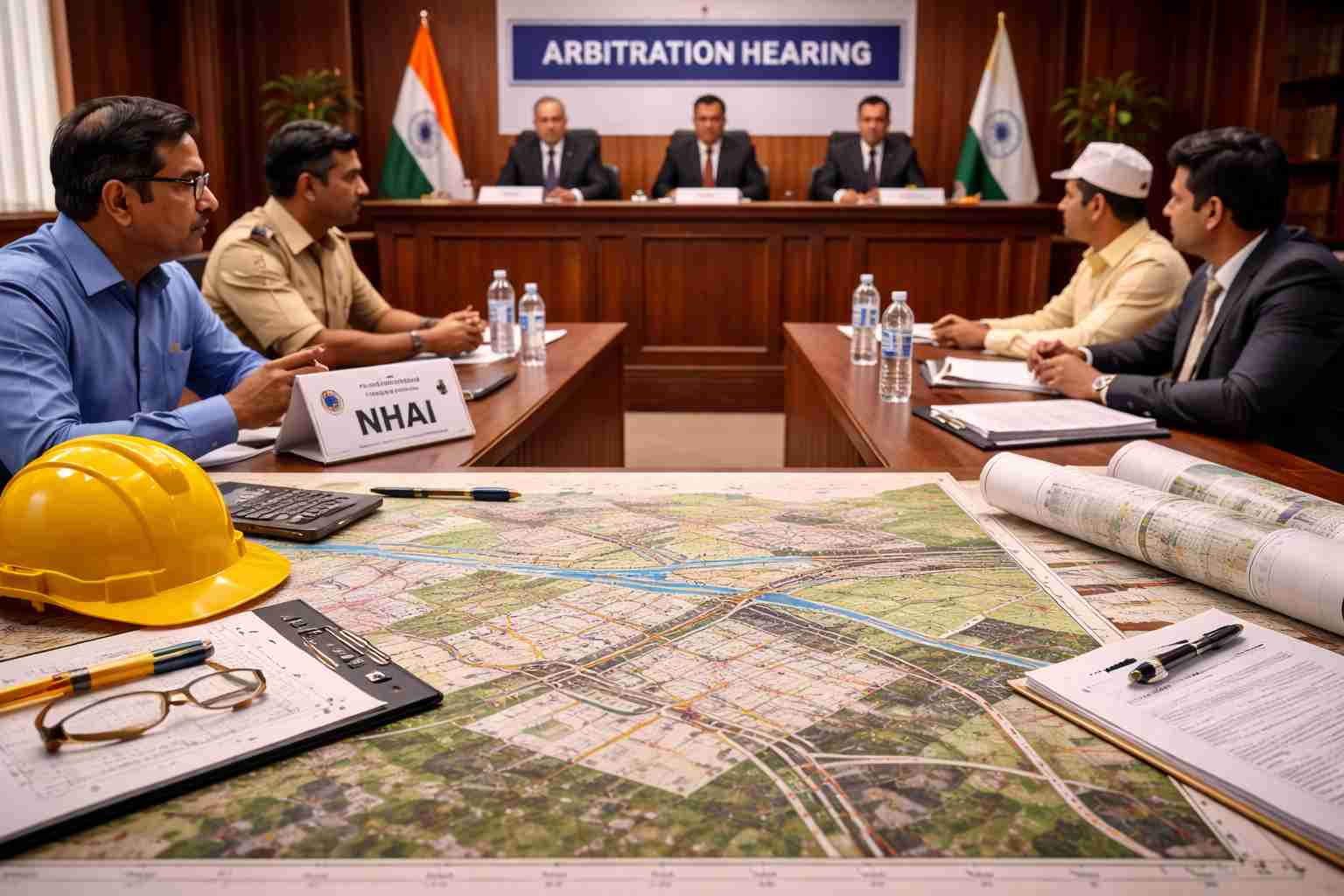
Simplified Explanation of the Judgment
This detailed judgment of the Patna High Court deals with a complex land acquisition dispute involving the National Highways Authority of India (NHAI) and a private landholder, and clarifies an extremely important legal principle: a court hearing a challenge to an arbitral award under Section 34 of the Arbitration and Conciliation Act, 1996 cannot modify the award. It can only set it aside or remand the matter.
The case arose out of the acquisition of land for a National Highway project (NH-30 / NH-84, Patna–Buxar four-lane road). The land of the aggrieved person was acquired under the National Highways Act, 1956. Compensation was initially determined by the Competent Authority / District Land Acquisition Officer, and thereafter by an Arbitrator (Additional Collector) under Section 3-G(5) of the National Highways Act.
The Arbitrator passed awards in 2016 treating the acquired land as agricultural land, resulting in comparatively lower compensation. Dissatisfied, the landholder approached the civil court by filing applications under Section 34 of the Arbitration and Conciliation Act, 1996, challenging the arbitral awards.
The Additional District and Sessions Judge, Patna, while deciding the Section 34 applications in 2018, set aside the arbitral awards. However, the court went a step further and directed that compensation be paid by treating the land as residential land.
This direction aggrieved NHAI, which then filed Miscellaneous Appeal Nos. 1010 and 1011 of 2018 before the Patna High Court. Both appeals involved the same legal issue and were therefore heard together.
Core Dispute Before the High Court
The central question before the Patna High Court was not whether the arbitral award was right or wrong, but rather:
After setting aside an arbitral award under Section 34, can a court itself decide the nature of land and direct payment of compensation accordingly?
NHAI argued that this amounted to modifying the arbitral award, which is strictly prohibited under Section 34. The landholder, on the other hand, argued that the land had been wrongly treated as agricultural despite being residential/commercial in nature and that the lower court was justified in correcting this injustice.
What the Patna High Court Examined
The High Court undertook an exhaustive analysis of:
- The National Highways Act, 1956, especially Section 3-G
- The Arbitration and Conciliation Act, 1996, particularly Sections 18, 19, 23, 24, 26, and 34
- The scope of judicial interference with arbitral awards
- The manner in which the arbitration proceedings were conducted
The Court found serious procedural lapses in the arbitration proceedings. The Arbitrator had:
- Not fixed any clear procedure under Section 19 of the 1996 Act
- Not given proper opportunity to parties to lead oral or documentary evidence
- Relied on committee recommendations and sale deeds without proper proof
- Failed to ensure compliance with principles of natural justice
Because of these defects, the High Court agreed that the arbitral awards were rightly set aside.
However, the Court drew a clear legal boundary when it came to the additional direction issued by the lower court.
Why the Lower Court Went Wrong
The Patna High Court held that the lower court exceeded its jurisdiction by:
- Declaring the nature of the land as residential, and
- Directing payment of compensation on that basis
The High Court emphasized that Section 34 proceedings are not appellate proceedings. A court hearing a Section 34 application:
- Cannot re-appreciate evidence
- Cannot determine market value
- Cannot enhance or reduce compensation
- Cannot modify or rewrite the arbitral award
Once an award is set aside, the only lawful course is to remand the matter to the Arbitrator for fresh determination in accordance with law.
Reliance on Supreme Court Jurisprudence
The High Court relied heavily on authoritative Supreme Court precedents which have consistently held that courts have no power to modify arbitral awards under Section 34. The judgment reiterated that judicial interference is intentionally limited to preserve the autonomy and finality of arbitration.
The Court explained that allowing courts to fix compensation themselves would defeat the entire statutory arbitration mechanism under the National Highways Act and undermine legislative intent.
Final Decision of the Patna High Court
The High Court ultimately held that:
- The arbitral awards were correctly set aside due to procedural illegality and violation of natural justice
- The lower court acted illegally in directing compensation by treating the land as residential
- Such a direction amounted to impermissible modification of the arbitral award
Accordingly, the Patna High Court:
- Allowed the appeals filed by NHAI in part
- Set aside only that portion of the lower court’s order which fixed the nature of land and compensation
- Remitted the matter to the Arbitrator (now the Divisional Commissioner, Patna)
- Directed that fresh arbitration be conducted strictly in accordance with the Arbitration and Conciliation Act, 1996, after giving full opportunity to both sides
Significance or Implication of the Judgment
This judgment has far-reaching implications for land acquisition cases in Bihar and across India:
- It firmly establishes that Section 34 courts cannot act as arbitrators
- It protects the institutional integrity of arbitration
- It ensures that compensation disputes are decided only after proper evidence and fair procedure
- It brings clarity for government authorities, landowners, and courts dealing with highway acquisitions
For landowners, the judgment ensures that unfair awards can be challenged, but through the correct legal process.
For authorities, it offers certainty that courts will not bypass statutory arbitration mechanisms.
Legal Issue(s) Decided and the Court’s Decision
- Can a court modify an arbitral award under Section 34 of the Arbitration Act?
➤ No. Modification is impermissible; only setting aside or remand is allowed. - Was the lower court justified in declaring the land as residential?
➤ No. This amounted to unlawful modification of the award. - What is the correct course after setting aside an arbitral award?
➤ The matter must be remitted to the Arbitrator for fresh determination.
Judgments Referred by Parties (with citations)
- Project Director, National Highways Authority of India v. M. Hakeem, (2021) 9 SCC 1
- National Highways Authority of India v. P. Nagaraju @ Cheluvalah, 2022 SCC Online SC 864
Judgments Relied Upon or Cited by Court (with citations)
- McDermott International Inc. v. Burn Standard Co. Ltd., (2006) 11 SCC 181
- Kinnari Mullick v. Ghanshyam Das Damani, (2018) 11 SCC 328
- Dakshin Haryana Bijli Vitran Nigam Ltd. v. Navigant Technologies (P) Ltd., (2021) 7 SCC 657
Case Title
National Highways Authority of India v. State Authorities & Private Landholder
Case Number
Miscellaneous Appeal Nos. 1010 of 2018 and 1011 of 2018
Citation(s)
2023 (1) PLJR 518
Coram and Names of Judges
Hon’ble Mr. Justice Rajeev Ranjan Prasad
Names of Advocates and who they appeared for
- For the Appellant (NHAI): Mr. Kumar Goutam, Advocate
- For the State Authorities: Mr. Arun Kumar Bhagat, AC to AAG-12
- For the Private Respondent: Mr. Indradeo Prasad, Advocate
Link to Judgment
MiMxMDEwIzIwMTgjMSNO-QNe2ckoVxtI=
If you found this explanation helpful and wish to stay informed about how legal developments may affect your rights in Bihar, you may consider following Samvida Law Associates for more updates.







