
Simplified Explanation of the Judgment
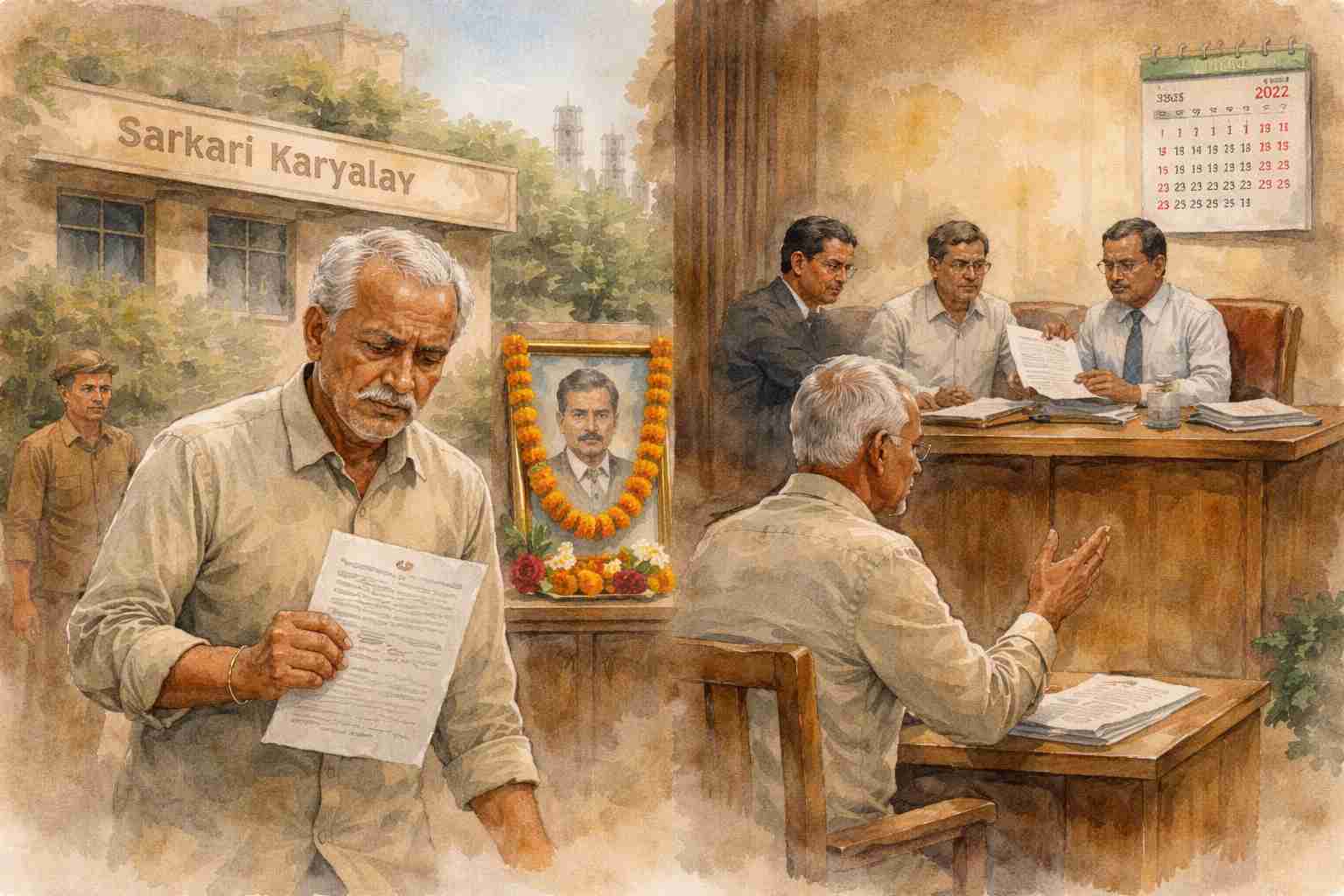
In this 2022 judgment, the Patna High Court rejected a retired engineer’s claim for retrospective promotion and monetary benefits that he sought nearly 15 years after his retirement. The Court held that delayed and stale claims cannot be revived merely through representations.
The case involved a retired Executive Engineer of the Water Resources Department, Government of Bihar, who approached the High Court seeking promotion to the post of Superintending Engineer with effect from 27 December 1993 — the date when he claimed he was due for promotion. He also demanded revision of pension and arrears based on that notional promotion.
Hon’ble Mr. Justice Madhuresh Prasad dismissed the writ petition on 4 November 2022, holding that the claim was time-barred, lacking merit, and barred by the petitioner’s own inaction for over a decade.
Background of the Case
The petitioner had served as an Executive Engineer in the Water Resources Department and retired on 31 January 2001. After his retirement, the department issued a notification on 8 November 2001 promoting 18 Executive Engineers to the rank of Superintending Engineer (Civil) in the pay scale of ₹14,300–18,300. His name appeared at serial number 17 in that list.
However, the promotion order made it clear that the benefits were notional only. The clause in the notification explicitly stated that financial benefits would be granted only from the date the officer actually took charge of the post, and that retrospective monetary benefits would require separate approval from the Finance Department.
Later, by a subsequent departmental order dated 24 February 2003, only 12 officers out of those 18 were granted actual financial benefits of promotion, because they had held “current charge” of the post of Superintending Engineer before the issuance of the 2001 notification.
The petitioner, who had never held charge of that higher post, was not included among them.
Feeling aggrieved, he made two representations in 2003 and 2008 requesting retrospective benefits, which were ultimately rejected by a departmental communication dated 9 February 2017. The letter informed him that since he never held the charge of Superintending Engineer, he was not entitled to monetary benefits for the promotion granted to him only notionally.
He filed the present writ petition in 2018, challenging that 2017 letter and seeking consequential financial benefits.
Arguments by the Petitioner
The petitioner argued that since the department itself had recognized that his promotion was due from 27 December 1993, he should not be denied financial benefits merely because the authorities delayed the issuance of the promotion notification until 2001. He contended that the delay was purely administrative, and an employee should not suffer for bureaucratic inaction.
He relied on two earlier decisions of the Patna High Court — one reported in 1990 (2) PLJR 248, and another in C.W.J.C. No. 1631 of 1996 — to claim that retrospective monetary benefits should follow once promotion is acknowledged from an earlier date.
State’s Response
The State government’s counsel pointed out that Clause 2 of the 2001 notification clearly provided that only officers who had actually held charge of the higher post could receive monetary benefits. The Finance Department had approved retrospective benefits only for those engineers who had indeed performed the duties of Superintending Engineer prior to their formal promotion.
Since the petitioner never held current charge and had already retired by 2001, his claim for retrospective pay and pension revision was inadmissible. The State also argued that his claim was hopelessly delayed — filed 15 years after the issue had been conclusively settled in 2003.
Court’s Findings and Reasoning
The High Court agreed with the State’s reasoning and dismissed the petition.
The Court first noted that the petitioner had never worked as a Superintending Engineer before retirement. His promotion was purely notional and did not carry any financial entitlement. The Finance Department’s concurrence had been limited only to those who had held the charge of the higher post.
It further observed that the petitioner never challenged the two key notifications — dated 8 November 2001 (granting notional promotion) and 24 February 2003 (granting actual financial benefits to 12 officers) — for over 15 years. These orders had attained finality long ago.
The communication dated 9 February 2017, which he challenged in this case, was only a reiteration of the earlier settled position, not a new decision. Hence, it did not create any new cause of action.
The Court relied on the Supreme Court’s ruling in Union of India v. C. Girija [(2019) 15 SCC 633], which held that a stale claim cannot be revived by filing repeated representations. The Supreme Court had observed that even if an authority replies to such a representation, it does not restart the limitation period or create a new right.
Justice Prasad emphasized that the principle of delay and laches bars relief under Article 226 of the Constitution when a petitioner sleeps over his rights for an unreasonable period. In this case, the petitioner’s silence for 15 years after the issue was decided against him made his claim untenable.
Final Decision
The Patna High Court dismissed the writ petition, holding that:
- The petitioner’s promotion was notional only, and he never held the higher post in practice.
- Retrospective financial benefits were granted only to those who had held the charge of Superintending Engineer before 2001.
- The petitioner’s challenge was filed after 15 years, making it hopelessly delayed and barred by laches.
- The 2017 communication merely restated a long-settled position and did not create any new cause of action.
Consequently, the Court ruled that the petitioner was not entitled to any relief or payment of arrears, pension revision, or interest.
Significance or Implication of the Judgment
This judgment underscores an important principle in service jurisprudence — that delay defeats equity. Even if an employee feels wronged, he must approach the court within a reasonable time.
The decision also clarifies that notional promotions do not automatically entitle employees to back pay or pension revisions unless they actually held or worked on the higher post.
For government departments, the ruling reinforces the validity of administrative clauses that link financial benefits to actual work performed. For employees, it highlights that repeated representations cannot revive a claim once it becomes time-barred.
Legal Issues and the Court’s Determination
- Whether the petitioner was entitled to retrospective monetary benefits after notional promotion.
No. The benefit was limited to officers who had held the charge of the higher post. - Whether filing representations revived his claim after 15 years.
No. The Court held that the claim had become stale, following Union of India v. C. Girija (2019) 15 SCC 633. - Whether the writ was maintainable against a 2017 letter reiterating an old decision.
No. It was only a repetition of an earlier settled issue and created no new cause of action.
Judgments Cited by the Court
- Union of India and Others v. C. Girija and Others, (2019) 15 SCC 633
- Dr. Paras Nath Prasad v. State of Bihar and Others, 1990 (2) PLJR 248
- Bindeshwari Singh v. State of Bihar and Others, C.W.J.C. No. 1631 of 1996
Case Title
Bindeshwar Das v. State of Bihar & Others
Case Number
Civil Writ Jurisdiction Case No. 543 of 2018
Citation
2023 (1) PLJR 400
Coram and Judges
Hon’ble Mr. Justice Madhuresh Prasad
Advocates
For the Petitioner: Mr. Rakesh Kumar Samrendra and Mr. Harsh Vardhan
For the Respondents: Mr. A. Chaturvedi (AC to SC-11) and Mr. Rewti Kant Raman (AC to SC-11)
Link to Judgment
MTUjNTQzIzIwMTgjMSNO-rtdi9EJEFjw=
If you found this explanation helpful and wish to stay informed about how legal developments may affect your rights in Bihar, you may consider following Samvida Law Associates for more updates.







